AMERICANA: GERSHWIN AND BERNSTEIN
Matilda Lloyd & Ensemble 360
Upper Chapel, Sheffield
Saturday 3 October 2026, 2.00pm
Tickets:
£23
£14 UC, PIP & DLA
£5 Students & Under 35s
HONEGGER Intrada (5’)
HINDEMITH Concerto for Trumpet & Bassoon [string reduction] (17)’
BERNSTEIN Sonata for Clarinet and Piano (10’)
HAYDN Trumpet Concerto [string reduction] (15’)
COPLAND Quiet City [string reduction] (10’)
BEACH Romance (6’)
GERSHWIN (arr. Morton) Promenade – Walking the Dog (3’)
GERSHWIN (arr. Morton) Three Preludes (8’)
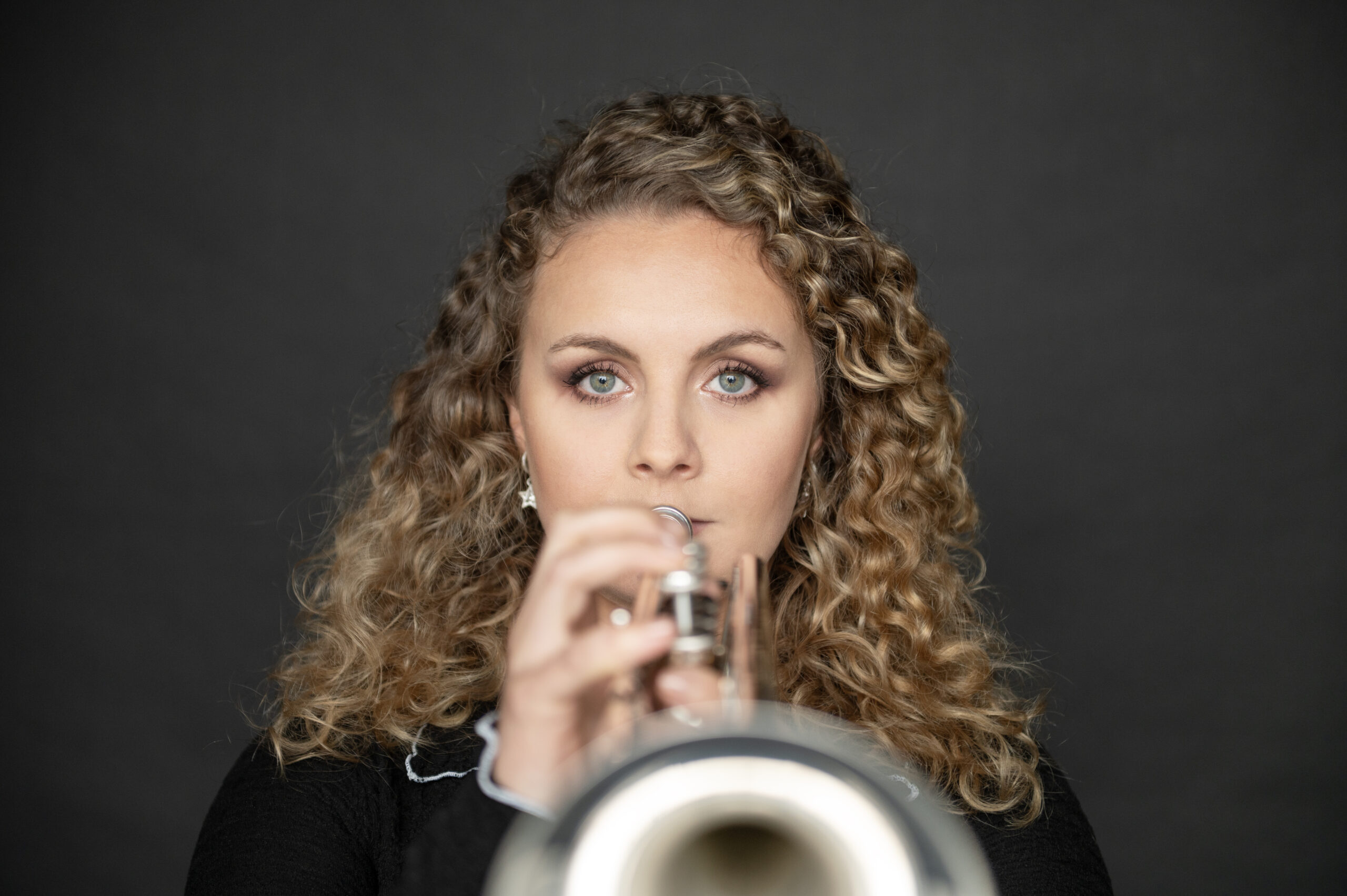
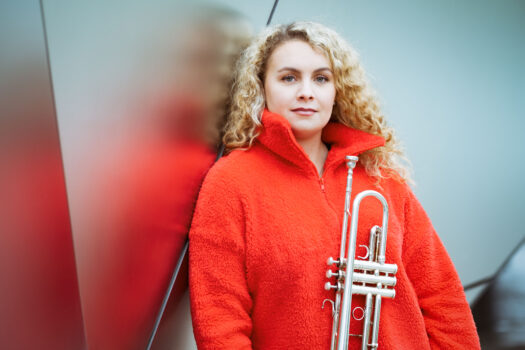
Winner of the Young Artist Category in the 2026 Royal Philharmonic Society (RPS) Awards, star trumpeter Matilda Lloyd joins Ensemble 360 for a sparkling celebration of American music, alongside some dazzling trumpet classics. Described by BBC Music Magazine as a “trumpeter extraordinaire,” and celebrated for her impeccable sound, crystalline phrasing, and exquisite control, Matilda Lloyd holds audiences spellbound through virtuosity and expressive power.
This brassy concert celebrates the brilliant sounds of the trumpet and its central place in American chamber music drawing on diverse traditions stretching back to Haydn.
Copland’s Quiet City is a portrait of the American night: a solitary walker and a bridge in fog. Beach’s Romance captures the elegance of the Boston salon, while Gershwin’s Three Preludes and whimsical Promenade encapsulate the moment jazz and European music collided, and a continent found its unique musical voice.
Save 20% when you book for 10 or more Music in the Round Sheffield concerts in one transaction.
Save 10% when you book for 5 or more Music in the Round Sheffield concerts in one transaction. Find out more.
HONEGGER Arthur, Intrada for Trumpet
Written in April 1947 for the Geneva International Music Competition, Honegger’s ‘Intrada’ takes its title from a Renaissance form given to brief ceremonial pieces that served as festive overtures for brass instruments in the 16th and 17th centuries. Composed in the final decade of his life, when illness had begun to slow his output, the piece is compact but demanding, requiring both stamina and expressive range from its soloist.
The work opens with a bold, cadenza-like flourish for solo trumpet: an arresting summons that immediately establishes the music’s ceremonial character. A second, chorale-like section carries a distinctly Spanish melodic flavour, reflecting Honegger’s long-standing interest in Iberian musical colour, before a virtuosic Allegretto gives both trumpet and piano a chance to display their technical brilliance. A short reprise of the solemn opening material closes the work with quiet dignity.
Throughout the piece, Honegger’s consistent use of pentatonic modes lends the music an immediately recognisable stylistic unity, lending the fanfare-like gestures an austere, almost modal colour rather than conventional triumphalism. Though brief, lasting under five minutes, the ‘Intrada’ has become a staple of the trumpet repertoire as a showcase piece for the instrument.
HINEMITH Paul, Concerto for Trumpet and Bassoon
I Allegro spiritoso – Agitato
II Molto Adagio – Allegro pesante
III Vivace
Composed in 1949, Hindemith’s Concerto for Trumpet and Bassoon pairs two instruments rarely heard together as concerto soloists: one bright and heroic, the other warm and often wryly comic. It belongs to a cluster of concertante works Hindemith wrote that year, alongside concertos for horn and for woodwind and harp, part of a late-career flowering of chamber concertos written during his years teaching at Yale.
True to Hindemith’s neoclassical instincts, the concerto favours clean lines, motoric energy, and craftsman-like counterpoint over romantic display. The result is lyrical, light-hearted, and unusually approachable for both performer and listener. Hindemith delights in setting the trumpet’s clarion brilliance against the bassoon’s earthier, more agile voice, trading themes and commentary between them almost as two characters in dialogue. Across its three movements — an energetic opening Allegro, a broader slow movement, and a spirited finale — the two soloists are treated as genuine equals, each given ample room for personality, while the piano knits the argument together with the wit and economy typical of Hindemith’s mature style.
BERNSTEIN Leonard, Clarinet Sonata
Grazioso
Andantino – Vivace e leggiero
Leonard Bernstein wrote his Clarinet Sonata on a holiday spent at Key West, Florida, in the summer of 1941, just after finishing his conducting studies with Fritz Reiner at the Curtis Institute. It was first performed in Boston on 21 April 1942 by the clarinettist David Glazer, with Bernstein at the piano. But it was another clarinettist – David Oppenheim – to whom the work was dedicated, and who gave the first New York performance, and made the first recording, both in 1943. Aaron Copland, Bernstein’s mentor, had expressed reservations about Clarinet Sonata being played in public as he thought it too heavily influenced by Hindemith, Bartók, Milhaud and Copland himself. After the Boston premiere Bernstein wrote to him: ‘Your weren’t supposed to know that the Clarinet Sonata was being done! Direct defiance of your orders. But, hell, I’ve got to hear it.’ A year later, Bernstein put it on the programme of the concert he gave with David Oppenheim at the League of Composers in New York and confessed to Copland: ‘I betrayed you by playing the Clarinet Sonata today … I felt the need to present my first League composition as a piece with a slightly larger form … and the Sonata does approach, at least, a big form. Besides … it provided a lovely excuse for having David Oppenheim come down. So you will forgive me, won’t you?’ Published the same year, Bernstein’s Clarinet Sonata, with its pastoral, rather Hindemith-like first movement and its ebullient 5/8 finale – unmistakably Bernstein – was one of the first pieces to establish his reputation.
Nigel Simeone 2014
HAYDN Joseph, Trumpet Concerto
Haydn’s trumpet concerto is the only significant monument to half a century of experiments in trumpet technology. It was written for an instrument that never really caught on (and today is largely unknown even among period-instrument specialists), and for that reason lay neglected for more than century.
Haydn responded to the capability of the instrument like a gleeful child with a new toy. At the outset he indulges in a little teasing, letting the trumpet join the orchestra in the opening tutti for a few notes, all of them playable on the natural trumpet. Only with the first solo entrance does he break new ground, with the trumpet running up the scale from its written middle C, playing notes not possible on the natural trumpet. From then on the trumpet sings, slides around chromatically, skips and jumps, and every now and then plays a fanfare figure, as if Haydn wants to remind us that this new-fangled thing really is a trumpet.
Only the middle movement, a song that would be at home in any of Haydn’s operas, is entirely free of trumpet clichés. Haydn occasionally gives the solo trumpet what seems a minor accompaniment part, but they are parts that involve notes that could not previously have been played on a trumpet, and would therefore have had a very different meaning in 1800, jumping out at listeners who knew they were hearing the impossible. The sheer wonder of it is lost on modern listeners who have heard “Flight of the Bumblebee” on a trumpet.
For a number of reasons, the keyed trumpet never became an orchestral instrument, though a similar instrument was, for a short time, a mainstay of military bands, and a bass key-bugle, the ophicleide, was introduced into the orchestra in the 1820s and lasted until mid-century. Instruments with valves were invented a few years after Haydn’s death in 1809, but did not start to make headway into orchestras for nearly a generation, by which time they had already replaced key-bugles in bands. Valve trumpets did not become standard in orchestras until about 1840. Thus there was a gap of decades between the composition of Haydn’s Concerto and a time when someone other than Weidinger could play it, and in that interval the whole idea of a trumpet concerto, so common in the Baroque era, was now beyond the pale. The Haydn Concerto lay forgotten until the 20th century, gaining a place in the concert repertory only in the 1930s.
COPLAND Aaron, Quiet City
One of the problems of American culture during the first half of the twentieth century was to create a distinctly American style of serious orchestral music. Various combinations of styles were tried, like Gershwin’s jazz-oriented style, or the more idiosyncratic style of Charles Ives. One of the first American composers to really crack this problem was Aaron Copland.
Copland was born in Brooklyn, and lived for most of his working life in and around New York. He died in 1990 just a few weeks after his 90th birthday. Like so many American composers of his time, he studied with Nadia Boulanger at the American Conservatory in France. He also visited England, Belgium and Italy, spending his summers on Boulanger’s advice, in Berlin, Vienna and Salzburg. He returned to New York in 1924 to a successful career composing, conducting, teaching, writing and as a general advocate of American music. Notable among his compositions were his ballet scores, Billy the Kid (1938), Rodeo (1942) and Appalachian Spring (1945). He also wrote many purely orchestral works including the very popular Fanfare for the Common Man (1942), which was incorporated into his Third Symphony of 1946.
Quiet City is generally regarded as having been a film score, but was originally written for a play. The original scoring was for clarinet, saxophone, trumpet and piano. The play failed, and Copland adapted his scoring for strings, cor anglais and trumpet and linked the small movements, thus creating a seamless composition of some ten minutes. Later, he incorporated the whole thing into a film score for a film called The City but this was only barely more successful than the play! Quiet City is one of Copland’s finest works, and marks him out as a composer who deserves to be heard more often in Europe.
Alan Hazeldine
BEACH Amy, Romance Op.23 (Arr. Trumpet)
One of the most prominent American composers of the late 19th and early 20th centuries, Amy Beach made significant contributions to classical music, particularly as a female composer in a time when the field was largely dominated by men. Among her impressive body of work is this Romance, composed in 1893 and dedicated to ‘Miss Maud Powell’. This piece, originally for violin and piano, stands as a testament to Beach’s unique style, rich in emotional depth and intricate musical techniques.
At its core, the Romance is a work of lyrical beauty, where Beach takes us on a journey through emotional highs and lows. The title itself, ‘Romance’, suggests themes of love, longing and introspection, which are vividly reflected in the music. From the very first note, the piece exudes a sense of melancholy and wistfulness, and the music’s soaring, impassioned lines and rich harmonic palette adapt magnificently to the trumpet. The instrument sheds its traditional bombast, replaced instead by a velvety, vocal lyricism. Beach weaves a deeply moving dialogue with the piano, moving from a gentle, yearning opening into a sweeping emotional climax before fading into a peaceful quiet.
However, in a broader context, this work can be seen as part of Beach’s ongoing struggle for recognition as a serious composer. In her time, many women composers were either sidelined or dismissed, and those who did achieve recognition were often overshadowed by their male counterparts. By dedicating to a fellow female musician and creating a piece that emphasises collaboration and equality between the instruments, Beach challenges these norms and asserts her own voice in the history of American classical music.
GERSHWIN George, Promenade – Walking the Dog
This charming instrumental cue for a small ensemble of musicians was written by George Gershwin for his and Ira’s first movie score for RKO to accompany a humorous shipboard pantomime sequence for Fred Astaire, Ginger Rogers, and their respective dogs. According to Oscar Levant, George intended this work to be “a private commentary on the plushy, overstuffed scoring favored by most Hollywood orchestrators.” Ira had the piece published in piano solo form as Promenade in 1960, but it is most frequently heard in a number of re-orchestrations for larger forces and has become quite popular with audiences.
GERSHWIN George, Three Preludes
When he was 11, Gershwin taught himself to play his first song on the piano by watching the keys on a player piano. It seems appropriate then, that four years later the teenaged Gershwin dropped out of school and started earning a living making piano rolls for player pianos. He also gigged in New York clubs and worked as a “plugger” – playing songs for potential sheet-music customers at the Jerome Remick music publishing company. The work improved the young composer’s improvisation skills, as well as his playing facility, and at age 17 Gershwin published his first song and his first solo piano composition. By the time he wrote the Three Preludes in 1926, he was an international sensation, having premiered the wildly successful Rhapsody in Blue two years prior.
Gershwin’s style, which combined ragtime, blues, jazz, and classical music, now sounds quintessentially “American” but in his own time, the chords and scales he used were nothing short of bizarre. The first prelude, a short, jazzy exclamation, opens with piano brightly and straightforwardly stating a bluesy phrase. The violin answers in a sly drawl, as if giving a wink. The piano retorts with a low, loud ostinato. The violin joins the party with pizzicato, elaborating on the five-note intro. The Latin feel of the music comes from the Brazilian baião rhythms in the piano.
The second prelude is “a sort of blues lullaby” according to Gershwin. Beginning with a pensive, solitary piano, violin then adds a sliding, bluesy melody, continuing the melancholy mood in a higher register. The piano moves up in register, playing alongside violin. A short middle section brings brighter material in, then falls back to the pensive piano ostinato and ends quiet and unassuming.
The third prelude, Agitato, jumps in immediately with a short introduction before beginning question-and-answer melodic phrases. The instruments weave and hop back and forth around each other and the texture is thick with flourishes. The restatement of the theme at the end of the movement is ostentatious, with the tempo and rhythm bringing the violin to an enormous slide up to a sky-scraping height.
Jascha Heifetz transcribed the Three Preludes (originally written for solo piano) for violin and piano in 1942. That version showcases both instruments, and the music shines with the violin’s new sonorities. The Three Preludes are the only concert work for solo piano to be published during Gershwin’s lifetime. They were premiered by the composer at the Hotel Roosevelt in New York City on December 4, 1926. The music was also performed at the Hollywood Bowl on September 8, 1937 in a tribute to Gershwin after his death in July of that year.
It is interesting to note that the final three works we hear tonight were all written in the same four years during which Ravel wrote his Sonata – between 1923-1927. Of course, each composer wrote from a different place, and each had his individual training, experience and style, but these pieces reflect the time period in which they were written, exhibiting the artistic diversity of the 1920s; much like composers today, Ravel, Ysaÿe, and Gershwin incorporated myriad influences, each creating his own – often groundbreaking – musical stamp.
Jessie Rothwell
Matilda Lloyd