
MOZART & BEETHOVEN STRING QUARTETS
Ensemble 360
Emmanuel Church, Barnsley
Friday 20 February 2026, 7.30pm
Tickets:
£16
£11.50 DLA / UC / PIP
£5 Under 35s & Students
BRITTEN Three Divertimenti for String Quartet (10’)
MOZART String Quartet No.20 in D ‘Hoffmeister’ (26’)
BEETHOVEN String Quartet Op.59 No.2 ‘Razumovsky’ (37’)
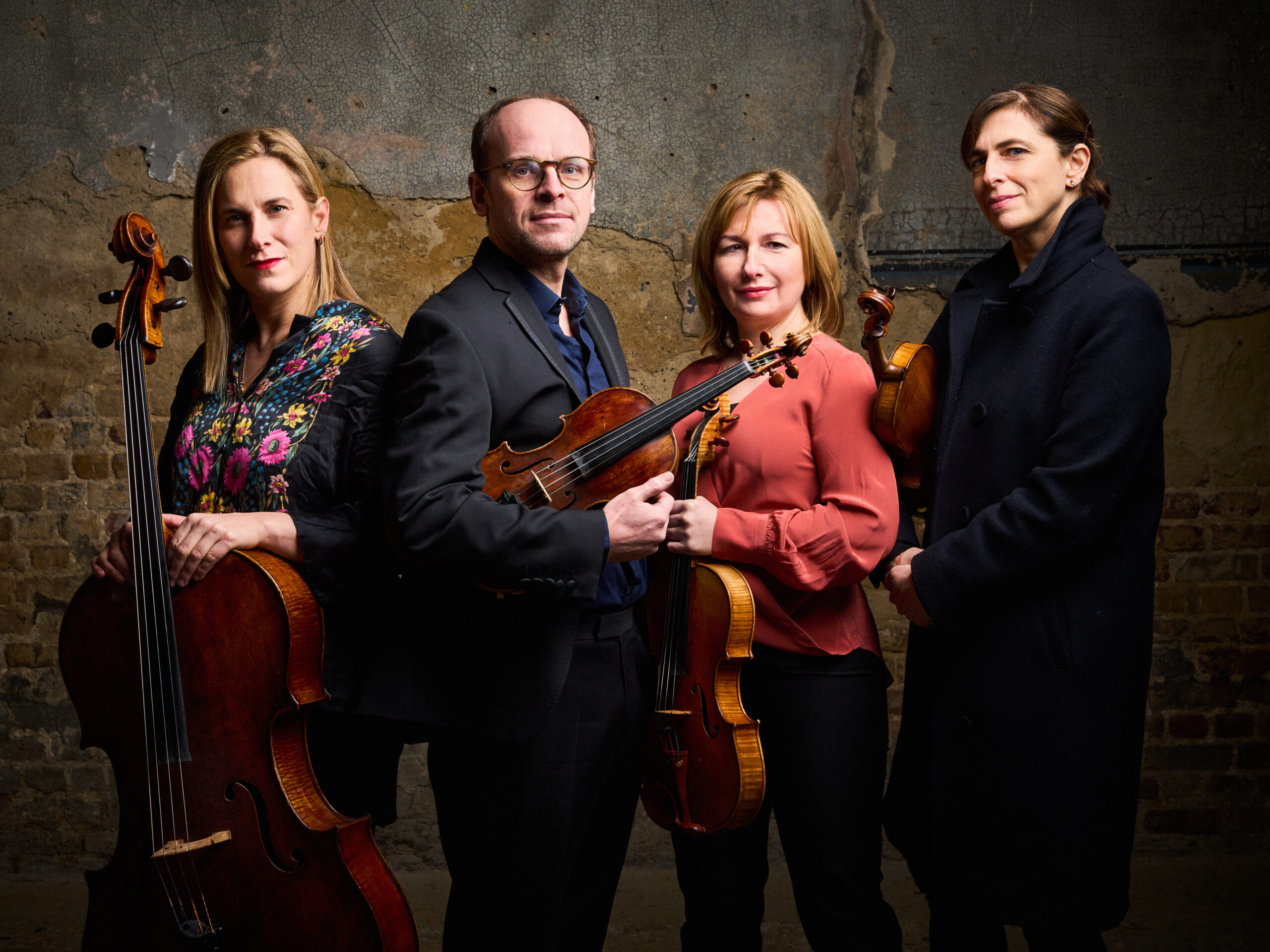
A passionate tour through three centuries of extraordinary music with the string quartet of Ensemble 360.
Britten’s playful and inventive Three Divertimenti is followed by Mozart’s radiant ‘Hoffmeister’ Quartet, blending grace and sophistication. The evening concludes with Beethoven’s fiery second ‘Razumovsky’ Quartet, a work of thrilling intensity and deep passion.
Performed with warmth and exhilarating energy, this programme showcases the expressive power of the string quartet.
BRITTEN Benjamin, Three Divertimenti for String Quartet
Britten planned these movements as part of a five-movement Quartetto serioso with a subtitle from Shakespeare’s Winter’s Tale: “Go play, boy, play!” An earlier version of the opening March was written for a suite inspired by the film Emil and the Detectives (the children’s novel by Erich Kästner was a great favourite of Britten’s), but this was never completed. Eventually he settled on a work in three movements, and the first performance was given by the Stratton Quartet at the Wigmore Hall on 25 February 1936. The audience response was chilly and a hurt Britten withdrew the Three Divertimenti, which were only published after his death. His brilliant gift for idiomatic quartet writing is already apparent in this early work – from the arresting rhythms and textures of the March to the beguiling central Waltz, and the driving energy of the closing Burlesque.
© Nigel Simeone
MOZART Amadeus, String Quartet in D K499
1. Allegretto
2. Menuetto and Trio. Allegretto
3. Adagio
4. Allegro
Like Haydn before him, Mozart habitually published his string quartets in groups of six (the ‘Haydn’ Quartets) or three (the ‘Prussian’ Quartets). Between these two sets there is a single work, entered in Mozart’s manuscript catalogue of his own works on 19 August 1786 as ‘a quartet for 2 violins, viola and violoncello’. The autograph manuscript (in the British Library) is simply titled ‘Quartetto’. It was published in 1788 by the Viennese firm founded by Mozart’s friend Franz Anton Hoffmeister and it has come to be known as the ‘Hoffmeister’ Quartet as a result. The first movement opens with a theme in octaves that outlines a descending D major arpeggio – an idea that dominates much of the movement despite some startling harmonic excursions along the way. The development section is marked by almost continuous quaver movement that gives way magically to the opening theme at the start of the recapitulation. The Minuet has an easy-going charm that contrasts with the sterner mood (and minor key) of the Trio section. The great Mozart biographer Alfred Einstein thought the Adagio spoke ‘of past sorrow, with a heretofore unheard-of-depth’. It is not only a deeply touching movement but also an extremely ingenious one, not least when the initial idea heard on two violins returns on viola and cello, investing the same music with a darker, richer texture. The finale is fast and playful, but there’s also astonishing inventiveness in the flow of ideas, from the opening triplets with their chromatic twists to a contrasting theme which scampers up and down the scale. A few sudden and surprising dynamic contrasts keep the listener guessing right to the end.
Nigel Simeone
BEETHOVEN Ludwig Van, String Quartet in E minor Op.59 No.2 Razumovsky
Allegro
Molto Adagio. Si tratta questo pezzo con molto di sentimento
Allegretto. Maggiore (Thème russe)
Finale. Presto
“Demanding but dignified” was how the Allgemeine Musik-Zeitung described Beethoven’s new quartets dedicated to Count Rasumovsky when they were first heard in 1807. Composed in 1806, and including Russian melodies from a collection of folk tunes edited by Ivan Prach (published in 1790), these quartets were a major development in the quartet form. But though they were longer and more challenging than any earlier quartets, they were an immediate success. Before the Rasumovsky Quartets were played, Beethoven offered them to publisher Breitkopf & Härtel in Leipzig – in a job lot with the Fourth Piano Concerto, the Fourth Symphony and Fidelio, but the deal fell through and the quartets were first published in Vienna by the Bureau des Arts et d’Industrie and in London by Clementi.
While the first of the Rasumovsky Quartets is unusually expansive, the second is more concentrated. From the opening two-chord gesture establishing E minor as the home key, the first movement is tense and full of rhythmic ambiguity. The hymn-like slow movement has a combination of richness and apparent simplicity that blossoms into a kind of ecstatic aria: Beethoven himself is reported to have likened it to “a meditative contemplation of the stars”. The uneasy rhythms of the Scherzo are contrasted by a major-key Trio section in which Beethoven quotes a Russian tune that famously reappeared in the Coronation Scene of Mussorgsky’s opera Boris Godunov. The finale begins with a surprise: a strong emphasis on the note C that is tantalising and unexpected in a movement that moves firmly towards E minor.
© Nigel Simeone
