
BEETHOVEN, BARTÓK & SCHUMANN
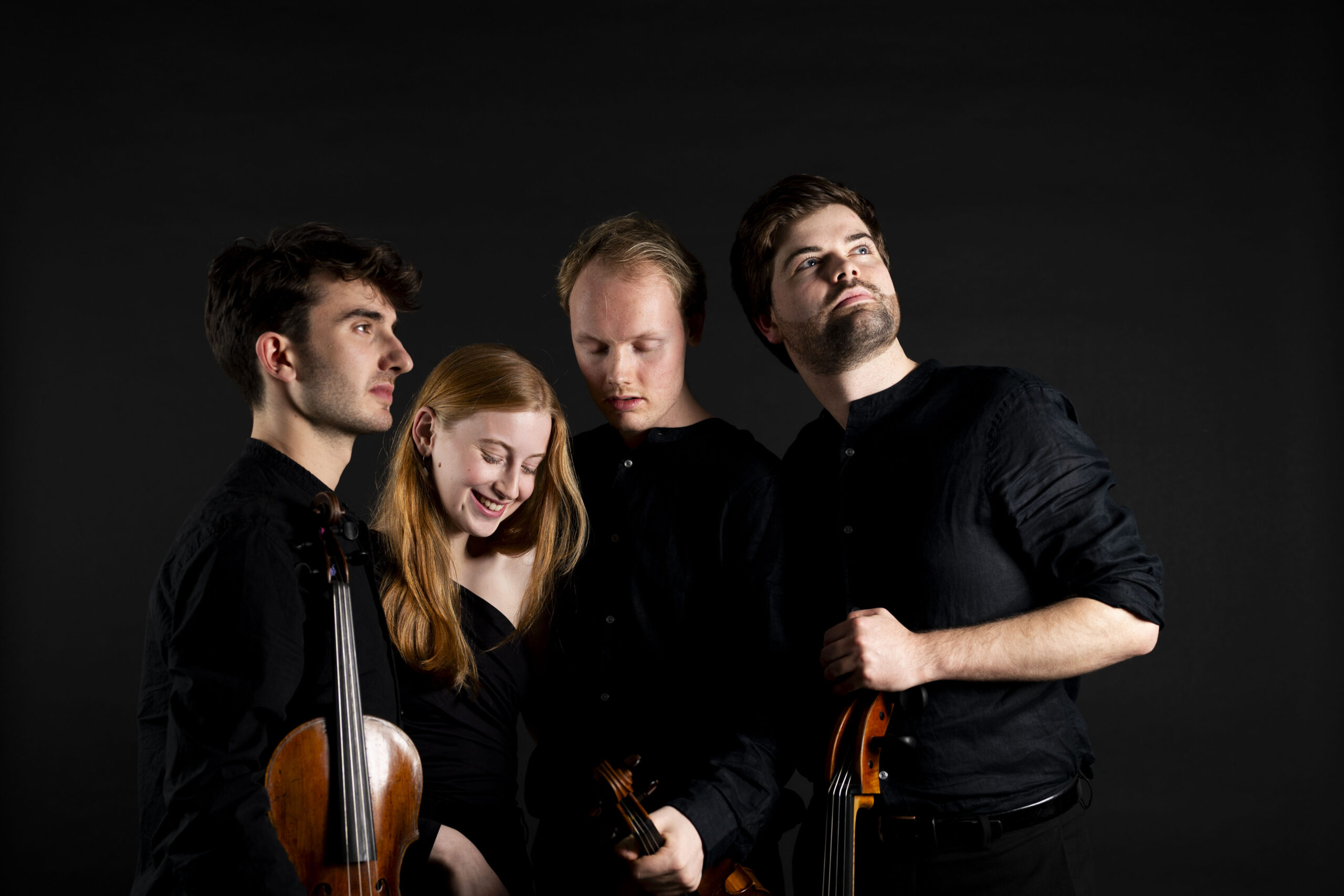
Fibonacci Quartet
Upper Chapel, Sheffield
Saturday 28 March 2026, 7.00pm
Tickets:
£23
£14 UC, PIP & DLA
£5 Students & Under 35s
BEETHOVEN String Quartet Op.18 No.1 (28’)
BARTÓK String Quartet No.5 (30’)
SCHUMANN String Quartet No.3 in A (26’)
Three contrasting pieces from the string quartet repertoire are brought together in this Sheffield debut for the Fibonacci Quartet. With a glittering array of prizes and accolades, this young group has rapidly made a name as one of the most exciting European quartets working today.
Beethoven’s First Quartet is an expansive work – by turns lyrical, dramatic and wryly comic – while Bartók’s Quartet No.5 dazzles with the composer’s signature folk-inflected energy and rhythm. Schumann’s Quartet No.3 brings the concert to a sumptuously romantic close.
Save 20% when you book for 10 or more Music in the Round Sheffield concerts in one transaction.
Save 10% when you book for 5 or more Music in the Round Sheffield concerts in one transaction. Find out more.
BEETHOVEN Ludwig van, String Quartet in F Op.18 No.1
Allegro con brio
Adagio affetuoso ed appassionato
Scherzo. Allegro molto
Allegro
Beethoven’s String Quartets Op.18 were written between 1798 and 1800 – his first exploration of the genre in which his teacher Haydn had excelled. Beethoven was commissioned to write the quartets by Prince Lobkowitz. The F major Quartet Op.18 No.1 was the second of the set to be composed, in January–March 1799. The first movement gave Beethoven a good deal of trouble. An early manuscript shows the state of the work before extensive revisions were made in the summer of 1800. In a letter to Carl Amenda dated 1 July 1801 (in which he also confides about his increasing deafness), he begs his friend not to show anyone the first version of the quartet as “it’s been reworked very thoroughly … I’ve only now learned how to write quartets properly”. The results of Beethoven’s revisions in the first movement were especially effective in increasing tension and momentum in the development section. A conversation reported between Amenda and Beethoven is revealing about the Adagio. Amenda said “it pictured for me the parting of two lovers”, to which Beethoven apparently replied: “Good! I thought of the scene in the burial vault in Romeo and Juliet.” After the emotional intensity of the slow movement, the Scherzo comes as a relief, before a swirling scale-like theme launches the finale.
Nigel Simeone 2013 ©
BARTÓK Béla, String Quartet No.5
Allegro
Adagio molto
Scherzo – alla bulgarese
Andante
Finale. Allegro vivace
Bartók composed his Fifth Quartet quickly: between 6 August and 6 September 1934. It was commissioned by Elizabeth Sprague Coolidge and dedicated to her. The first performance was given at the Library of Congress in Washington D.C. by the Kolisch Quartet on 8 April 1935. The opening uses emphatically repeated B flats to introduce a closely-argued first movement. The repeated notes return, this time on E naturals and the music becomes increasingly animated. At the close, all four instruments converge on a B flat. The second movement is a magnificent example of Bartók’s ‘night music’, full of mysterious trills and whispered flourishes over sustained chords, rising to a climax before sinking again into the darkness, ending when the cello slithers down a scale into silence. The third movement is a lively dance in a rhythm derived from Bulgarian folk music – in this case 4+3+2/8. The Andante is another piece of ‘night music’, this time punctuated by unexpected pizzicatos and gently shuddering repeated chords. As in the second movement, there is an intense fortissimo climax before the shuddering chords and pizzicato cello glissandos and a solitary violin B natural bring the movement to an enigmatic close. The fifth movement has similar energy and tension of the first, and the whole quartet can be seen as a gigantic arch form. To underline this, the final flourish brings all four instruments to the B flat from which the work began.
Nigel Simeone ©
SCHUMANN Robert, String Quartet No.3 in A
Andante espressivo – Allegro molto moderato
Assai agitato
Adagio molto
Finale. Allegro molto vivace – Quasi Trio
1842 is known as Schumann’s ‘year of chamber music’. In September and October he composed the Piano Quintet and Piano Quartet, and during the summer he devoted himself to string quartets, writing three of them in the space of six weeks. Three years earlier, in 1839, he had planned to spend the summer writing quartets, but two incomplete fragments were left abandoned. He did, however, immerse himself in studying Beethoven’s late quartets. Three years later, he wrote in his diary in February 1842 that he was having ‘quartet thoughts’ and in June he got down to serious work. All three quartets were dedicated to his friend Mendelssohn, and after Mendelssohn’s death in 1847, Schumann wrote to his publisher Härtel: ‘My quartets have taken on a special meaning for me through the death of Mendelssohn … I still view them as the best works of my earlier period, and Mendelssohn often expressed the same view to me.’ The Quartet in A major was the last to be written and Schumann composed it at great speed, finishing it in less than a week. The first movement begins with a dream-like introduction. This ends with a falling fifth that forms the start of the main theme that follows. The second subject is introduced by the cello before being taken up by the other instruments. This sonata form movement ends as it began, with a falling fifth, this time in the cello. The second movement is marked Assai agitato and it is a set of a variations on a restless theme. The music finds repose only in the serene coda which ends in radiant A major. The slow movement, in D major, is the expressive heart of the work, based on two themes, the first of them a richly harmonized melody, the other a more unsettled and fragmented idea. The finale is a rondo that brings the quartet to a jubilant conclusion
