DEATH & THE MAIDEN
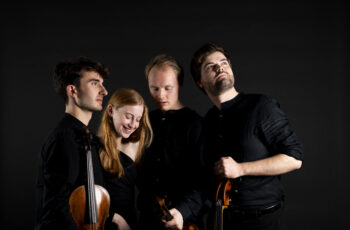
Dudok Quartet
White Rock Studio, Hastings
Monday 24 November 2025, 7.30pm
Tickets:
£10 – £20

SAARIAHO Terra Memoria (18’)
GESUALDO Moro, lasso, al mio duolo (4’)
MUSSORGSKY Songs and Dances of Death (selection) (10’)
LISZT Via Crucis (selection) (10’)
SCHUBERT String Quartet No.14 in D minor, ‘Death & the Maiden’ (35’)
Described as “quite simply revelatory” (The Irish Times) and “stylish, open-minded and adventurous” (The Guardian), the Dudok Quartet Amsterdam has made its name as playful, inventive interpreters of the string quartet repertoire. Coached by Peter Cropper (first violin of the Lindsay String Quartet and founder of Music in the Round) in the early years of their collaboration, they have since gone from strength to strength. Presenting Schubert’s extraordinary and profound ‘Death and the Maiden’ String Quartet alongside their own arrangement of a 17th century Italian madrigal by Carlo Gesualdo and Kaija Saariaho’s modern masterpiece, Terra Memoria (‘Earth Memory’), this concert promises to thrill, intrigue and delight.
Time advertised is start time.
SAARIAHO Kaija, Terra Memoria
“I feel when writing for a string quartet that I’m entering into the intimate core of musical communication,” the late Kaija Saariaho wrote of her second string quartet, Terra Memoria, in 2006. Twenty years separated her first and second outings for these forces, and while the electronics have departed in the journey from the initial Nymphéa to here (and the acute focus on timbre has relaxed), the pieces share a common musical argument. For one, there’s Saariaho’s continued fascination with the particular timbres and textures available to stringed instruments, like tremolandos, trills, and bowing techniques like playing at the bridge. What the two quartets also share is the sense of the music gleaming, resulting from these carefully chosen combinations.
Terra Memoria is a pretty straightforward title. “Earth refers to my material, and memory to the way I’m working on it,” Saariaho wrote. “The piece is dedicated “for those departed,” she continued. “Those of us who are left behind are constantly reminded of our experiences together: our feelings continue to change about different aspects of their personality, certain memories keep on haunting us in our dreams. Even after many years, some of these memories change, some remain clear flashes which we can relive.”
Saariaho died from brain cancer in 2023, so the piece becomes a kind of meta memorial today. But Terra Memoria is no redolent, misty-eyed tribute. Score indications vacillate frequently and distinctly, between misterioso, espressivo, and dolce (sweetly), followed by rasping sections called things like con violenza, impetuoso. The piece aches like a piece written a century before, full of expressive anguish and volatility. Listen for the waterfall-like constructions of limpid textures, and the stunning moment halfway through when the tiny, sky-high texture is delicately snuffed out.
© Hugh Morris 2025
GESUALDO Carlo, Moro, lasso, al mio duolo
The name of Carlo Gesualdo, Prince of Venosa, first spread across Italy because of a grand scandal. In 1590, after discovering his wife and her lover in flagrante, Gesualdo killed them both on the spot. Given all of the actors in this honour killing were drawn from nobility, news of the murder travelled particularly quickly; only later did his idiosyncratic corpus of strange harmonies emerge.
Moro, lasso, al mio duolo, a morose yet sparkily inventive madrigal for five voices, comes from Gesualdo’s sixth and most stylistically adventurous book of madrigals, published in 1611, two years before his death aged 47. Gesualdo’s late madrigals are notable for their harmonic ingenuity. They are heavily chromatic, emotionally volatile, and utilise false relations—chromatic contradictions, where two voices overlap by a semitone at the same time to create a particularly scrunchy moment—frequently. The effect is polarising. Eminent 18th century music historian Charles Burney described the opening of Moro, lasso as “extremely shocking and disgusting.” But, over 400 years since Gesualdo’s death, it still sounds strikingly unlike anything else in the musical canon.
© Hugh Morris 2025
MUSSORGSKY Modest, Songs and Dances of Death
Like Pictures at an Exhibition and his opera Khovanshchina, Mussorgsky’s Songs and Dances of Death number among the many works that required finishing or orchestrating by his composer friends. Today, they exist in many orchestrated versions, even serving as a jump-off point for Shostakovich’s Fourteenth Symphony, but the first version to exist was completed by Alexander Glazunov and Nikolai Rimsky-Korsakov, published in 1882, a year after Mussorgsky’s death.
Each of the four songs—Lullaby, Serenade, Trepak, and Field Marshal—are a poetic snapshot of a specific death; respectively, of a child, a girl, a drunken peasant, and a soldier. Mussorgsky set texts by Arseniy Golenishchev-Kutuzov, a younger friend of the composer, who lodged with Mussorgsky in the mid 1870s.
In some ways the collection is a tale of Mussorgsky’s domestic situation, setting words by one housemate, and later having it orchestrated by another, in Rimsky-Korsakov. It also tells of Mussorgsky’s preoccupations. Death was firmly on his mind, having experienced the loss of friends—the death of painter Victor Hartmann inspired him to write Pictures at an Exhibition—as well as suffering from frequent alcohol-induced health problems himself.
This cycle is certainly shadowed by death, but it’s interesting to note how death becomes an inevitable, inescapable fact, and in that way, a figure approaching the benign. (In this way, it bears a resemblance to Schubert’s calm, consoling figure who appears in the second stanza of Death and the Maiden.) In the first setting, Death appears at the door of a mother, then as a mysteriously seductive knight in the second, an enticing figure to a drunken figure in the third, and finally, the inevitable consequence of battle.
© Hugh Morris 2025
LISZT Franz, Via Crucis
One of the great surprises of 19th century musical history was the about turn of Franz Liszt, the flamboyant pianist and supporter of radical progressive motion in music, who later took minor orders at the Vatican in 1865, and closed out his life as Abbé Liszt. However, Liszt approached church music with the much the same spirit that he sought the music of the future among the members of Allgemeiner Deutscher Musikverein in his earlier years; writing in 1835 in De la musique religieuse, Liszt sought a “regeneration” of religious music, and saw the composer’s social role extending into the church as well as secular musical contexts.
Though there is a continuation of spirit, this is a Liszt unlike the fireworks of the B Minor sonata, the symphonic poems or the piano concerti. Via Crucis is a collaged work of musical pictures corresponding to the stations of the cross found in many Catholic churches. He finds a passionate if contained expressivity in this collection, which draws on plainchant and Bach’s Passion settings.
© Hugh Morris 2025
SCHUBERT Franz, String Quartet in D minor ‘Death and the Maiden’
i. Allegro
ii. Andante
iii. Scherzo
iv. Presto
The beginning of 1824 was a very difficult period for an ill, penniless and depressed Franz Schubert. “I find myself to be the most unhappy and wretched creature in the world,” he wrote to his friend Josef Kupelwieser. “I might as well sing every day now, for upon retiring to bed each night I hope that I may not wake again, and each morning only recalls yesterday’s grief.”
But he succeeded in channeling this moroseness into creation, and Schubert produced some of his most celebrated contributions to chamber music literature during this sorrow-filled period. Not only did he produce the String Quartet in A Minor D804, he returned—perhaps driven by his own reckoning with mortality—to his 1817 setting of Matthias Clodius’s Death and the Maiden, a two-stanza text which opens with the maiden’s frightened plea and closes with Death’s calm response.
This music forms the basis of the second movement, a theme which spins out in variations before turning towards its somber home. It follows an explosive first movement which introduces the composition’s underlying principles: a throbbing, unrelenting triplet figure, and a hewing towards minor tonalities. This is a work that plumbs the depths of despair.
The triplet theme returns as an accompaniment to the first violin’s descant in the first variation of the second movement. Then, two dances of death: A fast, jolting Scherzo, with a rare glimpse of the major mode sets up a galloping tarantella-rondo finale. It ends, completely spent, with two huge chords.
© Hugh Morris 2025