ELGAR PIANO QUINTET
Brodsky String Quartet & Martin Roscoe
Crucible Playhouse, Sheffield
Saturday 7 November 2026, 2.00pm
Tickets:
£23
£14 UC, PIP & DLA
£5 Students & Under 35s
PURCELL Fantasia No.5 (4’)
MACMILLAN For Sonny (5’)
MACMILLAN Memento (4’)
BRITTEN String Quartet No.3 (26’)
ELGAR Piano Quintet (37’)
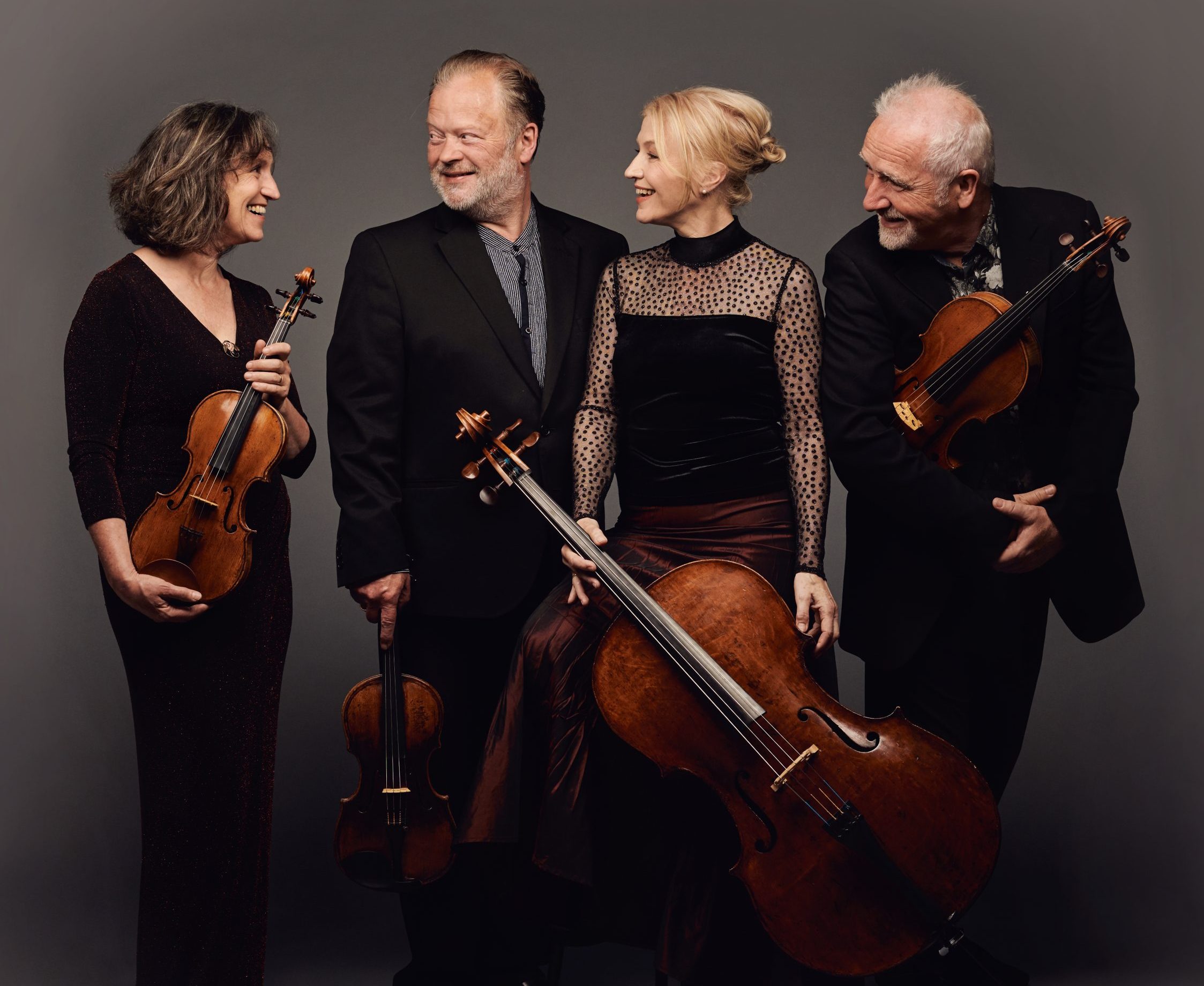
No stranger to Sheffield audiences, pianist Martin Roscoe was a frequent collaborator with the Lindsay String Quartet, founders of Music in the Round. Here he joins forces with another titanic quartet, the prolific Brodskys, who have been performing for over half a century to prizes and plaudits around the world.
Elgar’s Piano Quintet is an undisputed masterpiece: a tender yet muscular work of epic emotions. The emotional core of the piece begins with a ravishing viola melody, and its final movement magically conjures a stirring chorale before plunging to a thrilling and thundering conclusion.
Save 20% when you book for 10 or more Music in the Round Sheffield concerts in one transaction.
Save 10% when you book for 5 or more Music in the Round Sheffield concerts in one transaction. Find out more.
PURCELL Henry, Fantasia No.5
Henry Purcell composed his 15 fantasias for viol consort in a short, concentrated burst during the summer of 1680, when he was only 20 and newly installed as organist of Westminster Abbey. Fantasia No.5 in B flat major is the second of the nine four-part fantasias in the set and is dated 11 June 1680 in Purcell’s own hand.
By 1680 the viol consort ‘fancy’ was already an anachronism. Fashionable taste at Charles II’s court had turned decisively toward the French- and Italian-influenced style of the violin band, and the ensemble was no longer fashionable at the time of these works, having ceded ground to the instruments of the violin family. Purcell nonetheless turned to this old, contrapuntally demanding form seemingly for his own satisfaction rather than for performance or publication: the pieces would not have aroused much interest at the time.
Purcell’s fantasias are known for constant, rapid modulation, sometimes touching four or five different keys within a single bar, pushing into remote regions of chromaticism rarely explored before the 20th century. Formally, the fantasia follows no fixed dance or sonata pattern; it unfolds as a continuous chain of contrasting sections, with points of imitation opening out into free, expressive, often startlingly chromatic passages.
MACMILLAN James, For Sonny
This is a little miniature for string quartet written in memory of a little boy, the grandson of a friend, who died a few days after his birth.
Throughout, the first violin plays a simple fragment, like a nursery rhyme, repeating over and over again, pizzicato. The other instruments provide an ever-changing context for this little tune, sometimes accompanying it with easy harmonies, sometimes straying into stranger territory.
James MacMillan
MACMILLAN James, Memento for String Quartet
Memento was composed in memory of David Huntley, the charismatic Vice-President of Boosey & Hawkes in the United States, who died in 1994. This work was written for the concert given in his memory by the Kronos Quartet on 13 October 1994 (the other composers included Elliott Carter, Robin Holloway, Barbara Kolb and Aaron Jay Kernis). The Scottish connection with this piece is central to its musical language. According to Macmillan, Memento is ‘based on the modality of Gaelic lament music and the Gaelic heterophony of psalm-singing in the Hebrides.’
Nigel Simeone 2013
BRITTEN Benjamin, String Quartet No.3 Op.94
Duets: With moderate movement
Ostinato: Very fast
Solo: Very calm
Burlesque: Fast, con fuoco
Recitative and Passacaglia (La Serenissima): Slow – Slowly moving
This late and very private masterpiece was Britten’s last chamber work, completed in November 1975. It is also one of his very few works to contain self-quotations, from the opera Death in Venice. The structure is unusual (Britten contemplated calling it a ‘Divertimento’) and the five movements form an arch. Colin Matthews, who worked as Britten’s assistant on this quartet, has written that ‘the main weight [is] borne by the outer movements, while the middle movements are in the nature of intermezzi.’ The first movement is a melancholy Andante, while the brittle ‘Ostinato’ and ‘Burlesque’ frame the ‘Solo’, an Adagio of breathtaking restraint and luminous beauty. The Finale, ‘La Serenissima’, is an intimate hymn to Venice, a gentle Passacaglia (a favourite Britten form – in Peter Grimes and the Second String Quartet), but one which never finds repose: just as it seems to be settling on E major, Britten ends the work on a most enigmatic musical question mark.
Nigel Simeone 2013
ELGAR Edward, Piano Quintet in A minor Op.84
Moderato – Allegro
Adagio
Andante – Allegro
Elgar’s Piano Quintet is one of his last large-scale works, dating from the same period as the Violin Sonata and the Cello Concerto. In October 1918, Elgar wrote to the critic Ernest Newman, telling him that the first movement of his Piano Quintet was ready: ‘I want you to hear it. It is strange music I think, and I like it – but it’s ghostly stuff.’ The work was to be dedicated to Newman. The first private performance of the complete work took place on 7 March 1919 at Severn House, Elgar’s London home. George Bernard Shaw was there, and his reaction was enthusiastic: ‘The Quintet knocked me over … This was the finest thing of its kind since [Beethoven’s] Coriolan.’ Shaw is presumably referring here to the dark, uneasy opening which certainly recalls the mood of Beethoven’s overture.
As the introduction gives way to the main Allegro another influence is apparent: the Piano Quintet by Brahms. It is presumably the sweeping, passionate drive of the musical argument in this movement – punctuated by some dramatic references back to the introductory music – that led the English musicologist and Elgar biographer Percy Young to describe it in the most glowing terms, declaring that it was ‘in some ways Elgar’s finest movement’. The work’s central Adagio begins with a tranquil viola solo, supported by the other strings. This expansive movement is crowned by a passionate climax of almost orchestral grandeur, before subsiding back to the gentler, calmer mood of the opening. After a brief introduction that becomes increasingly agitated, the main theme of the finale is a noble arching theme marked ‘with dignity, song-like’. Much of the movement is restrained and reflective, but at the close Elgar drives home his musical ideas to a powerful and thrilling conclusion.
Nigel Simeone © 2011
“In the mighty [Elgar] Piano Quintet the Brodskys generate a consistently stimulating rapport with the admirable Martin Roscoe… ….piercing heartache and awestruck wonder course through the ensuing Adagio centrepiece. ”
Gramophone
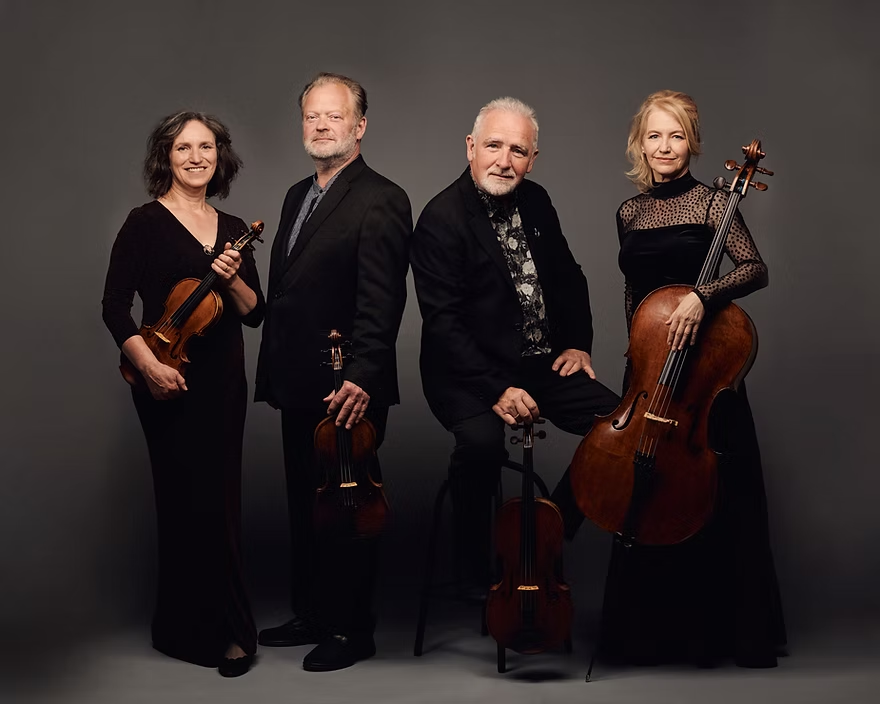
Brodsky String Quartet