
FOUR LAST SONGS
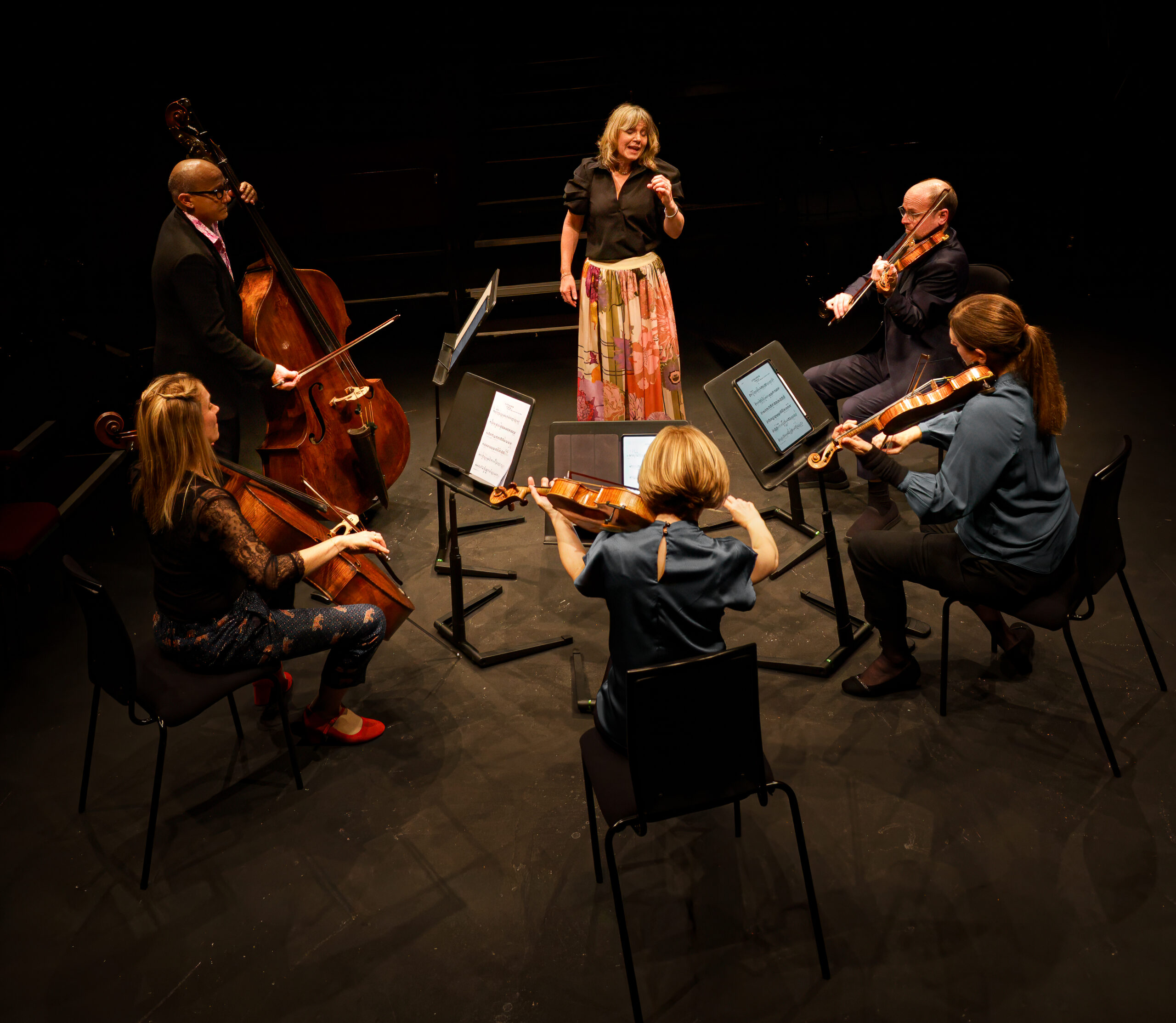
Ensemble 360 & Claire Booth
Crucible Playhouse, Sheffield
Saturday 23 May 2026, 7.00pm
Tickets:
£23
£14 UC, PIP & DLA
£5 Students & Under 35s
R STRAUSS Sextet from Capriccio (12’)
SARGEN Fallen, felled (world premiere commissioned by Music in the Round) (5’)
SIBELIUS En Saga (20’)
WAGNER Siegfried Idyll (20’)
R STRAUSS (arr. Ledger) Four Last Songs (25’)
“A swansong of sublime beauty” (Classic FM), Strauss’s ‘Four Last Songs’ are among the most touchingly beautiful and richly expressive pieces in the classical repertoire.
These exquisite works are performed alongside Sibelius’s charmingly evocative tone poem fairytale, presented in its original septet version. This closing concert promises warm melodies and lyrical beauty.
Post-concert drinks
Friends of Music in the Round are invited to join us for drinks after the Final concert. Find out more about how you can become a Friend and join the post-Festival party at: www.musicintheround.co.uk/friends
“No exploration of the song repertoire would feel complete without Four Last Songs. Pairing these luminous works with En Saga and Siegfried Idyll brings the festival full circle, uniting music of extraordinary beauty with a deep sense of narrative meaning. Strauss’s songs rise with radiant, almost transcendent lyricism, yet their poetry gently reminds us that the most profound story is our own—shaped by time, change, and reflection. Together, these works inhabit a space where sound and storytelling become inseparable. To perform this programme alongside my closest friends and colleagues in the Ensemble is a genuine privilege. Over the years, they have introduced me to a wealth of remarkable chamber music, continually broadening my perspective. It is both a joy and an honour to share the stage with them in music of such depth and sincerity.” Claire Booth, 2026
This concert is generously sponsored by Kim Staniforth, in memory of Margaret Staniforth.
Save 20% when you book for 10 or more Music in the Round Sheffield concerts in one transaction.
Save 10% when you book for 5 or more Music in the Round Sheffield concerts in one transaction. Find out more.
STRAUSS Richard, Sextet from Capriccio
Strauss’s one-act opera Capriccio comes from the final period of the composer’s life, which saw him move away from the large orchestras he had used hitherto into a sound world characterised by the use of more compact, refined music written for more chamber-like forces. It was a time clouded by war, but it was to bring forth a clutch of masterpieces, including the Second Horn Concerto, the symphonic poem Metamorphosen and the splendidly blithe Oboe Concerto.
Strauss was 75 and living in the Bavarian resort of Garmisch-Partenkirchen when World War II began. He was in the middle of writing his opera Die Liebe der Danae, which marked his farewell to large-scale, opulently scored operas. For his next and last stage project, he chose a libretto by the conductor Clemens Kraus, which turned on the relative merits of words versus music, personified as the rivalry between a poet and a musician for the love of a young widowed countess. This project was Capriccio, which occupied Strauss during 1940-41. Capriccio was subtitled a ‘conversation piece’, and is Strauss’s most intimate score; despite the intellectual nature of the subject, the music is elegant, translucent and utterly beautiful.
This string sextet acts as the overture or prelude to the opera and is played as the curtain rises, revealing the scene of the salon in a chateau near Paris in pre-Revolutionary France. The players are rehearsing the music that the musician Framand has written to celebrate the birthday of the young Countess Madeleine. The music is totally romantic in feeling, beginning serenely and building in intensity to a passionate climax, before subsiding once more into tranquility.
SARGEN Ellen, Fallen, felled
This piece is conceptualised as the Finale to RUMOURS, a song cycle for children’s voices and ensemble co-written by Ellen Sargen and children at Mundella Primary School, Sheffield, in Spring 2026. RUMOURS reimagines the tale of Hansel & Gretel as a group of children navigating the fabricated rumours they have heard about a woman who lives in the local woods nearby, and finding the courage to stand against the prejudice this woman encounters from the local town. Across three songs (Curious, Into the Woods and Stand up for her), the characters tackle learning how to trust someone and stand up against prejudice and discrimination.
Fallen, felled looks back on these themes and leans into the darkness that characterises Grimm’s Fairytales. At the centre of this piece ‘the witch’ sings about the Ash tree, which in Scandinavian mythology is the tree that links and shelters all worlds. Here it becomes a central symbol that intertwines the setting from our reimagined story with those who bring politics into protecting others. The piece includes themes written by the children and transformed through this lens.
SIBELIUS Jean, En Saga Op.9
Sibelius arrived in Vienna in the autumn of 1890 to begin his studies with Robert Fuchs and with Karl Goldmark, who encouraged him to study Mozart’s clarinet writing. In 1891 he was working on an Octet including clarinet, which had turned into a Septet for flute, clarinet and strings by September 1892. At the end of 1892 he had produced the first version of his orchestral tone poem En Saga, and Sibelius told one of his biographers that En Saga ‘had as its basis for flute, clarinet, and strings begun in Vienna.’ Sibelius was careful to cover his tracks, and no sketches have been discovered for either this or the equally mysterious Ballet Scene No. 2 (written just before En Saga). Even so, there’s plenty of evidence that En Saga did have an earlier incarnation as a chamber work – first as an octet, then as a septet – and the 1892 version of the orchestral score has been used to reverse engineer a fascinating reconstruction of Sibelius’s original conception for seven instruments.
© Nigel Simeone 2015
WAGNER Richard, Siegfried Idyll
Wagner composed the Siegfried Idyll at Tribschen, on Lake Lucerne. In 1869, his wife Cosima had a son – Siegfried – and a few months later, the piece Wagner had written in honour of mother and son had its first performance. On Christmas Day 1869, thirteen musicians gathered on the stairs outside Cosima’s bedroom and she awoke to the new piece (originally called Tribschen Idyll, with Fidi’s [i.e. Siegfried’s] Birdsong and Orange Sunrise, as a Symphonic Birthday Greeting from Richard to Cosima). Among the musicians in the first performance, the trumpeter was Hans Richter. Seven years later he conducted the first complete performance of Wagner’s Ring Cycle at the inaugural Bayreuth Festival. There’s a direct musical link: Brünnhilde’s music in the final scene of Siegfried – as she is woken by Siegfried on a rock ringed by fire – is drawn directly from the Siegfried Idyll.
Nigel Simeone 2014
STRAUSS Richard, Four Last Songs
Frühling
September
Beim Schlafengehen
Im Abendrot
In 1948, composer Richard Strauss was 84 and suffering from failing health and depression, yet still nurtured the ambition to write once more for the soprano voice. In exile in 1946, he had come across a collection of poems by Joseph von Eichendorff and had been moved by one of them, Im Abendrot, whose portrait of an elderly couple at the end of their lives closely matched the circumstances of Strauss and his wife Pauline. Two years later he composed three more songs on texts by Hermann Hesse: Frühling (Spring), September and Beim Schlafengehen (When Falling Asleep). Each of these, like Im Abentrot, explores themes of farewell, fulfilment, lifelong love and death.
The title ‘Four Last Songs’ is not Strauss’s own, but taken together the songs represent not only a summation of his style, but also a mood of conscious and deliberate farewell. Strauss never heard the songs performed; he died on 8 September 1949 at Garmisch and the first performance was given by Kirsten Flagstad with the Philharmonia Orchestra in the Royal Albert Hall on 22 May 1950.
James Ledger was commissioned to write a chamber arrangement for the great British soprano Dame Felicity Lott, which was premiered at the Wigmore Hall by her and the Nash Ensemble in 2005. He writes: “My philosophy in arranging these songs was to create an honest representation of the original as chamber music. There exists already an arrangement of Vier letzte Lieder for piano and voice. It could be argued that this version already constitutes chamber music. However, the piano only goes so far in capturing the breadth of the original (it is after all, played by only one person) and it leaves the songs firmly in a monochrome world and therefore offers no insight into the translucent instrumental world that Strauss occupies in the original.
“For this new arrangement, a combination of thirteen players (plus soprano) was decided upon, the instrumentation being: flute doubling piccolo, oboe doubling cor anglais, clarinet doubling bass clarinet, bassoon, horn, two violins, two violas, two cellos, double bass and piano. From this list it can be seen that the woodwind section is represented quite healthily, whilst the horn is the sole representative for the brass. Celesta, harp and timpani are also omitted in this version, but there is the inclusion of piano. The reduced number of strings firmly places this arrangement in an entirely different sound world from the original. For example, the lush opening of the fourth song, Im Abendrot, might typically have 50 or more string players in the orchestra and this physically can’t be re-created in this reduced version. Importantly, it shouldn’t try to do so.
“This leads to an interesting perception of arrangements as they are often regarded as poor cousins of the original. An arrangement shouldn’t be regarded as trying to improve on the original – although there are undoubtedly instances where this has been the case. An arrangement should be seen as a separate version in its own right. There are several reasons for remaining as true to the original instrumentation as possible with this arrangement. Firstly, Strauss writes so idiosyncratically for orchestral instruments it seemed fallacious to go against this. For example, I couldn’t imagine the horn solo that concludes September or the violin solo in Beim Schlafengehen on any other instrument. Secondly, these songs are so well known and well loved that to tamper with instrumentation too much could be seen as desecration of the original. I do hope that this chamber version presents the songs in a fresh way and at the same time remain as faithful as possible to the intentions of Richard Strauss.”
Frühling (Spring)
An invocation to Spring as a metaphor for all which is lost and irrecoverable. Strauss’s music captures the poet’s progress from impatience to fulfilment.
September
The symbolism of youth declining into old age is more explicit here; over a rippling of strings and woodwind, the soprano repeats a rocking phrase as the poet speaks of summer yearning for peace and closing wearied eyes.
Beim Schlaffengehen (Falling asleep)
The downward fall of the opening phrases mirror the gradual sinking into slumber. Strauss creates a ravishing melody first head on the solo violin. At the end his most characteristic instrument, the horn, takes over before being absorbed into the gently lulling string rhythm.
Im Abendrot (In the Sunset)
The song Strauss composed first takes its place as the finale. The poet shares a vision of an elderly couple looking into the sunset and asking ‘Ist das etwas der Tod?‘ (Is that perhaps death?) Strauss changed ‘that’ to ‘this’ and in the score quoted from his early tone poem, Tod und Verklärung (Death and transfiguration).

Ensemble 360
