
INTIMATE EPICS: BEETHOVEN & JANÁČEK
Fibonacci Quartet
The Guildhall, Portsmouth
Monday 6 October 2025, 7.30pm
Tickets:
£8 – £20
HAYDN String Quartet Op.33 No.4 (16’)
JANÁČEK String Quartet No.2 ‘Intimate Letters’ (26’)
BEETHOVEN String Quartet in C sharp minor Op.131 (40’)
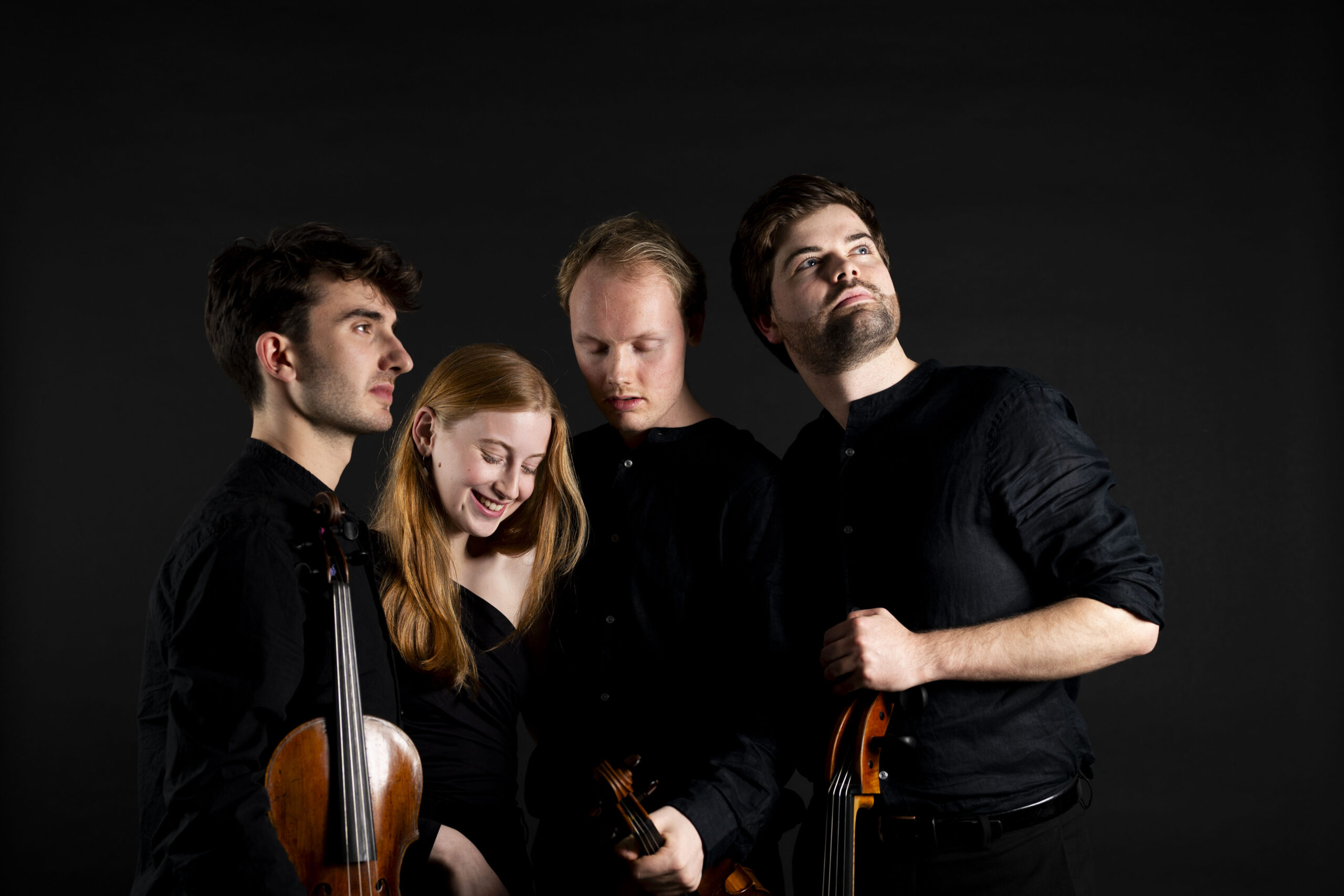
With a glittering array of prizes and accolades, this young quartet has rapidly made a name as one of the most exciting European quartets working today. Through three great string quartets, they will showcase their staggering range and committed artistry. Janáček’s ‘Intimate Letters’ is a rich late work of love and longing, and this programme is crowned by Beethoven’s towering final achievement blending a lightness of touch with the depth of a lifetime of music: both intimate and epic.
Series Discount: 20% discount if you book all 5 Portsmouth Chamber Music concerts.
Time advertised is start time.
HAYDN Joseph, Quartet in B flat Op.33 No.4
Allegro moderato
Scherzo. Allegretto – Minore
Largo
Presto
Haydn’s Opus 33 quartets, also known as the “Russian” quartets, are a collection of six string quartets composed in 1781. These works represent a significant milestone in the development of the string quartet as a genre, and they are widely regarded as Haydn’s finest compositions.
This quartet in B flat major opens with a vibrant and exuberant Allegro moderato showcasing Haydn’s signature humour and wit, with playful exchanges between the four instruments. The Scherzo is a lively and rhythmic dance that is full of energy and syncopation. The Adagio is a poignant and expressive, aria-like movement that showcases Haydn’s gift for melody and his ability to evoke deep emotion through music. The quartet concludes with a dazzling and virtuosic finale, that brings the work to an exhilarating conclusion. Throughout the quartet, Haydn’s use of form and inventive musical ideas play with tonality, harmonic structure and texture to create a rich and complex musical tapestry. The quartet is marked by surprise, unexpected turns, and humour, while maintaining a sense of coherence and unity. Haydn’s Opus 33 No.4 is a landmark in the development of the genre: a work of great beauty, depth, and complexity.
© Nigel Simeone
JANÁČEK Leoš, String Quartet No.2 “Intimate Letters”
Andante
Adagio
Moderato
Allegro
This extraordinary work was the result of extraordinary circumstances. As a married man in his 70s, Janáček had been head over heels in love with the much younger Kamila Stösslová for a decade by the time he wrote his 2nd String Quartet. This was a passionate (if largely one-sided) love that is eloquently expressed in the hundreds of letters he wrote her, and in the pieces that were directly inspired by her – from operas such as Katya Kabanova to the much more private world of chamber music. On 29 January he told Kamila about the latest piece to be inspired by her: ‘Today it’s Sunday and I’m especially sad. I’ve begun to work on a quartet; I’ll give it the name Love Letters.’ By 19 February the sketch was finished, and a couple of weeks later Janáček had written out a fair copy. He changed his mind several times about the title, eventually settling on Intimate Letters. The original scoring, noted on the manuscript, was to include a viola d’amore – the viola of love – but this was more symbolic than practical and after a private play-through, Janáček abandoned the idea.
Janáček’s letters to Kamila are revealing about the programmatic content of this quartet. The first movement he described as ‘the impression of when I saw you for the first time!’ and the third evokes a moment ‘when the earth trembled’. The fourth movement was ‘filled with a great longing – as if it were fulfilled.’ As for the whole work, he confided in April 1928 that ‘it’s my first composition whose notes glow with all the dear things that we’ve experienced together. You stand behind every note, you, living, forceful, loving.’
Janáček died on 12 August 1928, and the quartet had to wait another decade before it was published, by which time both Kamila and Janáček’s long-suffering wife Zdenka were dead. Intimate Letters stands as one of the most personal and original works in the twentieth-century quartet repertoire. The Czech novelist Milan Kundera summarized the essence of Janáček’s art as ‘capturing unknown, never expressed emotions, and capturing them in all their immediacy’.
Nowhere is it more immediate – or more emotional – than in this quartet.
© Nigel Simeone
BEETHOVEN Ludwig van, String Quartet in C sharp minor, Op.131
i. Adagio ma non troppo e molto espressivo
ii. Allegro molto vivace
iii. Allegro moderato
iv. Andante ma non troppo e molto cantabile
v. Presto
vi. Adagio quasi un poco andante
vii. Allegro
Beethoven himself considered the C sharp minor Quartet to be his finest work: an immense single span comprising seven movements that are performed without a break. When Richard Wagner heard the work performed by the Maurin-Chevillard Quartet in Paris, he was overcome with admiration. It’s always fascinating to read one great composer writing about another, and despite the purple prose, Wagner’s remarks are a wonderful tribute. He likens the Quartet to a “Beethoven day”, and describes the music as follows:
“I should designate the long introductory Adagio – than which, probably, nothing more melancholy has ever been expressed in sound – as the awakening on the morning of a day … It is, at the same time, a penitential prayer, a conference with God. The introspective eye views (Allegro, 6/8) there, too, the comforting phenomenon in which Desire becomes a sweet, sorrowful play with itself: the innermost dream-image awakens in a most charming reminiscence. And now (in the short transitional Allegro moderato) it is as though the Master, recollecting his art, addressed himself to his magic work. He employs (Andante, 2/4) the revived power of spells peculiarly his own, to charm a graceful shape … in order that he may enrapture himself by ever new and unprecedented transformations … We now fancy (Presto 2/2) that we see him who is so completely happy, cast a glance of indescribable serenity upon the outer world. … Everything is rendered luminous by his inner happiness. … He now reflects on how he must begin (Adagio, 3/4), a short but troubled meditation … He awakens, and now strikes the strings for a dance, in such a way as the world has never yet heard (Allegro Finale). It is the dance of the world itself: wild delight, the lamentation of anguish, ecstasy of love, highest rapture … and sorrow: suddenly, lightning quivers, the angry tempest growls; and above all this, the mighty player … smiles at himself, for the incantation was to him, after all, only a play. Night beckons to him. His day is finished.”
Nigel Simeone 2013
