
INTIMATE LETTERS
Ensemble 360 & Paul Hawkyard
Wiltshire Music Centre, Bradford on Avon
Saturday 24 October 2026, 7.30pm
Tickets:
£27 / £20 / £15.50 U18s & Students
(includes £3 booking fee)
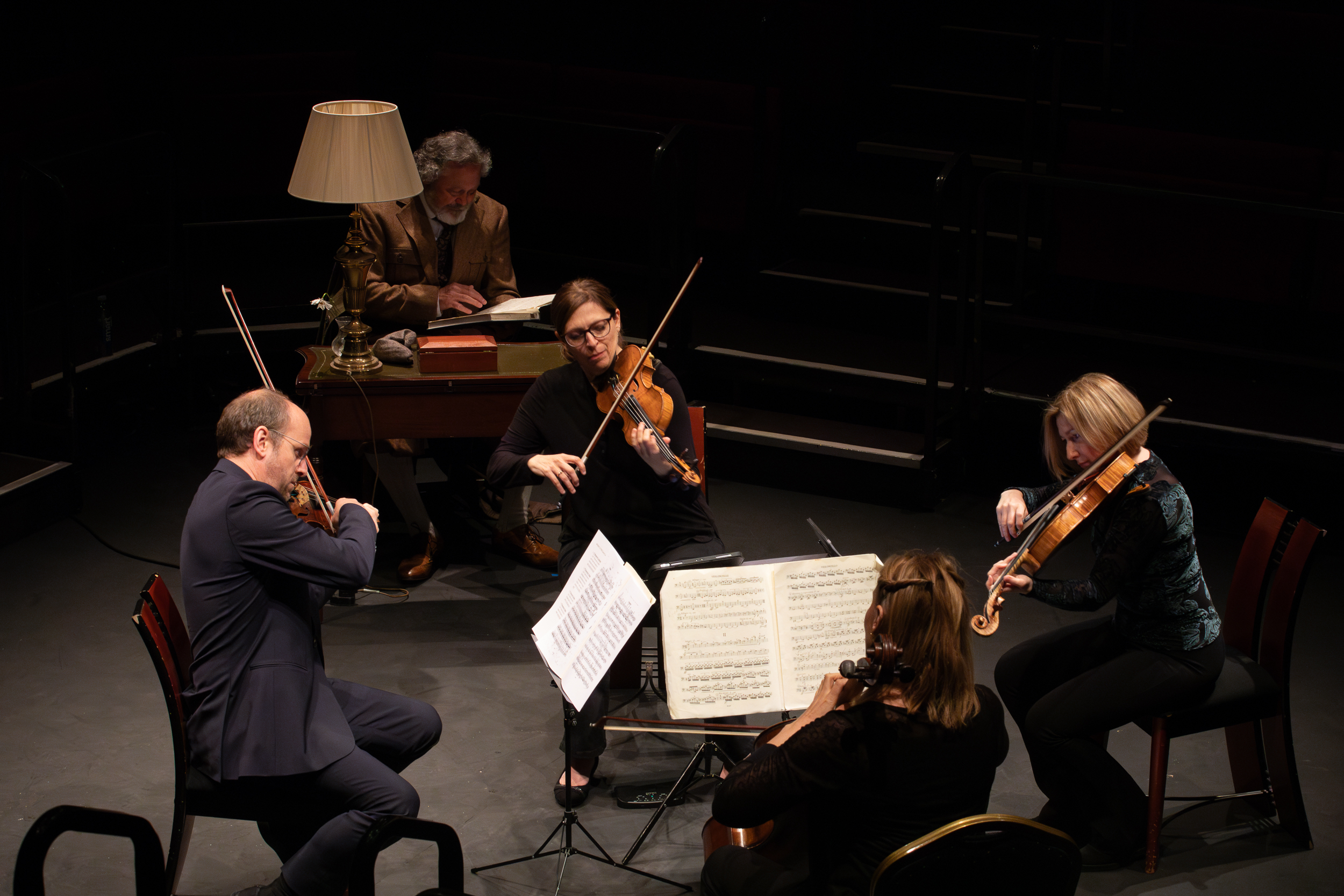
JANÁČEK String Quartet No.2 ‘Intimate Letters’ (with script by Paul Allen) (50′)
SCHUBERT String Quartet in D minor ‘Death and the Maiden’ (50’)
Janáček’s celebrated second quartet – nicknamed ‘Intimate Letters’ – is brought to life with readings of the Czech composer’s candid and personal writing, performed by actor Paul Hawkyard (King Minos, Monster in the Maze, 2024), in the role of ‘Leoš’.
This captivating work of music interspersed with words is followed by a Schubert masterpiece, his sublime ‘Death and the Maiden’ string quartet.
JANÁČEK Leoš, String Quartet No.2 “Intimate Letters”
Andante
Adagio
Moderato
Allegro
This extraordinary work was the result of extraordinary circumstances. As a married man in his 70s, Janáček had been head over heels in love with the much younger Kamila Stösslová for a decade by the time he wrote his 2nd String Quartet. This was a passionate (if largely one-sided) love that is eloquently expressed in the hundreds of letters he wrote her, and in the pieces that were directly inspired by her – from operas such as Katya Kabanova to the much more private world of chamber music. On 29 January he told Kamila about the latest piece to be inspired by her: ‘Today it’s Sunday and I’m especially sad. I’ve begun to work on a quartet; I’ll give it the name Love Letters.’ By 19 February the sketch was finished, and a couple of weeks later Janáček had written out a fair copy. He changed his mind several times about the title, eventually settling on Intimate Letters. The original scoring, noted on the manuscript, was to include a viola d’amore – the viola of love – but this was more symbolic than practical and after a private play-through, Janáček abandoned the idea.
Janáček’s letters to Kamila are revealing about the programmatic content of this quartet. The first movement he described as ‘the impression of when I saw you for the first time!’ and the third evokes a moment ‘when the earth trembled’. The fourth movement was ‘filled with a great longing – as if it were fulfilled.’ As for the whole work, he confided in April 1928 that ‘it’s my first composition whose notes glow with all the dear things that we’ve experienced together. You stand behind every note, you, living, forceful, loving.’
Janáček died on 12 August 1928, and the quartet had to wait another decade before it was published, by which time both Kamila and Janáček’s long-suffering wife Zdenka were dead. Intimate Letters stands as one of the most personal and original works in the twentieth-century quartet repertoire. The Czech novelist Milan Kundera summarized the essence of Janáček’s art as ‘capturing unknown, never expressed emotions, and capturing them in all their immediacy’.
Nowhere is it more immediate – or more emotional – than in this quartet.
© Nigel Simeone
SCHUBERT Franz, String Quartet in D minor ‘Death and the Maiden’
i. Allegro
ii. Andante
iii. Scherzo
iv. Presto
The beginning of 1824 was a very difficult period for an ill, penniless and depressed Franz Schubert. “I find myself to be the most unhappy and wretched creature in the world,” he wrote to his friend Josef Kupelwieser. “I might as well sing every day now, for upon retiring to bed each night I hope that I may not wake again, and each morning only recalls yesterday’s grief.”
But he succeeded in channeling this moroseness into creation, and Schubert produced some of his most celebrated contributions to chamber music literature during this sorrow-filled period. Not only did he produce the String Quartet in A Minor D804, he returned—perhaps driven by his own reckoning with mortality—to his 1817 setting of Matthias Clodius’s Death and the Maiden, a two-stanza text which opens with the maiden’s frightened plea and closes with Death’s calm response.
This music forms the basis of the second movement, a theme which spins out in variations before turning towards its somber home. It follows an explosive first movement which introduces the composition’s underlying principles: a throbbing, unrelenting triplet figure, and a hewing towards minor tonalities. This is a work that plumbs the depths of despair.
The triplet theme returns as an accompaniment to the first violin’s descant in the first variation of the second movement. Then, two dances of death: A fast, jolting Scherzo, with a rare glimpse of the major mode sets up a galloping tarantella-rondo finale. It ends, completely spent, with two huge chords.
© Hugh Morris 2025
