MOZART & FRIENDS
Ensemble 360 & Alasdair Malloy
Crucible Playhouse, Sheffield
Tuesday 8 September 2026, 7.00pm
Tickets:
£23
£14 UC, PIP & DLA
£5 Students & Under 35s
MOZART Oboe Quartet (15’)
MOZART Adagio for Glass Harmonica, K.356 (5’)
BOLOGNE Sonata for 2 Violins No.1 in B-flat (10’)
HAYDN Flute Quartet No.1 in D (15’)
BOCCHERINI Oboe Quintet in D minor (10’)
SÜSSMAYR Quintet for flute, oboe, violin, viola and cello in D (18’)
MOZART Quintet for glass harmonica, flute, oboe, viola and cello (15’)
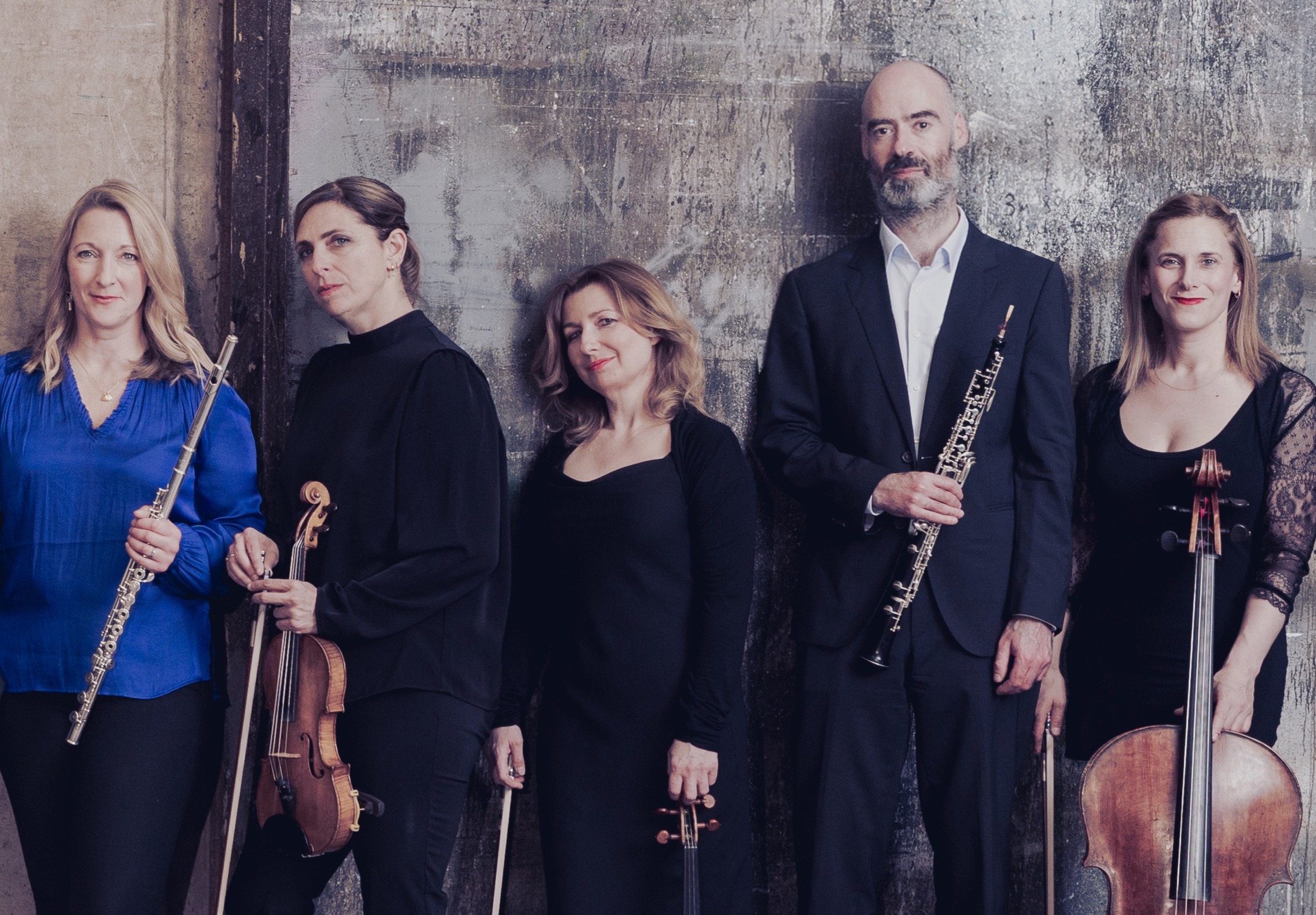
Celebrate Mozart and his lively circle of friends with Ensemble 360 in a delightful evening of music for winds and strings, including two works showcasing the unworldly sound of the glass harmonica.
This remarkable instrument has an ethereal, angelic tone, which fascinated and inspired Mozart. Rarely-played today, the instrument was invented by Benjamin Franklin and was popular in the 18th century. Its sound is created by the player moistening their fingers with water and gently touching the glass bowls rotating on a horizontal spindle.
Music from Mozart’s friends include a sonata full of wit, virtuosity, and graceful charm by Joseph Bologne, a swordsman and pioneering composer who was, briefly, Mozart’s neighbour in Paris; and a bright, elegant quintet by Franz Xaver Süssmayr, who famously completed Mozart’s unfinished Requiem following the composer’s death.
Save 20% when you book for 10 or more Music in the Round Sheffield concerts in one transaction.
Save 10% when you book for 5 or more Music in the Round Sheffield concerts in one transaction. Find out more.
MOZART Wolfgang Amadeus, Oboe Quartet K370
Allegro
Adagio
Rondeau: Allegro
Mozart’s Oboe Quartet was written in Munich in 1781 with a particular player in mind: the oboist Friedrich Ramm (c.1744–1813). Ramm had been a member of the famous orchestra in Mannheim, where Mozart had first met him in 1777 and wrote very enthusiastically at the time about his playing and his ‘beautiful fine tone.’ Mozart arrived in Munich in late 1780 to prepare his new opera Idomeneo and Ramm was in the orchestra. Their admiration seems to have been mutual, since Ramm said of Idomeneo after an early rehearsal that no music had ever impressed him more deeply. According to at least one early catalogue of Mozart’s works (by Johann André), the Quartet was written during January 1781, while final preparations were being made for the première of Idomeneo on 29 January 1781.
The Oboe Quartet has been described by the oboist and musicologist Bruce Haynes as a ‘sparkling, ethereal work’. In three movements, and score for oboe, violin, viola and cello, it’s especially innovative in its exploitation of the oboe’s upper register – using notes that were only to be found on the latest models of oboe, and something of a Ramm speciality. Haynes has also noted that none of Mozart’s other works for oboe use the instrument’s highest notes in this way. The writing for the oboe is superbly idiomatic – and it’s intriguing to speculate (as Haynes has) that if Mozart had not met the brilliant clarinettist Anton Stadler after his move to Vienna (coincidentally, in the same year he composed the Oboe Quartet) – he might have written late masterpieces for solo oboe rather than for clarinet. The first movement is a breezy Allegro, while the slow movement suggests a slow, lyrical opera aria (making the most of Ramm’s singing tone). The finale is more unusual: a rondo that has passages where oboe and strings are playing in different time signatures (the oboe playing in 6/8 time while the strings are in 4/4) and makes the most of the virtuoso possibilities of the soloist.
NIGEL SIMEONE, 2010
MOZART Wolfgang Amadeus, Adagio for Glass Harmonica
Adagio and Rondo K617 for glass harmonica, flute, oboe, viola, and cello
At some mellow moment at the end of a meal in congenial company you may have played musical glasses, moistening a fingertip and stroking round the rim of your wineglass. Given the right touch, each glass produces a small musical tone varying in pitch according to the amount of wine left in it.
Musical glasses inspired the American sage Benjamin Franklin to invent a controlled instrument he called the glassychord or armonica. Mozart first heard it as a boy of eight on a tour in London only a year or so after its invention, played by a Miss Davies. Ten years later, he and his father, in Vienna, heard the glass harmonica again, played by Dr Mesmer, on a “much better instrument than Miss Davies’s” and better performed. Mozart played on it himself; and it evidently did not lose its charm for him, for the last chamber work he wrote, in the year of his death, was this Adagio and Rondo in C for Harmonica, Flute, Oboe, Viola and Violoncello, composed for Marianne Kirchgässner, a blind virtuoso then in Vienna. Mozart himself performed it, probably playing the viola, in August 1791. Despite keyboard and other refinements, the harmonica was an awkward instrument and appeared rarely after 1820.
The Adagio begins with a solemn, dramatic chord answered at once by the gravely gentle harmonica, setting off a phased dialogue exploiting the contrasting timbres of harmonica and ensemble instruments. Chord interjections and a small climax resolving into C major herald the Rondo. The harmonica introduces the cheerfully simple rondo theme. Brilliant alternations, both instrumental and thematic, cleverly combine with changes of mood that owe much to clever key modulations. Mozart’s good humour and wit prevail throughout.
BOLOGNE Joseph, Sonata No.1 in B flat for Two Violins
I Allegro
II Aria con Variatione
The Chevalier de Saint-George was born Joseph Bologne. His father, George, was a wealthy French plantation owner in Guadeloupe; his mother was an enslaved person and George’s mistress. When Joseph was eight his father took him to France and enrolled him in an elite boarding school, where his extraordinary athletic and musical talents emerged. At 18 he became an officer in Louis XV’s court and assumed the title of Chevalier. From then on, he excelled on dual paths. He took part in fencing exhibitions throughout his life, and many considered him the finest fencer in Europe. His musical life thrived too: he was a greatly admired violinist, composer and conductor, directing several of Paris’s leading orchestras, including conducting the premieres of Haydn’s six ’Paris’ symphonies, as well as playing piano and violin duets with Marie Antoinette.
Saint-George composed 14 violin concertos, two symphonies and many sonatas, string quartets, songs and operas. The B flat Sonata is from a set of six sonatas for two violins that were published posthumously in 1800. Like the Chevalier himself, this two-movement Sonata, while brief, is elegant, technically assured, virtuosic and full of life. Musical lines pass effortlessly between the two violins in the nimble, harmonious opening movement, which takes a surprising minor turn in the development. The ‘Aria con Variatione’ begins quietly with a graceful song and ends with a bang, with a virtuosic third variation that is as dazzling as it is fun.
HAYDN Franz Joseph, Quartet in D Major for flute, violin, viola and cello, Op.5 No.1
I Presto (Allegro assai)
II Adagio
III Minuetto
IV Presto
Haydn was a leading figure associated with important changes to chamber music that occurred between 1750 and 1800. By about 1770 most of the changes associated with the transformation of the Baroque sonata (characterised by its four-movement, slow-fast-slow-fast pattern) into the Classical sonata had occurred. The Classical sonata omitted the opening slow movement; in the new three-movement pattern, a minuet sometimes replaced the fast, abstract finale. In other works, the inclusion of both minuet and finale restored the number of movements to four.
Simultaneously, the gradual replacement of the continuo (continuous bass accompaniment) by more significant contributions from each player had begun. Although the continuo persisted in orchestral music until at least 1770, its disappearance from chamber works began earlier. These changes also contributed to the emergence of the Classical period string quartet. Eager to exploit the new style, Haydn began to compose string quartets. He also explored combinations of wind and strings, as in the Six Quartets for Flute and Strings, Op.5.
This Quartet clearly demonstrates the new style; the flute is often highlighted, but the contributions of the other performers go far beyond occasional perfunctory chords. The opening Presto contains some delightful interchanges between flute and strings, and the ensuing Adagio is tranquil and introspective. A stately Minuetto is followed by a vivacious concluding Presto.
Ted Wilks ©
BOCCHERINI Luigi, Oboe Quintet in D minor Op.55 No.6
Allegretto commodo assai
Minuetto
Boccherini’s chamber music was extremely popular in Paris at the end of the eighteenth century. He was working in Madrid at the time, and had a lively correspondence with the composer and publisher Pleyel who had settled in Paris in 1795. In July 1797 Boccherini wrote about “an excellent oboist called Gaspar Barli not only has an extraordinary sweetness but draws the finest sounds from the highest register of his instrument.” Barli was the court oboist to Charles III and Charles IV of Spain and was for this remarkable player that Boccherini wrote a set of six quintets for oboe and strings. When Pleyel published them in Paris the same year, he clearly had an eye on maximising sales: they appeared as ‘Six nouveaux Quintetti pour flûte ou hautbois’, and they are often still played on the flute, as well as the oboe that Boccherini intended. The D minor Quintet is in two movements, both in the home key. The first has some attractive harmonic quirks while the second is a formal but very engaging Minuet which also has hints of the Spanish fandango.
Nigel Simeone © 2012
SÜSSMAYR, Franz Xaver, Quintet in D
Today if Franz Xaver Süssmayr (1766-1803) is remembered at all, it is for having completed Mozart’s Requiem. He was born in the Austrian town of Schwanenstadt. His first music lessons were from his father who then sent him to the Gymnasium in Kremsmünster where he received thorough music lessons in voice, organ, violin and composition. In 1788, he moved to Vienna where he studied with Antonio Salieri and then during 1790-1791 with Mozart with whom he became a close friend. Mozart, on his deathbed, knew that he would not live to complete his Requiem and discussed his ideas for competing the work with Süssmayr who is generally credited by scholars as having completed the bulk of the work. Interestingly, Mozart’s last son, born in 1791 a few months before his death, was named Franz Xaver. Most scholars believe this was no coincidence and posit it to one of two possibilities: the first that Mozart chose the name to honor his close friend and student, the second, less likely although there is considerable evidence to support it, that Franz Xaver Mozart (1791-1844) was the son of Süssmayr with whom Mozart’s wife Constanze had had an affair. After Mozart’s death, Süssmayr obtained several conducting positions at Vienna’s major theaters. A prolific composer, as were most of this era, he had over 600 compositions to his credit, mostly for voice or opera. He did not write a great deal of chamber music. There are two quintets, this being the second.
The Quintet in D Major, judging from its catalog number, was a late work composed sometime after 1792 and probably closer to 1800. It is one of the few pieces of chamber music that he wrote and the fact that it is for an unusual combination of instruments lends credence to the conclusion that it was the result of a commission from an amateur enthusiast that Süssmayr had received. In three movements, the opening and elegant Allegro con brio, sounds very Mozartean, certainly no accident considering that Süssmayr was his student and had copiously studied his composition methods. In fact, if you did not know better, you might well think that it was written by Mozart. In the somewhat short middle movement, Adagio, the flute and violin are entrusted with presenting much of the lovely melody. The finale, a dance-like Rondo allegretto, again sounds very much like Mozart.
“Ensemble 360… renowned for its virtuoso performances, bold programming and engaging interpretations.”
The Guardian

Ensemble 360