NORTHERN LIGHTS: SIBELIUS & GRIEG
Ensemble 360
Crucible Playhouse, Sheffield
Saturday 28 November 2026, 2.00pm
Tickets:
£23
£14 UC, PIP & DLA
£5 Students & Under 35s
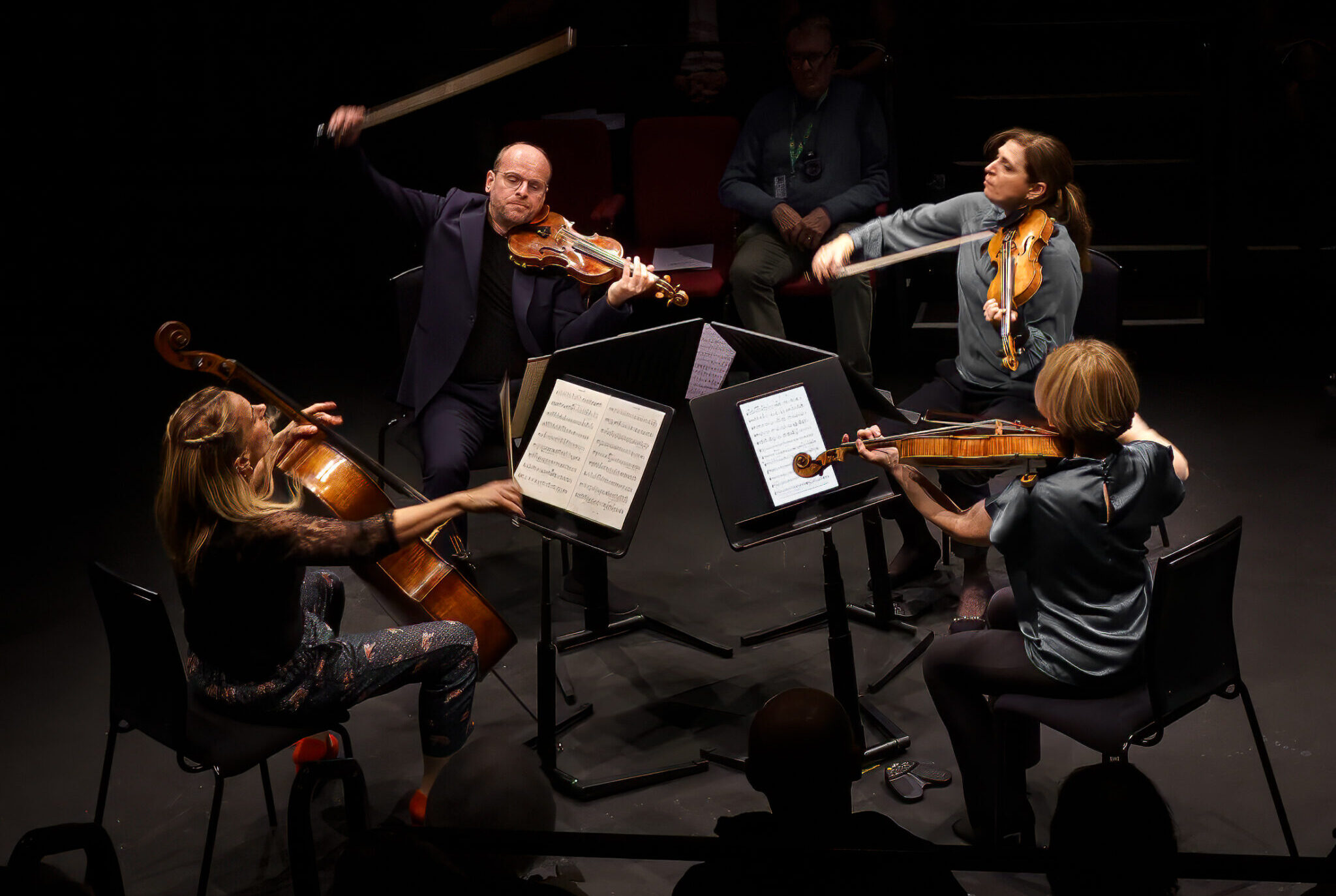
GRIEG Andante con moto (10’)
GRIEG Cello Sonata (28’)
SIBELIUS Andante Festivo (5’)
SIBELIUS String Quartet in D minor, ’Voces intimae’ Op.56 (28’)
Masterpieces and miniatures for strings and piano by two giants of Nordic classicism.
Grieg’s Cello Sonata is a passionate, expressive, dancing work, full of sweeping melodies and stirring tension. Sibelius’s taut String Quartet broods and bristles with soulful intensity and culminates in a fiery finale.
Part of NORTHERN LIGHTS A sweeping weekend of elemental music from the frozen north.
Friday 27 November – Sunday 29 November 2026

Save 20% when you book for 10 or more Music in the Round Sheffield concerts in one transaction.
Save 10% when you book for 5 or more Music in the Round Sheffield concerts in one transaction. Find out more.
GRIEG Edvard, Andante con moto
Grieg’s mature chamber music comprises five major works: three sonatas for violin and piano, a cello sonata and a string quartet. The quartet was composed in 1878 and after finishing it Grieg turned to writing a piano trio. Only the slow movement, marked Andante con moto, was finished, the last page of the manuscript dated 17 June 1878. It was written in Grieg’s composing hut built in the dramatic surroundings of the remote countryside inland from Bergen. This movement, in the key of C minor, has a mood that is profoundly melancholic though there is consolation to be found in the second theme (a transformation of the first theme), which is in E flat major. After Grieg’s death, the movement was found by his friend Julius Röntgen who told Grieg’s widow that it was ‘a beautiful piece. What solemnity it conveys! He can’t get enough of that single theme, which even in the major mode retains its mournful character. … The piece stands very well by itself and does not give the impression of being a fragment as it constitutes a perfect entity in itself.’ Despite Röntgen’s well-placed enthusiasm, it took until 1978 for the Andante con moto to appear in print, published as part of the complete edition of Grieg’s works.
GRIEG Edvard, Cello Sonata
1. Allegro agitato
2. Andante molto tranquillo
3. Allegro molto e marcato
Grieg’s great fame as a composer rests largely on the Piano Concerto, a handful of piano pieces, the Holberg Suite and movements from his incidental music for Peer Gynt. One work from the same period as the Piano Concerto was to provide an important source for the Cello Sonata: the incidental music for the play Sigurd Jorsalfar from 1872. The Cello Sonata was started in late 1882 and the first draft was finished in April 1883. Grieg dated the manuscript of his slightly revised version of the work 18 August 1883. It is one of a handful of major chamber works, along with three violin sonatas, one complete surviving string quartet and one left incomplete. The first movement of the Cello Sonata is in sonata form (something of a rarity for Grieg) and opens with a passionate and agitated theme which eventually gives way to a calmer second theme introduced by gentle chords on the piano. The movement ends with an animated coda based on the opening idea (with added hints of the opening phrase from the Piano Concerto). The expressive slow movement is based largely on the recycled ‘Homage March’ from Grieg’s Sigurd Jorsalfar incidental music (aptly enough, since in the original orchestral version this passage is scored for four cellos). The finale opens with a cadenza for the cello before launching into an extended Norwegian dance which occasionally threatens to become bombastic but which ends impressively. The work was dedicated by Grieg to his brother John, an accomplished cellist, and on 1 October 1883, Grieg sent him the first printed copy. The first two performances were given by two of Europe’s preeminent cellists of the time. The premiere was given by Friedrich Grützmacher in Dresden on 22 October 1883; a few days later (on 27 October) Julius Klengel gave the work in Leipzig. Grieg was the pianist on both occasions.
© Nigel Simeone
SIBELIUS Jean, Andante Festivo
Sibelius originally wrote the Andante festivo for string quartet in 1922. The first performance was given on 28 December 1922 in Jyväskylä at the 25th anniversary celebrations of the Säynätsalo sawmill (though Sibelius had originally been asked to write a cantata). He lived for another 35 years, but only a handful of major works followed this stirring pièce d’occasion, and the 1938 arrangement of the Andante festivo for string orchestra and timpani was virtually his farewell to composition.
© Nigel Simeone 2015
SIBELIUS Jean, String Quartet Op.56 ‘Voces Intimae’
Andante–Allegro molto moderato
Vivace
Adagio di molto
Allegretto (ma pesante)
Allegro
In February and March 1909, Sibelius came to London to conduct concerts of his own music and it was during this stay that he composed most of the Voces intimae (Intimate Voices) quartet. He first stayed at the Langham Hotel (across the road from Queen’s Hall) but asked his friend Rosa Newmarch to find cheaper lodgings where he could also work in silence. She found quiet rooms for him in Kensington and having installed him, ‘left the composer to settle down (as I hoped) to write his string quartet, Voces initimae.’ Word travelled in the neighbourhood that a composer was staying, emboldening one elderly lady to play Beethoven’s ‘Moonlight’ Sonata repeatedly, as a sign of solidarity. Newmarch intervened, there was no more Beethoven, and Sibelius was able to make good progress on the quartet in Kensington.
According to his diary, he began the second movement on 16 February, and sketched the third on 25 February. Work continued throughout March (at the end of which he left London) and the quartet was finished in Berlin on 15 April. The first performance took place a year later, on 25 April 1910, in Helsinki.
Voces intimae is a characteristically bold exploration of musical form: there are five movements (including two scherzos), with a highly expressive slow movement at the centre. There has been speculation about the title and the likeliest explanation is that it has some connection with the fear of death which Sibelius confided to his diary in London. It was clearly a personal reference that will probably remain a mystery, but it is entirely apt for a work that embodies such an intense musical dialogue between the four instruments.
© Nigel Simeone