PIANO CLASSICS
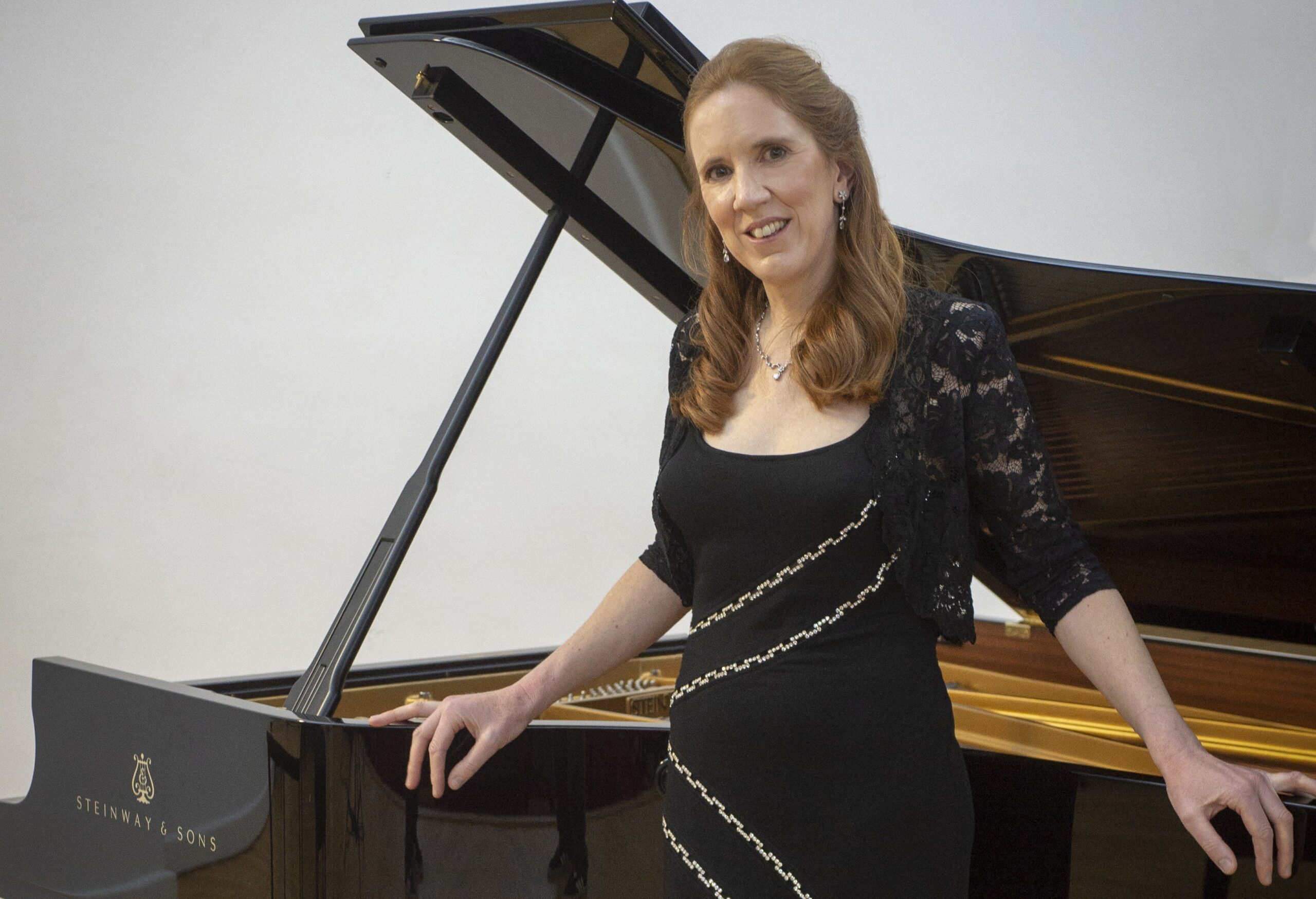
Sarah Beth Briggs
Crucible Playhouse, Sheffield
Saturday 5 September 2026, 2.00pm
Tickets:
£23
£14 UC, PIP & DLA
£5 Students & Under 35s
BEETHOVEN Bagatelles Op.126 (15’)
C SCHUMANN 4 Pièces fugitives Op.15 (14’)
TAILLEFERRE Sicilienne (3’)
POULENC 3 Novelettes (7’)
R SCHUMANN Waldszenen Op.82 (20’)
BRAHMS Piano Pieces Op.119 (15’)
“An artist of extraordinary magnetism” (Daily Telegraph), Yorkshire pianist Sarah Beth Briggs has enjoyed a distinguished career both on stage and in the recording studio. She returns to the Crucible Playhouse for an afternoon of glittering piano favourites.
Among the highlights are works by R Schumann and Beethoven: Schumann’s evocative Forest Scenes conjures a mysterious and haunting symbolic world, populated by hunters, lonely flowers and a watchful, prophetic bird; while Beethoven wrote of his lively Bagatelles that these were “quite the best pieces of their kind that I have written”.
Save 20% when you book for 10 or more Music in the Round Sheffield concerts in one transaction.
Save 10% when you book for 5 or more Music in the Round Sheffield concerts in one transaction. Find out more.
BEETHOVEN Ludwig van, Bagatelles Op.126
The familiar harmonic language of Beethoven may invite a relaxation, but I wonder what Beethoven’s contemporaries made of these miniature detonations and meditations. Far from being the “trifles” that their title suggests, the Bagatelles of Op. 126 are the product of the same period as the Ninth Symphony. Concentrated and explosive, they are every bit as expressively dense and seemingly modern as the compositions of Schoenberg we have already experienced. It is worth noting that Schoenberg’s Three Piano Pieces, composed in 1909, bear roughly the same chronological relation to us that the Bagatelles did to Schoenberg.
While Beethoven’s previous sets of published bagatelles had largely been accumulations of leftover minor statements, the six bagatelles of Op. 126 were deliberately composed as a single entity. In a letter to his publisher, Beethoven wrote that they were “quite the best pieces of their kind that I have written.” The instant juxtaposition of frantic motion and serene contemplation that we find in the final bagatelle, when contained in such a short duration, seems to enhance and deepen the sensations rather than constrict them.
In 1820, four years before the completion of Op. 126, Beethoven had already started work on not only the Ninth Symphony, but the monumental Missa solemnis as well. At this period of creative magnificence he also produced his three final piano sonatas, each an experiment in form. The first two movements of the Sonata in E, Op. 109, could be taken for two contrasting bagatelles. Their concision, whether in introspection or march-like vigor, is a startling contrast from the vastness of the Hammerklavier Sonata which came before. That the finale of Op. 109 is a set of six variations on a theme seems an almost misplaced technical observation as we experience the noble benediction of the last movement.
Grant Hiroshima
SCHUMANN Clara, Four Fugitive Pieces, Op.15
Four Fugitive Pieces, Op. 15, group of four brief compositions for solo piano by Clara Schumann, published in 1845. They are character pieces, presenting distinct movements of contrasting moods rather than an integrated multi-movement sonata.
Clara Schumann wrote the Four Fugitive Pieces soon after her marriage to the composer Robert Schumann in 1840. The music was published five years later. Wistfully understated, the pieces are romantic and introspective, suffused with the same gentleness that characterizes the nocturnes of Chopin. By calling the pieces fugitive, Schumann refers to the unrestrained nature of the music, which is freer and less restricted by formal conventions than music of earlier eras.
The pieces span a range of moods and keys. The first, “Larghetto,” in F major, is sweetly reflective, recalling Chopin. The second, “Un poco agitato,” in A major, is more nervous in character, with spirited lines that rise and fall. “Andante espressivo,” in D major, is the longest of the four pieces and returns to the nocturnal spirit of the “Larghetto.” The set then concludes in a playful mood with the “Scherzo,” in G major.
Betsy Schwarm
TAILLEFERRE Germaine, Sicilienne
Germaine Tailleferre is best known for being the only female member of the French group of composers known as Les Six, alongside Georges Auric, Louis Durey, Arthur Honegger, Darius Milhaud and Francis Poulenc. Although a prolific composer, until recently little of her music was performed regularly, and even now, forgotten works are being rediscovered.
Tailleferre studied at the Paris Conservatoire despite her father’s opposition to a musical career. In 1913, she met Auric, Honegger and Milhaud in Georges Caussade’s counterpoint class, and from around 1916 these four composers appeared on concert programmes together. Tailleferre’s music was often programmed in Paris in the 1910s and 20s, and her musical style, combining neo-Classicism with a ready wit and energy, can be compared to Poulenc’s and Milhaud’s.
Tailleferre was friendly with Ravel and visited him at his home in Montfort l’Amaury (his house still has a miniature porcelain sofa on display that was a gift from Tailleferre. Cocteau was condescending to her, describing her as ‘une Marie Laurencin pour l’oreille’ (‘a Marie Laurencin for the ear’), more it seems because both artists are women than because there are real parallels in their work. This marginalisation by resorting to gender-based statements rather than engaging with a creative artist’s work was sadly characteristic of this period.
It is not easy to say how many pieces Tailleferre composed for the piano. She tended to compose at the instrument, though subsequently she may have orchestrated or arranged the work for another medium. She was herself an excellent pianist who played piano duet and two-piano works with Satie and Stravinsky. Satie played his Trois Morceaux en forme de poire with Tailleferre in the late 1910s, and she and Stravinsky were commissioned to make a piano roll recording of The Rite of Spring, though sadly this project did not come to fruition.
Tailleferre’s musical language is remarkably consistent throughout her career. Her original works combine an essential Classicism with distinctly 20th century twists. She often creates tonal ambiguity or bitonal harmony by superimposing two or more different ostinati or scalar passages, and she combines straightforward Classical tonal material with complexifying harmony. Her piano works feature many lively, toccata-like movements with an appealing energy.
Published in 1929–30, Sicilienne exhibits the complex textures present in many of Tailleferre’s piano pieces, often being written on three staves. A lilting sicilienne rhythm is almost omnipresent, but a louder, more agitated central section reaches a climax before seeming to dissolve, leading to a poignant variation of the opening material.
POULENC Francis, 3 Novelettes
1. C major
2. B flat minor
3. E minor
Francis Poulenc achieved early success as one of the group of young French anti-establishment composers known as Les Six. But it was some time before he was recognised as a serious composer for during the early part of his career his music was characterised by its humour, and often its irreverent levity. It cannot be said that the piano was usually the vehicle of his deepest thoughts. Later in life he adopted a more individual path, which, although it retained some of those earlier characteristics, took on a more serious, deeply religious vein.
It was Schumann who first gave the name Noveletten to his eight pieces of Op.21 and he said that each was the equivalent of a romantic story. Poulenc followed this pattern, writing the first two Novelettes in 1927 and 1928. No. 1 is marked Modéré sans lenteur and has an air of gentle simplicity which adds to its particular charm. The second piece is impish and full of childish playfulness, bearing out the instruction Très rapide et rythmé. A later work, dating from 1960, the third Novelette is a free and luxurious improvisation on a theme from Manuel de Falla’s ballet El amor brujo.
BRAHMS Johannes, Four Piano Pieces Op.119
Adagio
Andantino un poco agitato
Grazioso e giocoso
Allegro risoluto
In May 1893, Brahms wrote to Clara Schumann about the first of his latest set of piano pieces: ‘It is teeming with dissonances! These are correct and can be explained – but perhaps they won’t be to your taste. This little piece is exceptionally melancholic and … every bar and every note must sound like a ritardando, as if one wanted to suck melancholy out of each one, taking pleasure in all those dissonances! Good Lord, surely this description will arouse your interest!’
The Intermezzo in B minor (marked Adagio) is based on a falling idea of infinite sadness, and it reveals the extent to which Brahms was continuing to experiment as he turned 60: this is music of haunting strangeness, making imaginative use of the sustaining power of the piano to create overlapping dissonances. The E minor Intermezzo that follows is demonstration of Brahms’s distilled, economical late style, dominated by a persistent motif from which all the material is derived (including its own accompaniment). The C major Intermezzo is a gentle scherzo, full of rhythmic inventiveness, and the set ends with a flamboyant Rhapsody in E flat major which has surprises too: using five-bar phrases, and ending in E flat minor.
© Nigel Simeone 2015
SCHUMANN Robert, Waldszenen Op.82
Schumann’s Waldszenen, Op.82, dates from 1848, just after finishing his opera Genoveva, the last act of which takes place in a forest. The woodland inspiration evidently persisted and the new set of pieces was completed in January 1849, with the last of them, ‘Vogel als Prophet’ (‘The Prophet Bird’) added as an inspired afterthought. One early review captured the spirit of these pieces, delighting in ‘the enigmatic rustlings, the distant melodies, the mystical flowers in this magical forest.’
Nigel Simeone