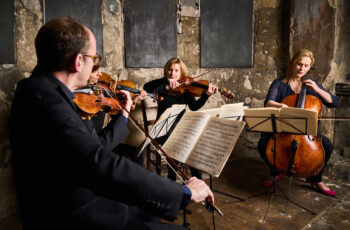
QUARTET FOR THE END OF TIME
Ensemble 360
Crucible Playhouse, Sheffield
Saturday 1 November 2025, 7.00pm
Tickets:
£23
£14 UC, PIP & DLA
£5 Students & Under 35s

KLEIN String Trio (12’)
SMIT Trio for Clarinet, Viola and Piano (12’)
MESSIAEN Quartet for the End of Time (50’)
Olivier Messiaen’s Quartet for the End of Time is the centrepiece of this concert showcasing music to mark the 80th anniversary of the end of the Second World War and the liberation of the internment, concentration and death camps of Europe. Considered one of the 20th century’s greatest works, Messiaen composed the Quartet while a prisoner of war in the Stalag VIII-A camp. As Steven Osborne writes, “the music seems to touch the far edges of human experience”. Also featured in the programme is Gideon Klien’s folk-infused String Trio, composed just ten days before Klien was transported from Terezín to Auschwitz, and Leo Smit’s lyrical and profoundly expressive Trio for Clarinet, Viola and Piano.
Messiaen Roundtable
Crucible Playhouse, 4.00pm
Tickets £5 / Free to all ticket holders for the evening concert,
but please book here in advance
Save 20% when you book for 10 or more Music in the Round concerts in one transaction.
Save 10% when you book for 5 or more Music in the Round concerts in one transaction. Find out more.
KLEIN Gideon, String Trio
i. Allegro
ii. Lento
iii. Molto vivace
Gideon Klein was born in Moravia in 1919, and, like Zykmud Schul, he studied with Alois Hába at the Prague Conservatoire. In December 1941, along with thousands of other Prague Jews, he was deported to Terezín. It was thus in the environment of a prison camp that Klein reached maturity as a composer in his early twenties. In 1940 he had been awarded a scholarship to study at the Royal Academy of Music in London, but was prevented from taking this up by the Nazis. He was also an extremely gifted pianist, and gave performances in Terezín of works such as Beethoven’s Sonata Op.111, Schoenberg’s Three Piano Pieces Op.11, and Janáček’s I.X.1905. The String Trio, finished in October 1944, was to be his last work. It’s a piece of great energy and assurance, and stylistically it’s a fascinating mixture of music inspired by Czech dance rhythms, but also by the more expressionist works of the Second Viennese School. Even by the traumatic standards of music written in Terezín, the circumstances in which Gideon Klein composed his String Trio are shocking: by October 1944, when he completed this piece, Klein had witnessed the death of Schul, and nine days after finishing the Trio, he, too, was transported to Auschwitz, along with Pavel Haas, and two other composers – Viktor Ullmann and Hans Krasa. Klein was subsequently moved to a coal-mining labour camp near Katowice. He died on 27 January 1945, but the precise circumstances of his death are uncertain: he either perished in the mining camp, or as one of many fellow-Jews who lost their lives on a brutal forced march made to accompany the fleeing SS.
Nigel Simeone © 2011
SMIT Leopold, Trio for Clarinet, Viola and Piano
i. Allegretto
ii. Lento
iii. Allegro vivace
Leopold Smit (1900-1943), known as ‘Leo’, was a Dutch composer. Born in Amsterdam, Smit studied at the Conservatorium van Amsterdam before moving to Paris in 1927 where he was in close contact with the group of composers known as ‘Les Six’ – musicians including Arthur Honegger, Darius Milhaud, and Francis Poulenc who pioneered the ‘neoclassical’ style.
Smit moved back to Amsterdam in late 1937. In November 1942, he and his wife, Lientje, (both Jewish) were forced to move to the ‘Transvaal’ neighbourhood, a deportation district in the east of Amsterdam. In March 1943, they were summoned to the Jewish Theatre (today again known as Hollandsche Schouwburg and National Holocaust Memorial), then transported to Westerbork. By the end of April, the couple were transported to the Sobibor extermination camp where they were murdered upon arrival.
Smit’s musical output is small but compelling. He was clearly influenced by the composers in his milieux – his use of polytonality (writing in two or more keys simultaneously) was inspired by the music of Darius Milhaud, for example, while the Trio for flute, viola and harp borrows Debussy’s instrumentation. There are obvious influences of jazz and light music (foxtrot, Charleston and rumba), also; Smit was particularly fond of George Gershwin.
Smit’s most neoclassical piece is the Symphony in C. Jurjen Vis describes the work: “Mozartian themes are put through a bitonal wringer”. The Divertimento for piano four hands, although jazzier in character, likewise draws on Mozart – the piece was composed as a response to Smit’s continuous playing (with students) piano excerpts of Mozart Symphonies.
In the Trio for clarinet, viola and piano, broadly developed and sensuous melodies tend to prevail. Composed in 1938, it is written for the instrumentation famously deployed in Mozart’s ‘Kegelstatt’ trio (K. 498). The work is in three movements: an opening Allegretto begins with a stately melody in octaves, then in dialogue with mysterious and chromatically rich, often fragmentary tunes that capriciously change in mood from one moment to the next. The central movement – ‘Lento’ – begins slow and solemn. Piano chords undergird long, winding melodies on the violin and clarinet, before the music develops in harmonic and textural complexity. The final ‘Allegro vivace’ sees pizzicato violin matched by staccato clarinet notes as the interplay between the instruments of the trio grows in intensity, each vying for the foreground before the piece reaches its dramatic conclusion.
MESSIAEN Olivier, Quartet for the End of Time
Liturgie de Crystal
Vocalise pour l’Ange qui annonce la fin du Temps
Abîme des oiseaux
Intermède
Louange à l’Éternité de Jésus
Danse de la fureur, pour les sept trompettes
Fouillis d’arc-en-ciel, pour l’Ange qui annonce la fin du Temps
Louange à l’Immortalité de Jésus
Messiaen composed his Quartet for the End of Time during his captivity as a Prisoner of War at Stalag VIII-A in the autumn of 1940. With three fellow-prisoners to write for – a violinist, cellist and clarinetist – he began by composing a short movement for them to play without piano – the ‘Intermède’. Once the camp authorities had found Messiaen a piano, he set to work on a piece that explores the possibilities of the unusual ensemble in typically inventive ways, using the four instruments together on only a few occasions. The clarinet plays a long solo (‘Abîme des oiseaux’) while the cello and violin each have a slow movement with piano – the two ‘Louanges’, both of which Messiaen recycled from works he’d composed in the 1930s: the Fête des Belles Eaux for the 1937 Paris Exposition and the Diptypque for organ. The first performance of the Quartet took place on 15 January 1941 in one of the camp huts, to an audience of a few hundred prisoners. The audience was either entranced or baffled by what they heard on that extraordinary night. A review in the camp newspaper likened the occasion to the premiere of The Rite of Spring, noting that “it’s often a mark of a work’s greatness that it has provoked conflict on the occasion of its birth.”
Nigel Simeone © 2012