RAVEL & GLASS: CINEMATIC QUARTETS
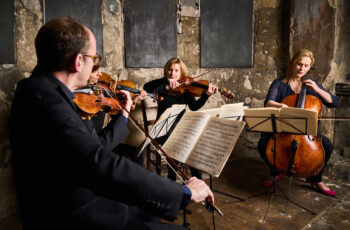
Piatti Quartet
Crucible Playhouse, Sheffield
Thursday 6 November 2025, 7.00pm
Tickets:
£23
£14 UC, PIP & DLA
£5 Students & Under 35s

HERMAN (arr. Birchall) Suite from ‘Psycho’ (10’)
GREENWOOD Prospector’s Quartet from ‘There Will Be Blood’ (3’)
GLASS String Quartet No.3 (18’)
RAVEL String Quartet in F (30’)
Ravel’s glorious, rhapsodic Quartet is the joyous conclusion of this concert of string music composed for, and used in, cinema. From Radiohead’s Jonny Greenwood’s spare and spectral score for Paul Thomas Anderson’s Oscar-winning ‘There Will Be Blood’, to Bernard Herman’s iconic music composed for Alfred Hitchcock’s ‘Psycho’, and Philip Glass’s String Quartet No.3 (composed for the 1985 film ‘Mishima: A Life in Four Chapters’), the Piatti Quartet showcases the captivating range of chamber music composed for the big screen.
The Piatti Quartet have been described by composer Julian Anderson as “living treasures of chamber music… meticulous attention to detail is combined with strong expressive impulse and a wonderful sense of musical drama”, and return to the Playhouse after several rapturously received concerts across their stellar career.
FILM SCREENINGS
A specially curated series of film screenings inspired by the Piatti’s ‘Cinematic Quartets’ takes place at The Showroom to coincide with their concert.
Wednesday 5 November, The Showroom
5.15pm Music in Films panel discussion
6.00pm ‘Mishima’
A panel discussion, including violinist Emily Holland from the Piatti Quartet, will delve into the ways music brings film to life.
Find more details about the panel discussion here: showroomcinema.org.uk
Sunday 9 November, The Showroom
2.30pm ‘There Will Be Blood’
HERRMANN Bernard, (arr. Birchall), Suite from ‘Psycho’
‘Psycho’ can easily be said to have one of the most iconic scores in film history– even if you haven’t seen the film, you will have heard the screeching strings from the shower-murder scene. Herrmann scored 7 films for director Alfred Hitchcock in total, with Psycho being the 6th in their collaboration, and wrote the music for other epics such as Citizen Kane, The Twilight Zone and The War of the Worlds. The score for Psycho was written only for the string section of an orchestra, with the strings being muted throughout the film (apart from in the iconic scene) which was to aid in the film’s stark, dissonant, claustrophobic feeling. The music contains influences from composers like Bartok, Debussy and Stravinski, and is extremely effective in conveying the thing Herrmann most wanted it to: “terror”.
GREENWOOD Jonny, Prospector’s Quartet from ‘There Will Be Blood’
As well as being lead guitarist of the rock band Radiohead, Jonny Greenwood has forged a hugely successful career as a composer of film scores. Credits include soundtracks for the films The Power of the Dog (2021, directed by Jane Campion) and We Need to Talk about Kevin (2011) as well as numerous films in collaboration with the director Paul Thomas Anderson – 2018’s Phantom Thread (for which Greenwood was nominated for an Academy Award) and 2007’s There Will Be Blood, from which this quartet is taken.
As a child, Greenwood played both the recorder (an instrument he would continue to play into adulthood) and viola. It is his affinity for string writing, and his knowledge of both rock and classical traditions, that sets him aside a film composer. The score for There Will Be Blood, for example, features quotations from the works of Arvo Pärt and Johannes Brahms (as well as some of Greenwood’s own previous compositions) and is characterised by Greenwood’s signature lush string-textures. IndieWire called the soundtrack “One of the most memorable scores this side of the year 2000”, while Variety noted the evocative nature of the music: “Jonny Greenwood’s musical compositions almost become another character in the film. Think Bernard Herrmann and Taxi Driver, another portrait of a twisted soul, with sound effects and music to match”.
Indeed, this is music that conjures the darkly unsettling world of Upton Sinclair’s novel Oil!, on which the film is based. In ‘The Prospector’s Quartet’, repeated notes played on the cello seem to evoke the machinery of oil extraction, while churning melodies in the strings grow in their foreboding intensity. Daniel Day-Lewis won an Oscar for his performance in the film. As IndieWire noted, “Greenwood’s work, which is string-heavy and beautifully unsettling, is as memorable as Day-Lewis’ performance … Close your eyes and you can almost feel the oil pulsing beneath the ground”.
GLASS Philip, String Quartet No.3 ‘Mishima’
Philip Glass has a musical language that is instantly palatable, with its flowing arpeggios and lush instrumentation. It’s also confined to a very narrow strip in the spectrum of musical expression, yet the potential for infinite subtlety reveals itself quickly. The idea is reminiscent of Pablo Picasso’s blue period, during which he only uses shades of blue and green to convey incredibly nuanced ideas and emotions. In Glass’ third string quartet, the harmony revolves closely around D minor in the first four movements, and E flat major in the last two. The development of the piece is constructed through subtle changes in the layering of material, rather than through traditional thematic development. Originally, these six movements were written as a soundtrack to the film “Mishima”, directed by Paul Schrader. It tells the story of the Japanese writer Yukio Mishima, who was an active nationalist who ended up taking his own life through the act of Seppuku, a ritual suicide, after having led a failed coup d’état.
Johannes Marmen 2016
RAVEL Maurice, String Quartet in F
i. Allegro moderato. très doux
ii. Assez vif. très rythmé
iii. Très lent Vif et agité
The first two movements of Ravel’s Quartet were finished in December 1902 and the next month he submitted the first movement for a prize at the Paris Conservatoire, where he was still a student. The jury was unimpressed and the Director Théodore Dubois was typically acidic, claiming that it “lacked simplicity”. The failure to win a prize meant that Ravel’s studies with Fauré were over but Ravel persisted with the Quartet, and by April 1903 he had finished all four movements. He put it aside for yet another doomed attempt at the Prix de Rome, but it’s likely that he made further revisions later in the year. The pianist and composer Alfredo Casella recalled running into Ravel in the street in January 1904: “I found [Ravel] seated on a bench, attentively reading a manuscript. I asked him what it was. He said: It is a quartet I have just finished. I am rather pleased with it.” The first performance was given at the Schola Cantorum by the Heymann Quartet, on 5 March 1904. It is dedicated “à mon cher maître Gabriel Fauré”.
In a parallel with Debussy’s Quartet, Ravel makes use of cyclic themes – material heard in the first movement returns in various guises throughout. The second movement is notable for Ravel’s brilliant use of cross-rhythms as all four string players become a kind of gigantic guitar. The rhapsodic slow movement includes a dream-like recollection of the cyclic theme. In the finale, Ravel’s use of irregular time signatures generates a momentum that is not only impossible to predict but impossible to resist. Recollections of the cyclic theme are woven into the texture with great subtlety and the kaleidoscopic string writing produces a conclusion that glitters and surges.
Nigel Simeone © 2012