REICH: ELECTRIC COUNTERPOINT
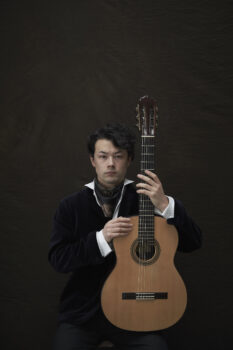
Sean Shibe
Crucible Playhouse, Sheffield
Saturday 5 December 2026, 7.00pm
Tickets:
£23
£14 UC, PIP & DLA
£5 Students & Under 35s
MUDARRA Fantasia VII and X (4′)
DOWLAND Praeludium (2′)
DOWLAND Forlorn Hope Fancy (4′)
DOWLAND Fantasia (4′)
J.S. BACH Cello Suite No.1 in G, BWV 1007
Prélude (3′)
Allemande (3′)
ADÈS Forgotten Dances Courante (2′)
J.S. BACH Cello Suite No.1 in G, BWV 1007 Sarabande (3′)
ADÈS Forgotten Dances Carillon (2′)
MESSIAEN O Sacrum Convivium (4’)
MONK Nightfall (10’)
REICH Electric Counterpoint (15’)
A magnetic performer, prolific recording artist, and a curious and wide-ranging musical explorer, this is a chance to experience one of the most celebrated musicians working today in the intimate setting of the Crucible Playhouse.
Making a triumphant return to Sheffield, Scottish guitarist Sean Shibe presents a virtuosic tour of four centuries of music, including a transcription of Bach’s beloved first cello suite, Steve Reich’s thrilling masterpiece Electric Counterpoint and a recent commission by the UK’s leading contemporary composer Thomas Adès, alongside two of the standout works from his celebrated album Lost & Found.
Save 20% when you book for 10 or more Music in the Round Sheffield concerts in one transaction.
Save 10% when you book for 5 or more Music in the Round Sheffield concerts in one transaction. Find out more.
BACH Johann Sebastian, Cello Suite No.1 in G, BWV 1007 (Prélude, Allemande, Sarabande )
Prélude
Allemande
Sarabande
Bach’s Cello Suites were probably composed in about 1720 during Bach’s time in Cöthen. It isn’t known for whom Bach wrote them, though there are at least two likely candidates working in Cöthen at the time: Christian Ferdinand Abel (1682–1761), a great friend of the composer for whom Bach wrote the three sonatas for viola da gamba and harpsichord (BWV 1027–9) and Carl Berhard Lienicke (d. 1751), the leading cellist of the Cöthen orchestra. Whether either of them was the player Bach had in mind is a matter of pure speculation since no documentary evidence has come to light. Equally uncertain is why Bach wrote them. The likeliest explanation is that they were intended – like much of his keyboard music – for private performance. Bach sets the tone of the First Suite with a Prelude made of undulating arpeggios. The Allemande meanders purposefully until it arrives at a strong final cadence in the home key. Using multiple stopping, the Sarabande is noble and understated. It is in two sections; the first ends on D (the dominant) and the second moves to E minor before returning to the tonic, G.
Nigel Simeone 2018
MESSIAEN Olivier, O Sacrum Convivium
The unaccompanied motet O sacrum convivium is an early work, revelling in a static chromaticism, which lends the work a fervently devotional quality. Though much of Messiaen’s music is overtly Christian in content, this is his only liturgical motet; the composer, with characteristic eccentricity, believed that plainsong was the perfect, and unsurpassable, music with which the liturgy should be adorned.
Matthew O’Donovan © 2010
MONK Meredith, Nightfall
Nightfall should be sung without vibrato so that the vocal colors and their translucent quality remain pure and clear. Recalling Baroque passacaglia procedure, the bass line underpins the entire work. Nightfall is an incantatory piece inspired by how light changes at the end of a day: the adding and subtracting of color and shadow; the slowly building and diminishing dynamics; the shifting texture as the sun intensifies and then disappears over the horizon. Nightfall was composed for and performed by Musica Sacra in 1995.
Meredith Monk
REICH Steve, Electric Counterpoint
Electric Counterpoint (1987) was commissioned by the Brooklyn Academy of Music’s Next Wave Festival for guitarist Pat Metheny. It was composed during the summer of 1987. The duration is about 15 minutes. It is the third in a series of pieces (first Vermont Counterpoint in 1982 for flutist Ransom Wilson followed by New York Counterpoint in 1985 for clarinettist Richard Stolzman) all dealing with a soloist playing against a pre-recorded tape of themselves. In Electric Counterpoint the soloist pre-records as many as 10 guitars and 2 electric bass parts and then plays the final 11th guitar part live against the tape. I would like to thank Pat Metheny for showing me how to improve the piece in terms of making it more idiomatic for the guitar.
Electric Counterpoint is in three movements; fast, slow, fast, played one after the other without pause. The first movement, after an introductory pulsing section where the harmonies of the movement are stated, uses a theme derived from Central African horn music that I became aware of through the ethnomusicologist Simha Arom. That theme is built up in eight voice canon and while the remaining two guitars and bass play pulsing harmonies the soloist plays melodic patterns that result from the contrapuntal interlocking of those eight pre-recorded guitars.
The second movement cuts the tempo in half, changes key and introduces a new theme, which is then slowly built up in nine guitars in canon. Once again two other guitars and bass supply harmony while the soloist brings out melodic patterns that result from the overall contrapuntal web.
The third movement returns to the original tempo and key and introduces a new pattern in triple meter. After building up a four guitar canon two bass guitars enter suddenly to further stress the triple meter. The soloist then introduces a new series of strummed chords that are then built up in three guitar canon. When these are complete the soloist returns to melodic patterns that result from the overall counterpoint when suddenly the basses begin to change both key and meter back and forth between E minor and C minor and between 3/2 and 12/8 so that one hears first 3 groups of 4 eighth notes and then 4 groups of 3 eighth notes. These rhythmic and tonal changes speed up more and more rapidly until at the end the basses slowly fade out and the ambiguities are finally resolved in 12/8 and E minor.
© Steve Reich
“WOW! I thought I’d take a dutiful listen and couldn’t get my headphones off. Sean Shibe has made one of the best recordings of Electric Counterpoint ever! ”
Steve Reich