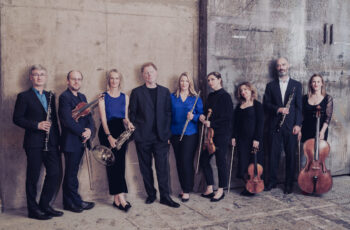
RELAXED CONCERT: THE GENIUS OF BEETHOVEN
Ensemble 360
Crucible Playhouse, Sheffield
Saturday 6 December 2025, 2.00pm
Tickets:
£5 / carers free

BEETHOVEN Sonata for Cello and Piano No.3 Op.69 (26’)
BEETHOVEN Trio for Piano, Clarinet and Cello Op.11 (20’)
For this ‘Relaxed’ concert featuring Beethoven, doors will be left open, lights raised, a break-out space provided, and there will be less emphasis on the audience being quiet during the performance. People with an Autism Spectrum, sensory or communication disorder or learning disability, those with age-related impairments and parents/carers with babies are all especially welcome.
BEETHOVEN Ludwig van, Cello Sonata in A
i. Allegro ma non tanto
ii. Scherzo. Allegro molto
iii. Adagio cantabile – Allegro vivace
On 14 September 1808, the publisher Gottfried Christoph Härtel signed a remarkable contract with Beethoven for his most recent works: the document signed by the two of them that day shows that Breitkopf and Härtel had acquired the rights to the Fifth Symphony, the Pastoral Symphony, the two Piano Trios Op.70 and the Cello Sonata in A major. The Cello Sonata had been written in the winter of 1807–8 and by the time of its publication it bore a dedication to Baron Ignaz von Gleichenstein, a friend of the composer who helped him with financial matters as well as a being a talented amateur cellist. The first performance was given in Vienna on 5 March 1809, at a concert by the cellist Nikolaus Kraft with Baroness Dorothea von Ertmann (to whom Beethoven later dedicated his Piano Sonata Op.101). As in the Kreutzer Sonata for violin and piano, Beethoven begins this Cello Sonata with the string soloist unaccompanied, introducing the simple but utterly memorable opening idea, answered by the piano. The spacious melodic material of this movement shows Beethoven at his most flowing and song-like. The Scherzo, in A minor, is full of tense syncopation, followed by an Adagio that begins as if it is to be one of Beethoven’s most serene slow movements, but it turns out to be a mere eighteen bars long, leading straight into the finale – a brilliant combination of structural tension and sunny lyricism.
Nigel Simeone © 2011
BEETHOVEN Ludwig van, Clarinet Trio in B flat
The Trio in B flat Op.11 for clarinet, cello and piano is one of Beethoven’s least-serious works. By 1798 he had settled in Vienna and had become so successful as a composer that the majority of his works were being written in response to commissions. A couple of years later Beethoven admitted that he had been receiving more commissions than he could fulfil.
The scoring is very unusual and although Beethoven may not have divined the soul of the clarinet with the unerring instinct of Mozart, the alternative version that Beethoven made for violin – a shrewd piece of salesmanship – is less colourful.
The unison opening of the first movement is arresting and the approach to the second theme is also striking, recalling as it does a comparable passage in Haydn’s Symphony No.102, also in B flat. The Adagio highlights the cello in a reflective theme which is related to the minuet of Beethoven’s Piano Sonata in G, Op.49 No.2 and indeed to the Septet of 1800.
In Beethoven’s hands the decidedly trivial could become a catalyst for the most imaginative art of transformation – the Diabelli Variations is perhaps the most extreme example – and for the finale of his Trio, Op.11, Beethoven took one of the popular tunes from a recent opera for his inspiration. In fact it is the only one of Beethoven’s major instrumental works to contain a set of variations on a theme by another composer. Joseph Weigl’s comic opera L’amor marinaro (“Love at sea”) was first performed at the Burgtheater in Vienna in October 1797, and the aria “Pria ch’io l’impegno” was an instant success. In addition to Beethoven, this frequently-hummed tune was also used by Joseph Eybler, Hummel and Paganini, who wrote an elaborate concert piece for violin and orchestra based on it.
Beethoven’s Op.11 acquired the nickname of Gassenhauer or “Street song” Trio as the result of his use of this theme, and the idea of using Weigl’s melody seems to have come from the clarinettist for whom Beethoven wrote the trio, Joseph Bähr. Although Beethoven considered writing another finale he never did so, presumably because he thought this finale too lightweight, but the nine variations are among the young Beethoven’s most inspired, witty and amusing. After the surprise of the opening variation being for piano solo, it stays silent in the second one, a duet for clarinet and cello. The fourth and seventh variations are in B flat minor – the latter’s dotted rhythms and blocks of chords reminiscent of a funeral march. After the last variation there is an amusing diversion from the home key of B flat to G major and to six-eight, the situation being saved and the original tempo regained just in the nick of time.
Jeremy Hayes © 2010