SOUNDS OF NOW: FELDMAN & HARRISON
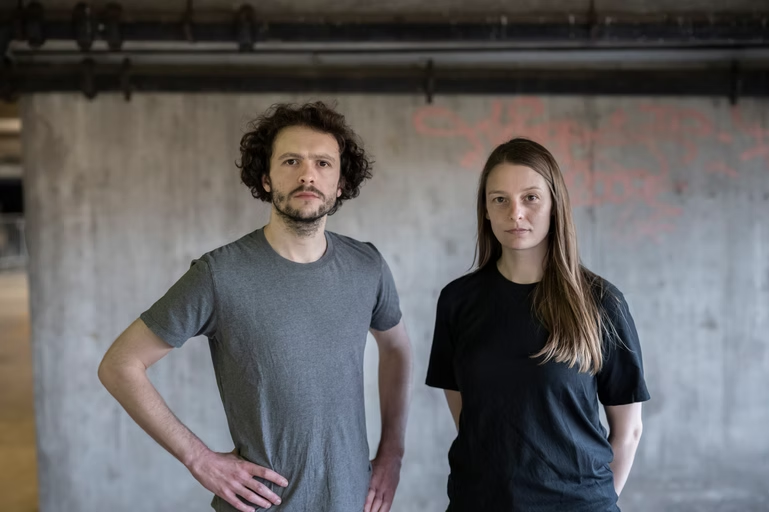
GBSR Duo
Crucible Playhouse, Sheffield
Saturday 5 September 2026, 8.00pm
Tickets:
£17
£10 UC, PIP & DLA
£5 Students & Under 35s
MONK FELDMAN Clear Edge (5’)
FELDMAN Dance Suite (For Merle Marsicano) (20’)
HARRISON Five Transfigurations and Seven Litanies (world premiere commissioned by Music in the Round) (75’)
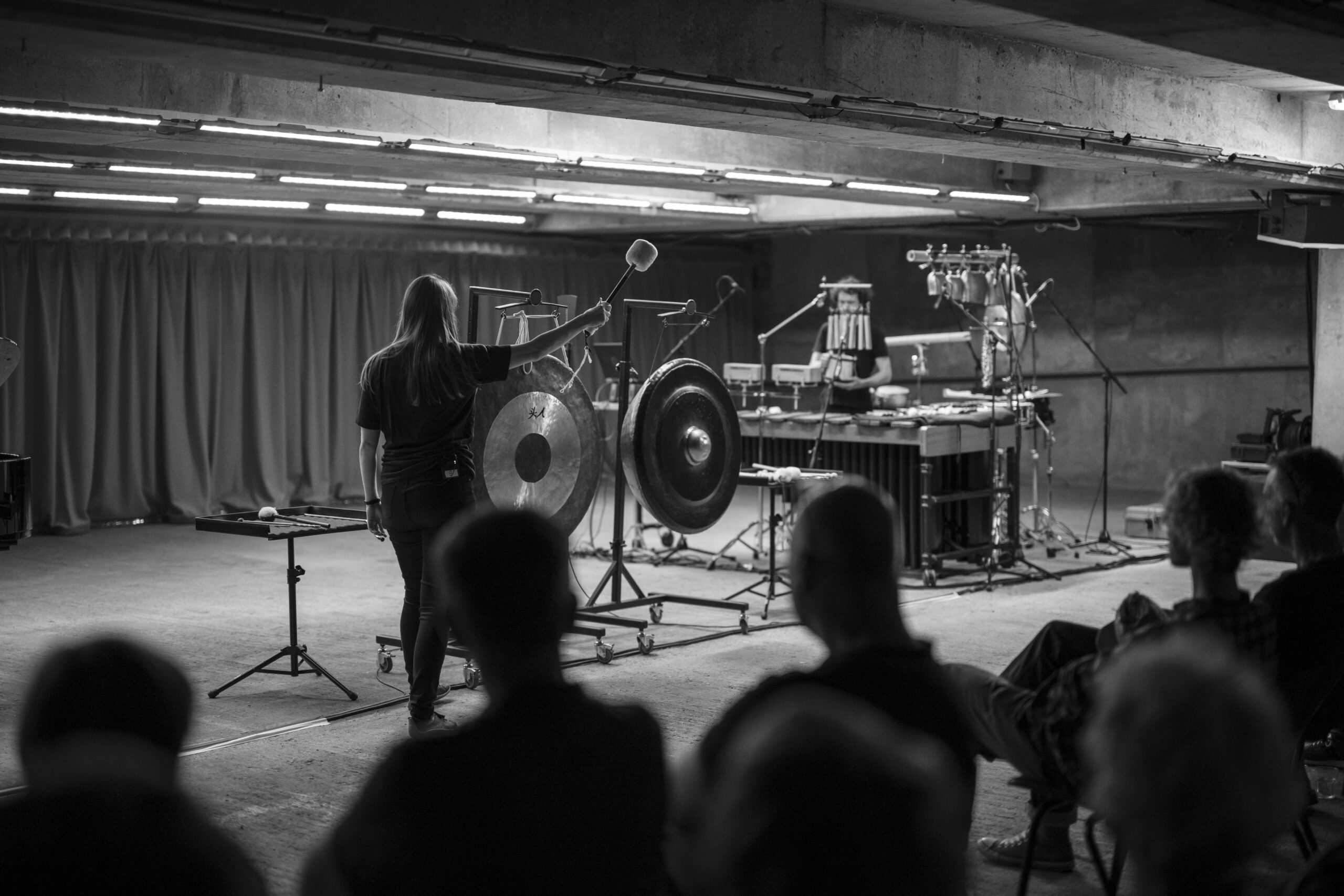
Known for bold, fearless programming, GBSR Duo is fast emerging as the leading interpreter of Morton Feldman’s music. Performances in London at the King’s Place, Barbican and Southbank Centre have received high praise from The Guardian: “the intense concentration of these performers and the delicately immersive sound world they created were utterly unforgettable”. Feldman’s rarely performed ‘Dance Suite’ features alongside a monumental new commission by Bryn Harrison, a leading British composer whose music has been described as “utterly compelling” (The Guardian).
With support from the Hinrichsen Foundation and the Vaughan Williams Foundation


Save 20% when you book for 10 or more Music in the Round Sheffield concerts in one transaction.
Save 10% when you book for 5 or more Music in the Round Sheffield concerts in one transaction. Find out more.
MONK FELDMAN Barbara, Clear Edge
The title of Barbara Monk Feldman’s Clear Edge refers to a new approach to articulation introduced in this piece. In contrast with the hazy blur of most of her compositions theretofore (and that nowhere more so than in her piano writing), Monk Feldman writes here with great specificity over piano pedalling and articulation, outlining at points in the score an approach that goes beyond achieving clarity and almost reaches the point of deliberately breaking the musical line. As is typical of Monk Feldman’s sensitive and vulnerable art, the music seems almost at the point of not coming out; here it is in addition almost being retracted or erased at the same time as it is enunciated.
GBSR Duo 2026 ©
FELDMAN Morton, Dance Suite
Dance Suite is the last of a trio of compositions Feldman wrote specifically for the dancer and choreographer Merle Marsicano, and by far the most substantial of the three both in duration and in the inclusion of percussion and celeste alongside the solo piano of those earlier works, Three Dances and Figure of Memory, although the former admittedly incorporates some percussion in the form of some notes played on a wine glass and snare drum by the pianist.
Here the percussion is the leading voice, with an opposition between pitched and unpitched sounds as important as that between percussion and keyboards. That contrast is epitomised in the two central movements, one for vibraphone solo and the other for drums, gong and crotale. The outer movements, both for the duo, between outline a gradual focussing of material from an initial abundance of material down to a single idea. The first movement, perhaps the most abstract of the four, is a series of ten numbered statements, some a simple harmony on the keyboards followed by a response in the percussion, others several lines of gestures between the instruments. Gradually the movement’s initial alternating-harmonies-plus-elaborate-interruptions coalesce into a single dense chord in the piano set against repeated pitches in the percussion. After the middle movement that same material is resumed and obsessed over, in a profoundly concentrated statement that seems to encapsulate the tone of much of Feldman’s middle-period work in somehow being abstract, minimalist and simultaneously ethereally funereal.
GBSR Duo 2026 ©
HARRISON Bryn, Five Transfigurations and Seven Litanies
As a composer, I have a long-held fascination with notions of musical time. Throughout my twenties and early thirties, I produced a steady output of solo and ensemble works that approached time as a circular and repeating entity. Many of my subsequent works, such as Repetitions in Extended Time (2008) and Surface Forms (repeating) (2009), operate at a speed and density that cannot be easily or immediately apprehended. The textural quality of these works is both fleeting and ephemeral. Occasionally I have written sparser pieces, such as an oblique (2008) for voice and piano and the 76-minute piano work Vessels (2012), that are less active and place the focus on each event as it arises.
This multi-movement work for piano and vibraphone attempts to bring together the approach adopted in Repetitions in Extended Time with that of Vessels. Transfigurations I and III are relatively quick, textural and dynamic. Whilst Transfiguration I plays with interlocking patterns that require deft reading and fidelity to the score, Transfiguration III enables the real-time generation of materials during performance. In this movement, the performers create the score from a set of guidelines provided by the composer, drawing on a different type of performance practice that requires improvisatory skills and real-time decision-making. This is my first attempt at enacting this way of working. Transfiguration V takes the horizontal processes utilised in Transfiguration I and III and turns them into a series of static chords that transform glacially over time. Each of the Seven Litanies is based on the modes of a synthetic scale, presented as slow, hymn-like meditations on the passing of time. The lines are at once simple and highly complex; unison passages are imbued with barely perceptible rhythmic nuance that call into question notions of sameness and difference. Throughout the Litanies and at various points in the Transfigurations, I have also included the subtle use of electronics, intended to add slight spatial and harmonic nuance to the music.
Five Transfigurations and Seven Litanies might be considered as a homage to Olivier Messiaen and Morton Feldman, two composers who belong to very different musical traditions, but who have influenced my music over the years and whom I still greatly admire. This is particularly evident in the harmonic progression of Transfiguration V, which, for me, is reminiscent of particular moments in Messiaen’s Quartet for the End of Time, and Feldman’s late piano music. The French spelling of ‘Litanie’ can be seen as a nod to Messiaen, but also to the Belgian composer Karel Goeyvaerts, whose Litanie 4 had a strong impact on me when I first heard it during the Huddersfield Contemporary Music Festival in 2002.
I am indebted to Siwan and George of GBSR for commissioning such a long piece, for their patience and understanding, and for their insights into realising the work. I would also like to thank my son, Harry, for the long hours spent making the sine tones for the Seven Litanies. Also, thanks to the Vaughan Williams Foundation and Music in the Round for providing financial support for the commission. Due to time constraints, it has been necessary to omit Transfiguration II and IV from the programme this evening. Whilst these movements await a subsequent performance, it is hoped that the spirit of the piece will still be conveyed as originally intended.
Bryn Harrison 2026 ©
“A wonderful, adventuresome, sensitive pair of musicians”
Kate Molleson, BBC Radio 3