SOUNDS OF NOW: SAXOPHONE & ELECTRONICS
David Zucchi & Robert Laidlow
Crucible Playhouse, Sheffield
Saturday 7 November 2026, 8.00pm
Tickets:
£17
£10 UC, PIP & DLA
£5 Students & Under 35s
TENNEY Saxony (25’)
TASSIE O Suns – O Grass of Graves world premiere (10’)
LAIDLOW content (30’)
ZUCCHI/LAIDLOW Interfaces Improvisation (15’)
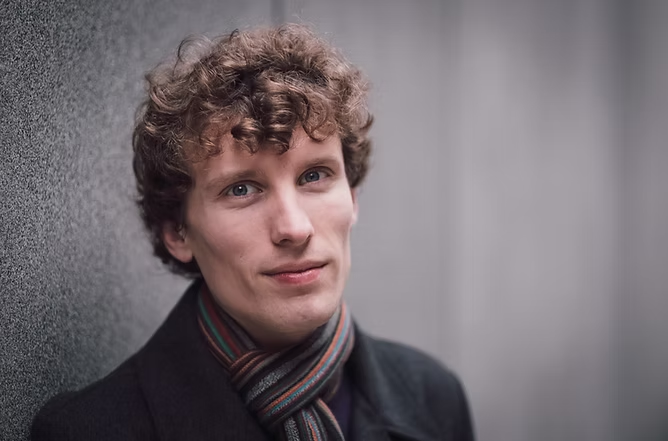
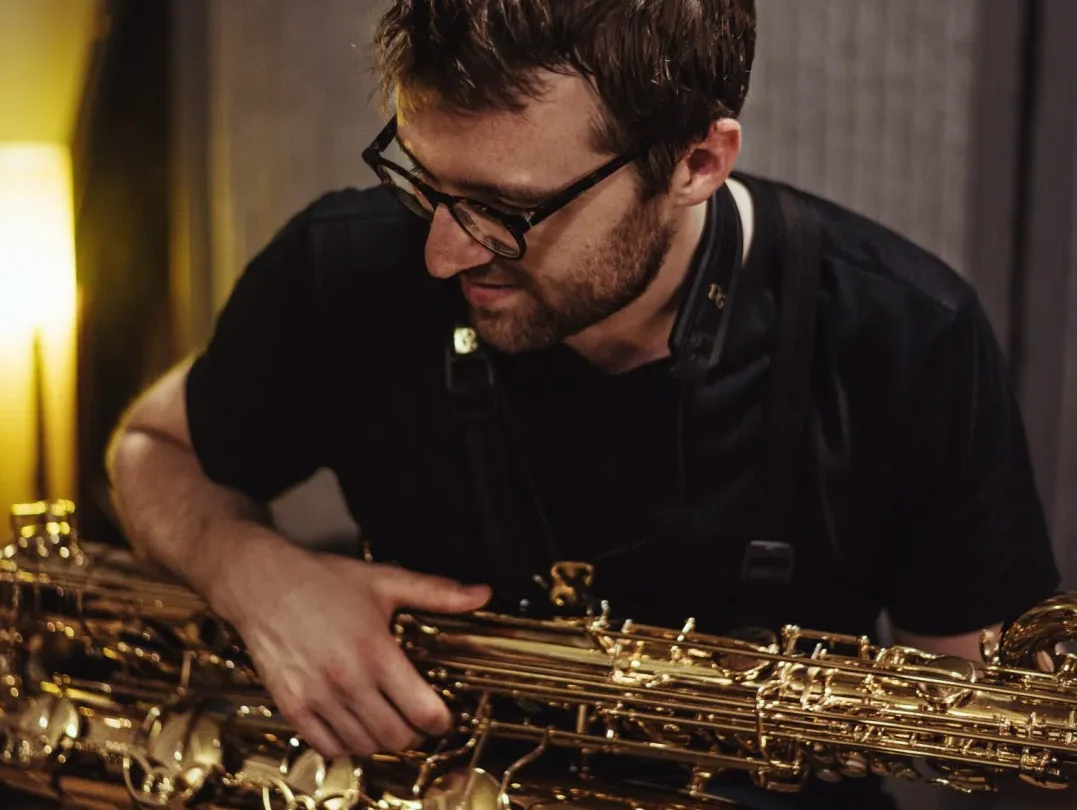
Praised for his “urgently visceral” playing (Tempo), London-based Canadian saxophonist David Zucchi performs a programme of innovative works for saxophone and live electronics. James Tenney’s groundbreaking Saxony (1978) sees a shimmering wall of sound built from tape delay and saxophones of every size, while Benjamin Tassie’s new work, O Suns – O Grass of Graves, explores the fragile sound world of the saxophone’s delicately unstable multiphonics.
The second half showcases Zucchi’s recent collaborations with composer and creative technologist Robert Laidlow. Content translates the internet’s overwhelming abundance (memes, infinite-scroll feeds, push notifications) in a raucous concert work for saxophone and electronics, while Interfaces Improvisation sees Laidlow perform alongside Zucchi using his tactile new electronic instrument, a ‘stacco’, which uses live AI to melt timbres together and control live-processed sound.
Save 20% when you book for 10 or more Music in the Round Sheffield concerts in one transaction.
Save 10% when you book for 5 or more Music in the Round Sheffield concerts in one transaction. Find out more.
TENNEY James, Saxony
For saxophones and electronic tape-delay (1978)
While the term “experimental” can be loosely applied to a wide variety of compositional techniques and practices, many of James Tenney’s (1934-2006) compositions play out as literal “experiments”: conceptually simple works framed by strict parameters (harmonic, technical, or otherwise), and focussed on the generation of new insights into composition and sonic experiences. Among the dizzying array of Tenney’s experimental endeavours – which ranged from text pieces, orchestral music, chamber music, electronic music, and sampling (to say nothing of his contributions to music theory and analysis) – his enduring interest in the compositional possibilities of the harmonic series generated some of his most engaging music.
Saxony is a wonderful convergence of both Tenney’s experimental approaches to composition and the harmonic language underpinning much of his other work. Originally written for one performer playing the four different saxophones of the conventional saxophone family ranging from the lowest (baritone) to the highest (soprano), Saxony could, in a sense, be crudely distilled to an instruction to “play the harmonic series on four saxophones”. However, as with much experimental music, it’s not always that simple.
Saxony is divided into nine sections of variable length. In each section, new pitches of the harmonic series are introduced and form the basis of an improvisation by the performer (or in some realisations, performers). In each section Tenney specifies to increase the “melodic activity” and the improvisatory freedom until, in the fifth segment, “anything goes”. After the fifth segment, the process reverses itself until the fundamental is re-established by the baritone saxophone, and the delay process gradually fades out.
Central to this work is the use of a tape-delay effect of twelve seconds, which creates a quasi-orchestral texture – “everything played will become a part of the total sonority.” Tape-delays were (and remain) a widely used effect in popular and experimental music by everyone from Karlheinz Stockhausen and Pierre Schaeffer to Elvis Presley, Lee “Scratch” Perry, Robert Fripp and beyond. It is used to “repeat” a sound (conventionally, in quick succession after the initial sound). Given the ease with which the tape-delay effect can be replicated using modern computer software, or even a digital delay, it is difficult to imagine how laborious Tenney’s initial process of tape-delay was, requiring meters of tape to execute. I once asked David Mott, the Canadian saxophonist who first recorded Saxony, about this process, succinctly described by him as “Good old days kind of challenges. Primitive technology. Fortunately that was all handled by Jim.”
TASSIE Benjamin, O Suns—O Grass of Graves
For soprano saxophone and electronics (2026)
A saxophone multiphonic is a single fingering that sounds several pitches at once: a small, unstable chord drawn from the instrument’s own resonances. O Suns—O Grass of Graves sets
these complex acoustic phenomena against samples of the Van Straten Organ, a recreation of a 1479 Dutch organ recorded by the composer at Het Orgelpark, Amsterdam, in 2022.
The organ and saxophone share a kinship: both are sounded through air, and both sit outside equal temperament, the organ in quarter-comma meantone and the saxophone in the instability of its multiphonics. The piece explores this common sonority. Retuned digitally and triggered by the performer using a custom-coded Max patch, the organ supports the saxophone’s multiphonics, finding in their unstable pitches a shared harmonic territory. O Suns—O Grass of Graves moves through this space – finding in the saxophone and organ’s meeting a constellation of spectral centres linked by common tones. The music moves between these, each wavering multiphonic tipping the harmony into a new region; each breath and press of the pedal drawing the piece deeper, its course held in the fragile balance of a single body and a single column of air.
O Suns—O Grass of Graves was composed for David Zucchi and co-commissioned by the Vaughan Williams Foundation, the Hinrichsen Foundation, and the Marchus Trust. The title is taken from Walt Whitman’s Song of Myself.
I hear you whispering there O stars of heaven,
O suns—O grass of graves—O perpetual transfers and promotions,
If you do not say any thing how can I say any thing?
LAIDLOW Robert, content
For soprano saxophone and electronics (2024)
content is music about the Internet. Like the Internet, you can’t keep up with it. It absorbs everything it touches. Nearly everything in the piece is a reference to something else; many of those references are themselves references. It is 100% a joke and simultaneously deadly serious. We hear the reaction before we hear the thing itself. AI-generated memes imagine a world of good-natured disagreements. This is interrupted music, its flow atomised by sponsors desperate to connect authentically with your bank account. Breaking news is pushed directly to your ears. We join stories halfway through, scroll back to understand the start, still don’t quite get it. Two sides of the coin are community and loneliness. The music is a feed that is completely cut up, could go on forever; at some point, you just need to pull the plug. These feelings are, I think, understood by people who have grown up with the Internet. It’s also very personal; it is specifically like my timeline, curated for me by a thousand algorithms starving for my attention. Even the saxophone is my instrument. I don’t know what this piece sounds like to anyone else.
Our improvised duet for saxophone and stacco uses AI to create and sustain impossible, otherworldly sounds. The stacco embeds AI algorithms into a physical instrument – something that can be touched, moved, and played sensitively. Every instrument was a new invention once, and the performance looks both to this past and to a possible future of musical performance. In rejecting derivative and imitative sounds, the stacco showcases a different, more creative, future for artificial intelligence in music. The stacco is an instrument which I developed with the Intelligent Instruments Lab in Reykjavik, designed specifically to encourage repeated use, practice, mastery and play.
Robert Laidlow
David Zucchi