
THIS SCEPTERED ISLE: BRITISH SONG
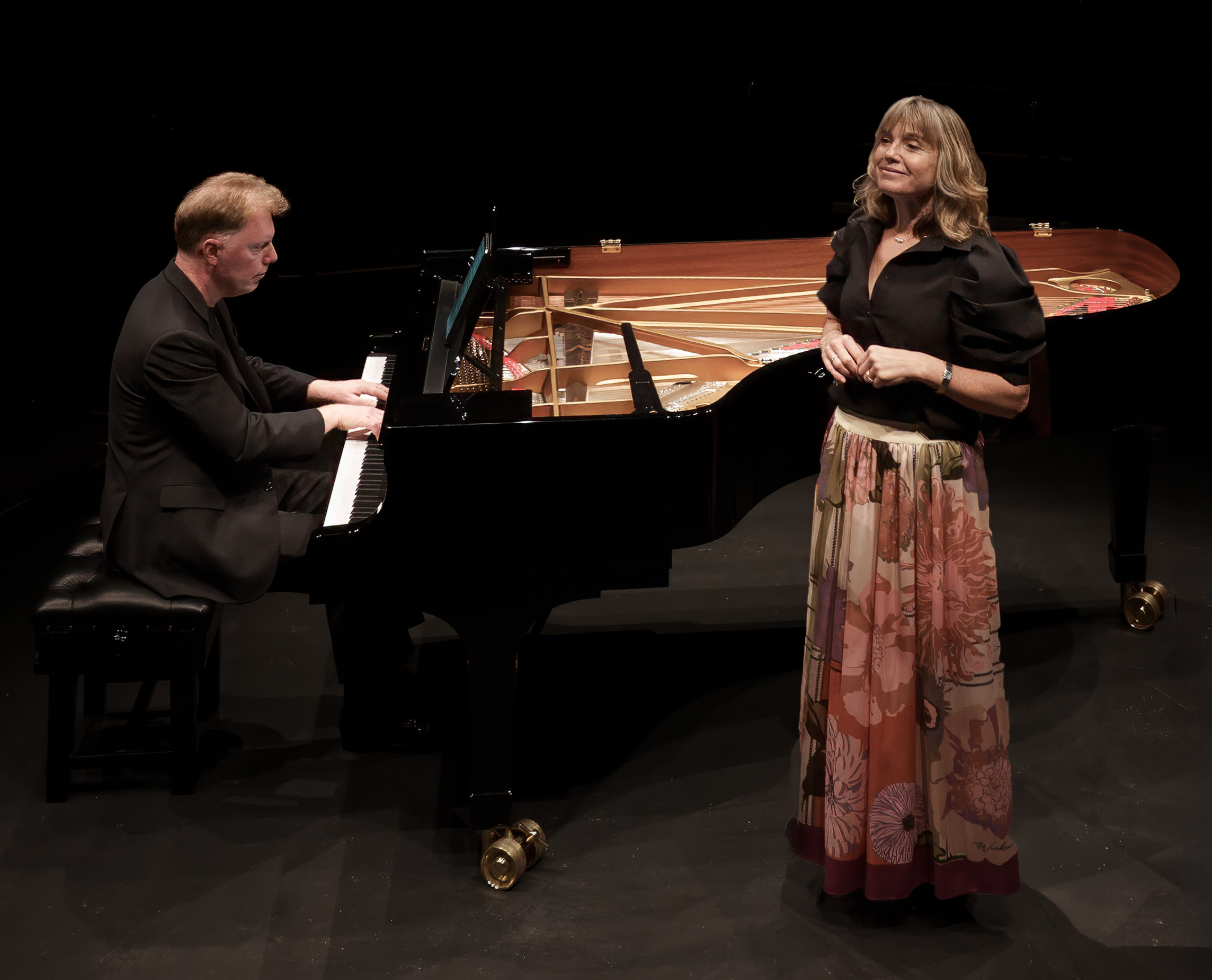
Claire Booth & Ensemble 360
Crucible Playhouse, Sheffield
Friday 22 May 2026, 2.00pm
Tickets:
£23
£14 UC, PIP & DLA
£5 Students & Under 35s
BRITTEN Phantasy Quartet (15’)
BRITTEN / PURCELL She Loves and She Confesses Too (2’)
BRITTEN / PURCELL O Solitude (6’)
BRITTEN / PURCELL Mad Bess (4’)
MATTHEWS Seascapes (13’)
KNUSSEN
Whitman Settings – When I heard the learn’d Astronomer (3’)
Whitman Settings – A Noiseless patient Spider (3’)
Whitman Settings – The Dalliance of the Eagles (2’)
Whitman Settings – The Voice of the Rain (3’)
WALTON Piano Quartet (30’)
A celebration of British song from one of its finest exponents. Praised for her “radiant, rapturous, wonderfully nuanced performances” (The Scotsman), Claire Booth performs a selection of her best-loved music, from Britten’s stirring reimagining of Purcell songs to Colin Matthews’ evocative seascapes in celebration of the prolific composer’s 80th birthday.
“Britten’s Purcell arrangements link strongly to Gwilym’s transcriptions earlier in the week. That ability to reinterpret is at the heart of all creativity, and so it’s great to remember this has forever been the case. Both Oliver Knussen and Colin Matthews have been dear friends and colleagues, and in Colin’s 80th year it feels very right to present one of his chamber pieces, written especially for me. The first time I met Ollie in my early 20’s I harangued him continually till he’d listen to my performance of these Whitman Settings. He managed to dodge the issue for a week, but I finally cornered him. Luckily for me, he loved what he heard, leading to a 25yr working friendship and many performances of these beautiful Whitman poems, till his untimely death in 2018. This concert demonstrates some of the breadth and vitality of the very best of English composers.” Claire Booth, 2026
Save 20% when you book for 10 or more Music in the Round Sheffield concerts in one transaction.
Save 10% when you book for 5 or more Music in the Round Sheffield concerts in one transaction. Find out more.
BRITTEN Benjamin, Phantasy Quartet Op.2
Britten’s Phantasy Op.2 is subtitled ‘Quartet in one movement for oboe, violin, viola and violoncello’. It was composed in September and October 1932 and first performed in a BBC broadcast on 6 August 1933. The oboe was played by the work’s dedicatee, Léon Goossens, with the International String Quartet. Britten was still a student at the Royal College of Music, but the individuality and ingenuity of his music is already strongly apparent. In 1934 the Phantasy was performed at the Festival of the International Society for Contemporary Music in Florence. Unlike a number of other British composers, Britten was quickly recognised as an outstanding talent abroad as well as at home, and this 1934 performance marked the arrival of an important new voice in European music. It did so in trying circumstances: the concert was half an hour late starting, and when Goossens and the Griller Quartet were about to begin, there was, according to the Musical Times, ‘a further delay – to silence an orchestra that was rehearsing in an adjoining room’.
The Phantasy is a single movement designed in an arch form: a central section framed by a spiky and ghostly march in which the cello introduces the dotted rhythms that were such an individual feature of Britten’s music. The central section is marked Allegro giusto, intercut with interludes, one of which is for strings alone. This gives the oboist a rest before a slower cadenza-like passage in which the oboe plays florid, wide-ranging phrases over long, sustained notes. At the close, the dotted march returns, at first triumphant, with multiple-stopped string chords, before reverting to the tense, mysterious mood of the opening.
© Nigel Simeone 2015
PURCELL Henry / BRITTEN Benjamin, She Loves and She Confesses Too, O Solitude, Mad Bess
She Loves and She Confesses Too
O Solitude
Mad Bess
Benjamin Britten was a great admirer of his fellow British composer Henry Purcell and created ‘realizations’ of Purcell’s songs for voice and piano. These are not just accompaniments, but rather a re-imagining of the baroque continuo part, adding modern harmonic sensibilities while respecting the original vocal line.
Britten’s setting of She Loves and She Confesses Too is a notable example of his efforts to realize and revive the music of the 17th-century composer. The song sets a poem by Abraham Cowley (1618–1667), and describes the direct, almost military, triumph of love after a lady finally confesses her affection.
O solitude is set using a ‘ground bass’, a short theme in the bass line that constantly repeats – in this case 28 times. The Purcell original is thought to date from the mid-1680s, and sets a translation of Antoine Girard de Saint’s La solitude. Britten paints its words through plaintive falling intervals, meandering passages and a wonderful use of the lowest register of the voice for ‘as only death can cure’.
One of Purcell’s ‘mad-songs’, Mad Bess was published in 1683. In Britten’s hands, it becomes a complex piece that has a deliberate craziness with many different sections and constant twists and turns in a short space of time. The singer and piano parts are often independent of each other, and Britten uses the opportunity to bring the words, such as ‘flaming eyes’, to life.
MATTHEWS Colin, Seascapes
Sidney Keyes died in Tunisia in April 1943 at the age of 20. Although usually spoken of as a war poet, none of the poems he is believed to have written during his short period of active service survive. However, of the poems I have chosen to set, all but one (The Island City) were written after he had enlisted in April 1942. Their mood is darker than his earlier work, but it is significant that his major ‘war’ poem The Foreign Gate was written while he was still at Oxford in February 1942. He is probably best known for Tippett’s 1950 settings of The Heart’s Assurance and Remember Your Lovers, but his Collected Poems (a volume of little more than 100 pages) reveal a remarkably sophisticated perspective, heavily influenced by Rilke and Yeats but demonstrating an exceptional, individual voice, brutally cut short. Victoria Sackville-West wrote of ‘the astonishing maturity of his mind, the intense seriousness of his outlook, and his innate pre-occupation with major things’.
Colin Matthews 2026 ©
- The Island City
Walking among this island
People inhabiting this island city,
Whose coast recedes, whose facile sand
Bears cold cathedrals, restively:
I see a black time coming, history
Tending in footnotes our forgotten land.
Hearing the once virginal
But ageing choirs of intellect
Sing a psalm that would appal
Our certain fathers, I expect
No gentle decadence, no right effect
Of falling, but itself the barren fall:
And Yeats’ gold song-bird shouting over all.
- From: North Sea
The evening thickens.
Figures, figures like a frieze
Cross the sea’s face, their cold heads
Disdainful of the wind that pulls their hair
The brown light lies across the harbour wall.
- Night Estuary
And yet the spiked moon menacing
The great humped dykes, scaring the plaintive seafowl,
Makes no right image, wakes no assertive echo.
Though one may stride the dykes with face upturned
To the yellow inflammation in the sky
And nostrils full of the living samphire scent,
There is no kindness in man’s heart for these.
In this place and at this unmeaning hour,
There is no hope for a man’s hope or his sorrow.
O you lionhearted poet’s griefs, or griefs
Wild as the curlew’s cry of passage;
O hope uneasy as the rising ebb
Among the sedges, cold and questing guest;
Leave me alone this hour with the restive night.
Allow me to accept the witless landscape.
- Interlude
- Seascape
Our country was a country drowned long since,
By shark-toothed currents drowned:
And in that country walk the generations,
The dancing generations with grey eyes
Whose touch would be like rain, the generations
Who never thought to justify their beauty.
There once the flowering cherry grasped the wall
With childish fingers, once the gull swung crying
Across the morning or the evening mist;
Once high heels rattled on the terrace
Over the water’s talk, and the wind lifted
The hard leaves of the bay; the white sand drifted
Under the worm-bored rampart, under the white eyelid.
Our country was a country washed with colour.
Its light was good to us, sharp limning
The lover’s secret smile, the fine-drawn fingers;
It drew long stripes between the pointed jaws
Of sea-bleached wreckage grinning through the wrack
And turned cornelian the flashing eyeball.
For here the tide sang like a riding hero
Across the rock-waste, and the early sun
Was shattered in the teeth of shuttered windows.
But now we are the gowned lamenters
Who stand among the junipers and ruins.
We are the lovers who defied the sea.
Text from Sidney Keyes: Collected Poems (1945)
KNUSSEN Oliver, Whitman Settings
Whitman Settings (1991)
Although these versions of characteristically powerful but unusually short poems by Walt Whitman constituted my eighth concert work for a soprano voice, they were my first in many years for voice and piano. Earlier attempts having been impossibly dependent on models rather too close to home, I was very conscious, while composing, of trying to re-imagine a very familiar genre with fresh ears – specifically of setting the voice in different contexts within the all-encompassing range of the piano. All four poems muse on things in space or the sky, and all four songs grow from the short idea heard at the outset. Whitman Settings was commissioned by the Amphion Foundation and is dedicated to Lucy Shelton, who gave the first performances at the 1991 Aldeburgh Festival (with Ian Brown) and at BBC Pebble Mill (with John Constable). In 1992 I made a parallel version for soprano and orchestra.
© Oliver Knussen
WALTON William, Quartet for Piano and Strings
1. Allegramente
2. Allegro scherzando
3. Andante tranquillo
4. Allegro molto
Walton started work on his Piano Quartet in 1918 – when he was sixteen years old – and he finished it in 1921. Herbert Howells’s work for the same forces was an influence and its success encouraged him to try his own hand at one. In 1924, it was published in the Carnegie Collection of British Music (as Howells’s Piano Quartet had been), though not before getting lost in the post for a couple of years. It’s a brilliant display of a young composer’s gifts, with a haunting slow movement and a ruggedly exciting finale.
Nigel Simeone 2013

Claire Booth
