
Sounds of Now: The Hermes Experiment
The Hermes Experiment
Winners of the Royal Philharmonic Society Young Artist Award 2021 and the Royal Over-Seas League Mixed Ensemble Competition 2019, The Hermes Experiment is one of the UK’s leading young contemporary music ensembles. Capitalising on their deliberately idiosyncratic combination of instruments (harp, clarinet, voice and double bass), The Hermes Experiment regularly commissions new works, as well as creating their own innovative arrangements and venturing into live free improvisation. They have commissioned over 60 composers at various stages of their careers. They have released two albums on Delphian Records – HERE WE ARE and SONG – both to critical acclaim.
The ensemble is dedicated to the value of contemporary music in education and community contexts. In 2021, they ran a Virtual Composition Project, supported by Arts Council England. They were ensemble in residence for the Young Music Makers of Dyfed 2018-19, and as part of their fifth birthday project they ran composition workshops in state schools in and around London. They regularly work with composition students from Trinity Laban, RAM, RCM, RWCMD, Leeds College of Music and Birmingham University. In 2014-15, they took part in Wigmore Hall Learning’s schemes.
The ensemble also strives to create a platform for cross-disciplinary collaboration. In June 2015, they created a ‘musical exhibition’ with photographer Thurstan Redding, and in September 2016 during an Aldeburgh Music Residency, they developed a new interpretation of Shakespeare’s The Winter’s Tale. They also worked with poet Ali Lewis in 2016 & 2019, devising new pieces with him.
The quartet has received funding from Arts Council England, The Marchus Trust, Vaughan Williams Foundation, Hinrichsen Foundation, Britten-Pears Foundation, Future of Russia Foundation, Oleg Prokofiev Trust, Nicholas Boas Charitable Trust, PRS for Music Foundation and Help Musicians UK. For the 2023-26 seasons, The Hermes Experiment is extremely grateful to be generously supported by The Marchus Trust.
*
ELISABETH JACQUET DE LA GUERRE
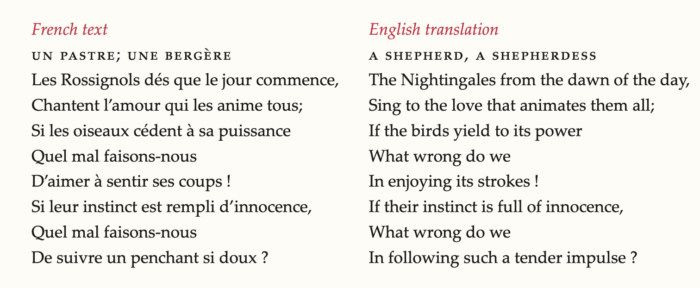
Les rossignols, dès que le jour commence (1694)
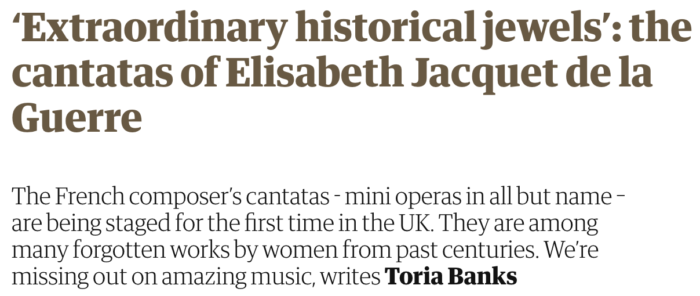
Read the guardian article here:
*
EWAN CAMPBELL
London, He Felt Fairly Certain, Had Always Been London (2016)
Ewan Campbell
Ewan is an award-winning British composer and music director. He holds a PhD in Composition from King’s College London and is Director of Music at Churchill and Murray Edwards Colleges at the University of Cambridge. Alongside this he directs the Wilderness Orchestra and choir.
Ewan is an enthusiastic teacher and enjoys working with young people. He mentors students of the Aldeburgh Young Musician scheme; supervises at Cambridge University; delivers workshops for Cambridge Music Outreach and judges the East Anglian Young Composer of the Year Competition.
*
London, He Felt Fairly Certain, Had Always Been London (2016)
This is a mixed notated / graphic score in which instructions are provided for how to follow a route through the music. Below is a copy of the part for the double bass.

*
AYANNA WITTER-JOHNSON
Draw the Line (2020)
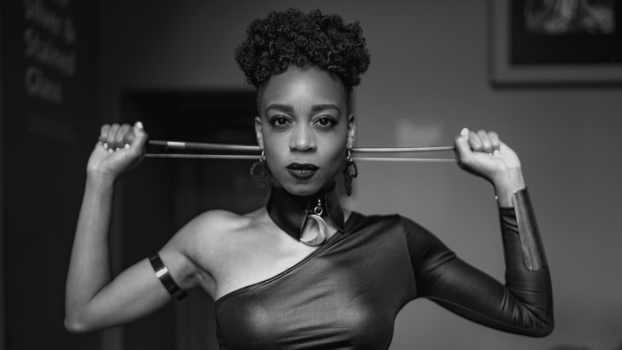
Ayanna Witter-Johnson is a multi-talented singer, songwriter, pianist and cellist. She has a phenomenal mastery for seamlessly crossing the boundaries of classical, jazz, reggae, soul and R&B, to imprint her unique musical signature with her virtuosic tap, strum and bow with her cello into her sound and vibe.
Draw the line (2020)
Commissioned by the Michael Cuddigan Trust for soprano Heloise Werner and double bassist Marianne Schofield of The Hermes Experiment. Draw the Line is a duo for soprano and double bass. A song anchored by a driving, organically built bass part that reflects and explores the depth of sadness and frustration that arose between two friends, from different backgrounds, unified by the series of lockdowns in London 2020, yet divided as a result of the rise of the Black Lives Matter movement.
*
IMOGEN HOLST
Cinquepace & Gigue from Suite for Unaccompanied Viola (1930)
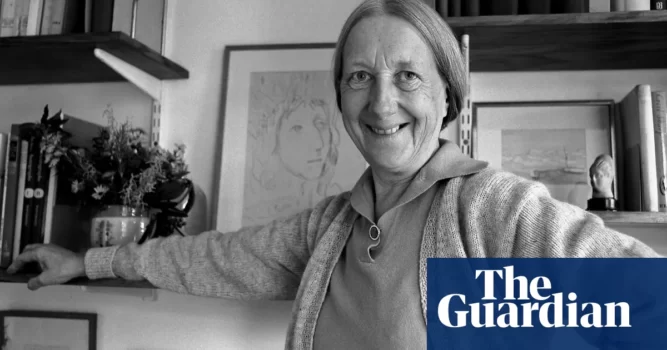
Imogen Holst, the daughter of Gustav Holst, wrote this suite for viola in 1930, though the exact date is unknown. It was first performed on 14th December 1931 at the Ballet Club Theatre, 2a Ladbroke Road, London W11, by Violet Brough who was the viola player with the Macnaghten String Quartet. In this concert the Quartet and others performed Elizabeth Maconchy’s Quintet for Strings, a Haydn String Quartet, songs by Patrick Hadley and Philip Rosseter and also gave the first performance of a string quartet by Betty Lutyens.
Read more about Imogen Holst here
Read more about Cinquepace & Gigue here
*
CAROLINE SHAW
The Ellipse from Plan and Elevation (2015)
Caroline Shaw
Caroline Shaw is a musician who moves among roles, genres, and mediums, trying to imagine a world of sound that has never been heard before but has always existed. She is the recipient of the 2013 Pulitzer Prize in Music, several Grammy awards, an honorary doctorate from Yale, and a Thomas J. Watson Fellowship. She has worked with a range of artists including Rosalía, Renée Fleming, and Yo Yo Ma, and she has contributed music to films and tv series including Fleishman is in Trouble, Bombshell, Yellowjackets, Maid, Dark, and Beyonce’s Homecoming. Her favorite color is yellow, and her favorite smell is rosemary.
Read a profile on Caroline Shaw here

Plan and Elevation
I have always loved drawing the architecture around me when traveling, and some of my favourite lessons in musical composition have occurred by chance in my drawing practice over the years. While writing a string quartet to commemorate the 75th anniversary of Dumbarton Oaks, I returned to these essential ideas of space and proportion — to the challenges of trying to represent them on paper. The title, Plan & Elevation, refers to two standard ways of representing architecture — essentially an orthographic, or “bird’s eye,” perspective (“plan”), and a side view which features more ornamental detail (“elevation”). This binary is also a gentle metaphor for one’s path in any endeavor — often the actual journey and results are quite different (and perhaps more elevated) than the original plan.
I was fortunate to have been the inaugural music fellow at Dumbarton Oaks in 2014-15. Plan & Elevation examines different parts of the estate’s beautiful grounds and my personal experience in those particular spaces. Each movement is based on a simple ground bass line which supports a
different musical concept or character. “The Ellipse” considers the notion of infinite repetition (I won’t deny a tiny Kierkegaard influence here). One can walk around and around the stone path, beneath the trimmed hornbeams, as I often did as a way to clear my mind while writing.
© Caroline Shaw
*
KERRY ANDREW
Fruit Songs (2001)
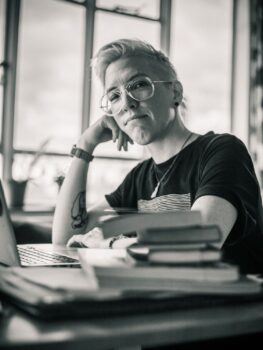
Kerry Andrew is a London-based musician, and author. Her debut novel, Swansong, was published by Jonathan Cape in 2018 and her second SKIN in 2021. She made her short story debut on BBC Radio 4 in 2014 with One Swallow and was shortlisted for the 2018 BBC National Short Story Award.
Kerry is the winner of four British Composer Awards and is best known for her experimental vocal, choral and music-theatre work, often based around themes of community, landscape and myth. She sings with Juice Vocal Ensemble and has released two albums with her band You Are Wolf: Hawk to the Hunting Gone (2014), a collection of avian folk-songs re-interpreted, and Keld (2018), inspired by freshwater folklore.
Fruit Songs
I mango
II plum
III blackberry
IV cherry
V apple
I never treat a poem as a ‘straight’ setting: ‘mango’ is fairly schizophrenic in nature, with sections of percussive phonetics interspersed with sung chunks of the whole text. ‘plum’ is simpler, only picking out ‘forgive me’ as a refrain. In ‘blackberry’, I chose an 11-note row, with 1 quaver pitch to a syllable, which is then deconsructed. ‘cherry’ examines a range of extra-vocal techniques using only the word ‘Oh!’, and has a more theatrical interplay between singer and guitarist. For ‘apple’, I stripped down the Drinkwater poem to what I saw as its essentials. Particular musical influences for these songs include Björk, Meredith Monk, Sheila Chandra, English folk, Japanese, West African and Indian music.
© Kerry Andrew
*
HANNAH PEEL
The Almond Tree (2011)
Hannah Peel
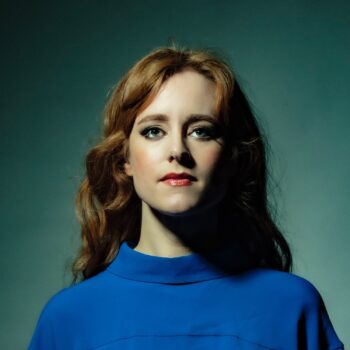
Mercury Prize, Ivor Novello and Emmy-nominated, RTS and Music Producers Guild winning composer, with a flow of solo albums and collaborative releases, Hannah joins the dots between science, nature and the creative arts, through her explorative approach to electronic, classical and traditional music
From her own solo albums to composing soundtracks like Game of Thrones: The Last Watch, or to orchestrating and conducting for artists like Paul Weller, her work is ambitious, forward-looking, always adapting and re-inventing new genres and hybrid musical forms
Hannah is a regular weekly broadcaster for BBC Radio 3’s Night Tracks.
The Almond Tree
This is a track from Hannah Peel’s 2011 debut album The Broken Wave, which she described as a collection of songs covering themes ranging from “joy and hope of falling in love through to the pain and loss of betrayal.” In 2018 The Almond Tree featured in the opening episode of the Channel 4 / Netflix series Kiss Me First.
Hannah performing The Almond Tree in 2011
*
MISHA MULLOV-ABBADO
The Linden Tree (2015)
Misha Mullov-Abbado
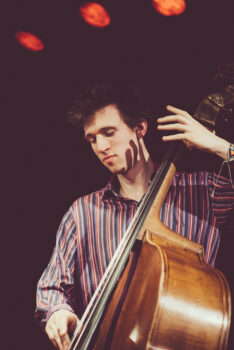
Award-winning, London-based jazz bass player, composer and arranger Misha Mullov-Abbado is a musician who combines great imagination with raw talent and a clear vision. A BBC New Generation Artist and with three critically acclaimed albums on Edition Records under his name, his most recent offering Dream Circus showcases his ‘melodic gift’ (John Fordham, The Guardian) and ability to masterfully combine beautifully-crafted compositions with free-spirited improvisation. Written over a three-year period the album, produced by fellow Edition Records bassist and bandleader Jasper Høiby (Phronesis), marks the arrival of an artist who has been on a voyage of self-discovery.
Read more about Misha Mullov-Abbado here
The Linden Tree (2015)
Misha Mullov-Abbado’s The Linden Tree retains the familiar folksong-like lyrics but crafts a new melody and accompaniment. The flowing tune stays true to the bittersweet melancholy of the original, but the score also introduces a range of jazz and swing elements into the instrumental accompaniment, from a strolling pizzicato bass to the occasional quasiimprovisatory solo from the clarinet.
© Kate Wakeling (written for the Hermes Experiment’s album Here we are)
*
EMILY HALL
I am happy living simply
The end of the ending
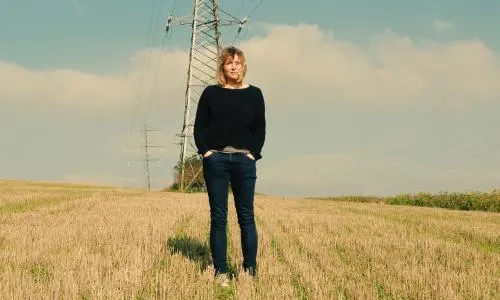
Emily Hall
Emily Hall is a composer, known first and foremost for her songwriting.
Much of Emily Hall’s music is formed from close creative relationships with singers, instrumentalists and writers and finding her own ways of using technology and live performance.
Read more about Emily Hall here
I am happy living simply (2017)
The end of the ending (2017)
Emily Hall’s two songs I am happy living simply and The end of the ending (2017) set fragments of text by Marina Tsvetaeva (1892– 1941), a Russian poet renowned for both her creative and political daring. Tsvetaeva’s poems are deceptively simple and Hall’s artful settings in turn capture something of their ambivalence. I am happy living simply is at first an uncomplicated celebration of dwelling in the present, as conveyed by the buoyant tick-tock of the harp and a sweetly lilting melody in the voice. A more feverish energy begins to creep into the song, however, as repetitions of the text grow more hectic amid flashes of dissonance. As Hall describes it, Tsvetaeva’s injunction to live ‘simply’ can only be achieved by ‘regimenting ourselves into simplification … sacrificing the beauty of chaos which ultimately is impossible to keep out’. Time weighs more heavily in The end of the ending with harp and double bass meting out a solemn pulse beneath the plaintive vocal line. Only the clarinet offers something like consolation in its ascending scale at the song’s close.
© Kate Wakeling (written for the Hermes Experiment’s album Here we are)
*
MEREDITH MONK
Double Fiesta (1986)
Meredith Monk
Meredith Monk is a composer, singer, director/choreographer and creator of new opera, music-theater works, films and installations. Recognized as one of the most unique and influential artists of our time, she is a pioneer in what is now called “extended vocal technique” and “interdisciplinary performance.” Monk creates works that thrive at the intersection of music and movement, image and object, light and sound, discovering and weaving together new modes of perception. Her groundbreaking exploration of the voice as an instrument, as an eloquent language in and of itself, expands the boundaries of musical composition, creating landscapes of sound that unearth feelings, energies, and memories for which there are no words.
Read more about Meredith Monk here
Double Fiesta (1986)
I originally composed “Double Fiesta” in 1986 for solo voice and two pianos. In the piece, I explored a variety of vocal qualities and quick shifts of persona or character within the underlying relaxed but buoyant atmosphere created by the two pianos. “Double Fiesta” was originally part of Acts from Under and Above, a chamber piece presenting images of solitude and friendship.
© Meredith Monk