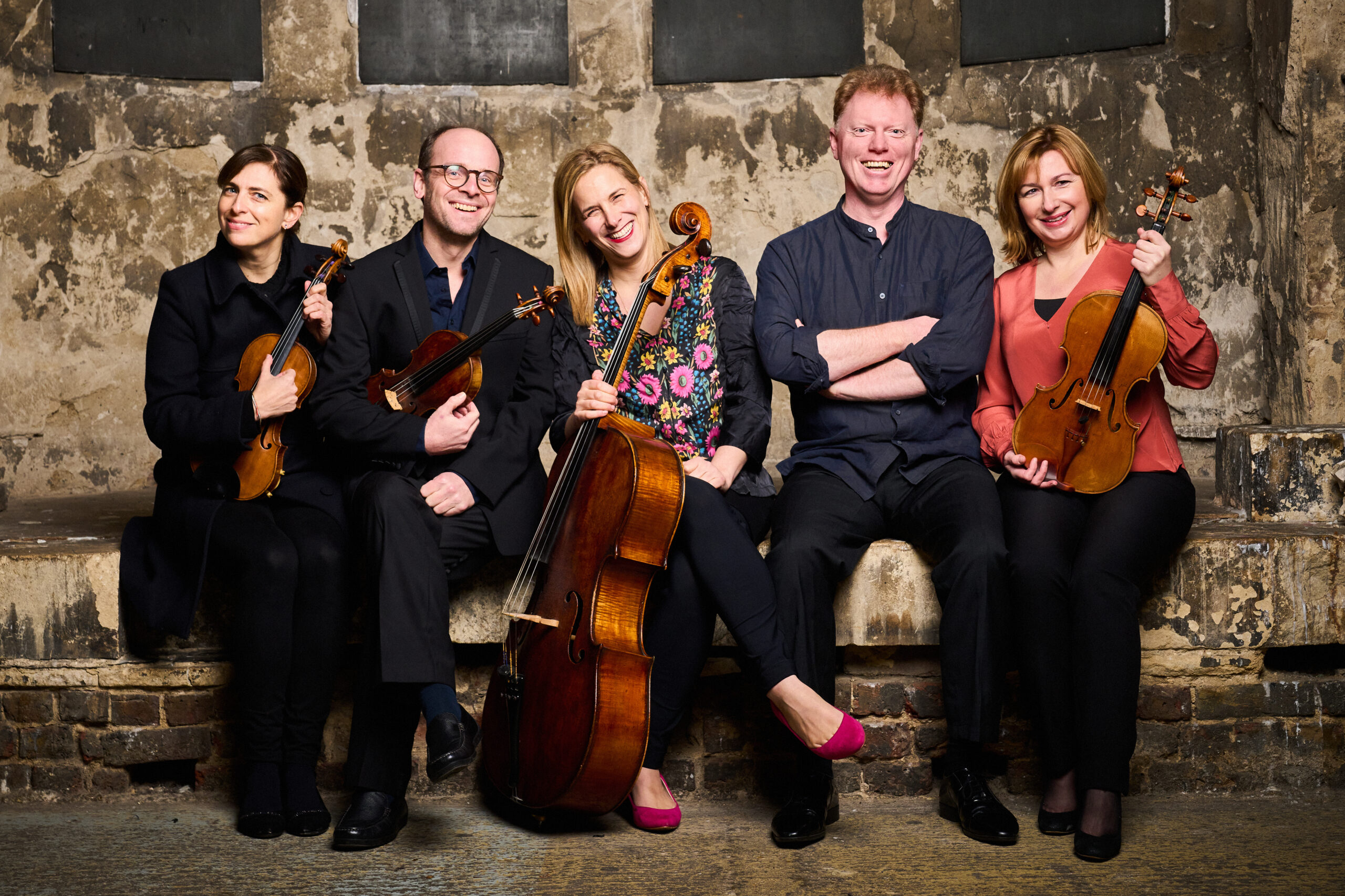
MOZART, JANÁČEK & BEETHOVEN

Marmen Quartet

Upper Chapel, Sheffield
Friday 24 March 2023, 7.00pm

£21
£14 DLA, UC & PIP
£5 Under 35s & Students 


Save £s when you book for 5 concerts or more at the same time 

Past Event

MOZART String Quartet in E flat K428 (25’)
JANÁČEK String Quartet No.2 Intimate Letters (27’)
BEETHOVEN String Quartet in E minor Op.59 No.2 Razumovsky (38’) 

In 2015 the Marmen Quartet was selected by our founder, violinist Peter Cropper, as the first ensemble to be supported by our new Bridge scheme. Established for musicians at the start of their professional career, the scheme provided the young quartet with coaching and development opportunities for three years.   

Since then, the Marmen Quartet has established themselves as a leading quartet, with a worldwide touring schedule and an impressive list of major prizes to their name. For their hotly anticipated return to Sheffield, they’ll be treating us to three of the greatest quartets in the repertoire, showcasing the intuitive brilliance of these four exceptional musicians. 


This concert is dedicated to the memory of Lord Menuhin of Stoke d’Abernon OM KBE, an inspirational violinist, conductor and educator whose personal kindness means so much to one of the sponsors.

MOZART Wolfgang Amadeus, String Quartet in E flat K428

Allegro non troppo 
Andante con moto 
Menuetto and Trio. Allegro 
Allegro vivace 

In 1785 the Viennese publisher Artaria issued a set of six string quartets by Mozart, the title page of which reads: “Six Quartets for two violins, viola and violoncello. Composed and dedicated to Signor Joseph Haydn, Master of Music for the Prince of Esterhazy, by his friend W.A. Mozart.” This was a most unusual dedication for the time: composers nearly always dedicated works to the aristocrats who supported them financially, not to fellow musicians. The long dedicatory epistle is headed “To my dear friend Haydn”. Mozart explains why he dedicated these quartets to Haydn, wanting to confide them “to the protection and guidance of a very celebrated man, especially when the latter by good fortune was at the same time his best friend.” The quartets, he writes, are “the fruit of a long and laborious study,” but that Haydn himself had told Mozart of his “satisfaction with them during your last visit to this capital. It is this above all which urges me to commend them to you … and to be their father, guide and friend!” 

After hearing these quartets, Haydn declared to Mozart’s father that “Before God and as an honest man, I tell you that your son is the greatest composer known to me either in person or by name.” Mozart’s “long and laborious study” included a detailed examination of Haydn’s Quartets Op.33 (composed in 1781), but while he had studied Haydn’s magnificent model, the results were no pastiche, but six works of extraordinary originality. 

The Quartet in E flat, K428, is the third of the “Haydn” Quartets and it was completed in 1783. It opens with a spacious theme in octaves that already reveals some of the chromatic colouring that gives this work its strikingly individual character. This harmonic daring is continued in the extraordinary slow movement – rich and intense – which seems to hint at the music of later composers, especially Brahms (the persistent drooping figure) and even Wagner. The Minuet is bracing but never predictable, while the central Trio is again more sinuous and chromatic. The delectable Rondo finale is a brilliant example of Mozart’s quartet writing at its most witty and inventive: a dazzling homage that captures the very essence of Haydn.  

© Nigel Simeone  

JANÁČEK Leoš, String Quartet No.2 “Intimate Letters”

Andante 
Adagio 
Moderato 
Allegro  

This extraordinary work was the result of extraordinary circumstances. As a married man in his 70s, Janáček had been head over heels in love with the much younger Kamila Stösslová for a decade by the time he wrote his 2nd String Quartet. This was a passionate (if largely one-sided) love that is eloquently expressed in the hundreds of letters he wrote her, and in the pieces that were directly inspired by her – from operas such as Katya Kabanova to the much more private world of chamber music. On 29 January he told Kamila about the latest piece to be inspired by her: ‘Today it’s Sunday and I’m especially sad. I’ve begun to work on a quartet; I’ll give it the name Love Letters.’ By 19 February the sketch was finished, and a couple of weeks later Janáček had written out a fair copy. He changed his mind several times about the title, eventually settling on Intimate Letters. The original scoring, noted on the manuscript, was to include a viola d’amore – the viola of love – but this was more symbolic than practical and after a private play-through, Janáček abandoned the idea.   

Janáček’s letters to Kamila are revealing about the programmatic content of this quartet. The first movement he described as ‘the impression of when I saw you for the first time!’ and the third evokes a moment ‘when the earth trembled’. The fourth movement was ‘filled with a great longing – as if it were fulfilled.’ As for the whole work, he confided in April 1928 that ‘it’s my first composition whose notes glow with all the dear things that we’ve experienced together. You stand behind every note, you, living, forceful, loving.’  

Janáček died on 12 August 1928, and the quartet had to wait another decade before it was published, by which time both Kamila and Janáček’s long-suffering wife Zdenka were dead. Intimate Letters stands as one of the most personal and original works in the twentieth-century quartet repertoire. The Czech novelist Milan Kundera summarized the essence of Janáček’s art as ‘capturing unknown, never expressed emotions, and capturing them in all their immediacy’. 

Nowhere is it more immediate – or more emotional – than in this quartet.  

© Nigel Simeone

BEETHOVEN Ludwig Van, String Quartet in E minor Op.59 No.2 Razumovsky

Allegro 
Molto Adagio. Si tratta questo pezzo con molto di sentimento  
Allegretto. Maggiore (Thème russe)  
Finale. Presto 

“Demanding but dignified” was how the Allgemeine Musik-Zeitung described Beethoven’s new quartets dedicated to Count Rasumovsky when they were first heard in 1807. Composed in 1806, and including Russian melodies from a collection of folk tunes edited by Ivan Prach (published in 1790), these quartets were a major development in the quartet form. But though they were longer and more challenging than any earlier quartets, they were an immediate success. Before the Rasumovsky Quartets were played, Beethoven offered them to publisher Breitkopf & Härtel in Leipzig – in a job lot with the Fourth Piano Concerto, the Fourth Symphony and Fidelio, but the deal fell through and the quartets were first published in Vienna by the Bureau des Arts et d’Industrie and in London by Clementi. 

While the first of the Rasumovsky Quartets is unusually expansive, the second is more concentrated. From the opening two-chord gesture establishing E minor as the home key, the first movement is tense and full of rhythmic ambiguity. The hymn-like slow movement has a combination of richness and apparent simplicity that blossoms into a kind of ecstatic aria: Beethoven himself is reported to have likened it to “a meditative contemplation of the stars”. The uneasy rhythms of the Scherzo are contrasted by a major-key Trio section in which Beethoven quotes a Russian tune that famously reappeared in the Coronation Scene of Mussorgsky’s opera Boris Godunov. The finale begins with a surprise: a strong emphasis on the note C that is tantalising and unexpected in a movement that moves firmly towards E minor.  

© Nigel Simeone 

“The entire concert radiated note-perfect brightness.”

Now Then magazine

WRACKLINE ALBUM TOUR

Fay Hield & Guests

Upper Chapel, Sheffield
Friday 31 March 2023, 8.00pm

£21
£14 DLA, UC & PIP
£5 Under 35s & Students 

Doors open 7.30pm
Concert starts 8.00pm

Past Event

Back on stage, after a couple of years pursuing other musical projects, award-winning folk artist, Fay Hield teams up once more with Sam Sweeney, Rob Harbron and Ben Nicholls to tour her new album, Wrackline. 

Exploring ideas of the space between, Wrackline looks to ghosts, fairies, spirits and talking animals to understand what it is about the unknown that entrances us. Working with traditional materials and ideas, Fay explores the feelings they evoke and how they relate to her experience in the contemporary world. Universal ideas of death, love and motherhood echo through time and space.  

Shifting between lighthearted and darker sides of the human psyche, Fay breathes life and meaning into old stories presenting them with a fresh twist and consummate musicianship from her guests, including fiddle, concertina, guitar, banjo and double bass.   

Expect to be enveloped in music, woven through magical stories and teased into thinking about your relationship with the world around you. 

Pre-concert event, 6.15pm – 7.15pm
FREE
Observe Fay and guests as they create a brand-new folk arrangement for performance later in the evening. (Please request ticket when booking for the 8pm concert) 


“A stunning and complete work of art, performed with Hield’s distinctive magic.”

Folk Radio UK Wrackline review

PIERROT LUNAIRE & MORE

Ensemble 360 & Claire Booth

Upper Chapel, Sheffield
Saturday 1 April 2023, 7.00pm

£21
£14 DLA, UC & PIP
£5 Under 35s & Students 


Save £s when you book for 5 concerts or more at the same time 

Past Event

GRIME Seven Pierrot Miniatures (12’)
BRAHMS Clarinet Trio (25’)
SCHOENBERG Pierrot lunaire (40’) 

One of Arnold Schoenberg’s most celebrated works, Pierrot lunaire is a masterpiece of ground-breaking melodrama. The music, written for five instrumentalists and a reciter of Sprechstimme or ‘spoken-singing’, features poetry by Albert Giraud that explores an obsession with the wonders of moonlight.  

Helen Grime, who curated the 2022 Sheffield Chamber Music Festival, took the same poems by Giraud as the starting point for her own brilliantly eccentric miniatures, while Brahms’s soul-searching trio is a sublime and celebratory work. 

When Ensemble 360 performs Pierrot Lunaire, they’ll be joined by star soprano Claire Booth, whose many dramatic interpretations of Pierrot over the years have been lavished with praise. She’s become the go-to singer to take on this astonishing role, with her perfect understanding of the complex and ever-changing character of Pierrot’s obsession with the beauty of the moon. After a recent performance, The Guardian’s critic Andrew Clements was stunned by Claire’s ability to tread the line between cabaret and nightmarish extremes, but with her caricature staying just “on the right side of winsomeness”.

If Claire and the Ensemble’s performance will be your first experience of Pierrot Lunaire, then be prepared for a truly unforgettable evening.


BRAHMS Johannes, Clarinet Trio in A minor Op.114

Allegro  
Adagio  
Andantino grazioso – Trio 
Allegro  
 

When Brahms first heard the playing of Richard Mühlfeld, principal clarinettist of the Meiningen Court Orchestra, he had not written any chamber music involving the clarinet. But after a meeting in March 1891 he was inspired – following more than a year of creative silence – to write two major works for his new-found muse. On 24 November 1891, Mühlfeld, the Joachim Quartet and Brahms himself played both the Trio and the Clarinet Quintet at a private concert for the Duke of Meiningen. The first public performances followed on 12 December 1891, in the Berlin Singakademie. For the Trio Mühlfeld was again joined by the cellist Robert Hausmann and Brahms. 


The four movements of the Trio are concise and clear in design, without quite the mystery or the rapturous spirit that pervades the Quintet. However, the writing for the three instruments is unusually closely integrated, intertwined even – prompting Brahms’s friend Eusebius Mandyczewski to write in a letter to the composer that ‘it was as if the instruments were in love with one another.’ Brahms’s technical prowess can also be seen at its most ingenious: the second theme of the first movement is introduced as a canon in inversion, a procedure that can also be found in Haydn, and perhaps this was a nod from Brahms to one of the composers of the past he most admired. As well as the Trio and Quintet, Brahms went on to write the two Clarinet Sonatas Op.120 for Mühlfeld – all late masterpieces inspired by this great clarinettist.  


© Nigel Simeone 

SCHOENBERG Arnold, Pierrot Lunaire

  1. Mondestrunken (Drunk with Moonlight)
  2. Columbine
  3. Der Dandy
  4. Eine blasse Wäscherin
  5. Valse de Chopin
  6. Madonna
  7. Der kranke Mond (The sick moon)
  8. Nacht. Passacaglia (Night)
  9. Gebet an Pierrot (Prayer to Pierrot)
  10. Raub (Theft)
  11. Rote Messe (Red Mass)
    12. Galgenlied (Gallows Song)
  12. Enthauptung (Beheading)
  13. Die Kreuze (The Crosses)
  14. Heimweh (Homesickness)
  15. Gemeinheit! (Foul play!)
  16. Parodie
  17. Der Mondfleck (The Moon spot
  18. Serenade
  19. Heimfahrt (Journey home)
  20. O alter Duft (O ancient fragrance)

The first performance of Stravinsky’s Rite of Spring in Paris in May 1913 may have provoked the most famous riot in musical history, but it wasn’t the only one. A few months earlier in Berlin on 16 October 1912, some members of the audience at the premiere of Schoenberg’s Pierrot lunaire were enraged by what they heard. When Albertine Zehme – the actress who had commissioned the work from Schoenberg – appeared on the platform in a Pierrot costume, she was, according to one eyewitness ‘greeted by an ominous murmur from the audience. One could not help admiring her courage, as she went on from poem to poem, disregarding the hissing, booing and insults shouted at her and Schoenberg. There were also fanatical ovations from the younger generation, but the majority were outraged. A well-known virtuoso, his face purple with rage, shouted: “Shoot him. Shoot him,” meaning Schoenberg, not the poor undaunted Pierrot.’ 

What was it that caused such rage? While Schoenberg’s use of Sprechgesang (speech-song) was not new (both Schoenberg and Humperdinck had used it before), its other-worldly effect in Pierrot lunaire is something that must have been disconcerting. So, too, was the sense of disorientation (and unpredictability) of Schoenberg’s music. To listeners in 1912 it’s easy to see how this might have seemed downright peculiar, but to audiences today, Pierrot lunaire is a work of eerie beauty. 

© Nigel Simeone 

“Schoenberg’s Pierrot Lunaire belongs alongside Stravinsky’s Rite of Spring and a few other modernist masterpieces as one of the truly groundbreaking scores of the early 20th century”

The Guardian

SOUNDS OF NOW: THE STRING QUARTETS OF ANNA MEREDITH

Ligeti Quartet

The Leadmill, Sheffield
Thursday 13 April 2023, 8.00pm

£16
£10 DLA, UC & PIP
£5 Under 35s & Students 


Save £s when you book for 5 concerts or more at the same time 

Past Event

Anna Meredith has achieved incredible success straddling multiple musical worlds, never compromising her raw, individual style. This concert launches the Ligeti Quartet’s new album, Nuc, providing a survey of Meredith’s career to date, heard through her original works for string quartet. 

Nuc started life as a conversation between Anna Meredith and Richard Jones (Ligeti Quartet’s viola player) after realising that after a decade of frequently working together, they had almost an album’s worth of music. So an idea developed in which they would not only make the first studio recordings of Anna’s original music for string quartet, but that Richard would create new arrangements of existing tracks by Anna including from her award-winning electronic and dance albums.

The result is a joyful, occasionally furious, never too serious, energetic/restful collection of tracks which dazzle with Anna’s signature compulsive harmonies, rhythmic shifts of gear and sparkling textures.

“One of the most innovative voices in contemporary British music.”

BachTrack

SCHUBERT & RACHMANINOV

Steven Osborne

Upper Chapel, Sheffield
Friday 10 March 2023, 7.00pm

£21
£14 DLA, UC or PIP
£5 Under 35s & Students 

***POSTPONED***

Past Event

***

Tonight’s concert in Sheffield with Steven Osborne has been postponed. Please bear with us while we make the arrangements for a new date. Tickets will be automatically transferred and box office will be in touch with ticket holders. Thanks for your patience, and sorry for any disappointment.

***

BEETHOVEN Bagatelle in A Op.33 No.4 (3’)
SCHUBERT Piano Sonata No.20 in A D959 (40’)
RACHMANINOV Preludes Op.23 & Op. 32 (selection) (10’)
RACHMANINOV Études Tableaux (selection) (10’)
RACHMANINOV Sonata No.2 in B flat minor (24’) 

Steven Osborne is one of the world’s most sought-after pianists, whose extraordinary musical depth has seen him in huge demand both on stage and in the recording studio, so it’s wonderful to welcome him back to Sheffield for what is sure to be a spectacular evening.  

Steven will open with Beethoven at his most perfectly simple, before the poignant beauty of music by Schubert, with a work he composed near the end of his life. Finally, the evening is completed with three breathtaking examples of pulse-racing works for piano by Rachmaninov. 

BEETHOVEN Ludwig Van, Bagatelle in A Op.33 No.4

Beethoven’s Bagatelles,Op.33, were first published in 1803 and they serve as a wonderful demonstration of his mastery of small forms. The A major Bagatelle, the fourth of the set, is a quiet, tender piece, its mood of calm entirely unruffled by drama. Though eminently Beethovenian in terms of its musical language, the serene feeling of this Bagatelle certainly seems to point the way forward to some of the music Schubert was to write more than two decades later.  


Nigel Simeone

SCHUBERT Franz, Piano Sonata No.20 in A D959

In May 1838, the Viennese firm of Diabelli published Schubert’s last three piano sonatas. Schubert had originally intended to dedicate this trilogy of sonatas to the pianist and composer Johann Nepomuk Hummel, but by the time they appeared in print Hummel, too, was dead and the publisher dedicated them instead to Robert Schumann, one of the most enthusiastic proponents of Schubert’s music. Schumann’s love of Schubert’s music had begun as a very private passion, as he wrote when reviewing the newly-published sonatas: ‘Time was when I spoke of Schubert reluctantly, and then only at night to the trees and the stars.’ In turn, Schumann’s great protégé Brahms wrote to his friend Adolf Schubring about Schubert, in words that could almost be a description of parts of Schubert’s A major Sonata in this concert: ‘Where else is there a genius like his, which soars with such boldness and certainty to the heavens, where we see the very greatest enthroned? He impresses me as a child of the gods who plays with Jove’s thunder and occasionally handles it in an unusual manner. But he plays in a region and a height which others cannot hope to attain.’ 

Composed in September 1828, two months before Schubert’s premature death, the A major Sonata opens with a noble first subject, soon contrasted with delicate triplets. Some typically adventurous harmonic excursions eventually arrive at the serene second subject. All this material is worked out in a spacious, unhurried sonata-form. The main theme of the slow movement (in F sharp minor) suggests a kind of cradle song, interrupted by a highly charged central passage full of dissonance and drama (pianist Alfred Brendel characterised it as ‘unease and horror’). The Schubert scholar Brian Newbould has written that in the delectable Scherzo, Schubert ‘uses the piano as percussionist and songster by turns’, while the finale combines elements of sonata form and rondo to create a sublime movement anchored by a gentle song-like main theme. 


Nigel Simeone 

RACHMANINOV Sergei, Preludes Op.23 & Op.32

One of the greatest pianists of his age, Rachmaninov’s own compositions for solo piano ranged from shorter works including sets of Preludes and Études-tableaux, to much more grandly-conceived pieces, notable among them his two piano sonatas. The Preludes (Op.23 and 32) were composed between 1901 and 1910. Unlike Chopin’s Préludes, Rachmaninov’s two sets were not conceived as a whole, but even though it wasn’t his initial plan, Rachmaninov eventually mirrored Chopin (and Bach before him) by composing one prelude in each of the twenty-four keys.


Nigel Simeone

RACHMANINOV Sergei, Études Tableaux

Rachmaninov’s conception of the form is more expansive than Chopin’s, with some preludes amounting to miniature tone-poems, but this tendency became more explicit in the two sets of Études-tableaux (Op.33 and 39), composed between 1911 and 1917. Reviewing an early performance, one Russian critic noted the stylistic evolution that can be detected in these works: ‘In the Études, Rachmaninov appears in a new light. The soft lyricist begins to employ more severe, concentrated and deepened modes of expression.’  


Nigel Simeone

RACHMANINOV Sergei, Sonata No.2 in B flat minor

Rachmaninov’s Piano Sonata No.2 in B flat minor was composed between January and August 1913, written simultaneously with his choral masterpiece The Bells. It was first published the following year but Rachmaninov was never entirely happy with the results and he made an extensive revision of the sonata in 1931, claiming that the original version was ‘too long’. Always ferociously self-critical, Rachmaninov’s 1931 revision has often been considered to be too drastic and pianists from Horowitz (with Rachmaninov’s blessing) to Steven Osborne in our own day have made performing editions which combine the best of both versions. The first movement, marked Allegro agitato, opens with a dramatic descent into despair, though this is by no means the only mood: one of the contrasting ideas is richly lyrical and the recapitulation is heralded by a glorious pealing of bells. The slow movement is a lilting intermezzo (with a more intense central section), while the Allegro molto finale brings the work to a thrilling and powerful close. The movements are played without a break and they are unified by thematic references which recur throughout the work.  

 Nigel Simeone

“A masterclass in the true beauty of pianism, delivered with an intelligent and instinctive musicality.”

The Scotsman

SIR SCALLYWAG & THE GOLDEN UNDERPANTS

Ensemble 360 & Polly Ives

Crucible Theatre, Sheffield
10-11 November 2022, 10.45am / 1.30pm

SOLD OUT

To join the waiting list, please contact ellen@musicintheround.co.uk

Sold Out

CONCERTS FOR PRIMARY SCHOOLS

CONCERTS FOR PRIMARY SCHOOLS

When King Colin’s golden underpants go missing, it’s Sir Scallywag to the rescue! Brave and bold, courageous and true, he’s the perfect knight for the job… even if he is only six years old! 

Original music by our children’s Composer-in-Residence, Paul Rissmann, features instruments including strings, woodwind, and horn, presented together with story-telling and projected illustrations from the best-selling children’s book by Giles Andreae and Korky Paul.  

Performed by the wonderfully dynamic and hugely engaging Ensemble 360 and Polly Ives, this concert is a great introduction to live music for children. It’s full of wit, invention, songs and actions, and plenty of opportunities to join in. 

Explore all the resources for teachers online here.

Books for teachers will be provided at the INSET sessions before the concerts. To enquire about pre-ordering a CD of the music, please email ellen@musicintheround.co.uk


SOUNDS OF NOW: Contemporary Music for All

Channing Hall, Sheffield
Saturday 8 October 2022, 5.00pm

FREE but please register your interest with us via Eventbrite

Past Event

Programme of music by CoMA’s Sheffield, Manchester & Allcomers participants including work by Cyborg Soloists composer Mark Dyer.

Join CoMA (Contemporary Music for All) for this programme of works that interweaves explorations of the human voice into the unique colours of an open ensemble. CoMA Sheffield and CoMA Manchester are joined by composer Mark Dyer (of the Cyborg soloists project), and will present his piece Mensura for voice and wearable metronome alongside other works by Sheffield and Manchester based composers, including a world premiere by Peter Bourne.

The programme will also include two pieces by the CoMA Allcomers Ensemble made up of players from all around Sheffield who have joined the ensemble for the day.*

Scores will be available for audience members to peruse during the concert.

*If you would like to join the Allcomers ensemble, please email ellen@musicintheround.co.uk to receive more details.

POP-UP MUSIC PERFORMANCES

Sheffield
14-21 May 2022
Free event

There’s no need to book for any of these free events, just turn up!

Saturday 14 May
10am-4pm
Sheffield Winter Garden
CLASSICAL SHEFFIELD / RAYE HARVEY violin
Musicians from Classical Sheffield perform short concerts throughout the day in Sheffield’s Winter Gardens. Performances include collaborations with violinist Raye Harvey – catch Raye at 1.30pm with CoMA Sheffield and at 2.00pm with violin and cello duo Lucy Philips & Jonny Ingall.

Sunday 15 May
1pm – 1.30pm
Samuel Worth Chapel
COME AND SING PERFORMANCE
SHEFFIELD CHAMBER CHOIR and public participants (CONDUCTED BY ROBERT WEBB)
Singers of all ages and abilities come together for music-making and an informal performance, following a morning of workshopping English composer Tippett’s arrangement of Willis’ Steal Away and American composer Shruthi Rajasekar’s Jayjaykar!.

Wednesday 18 May
1pm – 2pm
Crucible Studio Foyer
POP-UP PERFORMANCES BY LEEDS CONSERVATOIRE
Musicians from Leeds Conservatoire perform short concerts over the hour’s break between concerts.

Wednesday 18 May
4.30pm-6.30pm
Orchard Square
POP-UP PERFORMANCES BY
LEEDS CONSERVATOIRE & THE UNIVERSITY OF SHEFFIELD
Musicians from The University of Sheffield, Leeds Conservatoire, and participants from our recent Bridge weekend for young wind musicians, perform short concerts throughout the afternoon.

Thursday 19 May
5.30pm – 6pm
Site Gallery
SOUNDS OF NOW WORKSHOP PERFORMANCE
COMA SHEFFIELD & SHEFFIELD MUSIC SCHOOL 
Sheffield Music School are joined by CoMA Sheffield and musicians from Bastard Assignments in this workshop and informal performance of open scores by Sarah Hennies and Joanna Bailie. The public are welcome to watch the workshop process from 4.30pm, before we open our doors for an informal performance at 5.30pm.

Saturday 21 May
10am – 11am
Crucible Studio Foyer
POP-UP PERFORMANCES BY SHEFFIELD MUSIC ACADEMY
Sheffield Music Academy perform short concerts in the foyer, led by Martin Cropper.

Saturday 21 May
12pm – 1pm

Crucible Studio Foyer & Crucible Adelphi Room
POP-UP PERFORMANCES BY
SHEFFIELD MUSIC ACADEMY & THE UNIVERSITY OF SHEFFIELD MUSIC DEPARTMENT
Musicians from The University of Sheffield and Sheffield Music Academy perform short concerts in the Crucible Studio foyer and Adelphi Room.


CHOPIN WORKS FOR SOLO PIANO

Tim Horton

Crucible Playhouse, Sheffield
Friday 2 December 2022, 7.15pm

£20 
£14 Disabled / UC and PIP recipients
£5 Under 35s & Students 

Past Event

R SCHUMANN Kreisleriana Op.16 (32′)
STOCKHAUSEN Klavierstück VII (7’)
CHOPIN Two Nocturnes Op.27 (12’)
CHOPIN Three Mazurkas Op.59 (11’)
CHOPIN Sonata No.3 in B minor Op.58 (26’) 

Tim Horton continues his exploration into the music of one of the greatest composers for piano, Frédéric Chopin. Few musicians have had an influence on other composers quite like Chopin, and Tim has selected a sequence of some of his most beautiful music to illustrate this. Robert Schumann’s music is of intense passion that leaps without warning from tender to wild melodies, while Karlheinz Stockhausen’s approach to the piano was to find an entirely new world of sound, creating fascinating spine-tingling sonorities. 

Please note the change to the previously advertised programme for this concert.
We apologise for any disappointment this may cause.

Pre-concert talk with Tim Horton and Tom McKinney
6pm – 6.30pm
Tim Horton chats to Music in the Round’s Programme Manager and BBC Radio 3 presenter Tom McKinney. 
Free to all ticket-holders for the evening concert. Please request your ticket at time of booking.  

SCHUMANN Robert, Kreisleriana Op.16

Writing to a Belgian friend in 1839, Schumann wrote that of all his piano pieces, ‘I love Kreisleriana the most’, though he went on to admit that ‘only Germans will understand the title.’ In the same letter, he explained that ‘Kreisler was created by E.T.A. Hoffmann, an eccentric, wild and ingenious musician. There are many things about him you will like.’ The volatile mood-swings of Kreisleriana and the almost improvised feeling of some pieces are brilliantly imaginative musical evocations of the fictitious Kreisler’s personality. By turns passionate, intimate, capricious, dream-like and dramatic, Schumann wrote the pieces for Clara Wieck (whom he was to marry in 1840). Schumann told her that in Kreisleriana ‘you will play the main role, and I wish to dedicate it to you. You will smile so sweetly when you recognize yourself in them.’ Ultimately, the dedication was changed (Clara was afraid that accepting it would risk worsening the strained relations with her father), and the first edition, published in 1838, had an inscription from Schumann ‘to his friend F. Chopin’. Although Chopin’s reaction to the work was lukewarm, the following year he reciprocated by dedicating his Second Ballade to Schumann.

Nigel Simeone

STOCKHAUSEN Karlheinz, Klavierstück VII

Karlheinz Stockhausen began his series of Klavierstücke in 1952 while he was studying with Olivier Messiaen at the Paris Conservatoire. Klavierstück VII was composed in 1954 (a year after he left Paris) and extensively revised in 1955. One of the most remarkable features of the piece is the use of silently depressed keys allowing sympathetic vibrations to be set up. The result is that different sonorities are created by the same pitch – a technique that can be heard throughout the work.

© Nigel Simeone

CHOPIN Frédéric, Two Nocturnes Op.27

Chopin completed the pair of Nocturnes Op.27 in 1836 and they were dedicated to Countess Thérèse d’Apponyi, wife of the Austrian ambassador in Paris. In the rather desolate first nocturne, in C sharp minor, the Chopin scholar Arthur Hedley detected hesitation and anxiety, and a mood of night-time and mystery. Its companion piece, in D flat major, serves as a complete contrast, bringing light where there had been darkness. The opening melody – described by Hugo Leichentritt as ‘achingly beautiful’ – unfolds over a gently undulating accompaniment. Listening to this magnificent pair of pieces, it is no surprise that Schumann welcomed Chopin’s nocturnes as heralds of a new age in piano composition.

© Nigel Simeone

CHOPIN Frédéric, Three Mazurkas Op.59

Chopin’s mazurkas, inspired by the folk dances of his homeland, are often where he was at his most experimental, particularly with harmonies. The three Mazurkas Op.59 were composed in 1845. The first, in A minor, contains daring modulations, the second (dedicated to Mendelssohn’s wife, Cécile) is richly melodic (the main theme subtly varied and decorated as the piece progresses), while the third presents a rather brittle angular melody, often supported by chromatic harmonies.

© Nigel Simeone

CHOPIN Frédéric, Sonata No.3 in B minor Op.58

Chopin developed many new forms of piano music, from the kind of audacious miniatures found among the mazurkas to extended single-movement works such as the ballades and scherzos. But he also wrote three piano sonatas, drawing on structures inherited from Mozart and Beethoven. The Piano Sonata No.3, Op. 58, was completed in 1844 and its first movement is in sonata form. Even so, the music seems closer to the world of Chopin’s ballades than to any classical models, particularly in the rhapsodic development section. The outer sections of the Scherzo are filled with rapid movement, the ideas delicate and airy, while the slow Trio is richly harmonised but never loses its hints of unease. After a declamatory opening, the slow movement – a Chopin nocturne in all but name – is dominated by the song-like melody heard near the start, the mood changing for a dream-like central section before returning to the opening idea. The finale has a seemingly unstoppable momentum and energy, and for Marceli Antoni Szulc, Chopin’s first Polish biographer, this movement evoked images of the Cossack Mazeppa on a galloping horse.

© Nigel Simeone

CLARINET QUINTET: BRAHMS & MORE

Ensemble 360

Crucible Playhouse, Sheffield
Saturday 26 November 2022, 7.15pm

£20 
£14 Disabled / UC and PIP recipients
£5 Under 35s & Students 

Past Event

BRAHMS Clarinet Quintet (40’)
BRAHMS 3 Intermezzi for piano Op.117 (16’)
DOHNÁNYI Sextet (30’) 

Ensemble 360’s clarinettist Robert Plane takes centre stage in this programme of sumptuous Brahms and bravura Dohnányi. The concert opens with an autumnal quintet full of subtle turns between languid themes, playful conversation and wistful melodies. Dohnányi’s unusually scored sextet brings together piano, clarinet, horn, violin, viola and cello to create a dramatic and sassy piece that draws on the influences of Brahms, waltzes and dance-like jazz. 

BRAHMS Johannes, Clarinet Quintet Op.115

Allegro
Adagio
Andantino. Presto non assai, ma con sentimento
Con moto

In 1890, while only in his late fifties, Brahms declared that he was retiring: the String Quintet Op. 111 was to be his farewell from composition. A few months later he heard Richard Mühlfeld, clarinettist of the Meiningen Orchestra, and wrote to Clara Schumann that ‘the clarinet cannot be better played’. It inspired him to carry on composing. In the summer of 1891 Brahms went to stay at Bad Ischl in the Salzkammergut where he wrote the Clarinet Trio and Clarinet Quintet. Mühlfeld gave the premieres of both works on 12 December 1891 in Berlin. On hearing a performance in London the following year, George Bernard Shaw wrote that ‘it surpassed my utmost expectations’, and when the conductor Arthur Nikisch heard the Quintet, he fell to his knees in front of Brahms.

It has a rare and hypnotic beauty, thanks to its pervasive mood of melancholy, occasionally interrupted by quiet rapture, or by fiery gypsy figurations. The opening is played by the strings alone (like Mozart’s Clarinet Quintet), from which the clarinet emerges as if through the mists. Ideas gradually become more fully formed, and Brahms uses the tension between the home key (B minor) and its relative major (D major) to great expressive effect. The slow movement is a song-like Adagio, interrupted by a clarinet outburst in which Brahms evokes the improvisations of gypsy players. The third movement is a gentle interlude, with a more animated central section, and the finale is a theme and variations in which music from the opening movement is recalled at the end, to magical effect.

© Nigel Simeone

BRAHMS Johannes, Three Intermezzos Op.117

Andante moderato
Andante non troppo e con molto espressione
Andante con moto

These three short pieces were composed at the Austrian spa town Bad Ischl in 1892 and first performed in Berlin on 6 January 1893 by the pianist Heinrich Barth. Like the first of the Ballades Op.10, the first Intermezzo is based on a Scottish poem printed in Herder’s collection, this time a lullaby (and, informally, Brahms sometimes called the whole set ‘Lullabies’). Clara Schumann was enchanted by these pieces when she first saw them, telling Brahms that ‘In these pieces I at last feel musical life stir once again in my soul’. When Brahms’s publisher Simrock suggested using Lullabies instead of Intermezzi as the official title, Brahms’s response was endearingly curmudgeonly: ‘It should then say, lullaby of an unhappy mother or of a disconsolate bachelor’.

© Nigel Simeone

DOHNÁNYI Ernst von, Sextet in C Op.37

Allegro appassionato
Intermezzo
Allegro con sentimento
Presto, quasi l’istesso tempo

Born in Hungary, Dohnányi’s early compositions had been praised by Brahms, and he always had a strong sense of being part of the Austro-German Romantic tradition. In this respect he was very different from his classmate at the Budapest Academy, Béla Bartók, but his music is always beautifully crafted and has very individual harmonic touches. The Sextet for piano, violin, viola, cello, clarinet and horn was completed on 3 April 1935 and it is the most unusually scored of his chamber works. It was first performed in Budapest on 17 June 1935, with the composer at the piano, and received warm reviews. One critic specifically praised the unusual choice of instruments, commenting that ‘the combination … is neither coincidental nor arbitrary.’

The musical structure is unified by Dohnányi’s use of a dramatic rising motif – often on the horn – that is first heard right at the start. The first movement is brooding and tense, but ends with hope (the rising motif returning in triumph). The Intermezzo includes a rather sinister march, while the third movement is a set of variations that includes one that is scherzo-like. This leads directly into the finale – an almost dizzyingly ebullient movement which suggests a kind of jazzed-up Brahms.

Nigel Simeone © 2011

SHEFFIELD JAZZ

Espen Eriksen Trio & Andy Sheppard

Crucible Playhouse, Sheffield
Friday 25 November 2022, 7.30pm

£18
£16 Over 60, Disabled & Unemployed
£9 Students with an NUS card
£4 Under 16s

Past Event

ANDY SHEPPARD tenor saxophone 
ESPEN ERIKSEN piano
LARS TORMOD JENSET double bass
ANDREAS BYE drums 

Multi-award-winning British saxophonist Andy Sheppard, and the Norwegian masters of melody, Espen Eriksen Trio, is a partnership that has resulted in international tours and an acclaimed album. Espen’s trio is a tight unit with a dazzling use of dynamics, ranging from melancholic moods to hypnotic grooves and an almost telepathic level of interplay.  

With a career spanning over four decades, working with the likes of George Russell, Gil Evans and Carla Bley, Andy Sheppard is truly one of Europe’s leading saxophonists and composers. Expect absorbing and uplifting music from superb musicians at the top of their game. 

With a career spanning over four decades, working with the likes of George Russell, Gil Evans and Carla Bley, Andy Sheppard is truly one of Europe’s leading saxophonists and composers. Expect absorbing and uplifting music from superb musicians at the top of their game. 

Please note: Sheffield Jazz concerts are not included in any Music in the Round ticket discount offers.

“The symbiosis between the saxophonist and the trio is truly remarkable.”

All About Jazz

DANIEL PIORO & KATHERINE TINKER

Daniel Pioro & Katherine Tinker

Crucible Playhouse, Sheffield
Thursday 24 November 2022, 7.15pm

£20 
£14 Disabled / UC and PIP recipients
£5 Under 35s & Students 

Past Event

We’re very sorry but this concert has been postponed. Box office staff will be contacting ticket holders over the next few days. Please accept our apologies for any disappointment caused. We look forward to welcoming the artists in a future season.

Programme to include works by HILDEGARD VON BINGEN & HEINRICH BIBER.  

Innovative violinist and recently appointed Resident Artist at London’s Southbank Centre, Daniel Pioro, is joined by Katherine Tinker on piano and chamber organ for an exploration flowing from the ancient sacred sounds of Hildegard von Bingen and Heinrich Biber, to a selection of contemporary meditations.