BACH Cello Suite No.2 (21’) Cello Suite No.4 (24’)
Ensemble 360’s cellist, Gemma Rosefield presents two more of Bach’s well-loved and intimate works for unaccompanied cello, following her warmly-received recital in spring 2022. These Suites are some of the most frequently performed and recognisable solo compositions ever written for cello, and regularly feature in film and television soundtracks. They are presented together with a short, informal conversation about Bach’s celebrated works between Gemma and Tom McKinney, BBC Radio 3 presenter and Music in the Round’s Programme Manager.
BACH Johann Sebastian, Cello Suites No.2 & No.4
Cello Suite No.2 in D minor, BWV 1008
Prelude
Allemande
Courante
Sarabande
Minuet I / II
Gigue
Cello Suite No.4 in E flat, BWV 1010
Prelude
Allemande
Courante
Sarabande
Bouree I / II
Gigue
Bach’s Cello Suites were probably composed in about 1720 during Bach’s time in Cöthen. It isn’t known for whom Bach wrote them, though there are at least two likely candidates working in Cöthen at the time: Christian Ferdinand Abel (1682–1761), a great friend of the composer for whom Bach wrote the three sonatas for viola da gamba and harpsichord (BWV 1027–9), and Carl Berhard Lienicke (d. 1751), the leading cellist of the Cöthen orchestra. Whether either of them was the player Bach had in mind is a matter of pure speculation since no documentary evidence has come to light. Equally uncertain is why Bach wrote them. The likeliest explanation is that they were intended – like much of his keyboard music – for private performance.
MOZART Fantasia in C Minor K475 (13’) R SCHUMANN Fantasy in C Op.17 (30’) RACHMANINOV Variations on a Theme of Corelli (19’) LISZT Légende No.1: ‘St François d’Assise: la prédication aux oiseaux’ (10’) LISZT Mephisto Waltz No.1 (11’)
Llŷr Williams is known and loved by television and radio audiences the world over for his role as pianist in the finals of BBC Cardiff Singer of the World. In this solo recital, Llŷr brings together some of the most captivating works for piano. The endlessly inventive fantasies of Mozart and Schumann are a prelude to Rachmaninov’s set of Variations that take us deep into the heart of the piano. Llŷr’s recital ends with works by the master of pianistic virtuosity, Franz Liszt, one a work of profound religious sentiment followed by a second diabolicaldance.
MOZART Amadeus, Fantasia in C minor K475
Mozart completed his Fantasia in C minor on 20 May 1785 and it was published in December 1785 (in tandem with the Piano Sonata in C minor K457) with a dedication to Therese von Trattner (1758–96), one of Mozart’s favourite pupils. The Fantasia shows Mozart at his most audacious and the Mozart scholar Alfred Einstein wrote that the work ‘gives us the truest picture of Mozart’s mighty powers of improvisation – his ability to indulge in the greatest freedom and boldness of imagination, the most extreme contrast of ideas, the most uninhibited variety of lyric and virtuoso elements.’ This extraordinary work combines tragic grandeur with a relish for extreme chromaticism and bravura, alongside moments of great tenderness.
In December 1836, Robert Schumann finished a ‘Sonata for Beethoven’ but revised it in 1838 and gave it the new title Fantasie. It was published in 1839 with a dedication to Franz Liszt. Schumann marks the first movement to be played with ‘imagination and passion’. It is a highly original reinvention of sonata form, with unconventional key relationships and structural innovations, notably the interlude placed at the moment when the recapitulation might be expected to arrive. The second movement depicts Schumann’s imaginary army of Davidsbündler marching against the Philistines. Dominated by obsessive dotted rhythms, this colourful movement ends with a vertiginous coda. The third movement is a complete contrast. It is poetic, restrained, and noble – and surely full of quiet longing for Clara. When Clara first received a copy of the Fantasie she wrote to Schumann that it made her ‘half ill with rapture.’ Just over a year later, on 12 September 1840, they were finally able to marry. Liszt was immensely proud of the dedication, considering the Fantasie to be among the greatest of Schumann’s piano works, but he never performed it in public. Only with the next generation of pianists – many of them pupils of Liszt and Clara Schumann – did the Fantasie take its rightful place as a pinnacle of the Romantic piano repertoire.
RACHMANINOV Sergei, Variations on a Theme of Corelli
Rachmaninov’s Variations on a Theme by Corelli have a singular place in the composer’s output as the only major work for solo piano that he composed after leaving Russia in 1917. The title is slightly misleading since these are variations on La Folia, an ancient tune that was used by Corelli – as well as by Lully and Vivaldi among others – but certainly wasn’t composed by him. This set of twenty variations (with an Intermezzo between the 13th and 14th variations) was composed in Switzerland and the manuscript is dated 19 June 1931. Rachmaninov himself gave the first performance in Montreal on 12 October 1931. Dedicated to his friend Fritz Kreisler, the variations show Rachmaninov at his most concentrated and ingenious.
LISZT Franz, Légende No.1: St François d’Assise: la prédication aux oiseaux
In 1862–3, Liszt composed two Legends which he dedicated to his daughter, Cosima von Bülow (later Cosima Wagner). The first legend is a brilliantly evocative musical depiction of St Francis of Assisi praying to the birds. Liszt’s inspiration came not only from religious texts but also from the birds he observed on Monte Mario near Rome, while he was on a retreat – an occasion when he was visited by Pope Pius IX who may have been given a private performance of the piece. Liszt first played it in public at a concert in Budapest on 29 August 1865.
Liszt composed the Mephisto Waltz No.1 in about 1859, at the same time as a version for orchestra. It was dedicated to Carl Tausig, the Polish virtuoso who was considered Liszt’s most gifted pupil, still in his teens at the time. As well as being a dazzling concert waltz that calls on all a pianist’s technical resources, it is also a programmatic work derived from the 1836 Faust by Nikolaus Lenau (indebted to Goethe, and to Byron). Liszt quotes part of Lenau’s preface in the score to explain the story, which is closely mirrored by the music: A wedding feast is in progress with music and dancing. After encouraging Faust to join the festivities, Mephistopheles snatches a violin and draws seductive sounds from it. Faust whirls about with a beautiful woman in a wild dance, out of the hall and into the woods as a nightingale warbles its song.
HAYDN Piano Trio in F sharp minor Hob.XV:26 (14’) HUW WATKINS Piano Trio No.2 (c.25’) Music in the Round co-commission with Presteigne Festival and Wigmore Hall for Leonore Piano Trio MENDELSSOHN Piano Trio No.1 in D minor(30’)
The Leonore Trio – Tim Horton, Benjamin Nabarro and Gemma Rosefield – are now firmly established as one of the finest piano trios performing today. This concert continues their theme of the great 19th century works for trio, alongside those of the father of the piano trio, Joseph Haydn, and a brand-new commission created by the inimitable Huw Watkins. Mendelssohn’s first foray into the medium produced a masterpiece of passion, energy and lyricism.
HAYDN Joseph, Piano Trio in F sharp minor, Hob XV:26
Allegro
Adagio cantabile
Finale. Tempo di Menuetto
This trio was the last of three new works composed for the pianist Rebecca Schroeter during Haydn’s visit to London in 1794–5 for the first performances of the last six of his ‘London’ Symphonies. The second of this, with its ‘Gypsy’ Rondo, is probably Haydn’s best-known trio, but the present work, in F sharp minor, is much more elusive and subtle, though the wistful mood of the opening is soon changed by a move towards major keys and increasing animation in the piano part. The slow movement – in the very unusual key for the time of F sharp major – is a reworking of the F major slow movement of Haydn’s Symphony No.102. In the symphony this is headed ‘In Nomine Domini’ (In the Name of the Lord) – a reminder of the religious inspiration of some of Haydn’s secular works. The finale is unusual: a rather stately Minuet in F sharp minor, with a contrasting central section in F sharp major. The close is dramatic and rather austere.
Although my second piano trio runs continuously without a break for around quarter of an hour, it divides into four main sections which correspond roughly with a more traditional four movement scheme. Two slow movements are followed by two fast movements. The music was co-commissioned by Presteigne Festival, Music in the Round and Wigmore Hall for the Leonore Trio, and is dedicated to George Vass.
Molto allegro ed agitato
Andante con moto tranquillo
Scherzo. Leggiero e vivace
Finale. Allegro assai appassionato
Mendelssohn’s First Piano Trio was started in February 1839, but it was not until the summer that he got down to serious work (on the autograph manuscript the first movement is dated ‘6 June 1839’ and the last ’18 July 1839’), and he put the finishing touches to it in September. It was a busy year for Mendelssohn, not only as a composer but also as a conductor: on 21 March he conducted the world première of Schubert’s ‘Great’ C major Symphony.
The first performance of Mendelssohn’s D minor Trio took place in the Leipzig Gewandhaus on 1 February 1840, played by Mendelssohn himself with the violinist Ferdinand David and cellist Carl Wittmann. Robert Schumann’s review in the Neue Zeitschrift für Musik was ecstatic: he hailed Mendelssohn as ‘the Mozart of the nineteenth century’ and ‘the most brilliant of modern musicians.’ High praise indeed, but fully justified by a work that has a brooding passion that is at once very much of its time but also harks back to the Mozart of the Don Giovanni Overture and to the D minor Piano Concerto (K466) – a work which Mendelssohn performed on a number of occasions and for which he composed cadenzas. The Mendelssohn scholar Larry Todd has echoed Schumann’s view, describing the work as ‘a masterful trio with subtle relationships between the movements, and a psychological curve that incorporates the agitated brooding of the first, subdued introspection of the second and the playful frivolity of the third. The finale combines all three moods, before reconciling them in the celebratory D-major ending.’
NINA WHITEMAN cybird cybird (world premiere) ALEX GROVES Single Form (Swell) (world premiere) ZUBIN KANGA Steel on Bone LUKE NICKEL hhiiddeenn vvoorrttiicceess ALEXANDER SCHUBERT WIKI-PIANO.NET
Pianist, composer and inventor Zubin Kanga has worked with world-leading technology researchers to create the Cyborg Soloists project. Zubin performs on piano, newly invented digital instruments and interactive devices, to create a bewildering world of new sounds in works synchronised with film and choreographed movement.
The composers all use technology that physically responds to Zubin, from the subtle movements of his fingers using motion-sensitive gloves, to huge gestures that trigger explosive sequences of music and lights. You’ll be taken to brave new worlds of Artificial Intelligence, then plunge vertically in sound and video on a wild rollercoaster ride, and there’s even the chance to participate in composing a piece for Zubin in real time via Wikipedia.
Prepare to be hurled into a breath-taking multimedia extravaganza of an evening.
Nina Whiteman uses Movesense sensors and Holonic Systems software alongside AI-manipulated field recordings from her daily commute to create a work in which alien sonic environments are explored through gesture.
Research tells us that birds find it harder to learn their songs against a backdrop of traffic noise, and that their songs tend to occupy a narrower and higher bandwidth as a result of these stresses. I began to imagine birds as hybrids of technology, flesh, feather, and imposing chaotic environment. The Birds Aren’t Real conspiracy claims (satirically) that all birds have been replaced by robot drones. I began to wonder what it would be like if they had.
The Cybird Trilogy of multimedia works with live performers has grown from this engagement with machine learning, artificial intelligence and the natural world, and charts the ‘adventures’ of a cybird character that is inhabited and portrayed differently in each work. Its concerns are ecological, musical, and technological.
Holonic Systems (via the Holonist app) allows Movesense motion sensors to communicate with various software. The motion sensors are used to convert bird-like performer wing movements into audible phenomena, through control of playback speed (MaxMSP) and of a modular synthesiser app (MiRack)
As part of his Cyborg Soloists project, pianist Zubin Kanga has commissioned a series of new works that bring his practice into conversation with cutting edge technology. For Single Form (Swell), I’ve created a piece for pressure-sensitive keyboards that envelopes the audience in swirling noise and oceanic depths.
As a pianist, moving away from the keys and into the body of the piano feels like touching the bones, flesh and sinew of the instrument. It feels both more delicate and precise, and also more violent (for both player and piano) than interfacing with the keyboard. Steel on Bone is inspired by two types of films: medical documentaries and the samurai films of Akira Kurosawa. Steel is the material of both the scalpel and the katana, used for healing and for fatal duels. Using steel implements in the body of the instrument, the pianist draws delicate and violent sounds, transmogrifying them using MiMU’s multi-sensor gloves.
Luke Nickel uses Soundbrenner’s haptic metronomes alongside dreamlike roller-coaster visuals, an accelerometer, electronics and strobe lights in a play of vertiginous tempi across limbs.
Alexander Schubert explores the nature of internet culture, using a website to allow the audience to co-compose the work especially for each performance – the audience can link to sound files, youtube videos, change text and instructions, just like a Wikipedia page, creating a work that reflects the memes and internet obsessions at the time of each performance.
Wiki-Piano.Net is piece for piano and the internet community. It is composed by everyone. At every time. The composition is notated as an editable Wiki internet page and is subject to constant change and fluctuation. When visiting the website wiki-piano.net everybody can see the current state of the piece and make alterations. The website allows the visitor to place media content, comments, audio and picture in the piece as well as traditional score editing. The concert performances of the piece take the current state of the website as the score. Hence no
performance will ever be the same. Through the editing process of the community new versions of the piece will constantly evolve.
ESIN GUNDUZ En-he-du-an-na-me-en MIRA CALIX code poem: any chance of war? LAURA BOWLER Cover Squirrel Set includes improvisations by Angharad Davies
(A woman sits alone in the room. She tries to speak. Her voice is gone.)
Mezzo-soprano Rosie Middleton and violinist Angharad Davies perform a sequence of works that explore the sonic force of the human voice and how easily it can be silenced.
Esin Gunduz examines power and resistance in music that transforms Rosie’s voice through electronic manipulation. Semaphore, morse code and other non-verbal communication inform Mira Calix’s anti-war musical poem. In Cover Squirrel by Laura Bowler, the human voice switches from operatic power to broken and unintelligible fragments. This provocative performance blends music and physical gesture by two captivating, exceptional performers.
BRUCH Selection from 8 pieces Op.83 (c.20’) ALBERGA Duo from ‘Dancing with the Shadow’ (5’) VIEUXTEMPS Capriccio Hommage à Paganini(4’) MOZART Kegelstatt Trio K498 (20’)
Pianist Tim Horton is joined by the two newest members of Ensemble 360, Rachel Roberts on viola and Robert Plane on clarinet, for a varied programme. Opening with a selection of Bruch’s elegiac, lush fragments and concluding with Mozart’s innovative ‘Kegelstatt’ Trio, combined with two lesser-known works, this is the perfect introduction to these fabulous musicians.
BRUCH Max, Eight Pieces Op.83 for clarinet, viola and piano (extracts)
Bruch composed these pieces in 1908 for his son, Max Felix, who was a clarinettist. Three of the pieces were originally written with an additional harp part, but by the time the work was published in 1910, Bruch had settled on a trio of clarinet, viola and piano. Discussing publication with Simrock in February 1910, Bruch wrote that the pieces had been ‘met with great approval where they were played from the manuscript’ and it’s easy to see why. Bruch always intended separate performances of individual pieces (indeed, he advised against playing all of them together), and selections can be used to make an effective suite.
ALBERGA Eleanor, Duo from ‘Dancing with the Shadow’
Eleanor Alberga was born in Kingston, Jamaica, and she continued her musical studies at the Royal Academy of Music in London. In an interview she singled out the influence of Caribbean rhythms on her music, alongside the works of European contemporary composers. In Dancing with the Shadow another inspiration was modern dance – something Alberga got to know at first-hand when she became pianist for the London Contemporary Dance Theatre in 1978.
Dancing with the Shadow was completed in 1990, commissioned jointly by the ensemble Lontano and Sue MacLennan’s dance company. The first performance was given at The Place in London on 21 March 1990, played by Lontano under Odaline de la Martinez. The ‘Duo’, for clarinet and piano, is taken from the longer work. Notable for its athletic exuberance, this exciting piece opens with the clarinet alone, soon joined by the piano in a constantly animated dialogue.
VIEUXTEMPS Henri, Capriccio for solo viola, ‘Hommage à Paganini’
Like other nineteenth-century violinists, the Belgian virtuoso Henri Vieuxtemps liked to play the viola, particularly in chamber music. The Capriccio is the last of a set of six posthumously published pieces (the first five are for solo violin), probably composed in the last decade of Vieuxtemps’ life, after his playing career was ended by a series of strokes. It was composed as a tribute to Paganini (whose viola playing had inspired Berlioz to compose Harold in Italy).
‘Capriccio’ might suggest something rather whimsical, but Vieuxtemps’ work is marked Lento, con molta espressione (slow with much expression) and it is rooted in the key of C minor. The effect is rather sombre and elegiac, in spite of the virtuoso demands of Vieuxtemps’ writing, and the piece ends with two, quiet pizzicato chords.
This is Mozart’s only trio for his three favourite instruments: clarinet, viola and piano. The nickname ‘Kegelstatt’ means ‘skittle alley’, and legend has it that Mozart wrote the work during a game of skittles. This may be far-fetched, especially given the rather noble character of the music, but what is certain is that he wrote the trio in Vienna, and entered it in his own thematic catalogue on 5 August 1786. The first movement is a marvellous example of Mozart’s invention at its most concentrated and unforced: every element in this sonata-form movement derives from the ornamental turn that is such a distinctive feature of the opening. The Minuet surprises by its almost grand character – no mere courtly dance, but something more imposing – and this is followed by an unhurried Rondo that brings this radiant work to a lyrical conclusion.
We’re very sorry but this concert has been postponed due to Tony Halstead seriously injuring his hand. Box office staff will be contacting ticket holders over the next few days. Please accept our apologies for any disappointment caused.
Programme includes music by ECKLEBE, BUSH, COOKE, FRICKER & TOURNEMIRE
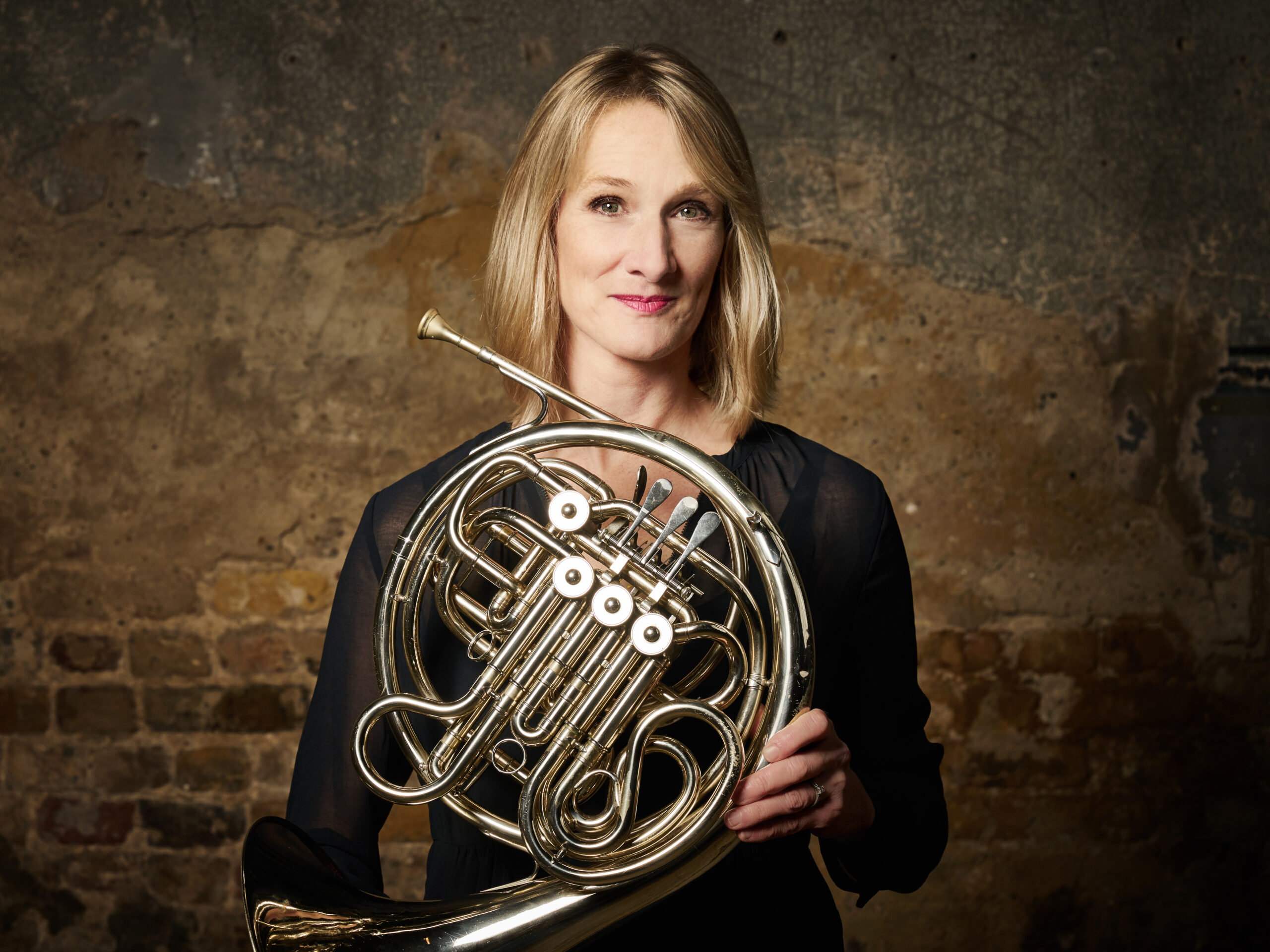
Our weekend of wind music concludes with a celebration of the horn, inspired by the musical library of Britain’s foremost 20th century horn player, Dennis Brain.
Following their recent CD release ‘From the library of Dennis Brain’, this is an opportunity to hear live in concert some of the lost gems featured on the CD by Stephen Stirling and Tony Halstead, two stars of the horn world. They are joined by Ensemble 360’s Naomi Atherton and guests who bring the afternoon to a joyful conclusion with treasured works from the horn repertoire.
Music in the Round is looking for horn players of approx. Grade 8 standard to join in with a performance of BERLIOZ Roman Carnival Overture as the finale to this horn celebration. Places are strictly limited for the massed horn rendition. Interested? Please contact Ellen before 24 August at ellen@musicintheround.co.uk
BEETHOVEN National Airs for flute and piano Op.105 and Op.107 (selection)(c.15’) FARRENC Sextet in C minor Op.40 (23’) DANZI Wind Quintet in B flat Op.56 No.1 (14’) BEETHOVEN Quintet for piano and wind in E flat Op.16 (25’)
A joyful showcase of Beethoven and more from the wind players of Ensemble 360. Beethoven’s Quintet for piano and wind is one of the great pieces in the wind repertoire, hugely enjoyable to both listen to and play. Writer of numerous wind quintets, Danzi’s knowledge of the instruments shines through in his melodic writing.
Inspired by Beethoven’s Quintet, Louise Farrenc’s Sextet adds the flute and is set in the style of a chamber concerto for piano and wind. A brilliant 19th century composer, she is now starting to achieve the recognition her outstanding music deserves.
BEETHOVEN Ludwig van, National Airs for flute and piano Op.105 & Op.107
The Scottish publisher and folksong collector George Thomson (1751–1851) – a friend of Robert Burns and Walter Scott – first approached Beethoven for some arrangements of Scottish songs as early as 1803, and eventually 25 of them (Beethoven’s Op. 108, for which the composer was well remunerated) were published by Thomson in 1818. Two years earlier, Thomson had written asking for some instrumental variations ‘in an agreeable style, not too difficult’. When he formally commissioned them in June 1818, Thomson also requested ad lib. flute parts, explaining that ‘we have a large number of flautists but alas, our violinists are few’, reminding Beethoven that the music should be ‘in a familiar, easy and slightly brilliant style.’
Thomson received the variations from Beethoven on 28 December 1818, and the National Airs with variations for the piano-forte and an accompaniment for the flute were published in July 1819, in a handsome edition that included a portrait of Beethoven on the title page. As musicologist and museum archivist Pamela Willetts has observed, they were not a commercial success. In 1820, Thomson wrote to Beethoven, grumbling that ‘the variations were not selling and that his outlay was a complete loss.’
The composer of three symphonies and an impressive body of chamber music as well as an extensive catalogue of works for piano (her own instrument), Louise Farrenc has thankfully been rediscovered after a century of neglect. Born Jeanne-Louise Dumont, she came from an artistic family and was encouraged to develop her gifts as a pianist and composer. She studied the piano with Moscheles and Hummel, and her composition teacher was Anton Reicha. In 1821 she married the flautist Aristide Farrenc who subsequently established a publishing business. After a successful career as a travelling virtuoso, Louise Farrenc was appointed professor of piano at the Paris Conservatoire in 1842, a post she held for thirty years. The Sextet for piano and wind quintet was written in 1851–2, immediately after the successful premiere of her Nonet for strings and wind (in which Joseph Joachim was one of the performers).
The first movement – the longest of the three – opens with a dramatic theme, decorated by elaborate piano writing, while the second theme is more lyrical. Broadly-conceived, this movement ends in grand style. The main theme of the slow movement is introduced by the wind alone before the being taken up by the piano, then by the whole ensemble with several short wind solos. The finale begins with an urgent and uneasy theme on the piano which gives way to a delicate second idea. But dramatic intensity is maintained throughout the movement, right up to the turbulent ending.
Allegretto
Andante con moto
Menuetto allegretto
Allegretto
Danzi was brought up in Mannheim, where he joined the orchestra run by the Elector Karl Theodor while still a teenager, as a cellist. His father was principal cellist in the orchestra (which moved, with Karl Theodor, to Munich) and he was praised by Mozart for his playing in the first performance of Idomeneo in 1781. In 1784, he was succeeded by his son, who later became an assistant Kapellmeister in Munich, before taking on the role of Kapellmeister in Stuttgart and later Karlsruhe. Though Danzi was a fine cellist, his fame as a composer rests largely on his nine woodwind quintets – works which show a consistent understanding of idiomatic wind writing.
The Quintet in B flat was one of a set of three first published in 1821, with a dedication to Anton Reicha – Danzi’s most important predecessor as a composer of wind quintets. After an amiable and well-crafted first movement in B flat major, Danzi reveals a more pensive side to his nature in the short Andante con moto, in D minor, its main thematic material being heard first on the oboe, then the bassoon. The Minuet is sturdy, while in the Trio section Danzi creates a witty dialogue between all five instruments. The last movement is a jaunty rondo.
BEETHOVEN Ludwig van, Quintet for wind and piano in E flat Op.16
Grave. Allegro ma non troppo
Andante cantabile
Rondo. Allegro ma non troppo
Beethoven completed his Quintet for Piano and Wind in 1797, five years after his arrival in Vienna, taking Mozart’s quintet for the same instrumental combination as his model. It’s probably no coincidence that one of Beethoven’s closest friends – Nikolaus Zmeskall von Domanovecz – owned the autograph manuscript of Mozart’s work at the time. Yet despite some obvious parallels in terms of structure and even some of the thematic material, the Beethoven Quintet sounds very individual. As the Canadian musicologist Cliff Eisen has written: ‘Beethoven [remained] true to his own voice, some obvious modellings of his quintet on Mozart’s notwithstanding: their keys and unusual scoring are identical, and both begin with elaborate slow introductions. At 416 bars, however, the first movement of Beethoven’s quintet far exceeds Mozart’s in scale: as in so many of his chamber and solo works, Beethoven aspires to the symphonic, something that is alien to Mozart’s greater intimacy and concision.’
BEETHOVEN Sextet in E flat Op.71 (18’) BEETHOVEN Octet in E flat Op.103(23’) MOZART ‘Harmoniemusik‘ from The Marriage of Figaro(18’)
Music for wind instruments (Harmoniemusik) was regularly composed in the 18th and 19th centuries, and Beethoven’s Sextet and Octet are two of the finest examples of this genre. The Sextet was reviewed at its premiere as “distinguished by fine melodies and a wealth of new and surprising ideas”, and the Octet is just as lyrical.
This concert features guest appearances from participants in Music in the Round’s Wind Development programme, Bridging the Gap: Tamara Sullivan (oboe), Ola Akindipe (clarinet) Ben Garalnick (horn) and Florence Plane (bassoon).
A bar will be serving beer, wine and soft drinks from 6.30pm.
BEETHOVEN Ludwig van, Sextet in E flat Op.71
Adagio. Allegro
Adagio
Menuetto. Quasi Allegretto
Rondo. Allegro
When Beethoven sent the score of his Sextet to the publisher Breitkopf & Härtel in 1809, he was modest about it: ‘The Sextet is from my early days and, moreover, it was written in a single night. There is really no other way to say that it written by a composer who produced some better works.’
Scored for pairs of clarinets, bassoons and horns, it was composed in 1796 (the high opus number is misleading). The Sextet is an elegantly crafted piece in which the young Beethoven also explores some unusual sonorities, not least the rich lower registers of all six instruments in the Adagio where the bassoon presents the main theme. The vigorous Minuet and Trio is launched by the sound of hunting horns, while the Rondo is a spirited movement, bringing this little-known work to a cheerful close.
The high opus number of Beethoven’s Octet for two oboes, two clarinets, two bassoons and two horns is misleading since it is one of the composer’s earliest pieces from his Vienna years: he started it while still in Bonn – and finished it in 1793, shortly after his arrival in the Austrian capital. It was reworked two years later as the String Quintet Op.4. Woodwind chamber music was all the rage in the late eighteenth century, nowhere more so than in Vienna, and it was usually written for performance outdoors. Like Haydn, Mozart and many others, the young Beethoven fulfilled the late eighteenth-century taste for Harmoniemusik (music for wind band) with cheerful, relatively undemanding works, of which his most substantial was this Octet.
Beethoven’s Octet was completed just when he started to take lessons from Haydn – and the wisdom and subtlety gained from those can be heard in his string quintet transcription (despite Beethoven’s far-fetched claim that he ‘learned nothing’ from his sessions with Haydn). But the Octet in its original version is one of Beethoven’s freshest early works. He clearly had good players in mind – the orchestras in Bonn and Vienna at the time evidently had wind sections with a taste for virtuosity, as can be heard especially in the delightful finale of this four-movement work. The first movement is engaging and straightforward, while the lyrical Andante has particularly prominent parts for oboe and bassoon. The Minuet is interesting: it’s already a long way from the courtly dance of its title, and an early example of what Beethoven would soon develop into the scherzos familiar from his symphonies.
MOZART Amadeus, ‘Harmoniemusik’ from Le nozze di Figaro for wind octet
Harmoniemusik – music for wind ensemble – was something that delighted Mozart, both as a composer (producing what are perhaps the finest serenades for woodwind ever written) and as someone who was willingly entertained by the arrangements that were often made of favourite numbers from operas of the day. Mozart himself alludes to this in a delightful way with the musical entertainment during the banquet in Act Two of Don Giovanni when a wind band plays tunes from operas by Soler, Sarti and also the aria ‘Non più andrai’ from Mozart’s own Nozze di Figaro.
Contemporary wind arrangements of Mozart’s music proliferated, including extracts from Figaro, Don Giovanni and Die Entführung aus dem Serail, while a selection of Harmonie arrangements from Die Zauberflöte was advertised in the Wiener Zeitung in January 1792. All provide delightful music for entertainment and sometimes include interesting clues about performance practice (giving an oboist, for example, an ornamented vocal line that included decorations as performed by singers but not included in the printed score of the opera itself). The identity of early arrangers is sometimes hard to determine, though the oboist Johann Wendt was particularly important as chief arranger for the Harmonie established by Emperor Joseph II in 1782. The best Harmonie arrangements, by Wendt and others, remain a charming way to experience operatic music in a new guise.
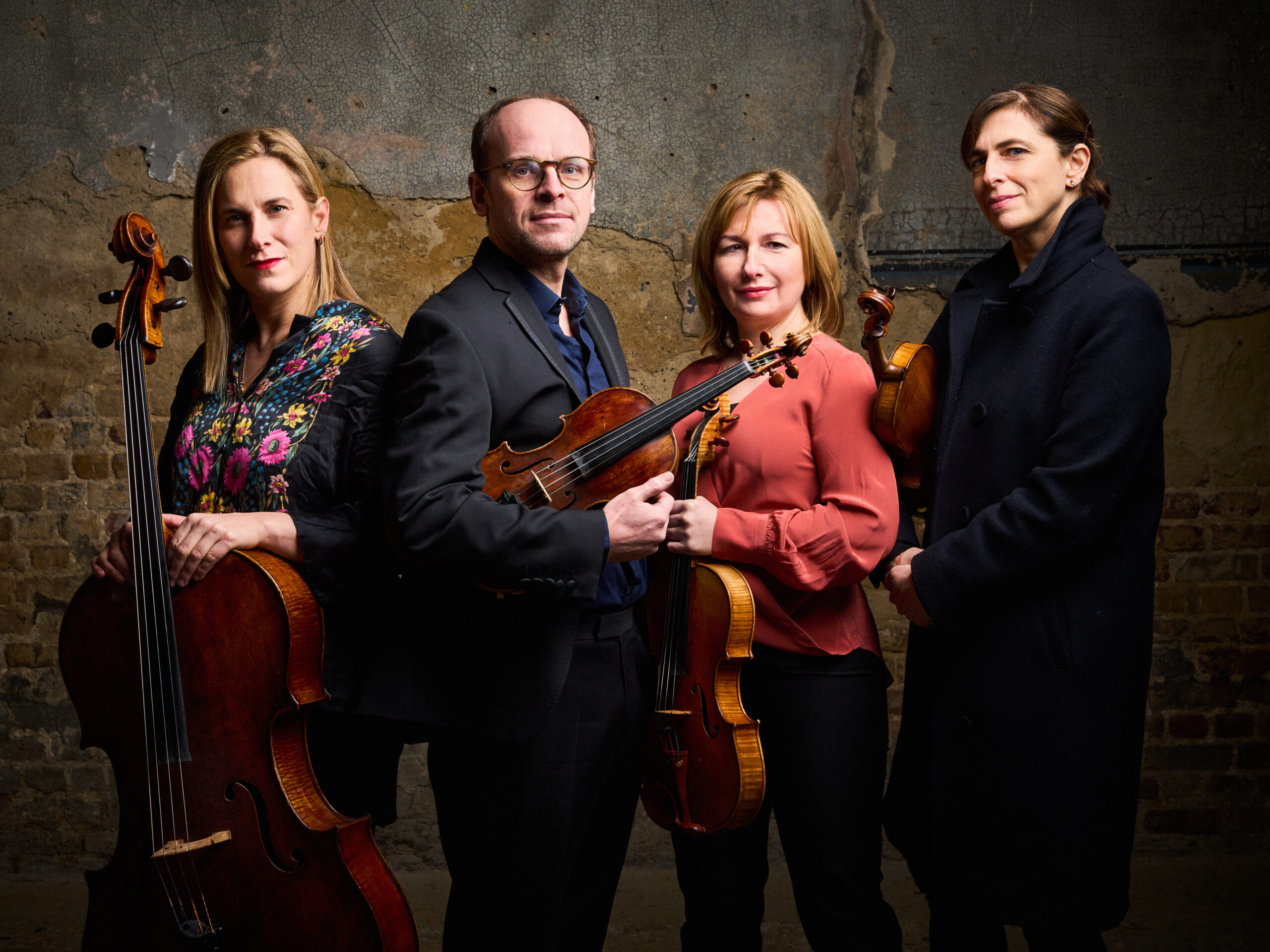
A chance to hear quartets from Beethoven’s early and middle periods, both marked by wit and invention, formal control and deft construction. The monumental first ‘Rasumovsky’ quartet follows, an intense work that marked a sea-change in Beethoven’s writing and is passionate, defiant and deeply moving.
(Rescheduled from 5 February 2022.)
BEETHOVEN Ludwig van, String Quartet in D Op.18 No.3
Allegro
Andante con moto
Allegro
Presto
The Quartet Op.18 No.3 is a landmark in Beethoven’s career: it’s his first string quartet. He began it in the Autumn of 1798, finishing it early the following year, and eventually placed it as the third of the Op.18 set. As a preparation, Beethoven immersed himself in quartets by other composers, especially Mozart and his teacher Haydn – he copied out two of Mozart’s Haydn quartets just as he was beginning work on his Op.18.
The first movement opens with an arching theme (characterised by a leap of a minor seventh between the first two notes). The slow movement, in B flat major, begins with a luxuriant presentation of the main theme, but the texture soon becomes more spare and fragmented, with numerous dramatic contrasts. The Scherzo-like third movement has a minor key Trio section, while the final Presto is notable for its unquenchable energy. Composer Robert Simpson wrote that this music ‘flies at once into the sky, alighting when and where it wishes’ – from the stormy development section to the unexpectedly quiet ending.
BEETHOVEN Ludwig van, String Quartet in F minor Op.95 Serioso
Allegro con brio
Allegretto ma non troppo, attacca subito
Allegro assai vivace ma serioso. Più allegro
Larghetto espressivo. Allegretto agitato. Allegro
‘The Quartet is written for a small circle of connoisseurs and is never to be performed in public.’ Thus wrote Beethoven to Sir George Smart in October 1816. The kind of public concerts he had in mind – mixed programmes of vocal and instrumental music – would indeed make an odd setting for a work of such concentrated intensity. Composed in 1810 and revised for publication in 1815, Beethoven dedicated it to his friend, Nikolaus Zmeskall von Domanovetz, a talented amateur cellist who worked as Hungarian Court Secretary in Vienna.
One of Beethoven’s shortest and most tautly argued quartets, it was the composer himself who called it Quartetto serioso on the autograph manuscript. The Beethoven expert William Kinderman sums up its character as ‘dark, introspective, and vehement’, and it’s no surprise that Beethoven takes a similarly pithy approach to form: a much-shortened recapitulation in the first movement, a slow movement that eschews lyricism in favour of a chromatic fugal section, and a prickly Scherzo (more of an anti-Scherzo really, since it is not only completely lacking in any kind of humour, but is even marked ‘serioso’). The finale sustains this tension and agitation until the last moment – then something extraordinary happens: the music takes a sudden turn to F major, and there’s a dash to the finish. The American composer Randall Thompson commented that ‘no bottle of champagne was ever uncorked at a better time.’
BEETHOVEN Ludwig van, String Quartet in F Op.59 No.1 Razumovsky
Allegro
Allegretto vivace e sempre scherzando
Adagio molto e mesto – attacca
Thème Russe. Allegro
The first of Beethoven’s three quartets written for Prince Razumovsky was composed in 1806 and performed the next year. Like the ‘Eroica’ Symphony (1804–5) it shows Beethoven expanding the possibilities of the form to produce something on an epic scale while retaining the essential intimacy of a string quartet. The first movement is introduced by a cello theme which musicologist Lewis Lockwood describes as ‘opening up a musical space of seemingly unbounded lyricism and breadth.’ The Scherzo, in B flat major, is an unusual movement: while it has no distinct Trio section, it is also Beethoven’s longest Scherzo to date, even though Beethoven removed a large repeat while revising the work. The slow movement has the unusual marking mesto – ‘mournful’ – and is cast in the tragic key of F minor. It ends on a trill that leads seamlessly into the finale. This is based on a Russian theme – a charming and appropriate choice since Razumovsky was the Russian Ambassador to Vienna at the time.
Come and play along with members of Ensemble 360 and one of Sheffield’s leading orchestras, Hallam Sinfonia! Spend an afternoon with these amazing, friendly musicians, playing through the first movement of Beethoven’s Symphony No. 5 (da-da-da-DUUUUMMM).
We have parts for all abilities of playing, whether you scraped through Grade I or were a concert soloist at the age of 12. As long as you have some experience of playing with others as part of a large group, you are really welcome! Our parts are specially arranged by Andrew J. Smith (BBC Ten Pieces) so you can select the part you feel most comfortable playing. We’ve even got parts for non-orchestral brass, saxophone and guitar. All you need is a working instrument and piles of enthusiasm – just come along and give it a go!
The afternoon will culminate in an informal performance for an audience of friends and family.
Please note that anyone under the age of 16 must be accompanied by an adult for the duration of the event.
Singers of all ages and abilities come together for music-making and an informal performance.
Sing with us in the peaceful setting of Samuel Worth Chapel as we explore two pieces of beautiful music that meld histories together through time.
We’ll workshop English composer Tippett’s arrangement of Willis’ Steal Away and American composer Shruthi Rajasekar’s Jayjaykar! before an informal performance to friends and family at the end of the event (1pm-1.30pm).
Sheffield Chamber Choir’s Robert Webb will lead us in performing this beautiful music which together references choral traditions from both England and India while providing perspectives from two very different places and points in history. Shruthi Rajasekar will also be zapping in from the US during the day and has recorded insights about her music especially for you. We’ll be sharing this with you during the break.
Either learn by ear or from provided notation. This event is for both beginners and experienced singers alike (although some experience of singing in a choir will be helpful).
Recordings of both pieces can be found here: https://linktr.ee/mitr_participation and if you’d like a chat before signing up, please email ellen@musicintheround.co.uk
We use cookies on our website to give you the most relevant experience by remembering your preferences and repeat visits. By clicking “Accept All”, you consent to the use of ALL the cookies. However, you may visit "Cookie Settings" to provide a controlled consent. You can find out how we use and process your data by reading our Privacy Policy
This website uses cookies to improve your experience while you navigate through the website. Out of these, the cookies that are categorized as necessary are stored on your browser as they are essential for the working of basic functionalities of the website. We also use third-party cookies that help us analyze and understand how you use this website. These cookies will be stored in your browser only with your consent. You also have the option to opt-out of these cookies. But opting out of some of these cookies may affect your browsing experience.
Necessary cookies are absolutely essential for the website to function properly. These cookies ensure basic functionalities and security features of the website, anonymously.
Cookie
Duration
Description
cookielawinfo-checkbox-analytics
11 months
This cookie is set by GDPR Cookie Consent plugin. The cookie is used to store the user consent for the cookies in the category "Analytics".
cookielawinfo-checkbox-functional
11 months
The cookie is set by GDPR cookie consent to record the user consent for the cookies in the category "Functional".
cookielawinfo-checkbox-necessary
11 months
This cookie is set by GDPR Cookie Consent plugin. The cookies is used to store the user consent for the cookies in the category "Necessary".
cookielawinfo-checkbox-others
11 months
This cookie is set by GDPR Cookie Consent plugin. The cookie is used to store the user consent for the cookies in the category "Other.
cookielawinfo-checkbox-performance
11 months
This cookie is set by GDPR Cookie Consent plugin. The cookie is used to store the user consent for the cookies in the category "Performance".
viewed_cookie_policy
11 months
The cookie is set by the GDPR Cookie Consent plugin and is used to store whether or not user has consented to the use of cookies. It does not store any personal data.
Functional cookies help to perform certain functionalities like sharing the content of the website on social media platforms, collect feedbacks, and other third-party features.
Performance cookies are used to understand and analyze the key performance indexes of the website which helps in delivering a better user experience for the visitors.
Analytical cookies are used to understand how visitors interact with the website. These cookies help provide information on metrics the number of visitors, bounce rate, traffic source, etc.
Advertisement cookies are used to provide visitors with relevant ads and marketing campaigns. These cookies track visitors across websites and collect information to provide customized ads.





 Download
