ECHOES FROM THE BIRDCAGE

Evelyn Glennie, Jill Jarman, Paul Booth, Ian East, Brian O'Kane & Angie Newman (BSL interpreter)

Crucible Theatre, Sheffield
Saturday 17 May 2025, 7.15pm

Tickets:
£22
£14 UC, PIP & DLA
£5 Students & Under 35s 

Past Event
Percussionist Evelyn Glennie performing in Echoes of the Birdcage

Experience the vibrant soundscape of London’s King’s Cross with Echoes from the Birdcage. 

In the first half, immerse yourself in a collection of percussion solos performed by Dame Evelyn Glennie, curated by Jill Jarman. These works capture the diversity of the city, from the meditative echoes of Messiaen to the energetic beats of Steve Reich and works infused with jazz and Balkan folk dance. 

The second half brings to life the dynamic spirit of King’s Cross with Echoes from the Birdcage in a stunning collaboration between Jill Jarman and Evelyn Glennie. Don’t miss this sonic journey that weaves together history, culture and the everyday rhythms of city life! 

Dame Evelyn Glennie is the world’s premier solo percussionist. A double GRAMMY winner and BAFTA nominee, she led 1000 drummers in the Opening Ceremony of the London 2012 Olympics. 

“[Evelyn Glennie is] quite simply a phenomenon of a performer” The New York Times 

Save 20% when you book for 10 or more Music in the Round concerts in one transaction.
Save 10% when you book for 5 or more Music in the Round concerts in one transaction. Find out more. 


Echoes from the Birdcage is an Arts Trust Production originally supported by King’s Cross, PRS Foundation and Arts Council England.


ECHOES FROM THE BIRDCAGE

The first half of the programme brings together a collection of short pieces curated by composer and pianist Jill Jarman (who worked with Evelyn Glennie to create the second half of the concert and who is performing as part of the ensemble here today). This diverse collection of music aims to immerse us in the diverse sounds and atmospheres of the city. Bach’s well-known ‘Prélude’ from Cello Suite No. 1 in G Major, resonates with spaces of meditation and worship away from the urgency of urban life.

In contrast, Jarman’s composition for saxophones and piano reflect a vibrant multiculturalism, drawing on diverse musical genres, as do two pieces by Ian East. East’s Dance of the Awakening & Secret Spaces, are inspired by Balkan folk dance, and Jarman’s Chick Pea, nods to jazz fusion, both foreground and celebrate a rich musical diversity. Vincent Ho’s solo Tam Tam piece, Sandman’s Castle, captures the duality of city life, moving between calm and chaos, hard and soft. This dynamic journey culminates with Reich’s Clapping Music and in Orologeria Aureola (composed by Glennie and Sheppard), which embody the energy and drive which inspired this concert.

INTIMATE LETTERS

Ensemble 360 & Paul Hawkyard

Crucible Playhouse, Sheffield
Saturday 17 May 2025, 2.00pm

Tickets:
£22
£14 UC, PIP & DLA
£5 Students & Under 35s

Past Event
Ensemble 360 string musicians in performance

SCHUBERT Quintet in C D956 (50’)
JANÁČEK String Quartet No.2 ‘Intimate Letters’ (with script by Paul Allen) (50′) 

Janáček’s exceptionally candid second quartet – nicknamed ‘Intimate Letters’ – is skillfully interspersed with the Czech composer’s own writing, performed by Paul Hawkyard (King Minos, Monster in the Maze, 2024), in the role of ‘Leoš’. 

The introspection and innovation evident in so much of Janáček’s work is brought to life through a compelling combination of words with music. 

Schubert’s final and perhaps finest chamber work, his sublime quintet for two violins, viola and two cellos, is one of his most highly prized works: pensive, symphonic, intricately structured and ultimately exuberant and triumphant. This glorious afternoon celebrates the epic within the intimate in two dramatic gems of chamber music repertoire. 

Save 20% when you book for 10 or more Music in the Round concerts in one transaction.
Save 10% when you book for 5 or more Music in the Round concerts in one transaction. Find out more. 

SCHUBERT Franz, String Quintet in C D956

Allegro ma non troppo

Adagio

Scherzo. Presto

Allegretto


‘Heavenly length’ was a term coined by Schumann to describe Schubert’s ‘Great’ C major Symphony, but it seems even more apt for the C major String Quintet that Schubert finished in 1828, two months before his death. His only string quintet, for string quartet with an extra cello – an instrumental combination pioneered by Luigi Boccherini, while Mozart (and Beethoven) preferred a second viola.


Schubert never heard the work played during his lifetime. He sent it to the publisher Probst in Leipzig on 2 October 1828, announcing proudly that he had ‘at last finished a Quintet for two violins, viola and two cellos’. But the reply was disheartening, suggesting that he’d have a better chance of success with some more songs or popular piano pieces. The first performance did not take place until 17 November 1850 when it was given in the small hall of the Musikverein in Vienna by a quintet led by Joseph Hellmesberger, and the Viennese firm of Spina eventually published the work in 1853. Reactions at the time were mixed, but the young Brahms fell under the spell of the music, and the original version of his Piano Quintet Op.34 – before it was extensively reworked for piano and strings –was scored for the same instrumentation as Schubert’s quintet, with two cellos (unlike Brahms’s later string quintets, which use the two-viola combination).


In a programme note on the String Quintet for an Aldeburgh Festival performance in 1955, Benjamin Britten wrote about some of the qualities he found most remarkable in the work: ‘Listening to it, as the beauties unfold one after another and the mood changes from light to darkness and back again to light, the overwhelming impression is of the wholeness of the music. Schubert’s effortless spontaneity is not only the result of his rapid and ‘instinctive’ writing; it is also the result of his miraculously mature understanding of form.’


The String Quintet opens with a first movement of expansive proportions. For Britten, in a brilliantly perceptive comment, the first few bars represented a kind of microcosm of what was to follow: ‘In the very opening bars of the Allegro ma non troppo, the mood and structure of the whole work can be heard in the serenity of the C major chord and its passionate crescendo towards the tragic diminished seventh and its gradual lessening of the tension.’ What is most memorable about this opening is not so much the thematic interest (though there’s plenty of that) but for the sense of anticipation, of expectancy that the music suggests. The second theme of this movement is one of Schubert’s most sublime inventions, a miracle of lyricism presented by the two cellos. The development starts with a particularly striking modulation into A major – a typically inspired surprise, while the movement ends with tranquil recollections of the second theme, its calm disturbed only by the fortissimo C major chord in the penultimate bar.


The Adagio is in the remote key of E major – transcendent and ethereal in its outer sections. Britten wrote of the slowly changing chords at the opening seeming ‘to hang motionless in the air while … flowing onwards’ as the first violin plays an expressive, slightly hesitant theme. The central section, in F minor, is a startling contrast: after serenity, suddenly the mood is wracked with turmoil – and uneasy hints of that even lurk in the reprise of the opening material, before stillness and peace are finally reached on the last E major chord.

The Scherzo is back in the home key of C major. The music is strongly driven by a kind rustic energy: Schubert makes the most of open strings with a theme that suggests hunting calls. After an

excursion into A flat major, the opening idea returns exultant before giving way to contrasting Trio section in D flat – ghostly and veiled in quality until the thrilling reprise of the Scherzo. The finale is a kind of Gypsy Rondo – with an obvious influence from Hungarian music. It begins in C minor before turning to C major. The second subject is a glorious lyrical theme that is soon decorated with triplet. The Quintet ends with a wilder reprise of the dance tune – and with one of the most memorable gestures in the entire Viennese Classical repertoire – a grinding, dissonant D flat resolving on to C.

JANÁČEK Leoš, String Quartet No.2 “Intimate Letters”

Andante 
Adagio 
Moderato 
Allegro  

This extraordinary work was the result of extraordinary circumstances. As a married man in his 70s, Janáček had been head over heels in love with the much younger Kamila Stösslová for a decade by the time he wrote his 2nd String Quartet. This was a passionate (if largely one-sided) love that is eloquently expressed in the hundreds of letters he wrote her, and in the pieces that were directly inspired by her – from operas such as Katya Kabanova to the much more private world of chamber music. On 29 January he told Kamila about the latest piece to be inspired by her: ‘Today it’s Sunday and I’m especially sad. I’ve begun to work on a quartet; I’ll give it the name Love Letters.’ By 19 February the sketch was finished, and a couple of weeks later Janáček had written out a fair copy. He changed his mind several times about the title, eventually settling on Intimate Letters. The original scoring, noted on the manuscript, was to include a viola d’amore – the viola of love – but this was more symbolic than practical and after a private play-through, Janáček abandoned the idea.   

Janáček’s letters to Kamila are revealing about the programmatic content of this quartet. The first movement he described as ‘the impression of when I saw you for the first time!’ and the third evokes a moment ‘when the earth trembled’. The fourth movement was ‘filled with a great longing – as if it were fulfilled.’ As for the whole work, he confided in April 1928 that ‘it’s my first composition whose notes glow with all the dear things that we’ve experienced together. You stand behind every note, you, living, forceful, loving.’  

Janáček died on 12 August 1928, and the quartet had to wait another decade before it was published, by which time both Kamila and Janáček’s long-suffering wife Zdenka were dead. Intimate Letters stands as one of the most personal and original works in the twentieth-century quartet repertoire. The Czech novelist Milan Kundera summarized the essence of Janáček’s art as ‘capturing unknown, never expressed emotions, and capturing them in all their immediacy’. 

Nowhere is it more immediate – or more emotional – than in this quartet.  

© Nigel Simeone

FAMILY CONCERT: GIDDY GOAT

Ensemble 360 & Lucy Drever

Crucible Theatre, Sheffield
Saturday 17 May 2025, 11.00am

Tickets:
£12
£7 UC, DLA & PIP
£5 Under 16s 

Past Event
Giddy Goat family concert image

Being a mountain goat is no fun when you are scared of heights! Stand poor Giddy on a mountain ledge and his head starts spinning and his knees turn to jelly. But can he find the fearless goat inside himself in time to rescue little Edmund, the sheep? 

This family concert based on the best-selling children’s book by Jamie Rix and Lynne Chapman features original music by Music in the Round’s Children’s Composer-in-Residence, Paul Rissmann, for strings, wind and piano. Presented together with story-telling and projected illustrations from the book, it’s a great introduction to live music for children aged 3 – 7 and includes plenty of opportunities to join in! 


Save 20% when you book for 10 or more Music in the Round concerts in one transaction.
Save 10% when you book for 5 or more Music in the Round concerts in one transaction. Find out more. 

20 YEARS OF ENSEMBLE 360: FESTIVAL LAUNCH

Ensemble 360

Crucible Playhouse, Sheffield
Friday 16 May 2025, 7.00pm

Tickets:
£22
£14 UC, PIP & DLA
£5 Students & Under 35s 

Past Event
Musicians from Ensemble 360

WATKINS Broken Consort (20′)
SWEENEY Equinox [World Premiere] (10’)
SCHUBERT Octet (60’)  

Schubert’s rousing Octet (perhaps the piece most closely associated with Ensemble 360 over their two decades) showcases the range and breadth of the ensemble, with its jaunty, memorable tunes and high drama. It is coupled here with two works written especially for the group.  

Huw Watkins’ Broken Consort premiered in 2008 and features different instrument groups and fanfares, before all 11 Ensemble 360 players come together for the exuberant finale. It is followed by the world premiere of a brand-new piano trio from Royal Philharmonic Society 2024 Composer Aileen Sweeney. A great way to start the 20th birthday celebrations! 

To celebrate 20 years of extraordinary music-making, ticket-holders are invited to join us for a free glass of wine or soft drink in the Crucible bar after the concert. 

RPS | Royal Philharmonic Society
Save 20% when you book for 10 or more Music in the Round concerts in one transaction.
Save 10% when you book for 5 or more Music in the Round concerts in one transaction. Find out more. 

Please note, the title of Aileen Sweeney’s piano trio has changed since the previously published listing.

WATKINS Huw, Broken Consort

Broken consort is a term used to describe an instrumental ensemble that developed in Europe during the Renaissance. It originally referred to ensembles featuring instruments from more than one family of instruments, as for example a group featuring both string and wind instruments. It also neatly describes what I have done with the eleven instruments from Ensemble 360 (a group featuring string, wind, brass and keyboard instruments). There are four main movements – a lament, a study, a sicilienne and a finale – which all use different groups of instruments with the whole ensemble only playing together in the finale. Each movement is preceded with a brief interlude (or introduction in the case of the lament) which all use the same fanfare-like material in different ways. This material occasionally finds its way into the main movements, more or less overtly, at important structural moments.

Huw Watkins, 2008

SWEENEY Aileen, Equinox [world premiere]

After coming off the back of a 4 month stint writing a slightly mad piece for symphony orchestra filled with drum grooves, riffs and polyrhythms galore, I jumped straight into this piano trio without really catching my breath. Having spent time listening to and being inspired by the simplicity of composers such as Max Richter and Philip Glass, I took this piece as an opportunity to relax into some meditative sounds and explore repetitive textures, mainly through improvisation at the piano.

Coincidentally, I was writing this piece in February/March during the approach to the spring equinox and couldn’t help but notice the evening skies gradually becoming brighter and more colourful with each passing day. I then began to see how the piece mirrored this transition from dark to light, starting with cold, slow moving harmonies that gradually blossom into brighter tonal centres and faster moving material, giving the piece a sense of optimism towards the end.

Aileen Sweeney, 2025

SCHUBERT Franz, Octet

Adagio–Allegro–Più allegro 
Adagio 
Allegro vivace–Trio–Allegro vivace 
Andante–variations. Un poco più mosso–Più lento 
Menuetto. Allegretto–Trio–Menuetto–Coda 
Andante molto–Allegro–Andante molto–Allegro molto 
 

Schubert wrote no chamber music between 1821 and 1823, but made up for this hiatus in 1824 with three extraordinary masterpieces: the String Quartets in A minor and D minor (Death and the Maiden) and the Octet. He was commissioned to write the Octet by Count Ferdinand Troyer, a clarinettist who was also chief steward to Archduke Rudolf. Troyer asked Schubert to compose a work that could stand alongside Beethoven’s Septet, an immensely popular piece at the time. To Beethoven’s ensemble of clarinet, bassoon, horn, violin, viola, cello and double bass, Schubert added a second violin, giving himself the scope to explore sonorities that had almost orchestral possibilities. There are close similarities between the two works: both are in six movements, with the same key relationships between the movements, with a set of variations at the centre, and with both a Minuet and a Scherzo. But while Beethoven’s Septet was conceived as a kind of large-scale divertimento, Schubert’s Octet is more ambitious in scale and has a much greater (and more serious) expressive range. 


Schubert completed the work on 1 March 1824. It was first performed privately at Troyer’s home (in Vienna’s Graben) soon afterwards and the first public performance was given in the Musikverein by an ensemble led by the great violinist Ignaz Schuppanzigh on 16 April 1827. When the work was eventually published in 1851 it was shorn of the fourth and fifth movements and but it appeared complete in the Collected Edition in 1889. 


The emotional range of the Octet is extraordinary for a work that appears, on the surface at least, to be quite benign. After the expansive but closely argued first movement, the sublime and tender clarinet melody that opens the slow movement has echoes of the ‘Unfinished’ Symphony (1822). The exuberant Scherzo, full of Schubert’s favourite dotted rhythms, is a complete contrast, though one that contains some surprising excursions into remote keys. The central variations are on a theme from Schubert’s early Singspiel Die Freunde von Salamanka (1815), the charming duet for Laura and Diego, ‘Gelagert unter’m hellen Dach der Bäume’ (‘Lying under the bright canopy of trees’) and the leisurely set of variations muse on aspects of the theme with unhurried inventiveness. The Minuet is markedly more relaxed than the Scherzo and contains some of the subtlest instrumental colouring in the whole work. The finale begins with stormy tremolos and a mood of foreboding that is seemingly dispelled when the main Allegro arrives, though in the course of this long movement there are more episodes of high drama (including a surprise return of the turbulent introductory music), until the exhilarating close – bringing to an end a work that 20th century composer Hans Gál described as ‘a romantic landscape whose delights are  numberless’. 


© Nigel Simeone 

BRANDENBURG: BACH FOR HARPSICHORD & STRINGS

Steven Devine & Ensemble 360

Crucible Playhouse, Sheffield
Saturday 29 March 2025, 7.00pm

Tickets:
£22
£14 UC, PIP & DLA
£5 Students & Under 35s 

Past Event
Harpsichordist Steven Devine

CPE BACH Flute Concerto in D minor (20’)
TELEMANN Fantasia No.2 in A minor TWV 40:3 (4’)
WF BACH Harpsichord Concerto in A minor F.45 (15’)
TURNER Lesson No.1 in G (11’)
JS BACH Brandenburg Concerto No.5 BWV 1050 (22’) 

Ensemble 360 is joined by leading harpsichordist Steven Devine for this special evening of music by three members of the Bach family. CPE Bach’s powerfully energetic Flute Concerto opens the concert (the final movement is a veritable fireworks display of virtuosity), while WF Bach’s Harpsichord Concerto puts the harpsichord centre stage with rapid passages off-set by punchy strings. The recital ends with one of the great masterpieces of the Baroque period – JS Bach’s Brandenburg Concerto No.5 – a joyful, triumphant work featuring a harpsichord solo of dazzling dexterity, as well as intricate melodies with flute and strings. 

Pre-concert Q&A, 5.30pm 6.15pm
Join harpsichordist Steven Devine and Music in the Round’s Sheffield Programme Manager Dr Benjamin Tassie for this informal pre-concert talk in the Crucible Playhouse sharing insights into the harpsichord and the captivating music being performed in this evening’s concert. 
FREE Please request tickets when booking for the evening concert. 

Save 20% when you book for 10 or more Music in the Round concerts in one transaction.
Save 10% when you book for 5 or more Music in the Round concerts in one transaction. Find out more. 

Browse the full programme online, explore the seasons with our digital brochure or download a copy of our 2025 brochure.

Download


BACH C.P.E., Flute Concerto in D Minor

It wasn’t until the Bach revival movement in the early 19th century—of Johann Forkel’s Bach biography of 1802, and Felix Mendelssohn’s performance of the St Matthew Passion in 1829—that the name Bach began to mean J.S., rather than C.P.E. This Bach, his second surviving son, was a prolific composer, who, in 1740, gained employment at the court of Frederick the Great in Berlin as a harpsichordist. 


C.P.E. Bach is one of those composers who falls between the cracks of periodised musical history. Yet, his influence is constantly understated, perhaps because his most influential work was not a composition, but an aesthetic treatise: On The True Art of Playing Keyboard Instruments, which was essential in shaping performance practices in the early Classical period. In particular, Philipp Emanuel was important in suggesting performers should align themselves emotionally with the music they are performing. (“A musician cannot move others unless he too is moved,” he wrote, such as in sad passages, where “the performer must languish and grow sad.”) He also helped codify some performance trends that we still come across today. “Ugly grimaces are, of course, inappropriate and harmful, but fitting expressions help the listener to understand our meaning,” he wrote. If you’ve ever remarked on why performers regularly perform with unsightly or unusual facial expressions, blame Philipp Emanuel! 


Bach was a prodigious composer both in the concerto form, and for the flute, a particularly popular instrument at the time—especially in the court of Frederick the Great—which Bach often rearranged existing concerti for. This concerto in D minor, written as early as 1747, is no different. Versions exist for harpsichord and flute, with contrasting scholarly arguments as to which came first. Spanning three movements—fast, slow, fast—the first is declamatory and technical, the second lilting (with liberal uses of ornamentation) and the third comes with a fluttering, nervous vitality. With its darting runs, juddering repetitions, crunching discords and loud ensemble exclamations, the concerto’s conclusion seems to prefigure some of the Sturm und Drang tempestuousness that Mozart and Haydn would deploy so effectively later that century. 


Hugh Morris 2024 

TELEMANN Georg Philipp, Fantasia No. 2 in A Minor

Telemann and his godson C.P.E. Bach had a lot in common: both studied law before pursuing music, both became key links between late-Baroque and early-Classical styles, and both composed prolifically—Telemann’s output is measured in the thousands. Alongside the reams of sacred music, instrumental suites, operas, and concerti, Telemann also wrote sets of unaccompanied instrumental fantasias, for violin, viola da gamba, harpsichord and flute. 


The second Fantasia of this set of twelve has four sections (Grave, Vivace, Adagio, and Allegro), with tempo changes aligning with changes of mood or character. This Fantasia in particular is a fantastic example of Telemann’s mastery of counterpoint, managing to keep multiple lines of melody spinning concurrently through regular changes of register. 


Hugh Morris 2024

BACH W.F., Harpsichord Concerto in A minor

Of all J.S. Bach’s famous children, Wilhelm Friedrich, the eldest son and half-brother of C.P.E Bach, has the most colourful reputation, as the black sheep of the Bach family. But is this reputation deserved? As scholars like David Schulenberg have pointed out, Friedrich has suffered historically thanks to the unfortunate combination of scant biographical detail, and uncharitable actors filling in the blanks. Albert Emil Brachvogel’s novel on Wilhelm Friedrich, turned into a 1941 film, framed Friedrich as the talented son trying to move out of his father’s shadow, and focused heavily on his capacity for immodesty, belligerence and drunkenness. Matters were not helped by a rakish, widely circulated portrait by Wilhelm Weitsch that is almost certainly not of Wilhelm, but instead of a relative. 


The style is an interesting compound. The opening movement retains a melancholic character, despite a stand-out harpsichord part, which emerges as a truly solo voice, rather than a member of concertino. Still, inbetween the sections of dazzling solo passagework, there’s still room for long stretches of rigorous counterpoint. The middle movement is a Cantabile, in stately triple time, ripe for ornamentation in the increasingly ornate solo part. The finale, Allegro, ma non molto, returns to the melancholy air of the opening, with repeated “sighing” gestures and downward figures passed around the ensemble. It’s disrupted, once again, by more harpsichord fireworks, before a resolute conclusion. 


Hugh Morris 2024

BACH J.S., Brandenburg Concerto No.5

The fifth of Bach’s Brandenburg Concertos represented a historic landmark. These “Concertos for Several Instruments”—collectively called the Brandenburgs after the works’ recipient, Christian Ludwig, Margrave of Brandenburg—were formally radical in their expansion of the concerto grosso form as far as it could go, with wildly different results in terms of length, instrumentation, style, and compositional techniques used. 


The fifth, probably the last of the set to be composed, elevates the harpsichord, transplanting it from a continuo role to the concertino group of solo instruments. Bach elevates the instrument further still, with an elaborate, cadenza-like passage for solo harpsichord at the end of the first movement of the piece. Many see this piece as the first keyboard concerto accordingly.  


The second movement, Adagio affettuoso, is a soloists-only moment. The combination of flute, violin and harpsichord was a common one in the form of the trio sonata, but here, the harpsichord plays more of a soloistic role, contributing its own lines of woven counterpoint. In the lively finale, the harpsichord once again dominates, this time the solo episodes between the tremendously elaborate fugal writing. 


Hugh Morris 2024 

CLASSICAL WEEKEND: BEETHOVEN FOR FLUTE

Ensemble 360

Upper Chapel, Sheffield
Friday 21 March 2025, 1.00pm / 5.15pm

£5 for everyone

Past Event
Flautist Juliette Bausor and pianist Tim Horton

BEETHOVEN 
   Flute Sonata in B flat (25’)
   Trio for piano, flute and bassoon (25’)  

Be transported to the classical elegance of an 18th century salon in this concert celebrating Beethoven’s joyful, sparkling music for flute to open Classical Sheffield’s Festival Weekend. Beethoven’s Flute Sonata is full of his characterful wit, while his Trio showcases the dazzling virtuosity of Ensemble 360.  

Save 20% when you book for 10 or more Music in the Round concerts in one transaction.
Save 10% when you book for 5 or more Music in the Round concerts in one transaction. Find out more. 

Browse the full programme online, explore the seasons with our digital brochure or download a copy of our 2025 brochure.

Download

BEETHOVEN Ludwig Van, Flute Sonata in B flat, Kinsky Anh. 4

  1. Allegro
  2. Polacca [Polonaise]
  3. Largo
  4. Theme and Variations: Allegretto


The authorship of this substantial flute sonata remains a mystery. But even if the identity of the composer remains uncertain, its association with Beethoven is genuine enough: a manuscript copy was found among the composer’s papers after his death. This found its way into the manuscript collection of the publisher Artaria and in their catalogue it appears as a ‘Sonata for piano and flute in B flat. Score. Autograph? Unpublished, probably from Beethoven’s early years.’ By 1970, when the Berlin State Library published a catalogue of its Beethoven holdings, the manuscript was described as a ‘fair copy’ and the attribution to Beethoven as ‘doubtful’. Even so, the title page has a note in pencil ‘Sonata fecit di Bethoe’ (i.e. Beethoven). If it is by Beethoven, then it is certainly an early piece, from his time in Bonn, before he moved to Vienna in 1792. The Beethoven scholar Willy Hess argued that Beethoven would not have kept a copy of the work in his library unless he had some sort of personal connection with it. This is a very fair assumption it gets us no closer to establishing the identity of the composer. It may have been by another pupil of Beethoven’s teacher Christian Gottlob Neefe, or by one of Beethoven’s colleagues from the court orchestra in which he played the viola. A further complication is that it might be a transcription of an as-yet-unidentified sonata for violin and piano, something suggested by the unidiomatic flute writing at the very start.  

Whatever the facts about its attribution, the Flute Sonata is a work of considerable charm, with some attractive ideas. In place of a minuet, the second movement is a Polonaise, the slow movement a song-like Largo and the finale a set of variations. 

BEETHOVEN Ludwig Van, Trio for Flute, Bassoon and Piano in G WoO.37

Allegro
Adagio
Tema andante con variazioni


Composed between 1786 and 1790, while Beethoven was still living in Bonn, the manuscript of this early work described it as a “Trio concertant à Clavibembalo, Flauto [e] Fagotto”. Whether it was ever played with a harpsichord is unclear, but it was composed for domestic music-making by the family of Baron Friedrich von Westerholt-Gysenberg, Equerry to the Elector of Bonn. The Baron himself was a bassoonist, his son Wilhelm was a flautist, and his daughter, Maria Anna Wilhelmine, was a fine pianist – according to Beethoven’s own teacher Neefe, her playing was “fiery” and of “marvellous accuracy”. For a time she was adored by the young Beethoven, who taught her the piano for several years before her marriage in 1792 and even sent her poetry declaring that “My heart will never change, and I will cherish you forever!”


Nigel Simeone © 2012

MENDELSSOHN STRING QUINTET

Consone Quartet & Kay Stephen

St Marie's Cathedral, Sheffield
Saturday 15 March 2025, 7.00pm

Tickets:
£17
£10 UC, PIP & DLA
£5 Students & Under 35s 

Past Event
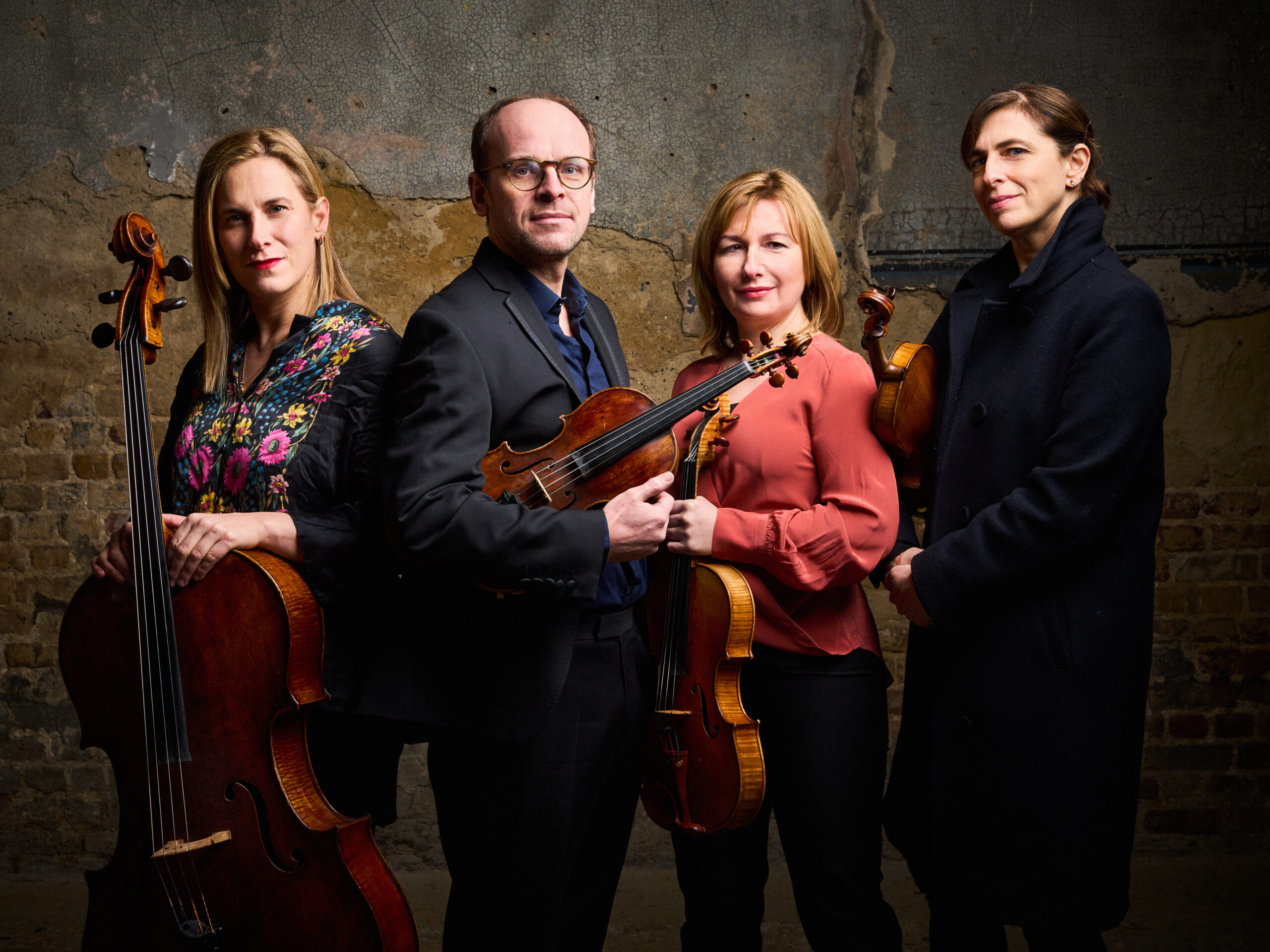
Musicians from the Consone Quartet with their instruments

MENDELSSOHN 
   Capriccio from Four Pieces Op.81 (5’)
   String Quartet in E flat Op.12 (28’)
   String Quintet in A Op.18 (32’) 

The Consone Quartet completes its series of Mendelssohn’s chamber works with his String Quintet No.1, a work full of youthful joie de vivre. Scored for two violins, two violas, and cello, the Quintet forms the triumphant conclusion to this concert celebrating the composer’s early work for strings, all composed when Mendelssohn was – astonishingly – still a teenager.  

Save 20% when you book for 10 or more Music in the Round concerts in one transaction.
Save 10% when you book for 5 or more Music in the Round concerts in one transaction. Find out more. 

Browse the full programme online, explore the seasons with our digital brochure or download a copy of our 2025 brochure.

Download

MENDELSSOHN Felix, Capriccio from Four Pieces for String Quartet, Op. 81, No. 3

Mendelssohn wrote this Capriccio for string quartet in 1843 and it was published posthumously as one of his Four Pieces for String Quartet, Op. 81. It opens as a kind of cradle song, the tempo Andante con moto and the violin melody unfolding over a rocking accompaniment. Mendelssohn then springs a surprise: after a kind of mini-cadenza for the first violin, the music gives way to a rapid fugue, marked Allegro fugato, assai vivace. What follows is a dramatic demonstration of Mendelssohn’s ability to fuse the discipline of fugal writing with an acute sense of musical drama, leading to a splendidly abrupt close with three brusque chords. 

Nigel Simeone 2024 

MENDELSSOHN Felix, String Quartet in E flat Op. 12

Adagio non troppo – Allegro non tardante
Canzonetta: Allegretto
Andante espressivo
Molto allegro e vivace


Mendelssohn completed this string quartet on the first of his many visits to London (where he went to conduct the Philharmonic Society). Though it was the first to be published during his lifetime, he wrote an earlier one in the same key when he was 14 and the A minor quartet Op.13 was actually finished in 1827. By the time he composed the Quartet Op.12, Mendelssohn had also written the Octet (1825) and the String Quintet in A major – and it has much the same kind of inspired fluency. The first movement begins with a slow introduction that soon gives way to a closely-argued Allegro. The main influence is Beethoven and particularly late Beethoven – music that was very novel and only recently published. This can be seen in the unusual structure of the second movement (in place of a conventional Scherzo), and in the most unusual way in which the second theme of the first movement returns to striking effect in the finale. The main theme of the slow movement is one of Mendelssohn’s most inspired. In the Finale, Mendelssohn combines something of the urgency of Beethoven with a character that is entirely his own.


Nigel Simeone ©2014

MENDELSSOHN Felix, String Quintet in A, Op. 18

  1. Allegro con moto
  2. Intermezzo: Andante sostenuto
  3. Scherzo: Allegro di molto
  4. Allegro vivace

 Another remarkable product of Mendelssohn’s prodigious teenage years, his String Quintet in A major was completed in 1826, just after he had written the Octet, though in 1832 he substituted the original Minuet second movement for the slow intermezzo, written in memory of his violinist friend Eduard Rietz. The scoring is the ‘Mozart’ ensemble, of two violins, two violas and cello. The Allegro con moto, in triple time, opens with an elegant violin theme, but the texture soon becomes more animated as livelier ideas emerge. Mendelssohn uses all five instruments with typical ingenuity to create a rich texture. The Intermezzo, marked Andante sostenuto, is a warmly expressive song-like movement, full of tenderness and reflecting the deep affection Mendelssohn had for Rietz who died of consumption in 1832 (his younger brother Julius was a lifelong friend of Mendelssohn’s). The Scherzo (in 2/4 time) is a fine early example of a type of movement Mendelssohn was to make his own, something he succeeded in doing without ever repeating himself. This one is beautifully scored for the five string instruments, with many delicate and imaginative touches, and an enchanting pianissimo close. The finale is the movement which most clearly reflects the influence of Beethoven on the young Mendelssohn – not the late masterpieces this time, but Beethoven’s earlier works such as the Op. 18 quartets. Even so, Mendelssohn never merely imitated, and his unmistakable stylistic fingerprints are on every page as this work heads to its very satisfying conclusion. 

Nigel Simeone 2024 

MENDELSSOHN STRING QUARTETS

Consone Quartet

St Marie's Cathedral, Sheffield
Saturday 15 March 2025, 3.00pm

Tickets:
£17
£10 UC, PIP & DLA
£5 Students & Under 35s 

Past Event
Consone String Quartet

MENDELSSOHN 
   String Quartet in D Op.44 No.1 (32’)
   Fuga from Four Pieces Op.81 (5’)
   String Quartet in A minor Op.13 (30’) 

Music in the Round’s Visiting String Quartet returns to Sheffield for its final immersive afternoon and evening of concerts exploring the music of Felix Mendelssohn. Here, the composer’s passionate String Quartet No.1 (written when he was just 18 years old – and newly in love) is presented alongside his String Quartet No.3, a composition full of light and levity.  

Save 20% when you book for 10 or more Music in the Round concerts in one transaction.
Save 10% when you book for 5 or more Music in the Round concerts in one transaction. Find out more. 

Browse the full programme online, explore the seasons with our digital brochure or download a copy of our 2025 brochure.

Download

MENDELSSOHN Felix, String Quartet in D Op.44 No.1

Molto allegro vivace
Menuetto. Un poco Allegretto
Andante espressivo ma con moto
Presto con brio


Mendelssohn married Cécile Jeanrenaud in 1837 and it was under the influence of this blissfully happy time in his life that he returned to the string quartet for the first time in almost ten years. During their honeymoon he composed the Quartet in E minor published as Op.44 No.2, to which two companion pieces were added in 1838: the Quartet in E flat Op.44 No.3 and the present Quartet in D major – published as the first of the set, but actually the last of the three to be completed, started in April 1838, but not finished until 24 July. It is a work that recaptures something of the untroubled rapture of the much earlier Octet, but almost as soon as the ink was dry on the new quartet, Mendelssohn and his wife succumbed to the measles epidemic that was sweeping through Leipzig at the time. As a result of this illness, Mendelssohn was unable to conduct his scheduled concerts in September, and it was not until October that he was able to resume his duties as conductor of the Gewandhaus concerts.


The first movement of the D major Quartet opens with a soaring, joyful theme that seems reminiscent of the Octet, though within a more restrained and consciously Classical framework. For the only time in his quartets Mendelssohn wrote a Minuet as the second movement. This elegantly-crafted piece is perhaps an indication of the more refined but less progressive approach of his music at the time, something that the Mendelssohn biographer Eric Werner attributed to the composer’s domestic bliss, and his ‘wish to please and impress Cécile.’ Werner went so far as to suggest that this ‘weakened his artistic integrity’, a claim that seems to be firmly contradicted by the effectiveness of the D major Quartet. The Andante espressivo is a gentle interlude before the exciting finale: launched with a tremendous energy that is sustained almost throughout and which brings the work to a rousing conclusion. The first performance was given from the composer’s manuscript on 16 February 1839 in the Leipzig Gewandhaus, played by a quartet led by Ferdinand David. Schumann described the character of his friend Mendelssohn’s music of this period with typical perceptiveness: ‘A smile hovers round his mouth, but it is that of delight in his art, of quiet self-sufficiency in an intimate circle.’


Nigel Simeone © 2011

MENDELSSOHN Felix, Fugue from Four Pieces for String Quartet, Op. 81, No. 4

The high opus number of Mendelssohn’s Fugue in E flat major is misleading. The four pieces were published after the composer’s death and he never intended them to be grouped together, not least because they were written twenty years apart. The Fugue is the earliest, composed in 1827, when Mendelssohn was 18 years old. It opens with the subject on the viola, answered in turn by the second violin, then the first and finally the cello. Mendelssohn’s astonishing gifts were already fully apparent from even earlier works (above all in the Octet), but this Fugue is a remarkable demonstration of his effortless handling of counterpoint and fugal technique. It is also an important reminder of the impact which the late Beethoven quartets had on the younger man: understandably, he was awe-struck by Beethoven’s reinvention of fugal writing in these works and became obsessed with them. While Mendelssohn’s fugue is less overtly dramatic than any of Beethoven’s – in fact it is rather elegant – the idea of this piece being a kind of homage to Mendelssohn’s musical gods of Bach and Beethoven is surely not far-fetched. 

Nigel Simeone 2024

MENDELSSOHN Felix, String Quartet Op.13 (1827)

Adagio – Allegro vivace

Adagio non lento

Intermezzo. Allegretto con moto – Allegro di molto

Presto – Adagio non lento


Mendelssohn composed this quartet in 1827, while he was still in his teens but two years after the Octet. Written just months after the death of Beethoven, the work heavily influenced by Beethoven’s late quartets which so fascinated the young Mendelssohn at the same time as they shocked and appalled many of his older contemporaries. The A minor Quartet opens with a slow introduction that quotes from a Mendelssohn song (“Ist es wahr?” – “Is it true?” – an echo of Beethoven’s “Muss es sein?” in Op.135). The three-note motif that Mendelssohn derives from his song reappears in all four movements. After the drama of the first movement and the Adagio with its stern central fugal section, the Intermezzo brings us closer to the world of the Octet’s Scherzo or the Overture to A Midsummer Night’s Dream that dates from the same period. The finale is modelled directly on the finale of Beethoven’s Op.132 Quartet, also in A minor. After an unusual violin cadenza over a tremolo accompaniment, the main part of the movement is driving and passionate, its main themes owing much to Beethoven’s example, until Mendelssohn – in a daring move – dissolves the musical action before a brief concluding Adagio where the “Ist es wahr?” music from the start makes a poignant return.


Nigel Simeone © 2012

POWER: SHOSTAKOVICH PIANO QUINTET

Ensemble 360

Tickets:
£17
£10 UC, PIP & DLA
£5 Students & Under 35s

Past Event
Ensemble 360 piano quintet

SHOSTAKOVICH 
   Piano Trio No.2 Op.67 (26’)   
   Piano Quintet Op.57 (36’) 

Music in the Round’s Shostakovich Weekend concludes with a celebration of some of the composer’s best-loved chamber music featuring the piano. The remarkable Piano Trio No.2 opens the concert with an other-worldly melody (played stratospherically high on the cello), giving way to virtuosic and rhythmic folk-tunes. The Piano Quintet follows, combining rustic abandon with moments of tender, lyrical beauty, underlining the range of Shostakovich’s powerfully expressive writing.  

Save 20% when you book for 10 or more Music in the Round concerts in one transaction.
Save 10% when you book for 5 or more Music in the Round concerts in one transaction. Find out more. 

Part of Music in the Round’s Shostakovich Weekend, Saturday 8 & Sunday 9 March 2025 

Immerse yourself in the chamber music of enigmatic Soviet-Russian composer Dimitri Shostakovich (1906-1975), one of the most important composers of the 20th century. This specially curated weekend of music and insights celebrating the composer in his 50th anniversary year includes performances of his intimate chamber works and a fascinating Roundtable with Durham University’s specialist in Soviet music, Professor Patrick Zuk. 

Browse the full programme online, explore the seasons with our digital brochure or download a copy of our 2025 brochure.

Download

SHOSTAKOVICH Dmitri, Piano Trio No.2 in E minor Op.67

Andante moderato
Allegro con brio
Largo
Allegretto


Shostakovich started his E minor Trio in late 1943, as a successor to his recently-completed Eighth Symphony. It began as a tragic wartime work but a few days before finishing the first movement, it became a response to a much more personal tragedy: the death in February 1944 of his “closest and most beloved friend”, Ivan Sollertinsky, a Jewish musicologist who had introduced Shostakovich to the music of Mahler. Shostakovich was devastated: he had “no words to express the pain that racks my entire being.” For or several months, he could find no music either, but in July he started to compose again, finishing the work on 13 August. The first performance followed in November and despite the private grief that motivated the work, and the inclusion of bitter, disturbing Jewish inflections in the finale, the trio won official approval, winning the Stalin Prize in 1946.


Nigel Simeone © 2011

SHOSTAKOVICH Dmitri, Piano Quintet in G minor Op.57

Prelude
Fugue
Scherzo
Intermezzo
Finale


After giving the premiere of Shostakovich’s String Quartet No.1 in 1938, the members of the Beethoven Quartet suggested to Shostakovich that he should write a quintet. He spent much of 1939–40 on his edition of Mussorgsky’s Boris Godunov, but in July 1940 he started work on the Piano Quintet, writing to Vasily Shirinsky (second violinist in the Beethoven Quartet) on 16 July: ‘Three days ago I started composing a piano quintet’, and again on 6 August suggesting himself as the pianist: ‘I would very much like to play it with you. Although I have never performed in public in such an ensemble, I think that it will be possible.’ Shostakovich completed the work on 14 September 1940 and gave a trial performance with the Glazunov Quartet in Leningrad the following month. In November he began rehearsing with the Beethoven Quartet for the official premiere in Moscow on 23 November. Before that, on 12 November, they performed the work for the Stalin Prize committee. According to Dmitri Tsyganov, first violinist of the Beethoven Quartet, the Moscow premiere was ‘without exaggeration, a triumph’, adding that ‘as our encore we repeated the intermezzo and the finale, and then the Scherzo, so we played almost the whole piece twice.’ Shostakovich was elated by this success, confiding to a friend that after the concert he had been ‘wandering the streets of Moscow – my soul filled with bliss.’ Several more immensely successful performances and a Moscow Radio recording followed over the next few weeks, and in May 1941 the Piano Quintet was awarded the Stalin Prize. While Shostakovich was thrilled to have one of his works greeted with such enthusiasm, there was at least one dissenting voice: Prokofiev grumbled that ‘so young a composer, at the height of his powers, should be so much on his guard, and calculate every note so carefully. He never takes a single risk and one looks in vain for a daring impulse, a bold venture.’ The Quintet is in five movements. The Prelude opens in a grandly rhetorical style, and this is followed by a long and thoughtful fugue. Coming as a complete change, the Scherzo third movement finds Shostakovich in A boisterous, rustic mood. The Intermezzo recalls the style and mood of Bach’s instrumental arias, the melody unfolding over a steady ostinato bass line. The sonata form Finale begins with a gently witty idea which is followed by a much rowdier tune, first heard in octaves on the piano. In a delightful surprise, the work ends quietly.


Nigel Simeone

REVOLUTION: SHOSTAKOVICH STRING QUARTETS

Ensemble 360

Upper Chapel, Sheffield
Saturday 8 March 2025, 7.00pm

Tickets:
£17
£10 UC, PIP & DLA
£5 Students & Under 35s 

Past Event
String players of Ensemble 360

SHOSTAKOVICH 
   String Quartet No.10 (26’)
   String Quartet No.12 (27’) 

Ensemble 360 performs two of Shostakovich’s late string quartets in this, the second concert of Music in the Round’s Shostakovich Weekend. Music of extremes, these quirky quartets are at times exuberant, at others sombre, and often capricious, playful and energetic.  

Save 20% when you book for 10 or more Music in the Round concerts in one transaction.
Save 10% when you book for 5 or more Music in the Round concerts in one transaction. Find out more. 

Part of Music in the Round’s Shostakovich Weekend, Saturday 8 & Sunday 9 March 2025 

Immerse yourself in the chamber music of enigmatic Soviet-Russian composer Dimitri Shostakovich (1906-1975), one of the most important composers of the 20th century. This specially curated weekend of music and insights celebrating the composer in his 50th anniversary year includes performances of his intimate chamber works and a fascinating Roundtable with Durham University’s specialist in Soviet music, Professor Patrick Zuk. 

Browse the full programme online, explore the seasons with our digital brochure or download a copy of our 2025 brochure.

Download


SHOSTAKOVICH Dmitri, String Quartet No.10, Op.118

  1. Andante
  2. Allegretto furioso
  3. Adagio –
  4. Allegretto – Andante


Shostakovich’s Tenth Quartet was composed in July 1964, and dedicated to his close friend Miecysław Weinberg (1919–96). Written in the space of eleven days, its four movements are often uneasy, its moods ranging from ambivalence to anger. Based on two main ideas, the first movement opens with an unadorned violin melody and the music develops quite freely: Gerald Abraham described it as ‘one of those movements so characteristic of Shostakovich, which it is foolish to try to refer to any conventional form’, adding that the ideas ‘develop freely … as a plant develops.’ The second movement, marked Allegretto furioso is filled with rage, its opening theme, in descending whole-tones is a familiar Shostakovich fingerprint (similar to passages in the Eighth Quartet and the first movement of the Fifth Symphony). The anger here is palpable, and Judith Kuhn wrote that this music was ‘perhaps the most successful and exciting of the composer’s attempts to use the string quartet to depict large-scale conflict.’ It sustained intensity is astonishing. The Adagio is Passacaglia (ground bass), a favourite form for Shostakovich, here used to powerful expressive effect. At the end of the movement, the passacaglia theme passes from the bass to the first violin, ending on a sustained note which is held over into the start of the concluding Allegretto. This begins with a dance-like theme (a kind of Trepak, reminiscent of Mussorgsky), but as the movement develops, earlier themes from the quartet return, including the passacaglia theme which is combined with the trepak, as well as material from other movements. The quartet ends with all four instruments in the upper register, fragments of motifs dissolving into near silence. 

The first performance was given on 20 November 1964 in the Moscow Conservatory, repeated the next day in the Glinka Concert Hall in Leningrad (now St. Petersburg), played on both occasions by the Beethoven Quartet. 

Nigel Simone 2025 

SHOSTAKOVICH Dmitri, String Quartet No.12, Op.133

  1. Moderato
  2. Allegretto–Adagio–Allegretto


Shostakovich completed his Twelfth Quartet on 11 March 1968 and the same day he wrote to Dmitri Tsyganov, first violinist of the Beethoven Quartet, which had, since 1938, worked very closely with the composer, and given the first performances of all his quartets apart from the first. In his letter to Tsyganov, Shostakovich wrote: ‘Tomorrow is your sixtieth birthday. I have just completed a quartet and I ask you not to refuse the honour of accepting my dedication to you.’ This quartet is cast in two movements which demonstrate the composer’s increasing fascination with incorporating twelve-tone techniques into his musical language, while remaining anchored in traditional keys: Shostakovich himself described the work as being in D flat major. The opening Moderato begins with a ghostly cello theme which opens with a 12-note row, but this immediately resolves on to the home key of D flat. Much of the musical argument in this movement involves finding ways of reconciling the tension between atonal themes and conventional tonality. The writing is often sparse, and the opening idea is contrasted with a rather nervous and tortured waltz-like second theme. There is a sense of the composer relishing the creative challenges posed by using elements of twelve-tone writing, and of finding ways to subsume those techniques into his own musical language. This becomes even more apparent in the very expansive second movement. The result has been described by Elizabeth Wilson as music of ‘unrelenting force and intensity’; and to create this extraordinary movement, Shostakovich made extreme demands on his players: not only in terms of technical virtuosity but also the range of colours and effects required.  

Any kind of overt espousal of twelve-tone techniques was likely to attract the wrong kind of attention from the authorities: the Soviet position on the Second Viennese School was hostile. Probably feeling the need to forestall official criticism, Shostakovich explained his intentions in an article about the new work, writing that ‘if a composer sets himself the aim of writing purely dodecaphonic music at all costs, then he is artificially limiting himself. But using elements of this system can be fully justified when dictated by the actual compositional concept.’  

Shostakovich was particularly pleased with what he had achieved in this remarkable quartet. He told Tsyganov that it worked ‘splendidly’, and that it was ‘more of a symphony than a chamber work.’ The private premiere was given by the Beethoven Quartet on 14 June 1968 at the USSR Composers’ Club in Moscow, followed by the official first performance at the Moscow Conservatory a few months later, on 5 November 1968. On that occasion, Shostakovich presented Tsyganov with the autograph manuscript.   

Nigel Simone 2025

CONFLICT: SHOSTAKOVICH STRING QUARTETS

Ensemble 360

Upper Chapel, Sheffield
Saturday 8 March 2025, 2.00pm

Tickets:
£17
£10 UC, PIP & DLA
£5 Students & Under 35s 

Past Event
Ensemble 360 string quartet musicians

SHOSTAKOVICH 
   String Quartet No.3 (33’)
   String Quartet No.8 (20’) 

Shostakovich’s most famous String Quartet No.8 takes centre stage, performed alongside Quartet No.3. Deeply expressive, raw and emotional, both quartets are rich with evocation and allusion – to Shostakovich’s own work, to the sounds of battle, and with his response in the aftermath of war. 

Save 20% when you book for 10 or more Music in the Round concerts in one transaction.
Save 10% when you book for 5 or more Music in the Round concerts in one transaction. Find out more. 

Part of Music in the Round’s Shostakovich Weekend, Saturday 8 & Sunday 9 March 2025 

Immerse yourself in the chamber music of enigmatic Soviet-Russian composer Dimitri Shostakovich (1906-1975), one of the most important composers of the 20th century. This specially curated weekend of music and insights celebrating the composer in his 50th anniversary year includes performances of his intimate chamber works and a fascinating Roundtable with Durham University’s specialist in Soviet music, Professor Patrick Zuk. 

Browse the full programme online, explore the seasons with our digital brochure or download a copy of our 2025 brochure.

Download

SHOSTAKOVICH Dmitri, String Quartet No.3 in F major Op.73

Shostakovich began his Third String Quartet in January 1946 but made no progress beyond the second movement until May when he went with his family to spend the summer at a dacha near the Finnish border. According to Beria (head of the Soviet secret police) in a letter to Shostakovich, this retreat was a personal gift from Stalin. It was a productive summer and the quartet was completed on 2 August 1946. The same day Shostakovich wrote to Vassily Shirinsky, second violinist of the Beethoven Quartet: ‘I have never been so pleased with a composition as with this Quartet. I am probably wrong, but that is exactly how I feel right now.’ The Beethoven Quartet gave the first performance at the Moscow Conservatory on 16 December 1946. Though there was an ominous silence from official critics, Shostakovich’s reputation was still high among the nation’s leaders: on 28 December he was given the Order of Lenin and each member of the Beethoven Quartet received the Order of the Red Banner of Labour. Just a year later the Third Quartet was denounced in the journal Sovetskaya musika as ‘modernist and false music.’

Although Shostakovich had no overt programme in mind, he invested a great deal of private emotion in the work – sufficient, as Fyodor Druzhinin (violist of the Beethoven Quartet) recalled, for the music to move the composer to tears when he attended a rehearsal in the 1960s, twenty years after he had written it. The start of the first movement, in F major, recalls the Haydn-like mood of the Ninth Symphony (completed in 1945) and this is followed by a contrasting idea, played pianissimo. The development includes some turbulent fugal writing, injecting a sense of unease that hovers over the rest of the movement. The Moderato con moto (in E minor) is based on a series of sinister ostinato figures and frequent repetitions while the third movement is a violent scherzo in G sharp minor. The Adagio is an extended passacaglia (ground bass) that gives way to a Moderato in which some kind of resolution is found in the closing bars, ending with three pizzicato F major chords.


Nigel Simeone

SHOSTAKOVICH Dmitri, String Quartet No.8

Largo 
Allegro molto 
Allegretto 
Largo 
Largo 
 

The Eighth String Quartet is often considered to be a kind of musical autobiography, permeated throughout with Shostakovich’s musical monogram, D–S–C–H (D, E flat, C, B). In an interview with Elizabeth Wilson, the cellist Valentin Berlinsky (a founder member of the Borodin Quartet) said that it was ‘a landmark, the summing up of a whole period in the composer’s life. The quotations from the composer’s previous works give it the character of autobiography.’

The quartet was composed very quickly (from 12 to 14 July 1960) during a visit to Gohrish, near Dresden. The printed dedication is ‘In memory of the victims of fascism and war’. To his friend Isaak Glickman, Shostakovich wrote – in a letter dripping with irony – that it was ‘ideologically flawed and of no use to anybody’. But what followed was a remarkable and much more personal revelation: ‘When I die, it’s unlikely that someone will write a quartet dedicated to my memory, so I decided to write it myself. One could write on the title page: “Dedicated to the author of this quartet” … And the quartet makes use of themes from my own works.’ But for all the sardonic mood of this letter, the composer was in an extremely emotional state when he composed it. He told Glickman that ‘the pseudo-tragedy of the quartet is so great that, while composing it, my tears flowed abundantly.’

Just after his return from Dresden he played the work through to a friend in Moscow, admitting that it would be his ‘last work’ and even hinting that it was a kind of suicide note. He had just been coerced into joining the Soviet Communist party and was in a mood of utter despair. In other words, for Shostakovich, it seems that the real ‘victim’ he had in mind when composing this quartet was himself. Like the Third Quartet, the Eighth is in five movements, played without a break. These constitute a deeply moving and sometimes harrowing tapestry of violently shifting moods and musical self-quotations, all held together by the DSCH motif which seems to haunt the whole work. 


© Nigel Simeone 

BACH FOR SOLO VIOLIN

Ensemble 360

Upper Chapel, Sheffield
Saturday 22 February 2025, 2.00pm / 7.00pm

Tickets:
£17
£10 UC, PIP & DLA
£5 Students & Under 35s

Past Event
Classical violinist Benjamin Nabarro from Ensemble 360

BACH
   Sonata No.2 in A minor BWV1003 (20’)
   Partita No.2 in D minor BWV1004 (30’) 

Returning for the second in his series of solo Bach recitals, Ensemble 360 violinist Benjamin Nabarro performs two masterpieces of the Baroque, JS Bach’s spellbinding Sonata No.2 and Partita No.2.  

Some of the finest music ever composed for violin, Bach’s Sonatas and Partitas are unmatched for their emotional power, rich drama and technical excellence. Extraordinarily virtuosic, Bach conjures two, three, even four voices from the solo violin in this dazzling tour-de-force of music-making. 

Save 20% when you book for 10 or more Music in the Round concerts in one transaction.
Save 10% when you book for 5 or more Music in the Round concerts in one transaction. Find out more. 

Browse the full programme online, explore the seasons with our digital brochure or download a copy of our 2025 brochure.

Download

BACH J.S., Sonata No.2 and Partita No.2 for solo violin


On Bach’s autograph fair copy of the Sonatas and Partitas he calls them ‘Six Solos for violin without bass accompaniment’. They were completed in 1720, the date Bach added beneath his signature on the title page, though it is likely that he had been working on them before then. These magnificent pieces stand as one of the greatest monuments of Baroque instrumental music, but there were earlier unaccompanied violin pieces that may have inspired Bach to write his own: in particular, the six partitas by Johann Paul von Westhoff (1656–1705); the unaccompanied Passacaglia which Heinrich Biber (1644–1704) composed as an epilogue to his Rosary Sonatas in about 1676; and the six partitas by Biber’s pupil Johann Joseph Vilsmaÿr (1663–1722), published in 1715.  

The Second Sonata is in four movements, with a slow opening movement followed by a faster fugue. The finale is characterised by fast, continuous writing full of the kind of kinetic energy that fuels so much of Bach’s music, while the third movement is a flowing Andante in C major. Some of Bach’s most innovative writing is to be found in the fugue – a marvel of ingenuity that also allows players to demonstrate virtuosity. Bach was writing for players of the greatest skill: he may have performed them himself and it is known that Johann Georg Pisendel – one of the finest players of the age – also performed Bach’s Sonatas and Partitas. There’s a brilliant kind of musical sleight-of-hand involved in the fugue: the violin is essentially an instrument designed to play a single melodic line, but here Bach requires the violin to play two or more lines at once, sometimes supported by bass lines that it also supplies itself.  

The Second Partita, in D minor, begins with an Allemanda that sets quite an austere tone and is notable for its absence of multiple-stopping. The Corrente that follows is largely unadorned, as is the fourth movement, a Gigue. However, in the third, a Sarabanda, Bach produces rich chordal writing (including quadruple-stopping) which provides not only a complete contrast of tempo and mood, but also of instrumental texture. But the pinnacle of the Second Partita is its closing Ciaconna (Chaconne) – aptly described by Nicholas Anderson as ‘a veritable Goliath of the violin repertory, built on a noble and declamatory theme.’ This broad and imposing initial idea is then treated to no fewer than sixty-four developing variations which seem to explore every possible facet of the theme with apparently effortless brilliance, the character of the music changing constantly (including an extended section in D major), before finally returning to the opening idea, and ending on two repeated Ds, finishing this mighty structure with the same two notes as the whole Partita began.   

After Bach’s death one notable exponent of these works was Haydn’s friend Johann Peter Salomon (1745–1815). Johann Friedrich Reichardt recalled Salomon in 1774 playing ‘the splendid solos without accompaniment by Seb. Bach, in which the setting is often developed in two or three parts, but also in one voice delightfully invented, so that any further accompaniment seems superfluous.’ The fugue from the Second Sonata that was the first movement to appear in print, published in 1798 as one of the examples in Jean-Baptiste Cartier’s L’Art du violon. The whole collection appeared for the first time in 1802, issued by the Bonn firm of Simrock. For most of the nineteenth century violinists regarded these works as technical exercises, until Joseph Joachim presented the Sonatas and Partitas in concerts, and even in the recording studio – in 1903, he made records of several movements that are extraordinarily evocative. It was largely thanks to Joachim’s efforts that the Sonatas and Partitas finally came to be recognised as one of the creative pinnacles of the violin repertory.