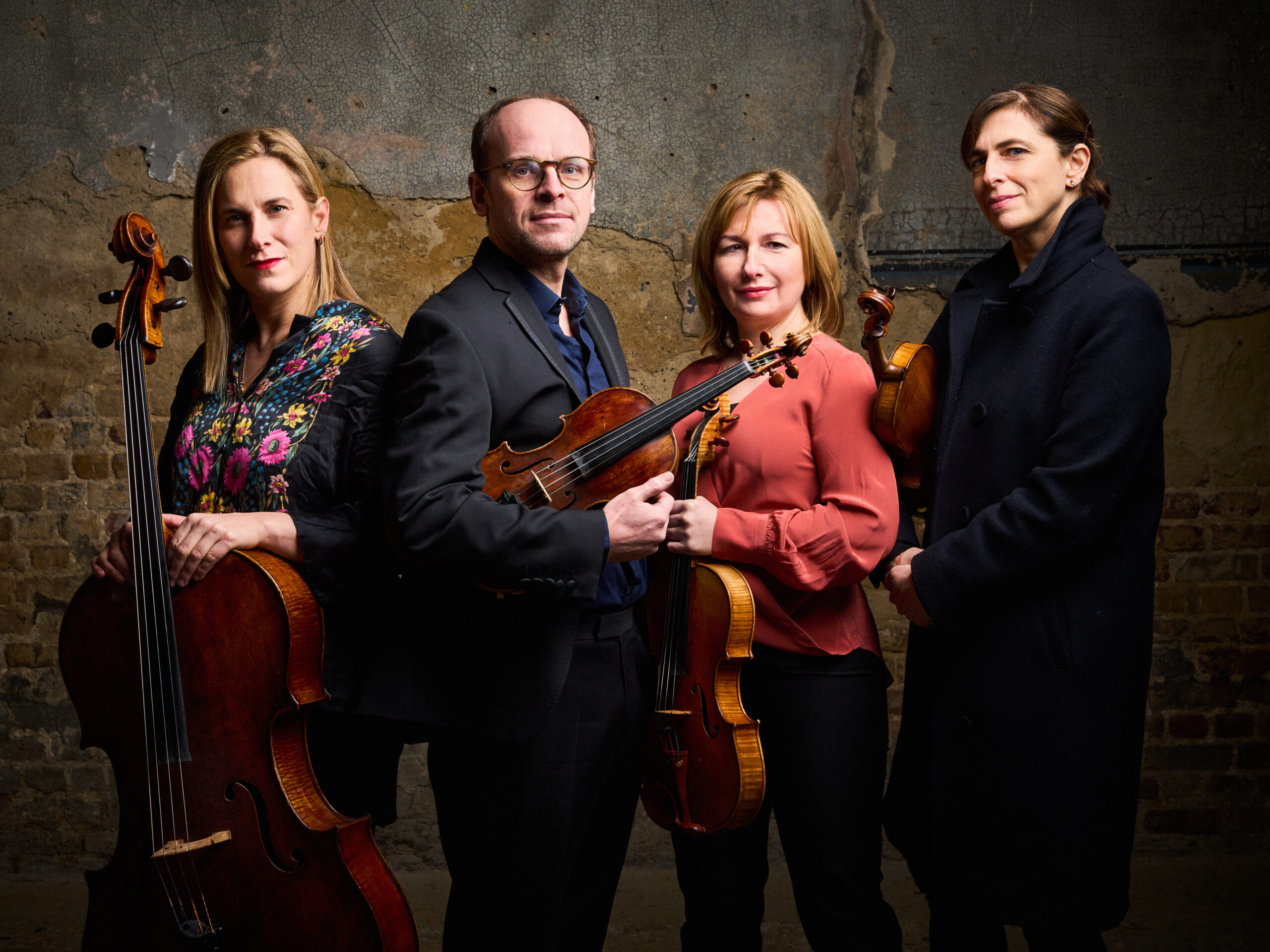
SOUNDS OF NOW: BRIDGE ENSEMBLE

Bridge Ensemble

Crucible Playhouse, Sheffield
Saturday 4 November 2023, 8.00pm

Tickets:
£16
£10 UC, PIP & DLA
£5 Students & Under 35s

Past Event


THEA MUSGRAVE Niobe for oboe and tape
(7′)
DAI FUJIKURA Cosmic Breath (11′)
WISSAM BOUSTANY And the Wind Whispered for flute (6′)
VALERIE COLEMAN Red Clay & Mississipi Delta (6′)
ARTURO MARQUEZ Danza de Mediodia (10′)
OLA AKINDIPE Èkó Scenes (10′) – World Premiere

At the end of their first year working together with Music in the Round through our Bridge scheme supporting promising young musicians, this formidable quintet presents a programme of new music for flute, clarinet, oboe, horn and bassoon.  Opening with Thea Musgrave’s haunting work for solo oboe and pre-recorded electronics, including Èkó Scenes a brand new Afrobeat-inspired work by the group’s clarinettist Ọlá Akindipe and concluding with US composer Valerie Coleman’s fusion of what she calls ‘blues dialect and charm of the south’, this is an accessible and eclectic tour through a world of music from composers too often unrepresented on the concert stage.


MUSGRAVE Thea, Niobe

Niobe, written in July and November 1987, was commissioned by the Park Lane Group for Ian Hardwick. The Tape was made in the Chiens Interdits Studios in New York; recording engineer, Jonathan Mann.

In Greek mythology, Niobe was the daughter of Tantalus and wife of Amphion, King of Thebes. She unwisely boasted to Leto about her many sons and daughters. Leto, who only had two children, Apollo and Artemis, was angered.

As punishment Apollo slew all of Niobe’s sons and Artemis all her daughters.

Out of pity for Niobe’s inconsolable grief, the Gods changed her into a rock, in which form she continued to weep.

In this short work for solo oboe and Tape, the solo oboe takes the part of Niobe bitterly lamenting her murdered children. The tape with the distant high voices and the slow tolling bells, and later gong, is intended to provide an evocative and descriptive accompaniment.

Thea Musgrave ©

BOUSTANY Wissam, …And the Wind Whispered…

As flute players, our creative life is forever bound in the air we breathe and blow – this wonderful invisible resource that is the foundation of our Art. I first performed …And The Wind Whispered… in Botswana and Zimbabwe in February 2009, but it took until 2011 before it was written down. Taking its inspiration from the wind, …And The Wind Whispered… seeks to make a statement about our fractured world… I have always been very weary of organized nationalism, religion and politics because they fragment and diminish our Humanity. At one point in my piece, the flute player says “and the wind never shows its passport, when it crosses the border.” Sit back and let the wind take you on a journey of its own choosing. This piece carries a wish with it – that humanity can one day rid itself from its self-imposed spiritual prisons.

© Wissam Boustany

COLEMAN Valerie, Red Clay & Mississipi Delta

Red Clay is short work that combines the traditional idea of musical scherzo with living in the South. It references the background of my mother’s side of the family that hails from the Mississippi delta region. From the juke joints and casino boats that line the Mississippi river, to the skin tone of kinfolk in the area: a dark skin that looks like it came directly from the red clay. The solo lines are instilled with personality, meant to capture the listener’s attention as they wail with “bluesy” riffs that are accompanied (‘comped’) by the rest of the ensemble. The result is a virtuosic chamber work that merges classical technique and orchestration with the blues dialect and charm of the south.

© Valerie Coleman

PIANO MASTERPIECES

Sarah Beth Briggs

Crucible Playhouse, Sheffield
Saturday 4 November 2023, 2.30pm

Tickets:
£21
£14 UC, PIP & DLA
£5
Students & Under 35s

Past Event

MOZART 9 Variations on a Minuet by Duport (14’)
HANS GÁL Sonata Op.28 (18’)
MENDELSSOHN Variations sérieuses (11’)
BEETHOVEN Variations on ‘God Save the King’ (9’)
SCHUBERT Impromptu in B flat D935 No.3 (11’)
CHOPIN Berceuse Op.57 (5’)
CHOPIN Ballade in F minor Op.52 (11’) 

“An artist of extraordinary magnetism” (The Daily Telegraph), Yorkshire pianist Sarah Beth Briggs has enjoyed a distinguished career both on stage and in the recording studio.  

For her highly anticipated return to Sheffield, the acclaimed pianist will be playing works from her most recent album Variations. Her programme features some of the greatest composers for piano, with music ranging from the fun and lightness of Mozart and Beethoven to the gorgeously tender melodies of Schubert and Chopin, alongside the sparkling freshness of a Sonata by Hans Gál. 

MOZART Wolfgang Amadeus, 9 Variations on a Minuet by Duport

Wolfgang Amadeus Mozart composed his Variations on a Minuet by Duport in 1789: an entry in his thematic catalogue dated Potsdam, 29 April 1789, lists ‘6 Variations for piano’ but in fact there were 9 of them. The cellist and composer Jean-Pierre Duport had been recruited by Frederick the Great in 1773 and after his nephew Friedrich Wilhelm II was crowned King of Prussia in 1786, Duport was made responsible for the chamber music at court. The theme is taken from one of Duport’s cello sonatas and its buoyant mood sets the tone for much of what follows, although the sixth variation is slow and dream-like. 

(C) Nigel Simeone

GÁL Hans, Sonata Op.28

Hans Gál studied with Brahms’s close friend Eusebius Mandyczewski and they later went on to edit the first complete edition of Brahms’s works. Gál’s opera, Die heilige Ente (‘The Sacred Duck’) was first performed in 1923 and enjoyed considerable success in Germany, and the Piano Sonata, Op.28, was composed four years later, during one of the happiest and most productive periods in Gál’s career, at a time when he was also Director of the Mainz Conservatoire. This success was cut short with the advent of the Nazis, when Gál was immediately dismissed from his post in March 1933 and his music banned. He returned to Vienna but was forced to flee after the Nazi annexation of Austria in 1938. It was the British musicologist Donald Tovey who invited Gál to Edinburgh, the city which he then made his home. 

In 1962, Gál himself wrote that Piano Sonata was ‘a concentrated, tightly-knit structure; the form of the four movements is completely clear. It will amuse you to hear me confess that I have only just noticed this on looking at the score: when you write in one go, you invent organically, whether you want to or not.’ 

(C) Nigel Simeone

BEETHOVEN Ludwig Van, Variations on ‘God Save the King’

Ludwig van Beethoven’s Variations on God Save the King were written in 1803 for the Scottish music publisher George Thomson. The composer sent them with a note that they were not too difficult and hoping that they would be a success. He also hoped to show the English ‘what a blessing they have’ with the tune, one which certainly seems to have fired his musical imagination.  

(C) Nigel Simeone


SCHUBERT Franz, Impromptu in B flat D935 No.3

Franz Schubert composed his Impromptu, D935, No.3, in 1827. It is another set of variations, the theme drawn from his own incidental music for the play Rosamunde (1823) which had already reappeared in the A minor String Quartet. With typical ingenuity, Schubert fashions a set of variations that are full of subtle surprises. 

(C) Nigel Simeone

CHOPIN Frédéric, Berceuse Op.57

Frédéric Chopin’s late Berceuse (1844) was originally called ‘Variantes’ and its theme (echoing a Polish folksong) is followed by 16 short variations, presented over a ground bass which establishes and sustains the mood of a cradle song.

(C) Nigel Simeone

CHOPIN Frédéric, Ballade in F minor Op.52

The Ballade in F minor (1842) is a complex structure which combines elements of sonata form with that of variations, a magnificent contrapuntally complex work which English pianist John Ogdon described as ‘the most exalted, intense and sublimely powerful of all Chopin’s compositions.’ 


© Nigel Simeone 

BACH CELLO SUITES

Ensemble 360

Upper Chapel, Sheffield
Friday 27 October 2023, 1.00pm / 7.00pm

Tickets:
£16
£10 UC, PIP & DLA
£5 Students & Under 35s

Past Event

JS BACH Cello Suite No.5 (26) 
JS BACH Cello Suite No.6 (24’) 

Concluding her series of Bach’s beloved Cello Suites, Ensemble 360’s celebrated cellist Gemma Rosefield returns to Upper Chapel, interspersing music with conversation and questions.  

Immerse yourself in the intricate melodies of Bach’s cello masterpieces. From the haunting prelude to an energetic gigue, the many movements of each suite showcase the versatility and expressiveness of the cello. 

BACH Johann Sebastian, Cello Suites 5 & 6

Cello Suite No.5 in C minor, BWV 1011 

Prelude 
Allemande 
Courante 
Sarabande 
Gavotte I / II 
Gigue 


Cello Suite No.6 in D, BWV 1012 

Prelude 
Allemande 
Courante 
Sarabande 
Gavotte I / II 
Gigue 


Bach’s Cello Suites were probably composed in about 1720 during Bach’s time in Cöthen. It isn’t known for whom Bach wrote them, though there are at least two likely candidates working in Cöthen at the time: Christian Ferdinand Abel (1682–1761), a great friend of the composer for whom Bach wrote the three sonatas for viola da gamba and harpsichord (BWV 1027–9), and Carl Berhard Lienicke (d. 1751), the leading cellist of the Cöthen orchestra. Whether either of them was the player Bach had in mind is a matter of pure speculation since no documentary evidence has come to light. Equally uncertain is why Bach wrote them. The likeliest explanation is that they were intended – like much of his keyboard music – for private performance. 

© Nigel Simeone  

SCHUBERT, JANÁČEK & BEETHOVEN

Leonkoro Quartet

Crucible Playhouse, Sheffield
Saturday 21 October 2023, 7.15pm

Tickets:
£21
£14 UC, PIP & DLA
£5 Students & Under 35s

Past Event

SCHUBERT String Quartet No.9 in G minor D173 (23’)
JANÁČEK String Quartet No.1 Kreutzer Sonata (19’)
BEETHOVEN String Quartet in F, Op.59 No.1 Razumovsky (40’)

The four outstanding young musicians of the Leonkoro Quartet have already acquired an astonishing list of international prizes to their name. Last year’s awards included first prize at the Wigmore Hall International String Quartet Competition, where they astonished both the jury and audience with their boundless energy and powerful musicality, and their appointment to the prestigious BBC Radio 3 New Generation Artists scheme. 

For their Sheffield debut, they’ll be performing a programme that tackles the profound drama of Janáček and Beethoven, alongside the graceful lightness of a quartet composed by Schubert when he was still a teenager. 

POST-CONCERT Q&A Free
Ticket holders are invited to stay on for an informal Q&A with the musicians after the concert.

SCHUBERT Franz, String Quartet in G minor, D173

Allegro con brio 
Andantino  
Menuetto. Allegro vivace 
Allegro 
 

Schubert’s sheer productivity in 1815, the year in which he turned 18 years of age, is nothing short of astonishing: over 150 songs, two symphonies, piano pieces, religious music and the present string quartet, written between 25 March and 1 April 1815, while Schubert was also working as an assistant teacher in his father’s school. According to a note in his own hand, the first movement was composed ‘in four and a half hours.’ There’s no mistaking the influences on the teenage Schubert in this music, particularly Beethoven’s Op.18 quartets and, above all, Mozart’s Symphony No.40.  

But far from being merely derivative or imitative, this quartet is a notable example of Schubert experimenting with quartet structures, and starting to find his way as an original genius. Schubert expert Brian Newbould has noted that ‘Schubert’s way of plucking … principles from the repertoire all around him in his teenage years … is part of a positive, learning, and properly creative purpose.’ Newbould goes on to write that in this quartet, we find ‘things here that represent the first stirrings of inclinations that were to come to fruition in later works.’ 

© Nigel Simeone 

JANÁČEK Leoš, String Quartet No.1 Kreutzer Sonata

Adagio – Con moto 
Con moto 
Con moto – Vivo – Andante 
Con moto – (Adagio) – Più mosso 
 

Janáček composed his 1st String Quartet in 1923, taking as his inspiration Kreutzer Sonata, the novella by Tolstoy that had in turn been inspired by Beethoven’s famous violin sonata. Janáček’s quartet was composed in just a few days, and it’s probable that he drew on material from an earlier piano trio (now lost) based on the same story. The music does not follow Tolstoy’s narrative in detail, but it does evoke the rage and passion of the protagonists, using a musical language made up of generally quite short motifs that form both the melodies and the urgent, thrilling ideas that accompany them. Janáček also alludes to Beethoven’s Kreutzer, most obviously at the start of the third movement where he recalls the second theme of Beethoven’s opening movement. Janáček’s own motto theme in the Quartet is the rising idea heard at the opening. This returns at the start of the fourth movement, but this time it is followed by a melancholy violin theme, marked ‘as if in tears’. Janáček’s final transformation of the motto theme is magnificent: a furious fortissimo, accompanied by chords marked ‘festive, like an organ’. After this ecstatic moment of release, the music subsides back to the brooding, unsettled mood of the opening. 


© Nigel Simeone 

BEETHOVEN Ludwig van, String Quartet in F Op.59 No.1 Razumovsky

Allegro
Allegretto vivace e sempre scherzando
Adagio molto e mesto – attacca
Thème Russe. Allegro

The first of Beethoven’s three quartets written for Prince Razumovsky was composed in 1806 and performed the next year. Like the ‘Eroica’ Symphony (1804–5) it shows Beethoven expanding the possibilities of the form to produce something on an epic scale while retaining the essential intimacy of a string quartet. The first movement is introduced by a cello theme which musicologist Lewis Lockwood describes as ‘opening up a musical space of seemingly unbounded lyricism and breadth.’ The Scherzo, in B flat major, is an unusual movement: while it has no distinct Trio section, it is also Beethoven’s longest Scherzo to date, even though Beethoven removed a large repeat while revising the work. The slow movement has the unusual marking mesto – ‘mournful’ – and is cast in the tragic key of F minor. It ends on a trill that leads seamlessly into the finale. This is based on a Russian theme – a charming and appropriate choice since Razumovsky was the Russian Ambassador to Vienna at the time.

© Nigel Simeone

“The Leonkoros draw on a wealth of youthful sonority, fiery vitality and rousing drive.”

Süddeutsche Zeitung

RACHAEL COHEN QUARTET

Rachael Cohen, Lewis Wright, Joe Downard & Jason Brown

Crucible Playhouse, Sheffield
Friday 20 October 2023, 7.30pm

Tickets:

£19
£17 Over 60, Disabled & Unemployed
£10 Students with NUS card
£5 Under 16s* 

 
*Sheffield Jazz tickets do not qualify for any Music in the Round ticket offers or discounts

Past Event

RACHAEL COHEN alto saxophone
ARTIE ZAITZ guitar
FERG IRELAND bass
WILL CLEASBY drums

Rachael Cohen is a prolific composer and one of the most creative and inventive saxophonists of her generation. Her tone and fluent, lyrical improvising style is often compared to the jazz greats of the Cool School, but also displays a harder edge when the music demands it.

Guitarist Artie Zaitz has been working and recording on the London and international scene for over a decade, regularly performing with artists such as Moses Boyd, Mark Kavuma’s Banger Factory and Camilla George.

Expect an absorbing mix of blues, ballads and bop-inspired tunes from the jazz catalogue and Rachael’s own compositions.

Please note the change to the previously advertised line-up. 

 “…Cohen takes a softly devious approach reminiscent of Lee Konitz – but, as with the canny Cool School veteran, the quietness is deceptive and the subtlety is in the weighting of phrases and the hipness with which she plays off the rhythm section.”   John Fordham, The Guardian

“Cool-school jazz from emerging guitar talent Zaitz, whose John Scofield-ish sound takes in some loping New Orleans shuffles and moody cinematic themed originals”  Time Out

“ She is a positive life-force and a truly remarkable musician”

London Jazz News 

LIGETI 100: PIANO & WIND

Ensemble 360

Upper Chapel, Sheffield
Saturday 30 September 2023, 7.00pm

Tickets:
£21
£14 UC, PIP & DLA
£5 Students & Under 35s

Past Event
Ensemble 360 classical musicians - oboe player Adrian Wilson, horn player Naomi Atherton and clarinet player Robert Plane

DORTI Duo Concertante (13′) 
LIGETI Selection of Etudes (c.12′) 
LUTOSŁAWSKI Dance Preludes for Clarinet and Piano (12′)
FARKAS Five Antique Hungarian Dances (16′) 
LIGETI Ten Pieces (13′) 

An evening of music for piano and wind celebrating the works of György Ligeti, one of the most innovative and influential composers of the late 20th century.  

Ligeti’s celebrated Ten Pieces for Wind Quintet and a selection of his mesmerising studies for piano are among the highlights of this concert celebrating the 100th birthday of this ground-breaking composer. Other works to feature include dances by Ligeti’s teacher, Farkas, and a breathtaking duo by Doráti, who conducted several premieres of Ligeti’s most famous works. 

DORÁTI Antal, Duo Concertante for oboe and piano

Antal Doráti’s long and distinguished conducting career has tended to overshadow his work as a composer. As a brilliantly gifted teenager, he began his studies at the Franz Liszt Academy in Budapest at the age of fourteen and from the start, his musical development was in the best possible hands: his composition teachers included Zoltán Kodály and his piano teacher was Béla Bartók. After graduating from the Academy in 1924, he joined the music staff at the Budapest Opera, making his conducting debut the same year.  

Notable later orchestral appointments included posts with the Minneapolis Symphony Orchestra, BBC Symphony Orchestra, Stockholm Philharmonic, Detroit Symphony Orchestra and Royal Philharmonic Orchestra. His numerous recordings included a pioneering set of the complete Haydn symphonies, made for Decca with the Philharmonia Hungarica. 

Doráti also found time to compose a number of pieces, ranging from an opera (The Chosen) to orchestral works (including a symphony) and the present Duo concertante for oboe and piano, completed in 1984 and dedicated to the great Swiss oboist Heinz Holliger who gave the first performance in Washington, D.C. on 21 April 1984 with the pianist Karl Ritter. A modern re-interpretation of a Hungarian rhapsody, the structure draws on traditional Hungarian dance forms, opening with a slow lassú and following this with a friss – a quick movement marked molto vivace 

© Nigel Simeone 

LIGETI György, Études for piano

Ligeti composed a series of 18 études for solo piano between 1985 and 2001, published in three books. When they first became known, these pieces were hailed as instant classics of the twentieth-century piano repertoire, and also provided a remarkable climax to Ligeti’s composing career. Following in the tradition of Chopin, Liszt and Debussy, these pieces pose tremendous technical challenges while also resulting in brilliant musical miniatures, whether dazzling or poetic. Ligeti himself wrote that he imagined in the Études ‘highly emotive music of high contrapuntal and metrical complexity, with labyrinthine branches and perceptible melodic forms … not tonal, but not atonal either.’  


They are dedicated to various important exponents of contemporary music, ranging from the composers Pierre Boulez and György Kurtág, to the pianists Pierre-Laurent Aimard and Volker Banfield. Described by critic Andrew Clements as ‘the most important additions to the solo-piano repertoire in the last half-century’, one remarkable feature is the way in which, as Clements put is, ‘in the Études, Ligeti effectively created a new pianistic vocabulary’. The influences described by Ligeti on these works included medieval and Renaissance music, African polyphony, Latin-American dances, Balinese gamelan, jazz pianists including Bill Evans and Thelonius Monk and the folk music of Ligeti’s native Hungary. But all of these are subsumed into a language that is entirely Ligeti’s own, with the most exhilarating results. 


© Nigel Simeone 

LUTOSŁAWKSI Witold, Dance Preludes

Allegro molto
Andantino
Allegro giocoso
Andante
Allegro molto

In 1954, Witold Lutosławski wrote his five Dance Preludes for clarinet and piano, based on folk tunes from Northern Poland, describing them as his ‘farewell to folk music’. In 1959 he recast the pieces for the Czech Nonet – comprising wind quintet, violin, viola, cello and double bass – in which he makes one significant change: no longer is the clarinet the soloist, but the thematic material is shared between the whole ensemble. Lutosławski’s biographer Charles Bodman Rae has described the way the composer transforms the folk tunes, and generates the propulsive energy in the faster movements: ‘Superimposition of different metres is the main feature of these pieces, resulting in metrical and rhythmic contradictions. This technique is most noticeable in the first, third and fifth pieces and invests them with much of their rhythmic vitality.’

This Nonet version of the Dance Preludes was first performed by the Czech Nonet at a concert in Louny, 40 miles northwest of Prague, on 10 November 1959.

Nigel Simeone 2013

FARKAS Ferenc, Five Antique Hungarian Dances (version for wind quintet)

Intrada 
Lassú (Slow Dance) 
Lapockás tánc (Shoulder Blade Dance) 
Chorea hungaricae 
Ugrós (Leaping Dance) 
 

Ferenc Farkas studied with Leo Weiner at the Franz Liszt Academy in Budapest and later with Ottorino Respighi in Rome. On returning to Budapest in 1932, one of his first commissions was for a film score and he went on to compose extensively for film and theatre productions. At the same time, he began researching Hungarian folk music and began a distinguished teaching career: his pupils included Ligeti and Kurtág. 


This work, officially titled Antique Hungarian Dances from the 17th Century, exists in versions for various solo instruments and ensembles, with the present wind quintet version dating from 1959. In a note on the work, Farkas himself wrote that ‘compared with the rich folk-song heritage of Hungary, our ancient airs and dances that have been preserved in writing have a more modest role. For this work I have been influenced by dances of the 17th century, written by unknown amateurs in a relatively simple style … My interest in this music was first captured in the 1940s. I was so fascinated that I decided to give these melodies new life. I fitted the little dances together, in rondo form, and leaning on Baroque harmony and counterpoint, I attempted a reminiscence of that atmosphere of provincial Hungarian life at the time.’ 


© Nigel Simeone 

LIGETI György, Ten Pieces

Ligeti composed his Ten Pieces between August and December 1968. He said that his first idea was ‘to compose a virtuoso work … to bring out the individual character of the five very different instruments available to me. My first idea was to write five short virtuoso pieces, but as I was working on the sketches, I began to sense that this didn’t work in formal terms … It made more sense to have ensemble pieces contrast with virtuoso pieces, in order to supply points of repose. It was thus that the final form came about: ten pieces with a regular alternation of ensemble pieces and virtuoso pieces.’ 


The first performance was given on 20 January 1969 in Malmö, Sweden, played by the Wind Quintet of the Stockholm Philharmonic Orchestra. Each piece is short – the first, marked Molto sostenuto e calmo is one of the longer movements, lasting just over two minutes, while the fourth, fifth and sixth, all very fast, last less than a minute each. In his biography of Ligeti, British composer Richard Steinitz has described the Ten Pieces as ‘both accessible and delightfully characteristic of their composer … The style is intentionally kaleidoscopic’ (likened by Ligeti himself to Tom and Jerry cartoons), and ‘the music is quirky, epigrammatic and comic.’ 


© Nigel Simeone 

FOCUS ON THE CLARINET

Ensemble 360

Upper Chapel, Sheffield
Friday 6 October 2023, 1.00pm / 7.00pm

Tickets:
£16
£10 UC, PIP & DLA
£5 Students & Under 35s

Past Event

DEBUSSY Premiere rhapsodie (8’)
YORK BOWEN Clarinet Sonata (16’)
HARRISON Drifting Away (5’)
WEBER Grand Duo Concertant (21’) 

Praised by International Record Review as “an eloquent and impassioned clarinettist [whose] playing is full-blooded and committed”, Robert Plane, the newest member of Ensemble 360, has been a remarkable addition to this highly regarded Ensemble. 

Debussy’s impressionistic Premiere rhapsodie, performed by Rob and pianist Tim Horton, moves from a dreamy opening to a virtuosic conclusion. The pair will also perform Drifting Away, the work of Pamela Harrison, an often overlooked English composer who Rob has done much to champion. The concert concludes with Weber’s celebrated duo marked by soaring melodies and dazzling cadenzas. 

POST-CONCERT TALK Free
Ticket holders are invited to stay for an informal talk from Rob about Pamela Harrison, who features in the concert.

DEBUSSY Claude, Première Rapsodie for Clarinet and Piano

The test pieces specially composed for the final exams at the Paris Conservatoire have something of a bad reputation. Many of them are routine competition showpieces but sometimes a work of much more lasting importance was written for these occasions. Such is the case with Debussy’s Première Rapsodie, completed in January 1910 for the clarinet concours at the Conservatoire that summer (Debussy also dashed off a sight-reading test for the same competition, published as his Petite pièce for clarinet and piano). Debussy himself was a member of the jury and he found most of the players unsatisfactory in the Rapsodie. However, the eventual winner, Vandercruyssen, impressed him. Debussy wrote to his friend and publisher Jacques Durand that Vandercruyssen ‘played by heart, and like a great musician’. A year later, Debussy prepared the better-known version of the piece for clarinet and orchestra, but the original with piano is superbly written for both instruments. The clarinettist David Pino has claimed, with justification, that the Première rapsodie was ‘the first major work for solo clarinet written in the twentieth century’.

It opens in a mood of stillness (marked ‘Rêveusement lent’ – ‘dreamily slow’), with the piano adding gentle momentum in the accompaniment after a few bars, and the clarinet – instructed to play pianissimo but also ‘sweetly’ and ‘penetrating’ – introducing a languorous theme that gradually becomes more animated. A sudden speeding up introduces a more capricious idea that is briefly stopped in its tracks by a series of trills and a return to earlier music. But the faster speed soon returns, starting with rumbling low notes on the piano and a series of upward flourishes on the clarinet. This gives way to a new section marked ‘Modérément animé (‘Moderately animated) and ‘playful’, a passage that quite brilliantly exploits the possibilities of the clarinet, especially its ability to play rapid figurations and lyrical lines. A return to the slower music gives way, finally, to a thrilling conclusion.

What makes this such an outstanding work is that Debussy combines extremely idiomatic writing – appropriate for a piece that was intended to demonstrate a player’s technical command – with musical ideas that have memorable substance. On 16 January 1911 the clarinettist Paul Mimart (to whom the work was dedicated) gave the first performance in a concert, at the Salle Gaveau in Paris, in one of the concerts promoted by the Société musicale indépendante. According to Debussy’s biographer Léon Valas, another performance took place at the end of 1911 in Russia, and it was greeted by the audience with confusion. A baffled Debussy wrote to a friend: ‘Surely this piece is one of the most immediately pleasing I have ever written!’

© Nigel Simeone

YORK BOWEN Edwin, Clarinet Sonata in F minor, Op.109

Allegro moderato 
Allegretto poco scherzando 
Finale. Allegro molto 
 

York Bowen was a virtuoso pianist (in 1925 he made the first ever recording of Beethoven’s Fourth Piano Concerto) and had a parallel career as a prolific composer whose output included instrumental works written for many distinguished soloists, among them violinist Fritz Kreisler, oboist Léon Goossens, violist Lionel Tertis and horn player Denis Brain. When York Bowen heard the clarinettist Pauline Juler give the first performance of Gerald Finzi’s Five Bagatelles at one of the National Gallery Concerts in January 1943, he was immediately inspired to compose a work for her. The result was the Clarinet Sonata in F minor, given its premiere by Juler and the composer later that year. 


Starting with a wide-ranging theme for the clarinet (extending over two and a half octaves), this vibrant, lyrical work explores the technical possibilities of the clarinet with consummate skill. The second theme is closely related to the first, and the movement ends with a coda based on the work’s opening. The Scherzetto is a capricious counterpart to the first movement and elements of it are also heard at the start of the finale, marked Allegro molto. This is a rondo in which music from the opening movement is also recalled before an imposing coda brings this remarkable post-romantic sonata to a powerful close.  


© Nigel Simeone 

HARRISON Pamela, Drifting Away (for clarinet and piano)

Pamela Harrison studied at the Royal College of Music with Gordon Jacob (composition) and Arthur Benjamin (piano), and she composed several important works during the Second World War, including a String Quartet first performed in 1941 at the National Gallery Concerts. She wrote several important works for clarinet, inspired in part by a warm friendship with Jack Brymer for whom she composed a rugged and dramatic Clarinet Sonata in 1953, following this with a Clarinet Quintet in 1956. Drifting Away dates from two decades later: it was first performed by Brymer in 1975 at Sherbourne School. The title was derived from lines by W.B. Yeats: 

 
I heard the old, old men say 
All that’s beautiful drifts away 
Like the waters. 


Appropriately enough, this tender and evocative work, exquisitely crafted, was played by Brymer at the memorial service for Pamela Harrison in 1990.  


© Nigel Simeone 

WEBER Carl Maria Von, Grand Duo Concertant in E flat Op.48

Allegro con fuoco 
Andante con moto 
Rondo. Allegro 
 

Weber’s own diaries contain a wealth of information about when he composed this work. The first movement to be written was the Rondo finale, completed in Munich on 5 July 1815 and a note from a few days later mentions sketches “for the sonata with clarinet and piano”. By 19 July Weber had also written the slow movement, describing it as an “Adagio”. It wasn’t for another year that he turned his attention to the first movement – noting in Berlin on 5 November that the “First movement of the Duo in E flat was written down”, and finally on 8 November “Allegro in E flat for the Clarinet and Piano Duo finished.” The work was published by Schlesinger in Berlin six months later, Weber noting that he received printed copies on 19 June 1817.  


What is remarkable about this work, given its rather fragmented composition history, is that the finished piece has such concentration and coherence. An early review in the Allgemeine Musik-Zeitung was full of praise: “The whole piece has an original and fiery spirit as well as tender heartfelt feelings; a thorough development of ideas comes without any pedantry … The harmonic and melodic aspects of each movement are beautifully balanced against each other and both instruments are treated with a perfect knowledge of what each can do.” 


The ebullient and virtuoso writing for the two instruments in is one of the glories of the Grand Duo. It was conceived as a real partnership for clarinet and piano, with neither part dominating the proceedings. The results are very rich melodically but also extremely successful in terms of Weber’s handling of large-scale forms. Though the work was called Grand Duo concertant when it was published, it’s interesting to note from Weber’s diaries that he referred to this substantial three-movement work at least once as a “Sonata”. 


© Nigel Simeone  

CHOPIN FOR SOLO PIANO

Tim Horton

Cast, Doncaster
Saturday 14 October 2023, 7.00pm

Tickets: £15*

Under 26s: £13*

*Box office delivery charges may apply.


Past Event

CHOPIN Two Nocturnes Op.48 (14’)
RAVEL Gaspard de la Nuit (23’)
CHOPIN
Scherzo No.1 in B minor Op.20 (9’)
Scherzo No.2 in B flat minor Op.31 (10’)
Scherzo No.3 in C sharp minor Op.39 (7’)
Scherzo No.4 in E Op.54 (11’)

Tim returns to Doncaster to perform another in his compelling series of concerts exploring Chopin’s most beguiling music.
Again, he includes music inspired by the mastery of the composer. This time it’s the great Maurice Ravel. In ‘Gaspard de la Nuit’, Ravel’s piano-writing creates dazzling portraits of characters and landscapes, with moments of thrilling energy and serene beauty. With Tim on the piano stool, this is guaranteed to be a breathtaking evening of music.

CHOPIN Frédéric, Nocturne Op.48 No.1

Chopin’s Nocturne in C minor is among the finest of all his explorations of this form. More overtly dramatic than most of his other nocturnes, it begins with a solemn, halting melody in the right hand, supported by chords that have some of the characteristics of a funeral march. The result, though, is more lyrical and more plangent (reminding us of Chopin’s fondness for bel canto opera) than the austere tread of his most famous funeral march (in the B flat minor Sonata). The central section is a richly harmonized chorale in C major, that is – in due course –infiltrated and disturbed by a quicker, more chromatic figure in a triplet rhythm that eventually provokes an explosive climax – complete with Lisztian octaves – before the music turns back to the minor key, and the material from the opening. Here Chopin does something unexpected. The uneasy triplet rhythms that had disrupted the chorale are now transformed into a restless, agitated accompaniment for the melody, and it is only in the last two bars that the nervousness finally subsides.


This Nocturne was the first of a pair dedicated to a favourite Chopin pupil – Laure Duperré, the beautiful daughter of an admiral – and was first published in 1841 by Schlesinger in Paris. The following year, it was reviewed in the Revue et Gazette musicale by Maurice Bourges. Writing in the form of a letter to an unnamed Baroness, Bourges offers a description of the work’s design that was quite novel for the time outside the pages of composition treatises (Schumann was one of the few who had attempted something similar in the general musical press): ‘Here in a few words is an outline of the thirteenth nocturne. A first period, in C minor, is distinguished by the character of the melody that dominates it; the second, in C major, begins pianissimo; it belongs to the complex form that has been very aptly called melodic harmony; then it ends with a restatement of the first theme, accompanied this time by pulsating chords that give the general rhythm a new warmth.’

Nigel Simeone 2010

RAVEL Maurice, Gaspard de la Nuit.

Maurice Ravel completed Gaspard de la nuit on 8 September 1908, and the first performance took place on 9 January 1909, at the Salle Erard in Paris. The pianist was Ricardo Viñes, one of the most energetic advocates of new French and Spanish music, and a long-time friend of Ravel’s. Exact contemporaries, they were both members of Les Apaches, a group of like-minded artistic friends. While they were students, Viñes had introduced Ravel to the poetry of Aloysius Bertrand that was later to inspire Gaspard de la nuit. Gaspard refers to a Persian treasurer guarding the royal jewels at night. 


Betrand’s prose poems had been published in 1842 (a year after his death), and influenced later Symbolist poets, notably Baudelaire and Mallarmé. Ravel’s Gaspard, subtitled ‘three poems’, begins with Ondine, a dream-like depiction of a water sprite. Ravel’s music seems to mirror the strange beauty of the poem:  


Listen! … it is Ondine who brushes drops of water on the resonant panes of your windows, lit by the gloomy rays of the moon; and here in gown of watered silk, the mistress of the chateau gazes from her balcony on the beautiful starry night and sleeping lake. 


Le Gibet is a grim evocation of a corpse hanging from the gallows. A bell – incessant and obsessive – tolls throughout the piece, represented by repeated B flats, the first and last sounds we hear. 


Ravel once said his initial idea for Scarbo had been to ‘make a caricature of Romanticism’, but admitted that ‘perhaps it got the better of me.’ The result is music of dazzling originality. The poem depicts a goblin who darts in and out of the shadows, and Ravel’s piece mirrors this with quiet passages disturbed by sudden outbursts. The critic Vladimir Jankélévitch described Scarbo as ‘a fiendish encyclopedia of all the traps, obstacles and snares that a limitless imagination can devise for a pianist’s fingers.’ 

 (C) Nigel Simeone

CHOPIN Frédéric, Four Scherzos

Chopin’s Scherzos were composed between the mid-1830s and 1843. Scherzo means ‘jest’ or ‘joke’ and earlier composers such as Haydn and Beethoven often invested scherzo movements with playful elements. But Chopin took the form in a quite different direction prompting Robert Schumann to ask about the B minor Scherzo, Op.20: ‘How is “gravity” to clothe itself when “jest” goes about in such dark veils?’ Certainly, the mood of the B minor Scherzo (published in 1835) is sombre and sinister, the outer sections full of suspense and wildness. Only in the central section (in B major) is there any sense of repose.  


The B flat minor Scherzo, Op.31 (1837), was likened by Schumann to Byron’s poetry, ‘overflowing with tenderness, boldness, love and contempt.’ Chopin himself is said to have compared the hushed opening to a question, the explosive second phrase providing the answer, but the piece as a whole is remarkably intense and unified, its ideas seeming to grow from one to the next to create a remarkable inner coherence.  


His approach in the C sharp minor Scherzo, Op.39 (1838–9) is rather different, depending for its effectiveness on the sharp contrasts and surprising juxtapositions between the rapid octaves at the opening and the hymn-like second theme and the exquisite tumbling cascades with which it is decorated. The mood at the close is dazzling and defiant. 


The E major Scherzo, Op.54 (1843), is the one which perhaps most clearly matches the expectations of its title: there is a certain playfulness and elegance in a work that was composed tandem with the Fourth Ballade and the Polonaise in A flat, Op.53. But in spite of its apparent conformity with the title, this is late Chopin and the music is full of innovation, whether in the exploration of piano textures or Chopin’s increasingly rich harmonic palate. More introspective than its predecessors, it is also a work which seems tinged with sadness as well as mercurial brilliance.  


© Nigel Simeone 

CHOPIN FOR SOLO PIANO

Tim Horton

Emmanuel Church, Barnsley
Friday 13 October 2023, 7.30pm

Tickets
£14.50
£10 UC, PIP & DLA
£5 Students & Under 35s

Past Event

CHOPIN Two Nocturnes Op.48 (14’)
RAVEL Gaspard de la Nuit (23’)
CHOPIN
Scherzo No.1 in B minor Op.20 (9’)
Scherzo No.2 in B flat minor Op.31 (10’)
Scherzo No.3 in C sharp minor Op.39 (7’)
Scherzo No.4 in E Op.54 (11’)

Tim returns to Barnsley to perform another in his compelling series of concerts exploring Chopin’s most beguiling music.
Again, he includes music inspired by the mastery of the composer. This time it’s the great Maurice Ravel. In ‘Gaspard de la Nuit’, Ravel’s piano-writing creates dazzling portraits of characters and landscapes, with moments of thrilling energy and serene beauty. With Tim on the piano stool, this is guaranteed to be a breathtaking evening of music.

CHOPIN Frédéric, Nocturne Op.48 No.1

Chopin’s Nocturne in C minor is among the finest of all his explorations of this form. More overtly dramatic than most of his other nocturnes, it begins with a solemn, halting melody in the right hand, supported by chords that have some of the characteristics of a funeral march. The result, though, is more lyrical and more plangent (reminding us of Chopin’s fondness for bel canto opera) than the austere tread of his most famous funeral march (in the B flat minor Sonata). The central section is a richly harmonized chorale in C major, that is – in due course –infiltrated and disturbed by a quicker, more chromatic figure in a triplet rhythm that eventually provokes an explosive climax – complete with Lisztian octaves – before the music turns back to the minor key, and the material from the opening. Here Chopin does something unexpected. The uneasy triplet rhythms that had disrupted the chorale are now transformed into a restless, agitated accompaniment for the melody, and it is only in the last two bars that the nervousness finally subsides.


This Nocturne was the first of a pair dedicated to a favourite Chopin pupil – Laure Duperré, the beautiful daughter of an admiral – and was first published in 1841 by Schlesinger in Paris. The following year, it was reviewed in the Revue et Gazette musicale by Maurice Bourges. Writing in the form of a letter to an unnamed Baroness, Bourges offers a description of the work’s design that was quite novel for the time outside the pages of composition treatises (Schumann was one of the few who had attempted something similar in the general musical press): ‘Here in a few words is an outline of the thirteenth nocturne. A first period, in C minor, is distinguished by the character of the melody that dominates it; the second, in C major, begins pianissimo; it belongs to the complex form that has been very aptly called melodic harmony; then it ends with a restatement of the first theme, accompanied this time by pulsating chords that give the general rhythm a new warmth.’

Nigel Simeone 2010

RAVEL Maurice, Gaspard de la Nuit.

Maurice Ravel completed Gaspard de la nuit on 8 September 1908, and the first performance took place on 9 January 1909, at the Salle Erard in Paris. The pianist was Ricardo Viñes, one of the most energetic advocates of new French and Spanish music, and a long-time friend of Ravel’s. Exact contemporaries, they were both members of Les Apaches, a group of like-minded artistic friends. While they were students, Viñes had introduced Ravel to the poetry of Aloysius Bertrand that was later to inspire Gaspard de la nuit. Gaspard refers to a Persian treasurer guarding the royal jewels at night. 


Betrand’s prose poems had been published in 1842 (a year after his death), and influenced later Symbolist poets, notably Baudelaire and Mallarmé. Ravel’s Gaspard, subtitled ‘three poems’, begins with Ondine, a dream-like depiction of a water sprite. Ravel’s music seems to mirror the strange beauty of the poem:  


Listen! … it is Ondine who brushes drops of water on the resonant panes of your windows, lit by the gloomy rays of the moon; and here in gown of watered silk, the mistress of the chateau gazes from her balcony on the beautiful starry night and sleeping lake. 


Le Gibet is a grim evocation of a corpse hanging from the gallows. A bell – incessant and obsessive – tolls throughout the piece, represented by repeated B flats, the first and last sounds we hear. 


Ravel once said his initial idea for Scarbo had been to ‘make a caricature of Romanticism’, but admitted that ‘perhaps it got the better of me.’ The result is music of dazzling originality. The poem depicts a goblin who darts in and out of the shadows, and Ravel’s piece mirrors this with quiet passages disturbed by sudden outbursts. The critic Vladimir Jankélévitch described Scarbo as ‘a fiendish encyclopedia of all the traps, obstacles and snares that a limitless imagination can devise for a pianist’s fingers.’ 

 (C) Nigel Simeone

CHOPIN Frédéric, Four Scherzos

Chopin’s Scherzos were composed between the mid-1830s and 1843. Scherzo means ‘jest’ or ‘joke’ and earlier composers such as Haydn and Beethoven often invested scherzo movements with playful elements. But Chopin took the form in a quite different direction prompting Robert Schumann to ask about the B minor Scherzo, Op.20: ‘How is “gravity” to clothe itself when “jest” goes about in such dark veils?’ Certainly, the mood of the B minor Scherzo (published in 1835) is sombre and sinister, the outer sections full of suspense and wildness. Only in the central section (in B major) is there any sense of repose.  


The B flat minor Scherzo, Op.31 (1837), was likened by Schumann to Byron’s poetry, ‘overflowing with tenderness, boldness, love and contempt.’ Chopin himself is said to have compared the hushed opening to a question, the explosive second phrase providing the answer, but the piece as a whole is remarkably intense and unified, its ideas seeming to grow from one to the next to create a remarkable inner coherence.  


His approach in the C sharp minor Scherzo, Op.39 (1838–9) is rather different, depending for its effectiveness on the sharp contrasts and surprising juxtapositions between the rapid octaves at the opening and the hymn-like second theme and the exquisite tumbling cascades with which it is decorated. The mood at the close is dazzling and defiant. 


The E major Scherzo, Op.54 (1843), is the one which perhaps most clearly matches the expectations of its title: there is a certain playfulness and elegance in a work that was composed tandem with the Fourth Ballade and the Polonaise in A flat, Op.53. But in spite of its apparent conformity with the title, this is late Chopin and the music is full of innovation, whether in the exploration of piano textures or Chopin’s increasingly rich harmonic palate. More introspective than its predecessors, it is also a work which seems tinged with sadness as well as mercurial brilliance.  


© Nigel Simeone 

‘AMERICAN’ STRING QUARTET & MORE

Ensemble 360

Tickets
£14.50 
£10 UC, PIP and DLA
£5 Students & Under 35s

Past Event
String players of Ensemble 360

SUK Meditation on the Old Czech Chorale
COLERIDGE-TAYLOR Clarinet Quintet
HOWELLS Rhapsodic Quintet
DVOŘÁK Quartet in F Op. 96 ‘American’

A sumptuous afternoon of music performed by Ensemble 360, including Dvořák’s beloved ‘American’ string quartet and two clarinet quintets showcasing the lush harmonies of Howells and Coleridge-Taylor.

Part of Hoylandswaine Festival

SUK Josef, Mediation on the Old Czech Chorale

Josef Suk, a student of Antonín Dvořák and later his son-in-law, was a composer with a distinct artistic voice and strong ties to Czech musical heritage. His composition, the “Meditation on an Old Czech Chorale,” pays homage to the Bohemian patron saint, St. Wenceslas, and was written when a member of the Bohemian String Quartet to supplement the obligatory playing of the Austrian national anthem (after 1914) with a more distinctively Bohemian piece, and prayer for the wellbeing of the Czech people.

The “Meditation on an Old Czech Chorale’” is a single-movement for string quartet, which was later expanded into a version for string orchestra, adding a double bass line, and later still adapted for violin and organ. Suk‘s use of the violin as the leading voice enhances the expressive nature of the piece, allowing for moments of spiritual contemplation. The work commences with a solemn and tender introduction, featuring the initial statement of the hymn melody. Through subtle variations, this simple melody moves from serene introspection to intense and soaring passages as a recurring motif. The piece reaches a climax with the violin in its highest register, conveying a profound yearning. It gradually fades away, into tranquility.

COLERIDGE-TAYLOR Samuel, Clarinet Quintet Op.10

Allegro energico
Larghetto affettuoso
Scherzo. Allegro leggiero
Finale. Allegro agitato – Poco più moderato – Vivace

Samuel Coleridge-Taylor was born in London and entered to Royal College of Music in 1890 to study the violin. His ability as a composer soon became apparent, and he studied composition with Stanford, becoming one of his favourite pupils. His Piano Quintet Op.1 (1893) heralded the arrival of a remarkable talent, but the Clarinet Quintet, composed in 1895, demonstrates Coleridge-Taylor at the height of his creative powers. Stanford had given his students a challenge, declaring that after Brahms’s Clarinet Quintet, written in 1891, nobody would be able to escape its influence. Coleridge-Taylor couldn’t resist trying, and when Stanford saw the result he is said to have exclaimed ‘you’ve done it!’ Coleridge-Taylor took his influences not from Brahms but from another great contemporary composer: in places this work sounds like the clarinet quintet that Dvořák never wrote. That’s a mark of Coleridge-Taylor’s wonderfully fluent and assured writing. The sonata form first movement is both confident and complex, with the clarinet forming part of an intricately-woven ensemble texture. The Larghetto has a free, rhapsodic character, dominated by a haunting main theme. The Scherzo delights in rhythmic tricks while the central Trio section is more lyrical. The opening theme of the finale governs much of what follows until a recollection of the slow movement gives way to an animated coda. The first performance took place at the Royal College of Music on 10 July 1895, with George Anderson playing the clarinet. Afterwards, Stanford wrote to the great violinist Joseph Joachim describing the piece as ‘the most remarkable thing in the younger generation that I have seen.’

HOWELLS Herbert, Rhapsodic Quintet for Clarinet and Strings Op.31 

Lento, ma appassionato – A tempo, tranquillo – Piu mosso, inquieto – Doppio movimento ritmico, e non troppo allegro – Più elato – Meno mosso – Lento, assai tranquillo – Più adagio 

Herbert Howells is probably best remembered for his church music (including the famous hymn tune ‘All my hope on God is founded’ as well as several outstanding settings of service music) and for his choral masterpiece Hymnus paradisi. But he was also a gifted composer for instruments and wrote a good deal of chamber music at the start of his career. The Rhapsodic Quintet was completed in June 1919 and Howells himself said that there was ‘a mystic feeling about the whole thing’. Still, mystic feelings didn’t come without some serious hard work, and the Howells scholar Paul Spicer has drawn attention to an entry in the composer’s diary where he noted that the quintet had involved quite a lot of preparatory thinking. Howells wrote of his ‘long ponderous thoughts on problems of musical form … hours spent in an easy-chair, fire-gazing, form-thinking.’ The ‘form-thinking’ was clearly productive, since this beautifully written quintet for clarinet and strings in one movement appears to flow effortlessly from one idea to the next as well as having overall coherence. This was an early work – Howells had only recently finished his studies at the Royal College of Music with Stanford and Charles Wood – but his handling of the instruments shows tremendous assurance. Cobbett’s Cyclopedic Survey of Chamber Music makes particular mention of this, describing the work as having a ‘sensitive appreciation of instrumental needs’, but there is more to it than that, since Howells also shows a great gift for unfolding long, lyrical melodies, and contrasting these with more capricious ideas. It’s this combination of fluent and idiomatic writing with memorable thematic material that led Christopher Palmer, in his biography of Howells, to call the Rhapsodic Quintet ‘an outstanding achievement’.  

DVOŘÁK Antonin, String Quartet in F Op.96 ‘American’

Allegro ma non troppo
Lento
Molto vivace
Finale. Vivace ma non troppo

Dvořák was teaching in New York in 1893, and for his summer holiday he travelled over a thousand miles westwards, to the village of Spillville in Iowa, set in the valley of the Turkey River. It had been colonized by Czechs in the 1850s and in these congenial surroundings Dvořák quickly wrote the String Quartet in F major. On the last page of the manuscript draft, he wrote: ‘Finished on 10 June 1893, Spillville. I’m satisfied. Thanks be to God. It went quickly.’

Coming immediately after the ‘New World’ Symphony (which was to have its triumphant première in New York later in the year), the quartet has a mood that suggests something of his contentment in Spillville. Dvořák’s assistant Josef Kovařík recalled the composer’s routine: walks, composing, playing the organ for Mass and talking to locals, observing that he ‘scarcely ever talked about music and I think that was one of the reasons why he felt so happy there.’

Just how ‘American’ is the quartet? While remaining completely true to himself, Dvořák admitted that ‘as for my … F major String Quartet and the Quintet (composed here in Spillville) – I should never have written these works the way I did if I hadn’t seen America’. The first performance was given in Boston on New Year’s Day 1894 by the Kneisel Quartet.

© Nigel Simeone

CLASSICAL WEEKEND: BRIDGE MUSICIANS

Ensemble 360

St Matthews Carver Street, Sheffield
Saturday 18 March 2023, 2.00pm

£5

(Special price for all as part of Classical Weekend) 


Save £s when you book for 5 concerts or more at the same time 

Past Event

Two members of Music in the Round’s Bridge Quintet, Benjamin Garalnick (horn) and Lorraine Hart (oboe) are accompanied by Domonkos Csaby (Piano) in this afternoon of music and poetry inspired by myth and legend.

BERGE Horn-Lokk (7′)

MUSGRAVE Niobe (5′)

LIZST Au Bord d’une Source (4′)

REINECKE Trio in A minor (25′)

Pieces will be introduced by the musicians who will also read poetry connected to the works they are playing.

Classical Sheffield’s biennial celebration of live music-making continues 17 – 19 March 2023. 

BERGE Sigurd, Horn-lokk

Sigurd Berge (1929-2002) was a Norwegian composer known for his contributions to music education and his interest in Norwegian folk music. His works span a variety of styles, from traditional tonal music to electronic music and multi-media compositions.

Berge’s Horn-lokk is an unaccompanied horn solo composed in 1972 for fellow Norwegian Frøydis Ree Wekre. It consists of four sections and incorporates melodies inspired by Norwegian folk music. The piece showcases the horn as an instrument and is challenging for the performer due to its tessitura and required techniques.

The Horn-lokk contains traits reminiscent of traditional horn calls but with more complex tonality and dissonant intervals. The piece lacks the heroic quality of popular horn call melodies and instead presents a haunting and repetitive melody that grieves, with a cathartic outburst of fury at the climax.

MUSGRAVE Thea, Niobe

Niobe, written in July and November 1987, was commissioned by the Park Lane Group for Ian Hardwick. The Tape was made in the Chiens Interdits Studios in New York; recording engineer, Jonathan Mann.

In Greek mythology, Niobe was the daughter of Tantalus and wife of Amphion, King of Thebes. She unwisely boasted to Leto about her many sons and daughters. Leto, who only had two children, Apollo and Artemis, was angered.

As punishment Apollo slew all of Niobe’s sons and Artemis all her daughters.

Out of pity for Niobe’s inconsolable grief, the Gods changed her into a rock, in which form she continued to weep.

In this short work for solo oboe and Tape, the solo oboe takes the part of Niobe bitterly lamenting her murdered children. The tape with the distant high voices and the slow tolling bells, and later gong, is intended to provide an evocative and descriptive accompaniment.

Thea Musgrave ©

LISZT Franz, Au Bord d’une Source

Au Bord d’une Source (“Beside a Spring”) is the 4th piece of the first suite of Années de Pèlerinage (“Years of Pilgrimage”) which was composed between 1835 and 1838 and published in 1842.

The music begins with a gentle, flowing melody that represents the babbling of a spring. Liszt uses arpeggios and delicate trills to create a sense of water cascading over rocks. As the piece progresses, the melody becomes more complex and the harmonies richer, perhaps reflecting the increasing depth of the spring as it flows. He uses dynamic contrast to convey the ebb and flow of the water, as well as sudden bursts of energy that suggest the rush of water over rapids.

REINECKE Carl, Trio for Oboe, Horn & Piano Op.188

Allegro moderato
Scherzo. Molto vivace
Adagio
Allegro ma non troppo

Carl Reinecke was born near Hamburg, in the town of Altona – which was part of Denmark until 1864. As a young man he worked as court pianist for King Christian VIII in Copenhagen, before moving to a series of jobs in Germany. In 1860 he was appointed director of the Leipzig Gewandhaus Orchestra and professor of composition and piano at the Leipzig Conservatoire, and he remained an important musical force in Leipzig for the next 35 years. Despite his activities as a conductor, pianist and teacher, Reinecke was a prolific composer. Many of his works from the 1880s are groups of short piano pieces and songs, but among the more substantial compositions from this time are two important chamber works: the ‘Undine’ Sonata for flute and piano, and the Trio Op.188 for oboe, horn and piano. Its very unusual scoring suggests that Reinecke wrote the Trio for two specific players in the Gewandhaus Orchestra. It was first performed in the Gewandhaus on 22 November 1886 by the oboist Gustav Hinke, horn player Friedrich Gumpert and Reinecke himself as pianist. Gustav Hinke was principal oboe of the orchestra and was the dedicatee of another trio for the same combination by Heinrich von Herzogenberg (written in 1889) as well as of Reinecke’s own Octet (1892). Friedrich Gumpert was first horn in the Gewandhaus Orchestra from 1864 until 1898. The musical language of Reinecke’s Trio suggests a composer who was a contemporary and friend of Johannes Brahms (Reinecke conducted the first complete performance of Brahms’s German Requiem) but it’s also distinctive: Reinecke writes beautifully for his unusual ensemble, and the long melodic horn line – later taken over by the oboe – in the slow movement is particularly memorable, while the major key finale includes some splendidly idiomatic writing (hunting-horn rhythms and lyrical oboe phrases) that make for a stirring conclusion.

Nigel Simeone © 2010

HAYDN, BORODIN & BEETHOVEN QUARTETS

Esme Quartet

The Guildhall, Portsmouth
Monday 22 May 2023, 7.30pm

Tickets
£10 – £20

Past Event

HAYDN Quartet in D Op.71 No.2
BEETHOVEN Quartet in B flat Op.18 No.6
BORODIN Quartet No.2 in D

The Esme played once before in Portsmouth, in October 2019, after winning the Wigmore Hall competition the previous year.

Originally from South Korea, they are based in Germany and have already established themselves as one of the most exciting quartets in the world. Korngold is now best known for his Hollywood film scores, but as a young man he was warmly praised by figures such as Mahler and Strauss. By 1935, however, when this second quartet was composed, ‘romantic’ music had fallen out of fashion and he struggled to be taken seriously by the musical establishment.