ANONYMOUS Scottish Lute Manuscripts JS BACH Suite in E Minor BWV 996 (15’) EASTMAN Buddha (10’) REICH Electric Counterpoint (15’) WOLFE Lad (17’)
Sean Shibe was the first guitarist to be selected as a BBC Radio 3 New Generation Artist, and his breath-taking rise to acclaim has been acknowledged with major awards from the Royal Philharmonic Society and Gramophone magazine. His recent disc of Bach has been described as the finest ever recorded on guitar, and his performance of Steve Reich’s classic work, Electric Counterpoint, astonished the composer. Incomparably gifted and blessed with a spirit of adventure, Sean Shibe is a guitarist like no other.
There are four suites by Bach which in the 20th century became commonly known as ‘Lute Suites’. They were adapted for classical guitar and popularised in best-selling recordings by Julian Bream and John Williams. But were they even written for the lute? Bach certainly knew Sylvius Leopold Weiss, the great German lutenist who once challenged him to an improvisation duel – Weiss at the lute, Bach at the organ. Bach also included beautiful continuo parts for lute in works like the St Matthew Passion and some of his cantatas. But four suites for solo lute? That seems increasingly unlikely, and modern scholarship demonstrates that Bach almost certainly composed these suites for the lautenwerck, a harpsichord with gut strings. Although none of those instruments has survived, there is evidence that Bach owned two at the time of his death.
Nevertheless, with some modification, they work wonderfully well on both lute and guitar, and the Suite in E minor is the earliest of the suites having been composed by at least 1712. Like so much of Bach’s keyboard music from the time, the six movements are in the French style, with many similarities to the Toccatas he was writing for harpsichord.
Until very recently, the brilliant and tragic life of Julius Eastman and his seminally iconoclastic music, had been almost entirely forgotten after his death in New York at the age of 49. But a surge in performances of his music is now taking place, along with a re-evaluation of the considerable importance of his work.
Eastman was an exceptional pianist who studied with the legendary Mieczysław Horszowski, but his interest in experimental music led to him becoming a central figure in the more radical styles of music during the 1960s and 70s. Eastman was also blessed with a fine baritone voice, and in America he became the go-to performer of Peter Maxwell Davies’ Eight Songs for a Mad King, even performing the work when it was conducted by Pierre Boulez at the Lincoln Centre.
By the 1980s, Eastman had cut ties with many academic institutions and was unable to secure regular employment. His music was considered far too extreme for performances in any mainstream venues, and he gradually became isolated and despondent to a point where drug addiction took control of his life. For a period he was homeless, and after a heart attack, he died alone in a New York hospital – it took eight months after his death for any type of modest obituary to appear in print.
Eastman’s deliberately provocative works tackled political and social issues, centred around the prejudice he experienced being black and gay. Often obsessively repetitive, he combined a minimalist style with a certain flavour of pop and jazz, but the score for Buddha, composed in 1984, is simply a single page of manuscript paper in which notes and motifs are hinted at within an oval boundary. And so the piece is open to a considerable amount of free choice, improvisation and duration.
Electric Counterpoint (1987) was commissioned by the Brooklyn Academy of Music’s Next Wave Festival for guitarist Pat Metheny. It was composed during the summer of 1987. The duration is about 15 minutes. It is the third in a series of pieces (first Vermont Counterpoint in 1982 for flutist Ransom Wilson followed by New York Counterpoint in 1985 for clarinettist Richard Stolzman) all dealing with a soloist playing against a pre-recorded tape of themselves. In Electric Counterpoint the soloist pre-records as many as 10 guitars and 2 electric bass parts and then plays the final 11th guitar part live against the tape. I would like to thank Pat Metheny for showing me how to improve the piece in terms of making it more idiomatic for the guitar.
Electric Counterpoint is in three movements; fast, slow, fast, played one after the other without pause. The first movement, after an introductory pulsing section where the harmonies of the movement are stated, uses a theme derived from Central African horn music that I became aware of through the ethnomusicologist Simha Arom. That theme is built up in eight voice canon and while the remaining two guitars and bass play pulsing harmonies the soloist plays melodic patterns that result from the contrapuntal interlocking of those eight pre-recorded guitars.
The second movement cuts the tempo in half, changes key and introduces a new theme, which is then slowly built up in nine guitars in canon. Once again two other guitars and bass supply harmony while the soloist brings out melodic patterns that result from the overall contrapuntal web.
The third movement returns to the original tempo and key and introduces a new pattern in triple meter. After building up a four guitar canon two bass guitars enter suddenly to further stress the triple meter. The soloist then introduces a new series of strummed chords that are then built up in three guitar canon. When these are complete the soloist returns to melodic patterns that result from the overall counterpoint when suddenly the basses begin to change both key and meter back and forth between E minor and C minor and between 3/2 and 12/8 so that one hears first 3 groups of 4 eighth notes and then 4 groups of 3 eighth notes. These rhythmic and tonal changes speed up more and more rapidly until at the end the basses slowly fade out and the ambiguities are finally resolved in 12/8 and E minor.
WOLFE Julia, LAD for 9 bagpipes (arr. for electric guitar by Sean Shibe)
Julia Wolfe studied at Yale School of Music where she became associated with fellow composers Michael Gordon and David Lang, and in 1987 they formed the Bang on a Can collective. The trio soon attracted considerable attention for their Bang of a Can Marathon festivals of new music in Lower Manhattan, with single performances lasting almost a full day, where the audience was instructed to dress and act informally and to come and go as they pleased. Wolfe’s music is rooted in the American minimalist style of composers such as Steve Reich and Philip Glass, but laced with the aggressive drive and energy of rock music.
LAD, for 9 bagpipes, was composed for the 2007 Bang on a Can Festival and first performed by a bagpipe ensemble led by Matthew Welch. It was Welch who introduced Wolfe to a variety of techniques on the bagpipes, most notably the long crying glissandi which Wolfe describes as “a crazy siren-like sound”, and “animal sounds” that recall a heavily distorted electric guitar.
Welch later performed a version for eight pre-recorded bagpipes with himself playing the ninth part live, an arrangement recalling the series of Counterpoint works by Steve Reich. In 2018, Scottish guitarist Sean Shibe adapted LAD for live electric guitar accompanied by a backing track. In Shibe’s words “there’s something really destructive and terrible about it [LAD], but it also has a redemptive element too.”
Soprano Ruby Hughes is celebrated internationally for her soulful tone, emotional intensity and commanding presence. Together with acclaimed pianist Joseph Middleton, they have created intimate performances and recordings, including their highly praised 2021 release of Helen Grime’s moving song cycle ‘Bright Travellers’, exploring the intense joys and pains of early motherhood.
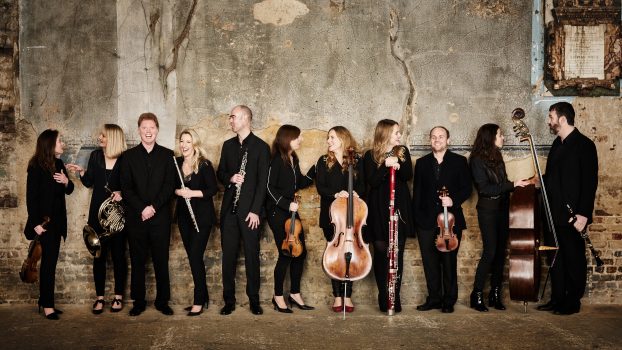
In the second half, Respighi’s beloved sunset song for voice and string quartet brings Hughes together with the string players of Ensemble 360, who will then share Ravel’s dazzling quartet before being rejoined by this very special guest to conclude with a delicate blessing in song.
Song sheets will be available to purchase at this concert.
Please note the earlier start time for this concert.
i. Soundings
ii. Brew
iii. Visitations
iv. Milk Fever
v. Council Offices
I came across Fiona Benson’s collection ‘Bright Travellers’ by chance not long after I’d given birth to my son. I was very taken and moved by the series of poems about pregnancy and early motherhood and knew instantly that I wanted to set them. The poems are direct, sometimes funny and achingly beautiful and have a natural musicality about them. Writing this set of five songs was an extremely intense and sometimes emotional experience for me, as the poems move between a huge range of emotions from hope and joy to great sadness.
The first two movements of Ravel’s Quartet were finished in December 1902 and the next month he submitted the first movement for a prize at the Paris Conservatoire, where he was still a student. The jury was unimpressed and the Director Théodore Dubois was typically acidic, claiming that it “lacked simplicity”. The failure to win a prize meant that Ravel’s studies with Fauré were over but Ravel persisted with the Quartet, and by April 1903 he had finished all four movements. He put it aside for yet another doomed attempt at the Prix de Rome, but it’s likely that he made further revisions later in the year. The pianist and composer Alfredo Casella recalled running into Ravel in the street in January 1904: “I found [Ravel] seated on a bench, attentively reading a manuscript. I asked him what it was. He said: It is a quartet I have just finished. I am rather pleased with it.” The first performance was given at the Schola Cantorum by the Heymann Quartet, on 5 March 1904. It is dedicated “à mon cher maître Gabriel Fauré”.
In a parallel with Debussy’s Quartet, Ravel makes use of cyclic themes – material heard in the first movement returns in various guises throughout. The second movement is notable for Ravel’s brilliant use of cross-rhythms as all four string players become a kind of gigantic guitar. The rhapsodic slow movement includes a dream-like recollection of the cyclic theme. In the finale, Ravel’s use of irregular time signatures generates a momentum that is not only impossible to predict but impossible to resist. Recollections of the cyclic theme are woven into the texture with great subtlety and the kaleidoscopic string writing produces a conclusion that glitters and surges.
Timothy Cape, Edward Henderson, Caitlin Rowley, Josh Spear
These four composer-performers integrate theatre, spoken word, choreography and visuals into their music-making, often coated with a deliciously wild sense of humour. Their music is beautiful, wonderful and endlessly surprising. Expect the unexpected!
Sounds of Now is a platform for musicians who are creating and exploring some of the most exciting artistic ideas today, nurturing talent, inspiring new thinking and provoking debate. This new series from Music in the Round is your invitation to engage and connect with music in new ways.
BYSTRÖM Kinderszenen (8’) ABRAHAMSEN Six Pieces for Horn Trio (15’) GRIEG Cello Sonata (28′)
A wonderful soundscape evoking the icy Swedish winter opens this concert, written by Swedish composer Britta Byström. It features horn, violin and piano, the same combination as Abrahamsen’s Six Pieces, which is also evocative and plays with the timbre of the different instruments. This Scandinavian programme concludes with Grieg’s Cello Sonata, full of warm-hearted charm, joyous excitement and just the occasional hint of his more famous Piano Concerto.
BYSTRÖM Britta, Kinderszenen (Scenes of Childhood) for horn, piano and violin
After starting to learn the trumpet at the age of ten, Britta Byström soon started to compose her own music. Most of her output is for orchestra, but her quest for new and surprising sonorities can also be heard in chamber works including a string quartet (Letter in April), and a piano trio (Symphony in Yellow) as well as the present horn trio. Byström’s Kinderszenen borrows its title from Schumann’s famous piano work and its scoring from Brahms’s Horn Trio, but the music is entirely original in colour and substance. Bystöm says that before starting a composition she always has a clear picture in her mind of the musical world she wants to create, and this is apparent from the first notes of Kinderszenen where fragmentary themes on violin and horn are set against repeated notes on the piano, suggesting perhaps that Byström’s childhood scenes are those of a Swedish winter. The form of this single movement and its contrasting episodes seem to evolve naturally: a fast section is notable for its rhythmic energy but fizzles out on a sustained horn note, giving way to a passage of eerie calm with the violin playing pizzicato against piano trills. A brief return to the vigour of the fast music leads to a recollection of the opening before Kinderszenen dissolves into silence.
My 6 Pieces for horn, violin and piano was written in 1984 as a commission from the Danish Radio for a concert where Ligeti’s horn trio should receive its Danish premiere played by Danish musicians.
My trio is based on my work ’Studies for Piano’. While I wrote these studies I tried to ’conjure up’ instrumental parts inside the piano movement. When I received the commission for a horn trio I turned to six of the studies and deepened them by ’screening them’ so that their parts and moods appeared in a clearer way. Furthermore I changed the order of the movements so a new unity appeared, beginning with a steadily hesitating ’Serenade’ in slow-motion followed by the ’Arabesque’ which hardly gets started before it stops. Then ’Blues’, a melancholy melody and ’Marcia Funebre’, like a fossilized picture with a dramatic threatening outburst ending with a quiet but majestic melody in violin and horn, a melody that disappears in the chords of the piano. Before the last movement ’For the Children’ is a large ’Scherzo misterioso’.
1. Allegro agitato
2. Andante molto tranquillo
3. Allegro molto e marcato
Grieg’s great fame as a composer rests largely on the Piano Concerto, a handful of piano pieces, the Holberg Suite and movements from his incidental music for Peer Gynt. One work from the same period as the Piano Concerto was to provide an important source for the Cello Sonata: the incidental music for the play Sigurd Jorsalfar from 1872. The Cello Sonata was started in late 1882 and the first draft was finished in April 1883. Grieg dated the manuscript of his slightly revised version of the work 18 August 1883. It is one of a handful of major chamber works, along with three violin sonatas, one complete surviving string quartet and one left incomplete. The first movement of the Cello Sonata is in sonata form (something of a rarity for Grieg) and opens with a passionate and agitated theme which eventually gives way to a calmer second theme introduced by gentle chords on the piano. The movement ends with an animated coda based on the opening idea (with added hints of the opening phrase from the Piano Concerto). The expressive slow movement is based largely on the recycled ‘Homage March’ from Grieg’s Sigurd Jorsalfar incidental music (aptly enough, since in the original orchestral version this passage is scored for four cellos). The finale opens with a cadenza for the cello before launching into an extended Norwegian dance which occasionally threatens to become bombastic but which ends impressively. The work was dedicated by Grieg to his brother John, an accomplished cellist, and on 1 October 1883, Grieg sent him the first printed copy. The first two performances were given by two of Europe’s preeminent cellists of the time. The premiere was given by Friedrich Grützmacher in Dresden on 22 October 1883; a few days later (on 27 October) Julius Klengel gave the work in Leipzig. Grieg was the pianist on both occasions.
L BOULANGER Two Pieces for Violin & Piano (5’) DEBUSSY Piano Preludes Nos 4, 6 & 7 from Book 1 (12’) N BOULANGER Three Pieces for Cello & Piano (8’) SIERRA Butterflies Remember a Mountain (11’) RAVEL Sonata for Violin & Cello (20’)
The Boulanger sisters were pioneering musicians in the early 20th century. Lili was the first woman to win the Prix de Rome composition prize, and Nadia taught many students who went on to become famous, such as Aaron Copland, John Eliot Gardiner and even Burt Bacharach! Debussy also features in this French afternoon, with three of his beautiful, evocative Preludes, and Ravel’s Sonata dedicated to his memory – a piece with echoes of both Debussy and the folk music of Hungary.
Lili Boulanger was the sister of the famous teacher Nadia Boulanger who taught Aaron Copland, Elliott Carter and Philip Glass amongst others. She was a composer for the last 10 years of her tragically short life – she died at 25 – and her music stands in the main line of French music exemplified by Faure, somewhat tinged with the influence of Debussy’s Impressionism. It is generally beautiful, delicately coloured, and touching. These challenging ‘Two Pieces for Violin and Piano’ exemplify these qualities.
The Nocturne begins sparsely, with bare octave figures wound about with a theme built from a repetitive rise-and-fall figure. As the texture becomes thicker the violin becomes more virtuosic and begins to climb. There is no harmonic resolution until the final ppp note in the top register, which is answered by an low octave from the piano.
The Cortege is more lively without being fast. Shifting rhythmic accents, tricky runs and contrasting dynamics make this an exciting piece.
By 1909, Debussy had already composed some of his defining works, including the enthusiastically-received tone poem, Prélude à l’après-midi d’un faune (1894). He had also heard and experienced music outside of the Western Classical tradition.
The fourth prelude of Book I, “Les sons et les parfums tournent dans l’air du soir” (“The sounds and fragrances swirl through the evening air”), takes both its title and inspiration from the poetry of Charles Baudelaire. It is a gentle waltz-like piece in A major with melodies that seem to float as effortlessly as the sounds and fragrances in Baudelaire’s line. Even the harmonies seem tinged with a dusky hue, giving musical evocation to the twilight setting. The prelude is built around three principal ideas and embodies a sort of ternary design, with a brief middle section in the key of A-flat major. It is gentle and subdued, and nowhere is to be found a disturbing phrase or melodic figure. The only true point of contrast within the prelude is a melody in octaves accompanied by a persistent sixteenth-note countermelody. This, however, simply returns us to a variant of the opening melodic motif and the prelude’s serene close.
Des pas sur la neige (Footsteps in the Snow, No. 6) shows Debussy’s unparalleled creativity in using harmonic colours. An omnipresent ostinato runs throughout as a representation, perhaps, of a barren, snow-covered land. Musically, a similar parallel exists: it is a ‘blank’ canvas upon which an array of harmonies are added at different points. These rich sonorities transform the scenery from desolate to ominous to poignant, all before returning to the original key of D minor.
One of the most technically impressive of this first volume is Ce qu’a vu le vent d’ouest (What the West Wind Saw, No. 7) – robust and at times aggressive, this prelude captures the wind’s fury with the sweeping arpeggios, dominant 7th chords, and perhaps surprisingly dense textures – not to mention the massive chords at the conclusion which maximize the instrument’s low register. However furious the character may be, Debussy’s signature innovative style remains present.
BOULANGER Nadia, Three pieces for cello and piano
Moderato Sans vitesse et à l’aise Vite et nerveusement rythmé
Nadia Boulanger, teacher, conductor, early music pioneer and trusted adviser to the likes of Stravinsky and Poulenc, was also a gifted composer. Fiercely self-critical, she always claimed her own music was nothing like as significant as that of her brilliant younger sister, Lili, but with the rediscovery of Nadia’s music it has become clear that she was a remarkable talent in her own right. She entered the Paris Conservatoire at the age of nine and subsequently studied composition with Fauré. Most of her music dates from between 1904 and 1918 (the year Lili died), including the Three Pieces for cello and piano, composed in 1914 and first published the following year. The first, in E flat minor, presents a song-like melody on the cello over a hushed piano part marked doux et vague. After a brief climactic central section, the opening music returns for a serene close in E flat major. The second piece, in A minor, treats a deceptively simple tune – almost a folksong – in an ingenious canon between the cello and the piano. The last piece, in C sharp minor, is quick, with a middle section that provides a contrast in both rhythm and texture to the playful but muscular mood of the rest.
This work, my second for piano trio, was inspired by a study of Monarch butterfly migration patterns, as well as by elements from Ravel’s Trio and my own song setting “Diving Girl” from the cycle Streets and Rivers. The work’s title is derived from the three movement titles as follows:
Butterflies
Remember
A Mountain
Butterflies Remember A Mountain was commissioned by the Philharmonische Gesellschaft Bremen. It is dedicated with admiration to the trio of Nicola Benedetti, violin, Leonard Elschenbroich, cello, and Alexei Grynyuk, piano.
In 1920, Ravel was asked to contribute to a musical supplement in memory of Debussy for the Revue musicale (other contributors included Bartók, Satie and Stravinsky). This ‘Tombeau’ for Debussy (with a front cover specially drawn by Dufy) appeared in December 1920 and included a ‘Duo’ for violin and cello that would become the first movement of the Sonata for Violin and Cello. It was another two years before Ravel completed the other movements and the whole work was published in 1922 with a dedication to Debussy’s memory. Ravel himself described the austere, pared-down language of the Sonata as ‘stripped to the bone’ and said that ‘harmonic charm is renounced’. The Sonata is also remarkable for its thematic unity, and some ingenious cyclic transformations. For instance, the violin theme heard at the start returns later in the work as do other ideas. The Scherzo suggests that Ravel was familiar with Kodály’s 1914 Duo for violin and cello: Ravel includes elements of Hungarian music in a movement of formidable drive and energy. The slow movement is stark and serious and after building slowly to an impassioned climax, its ending is remote and strange. The finale is brilliantly written for both instruments, bringing this extraordinary work to an athletic close, the dissonances finally resolving on to a chord of C major.
BEETHOVEN Piano Sonata No.30 in E Op.109 (22’) BEETHOVEN Piano Sonata No.31 in A flat Op.110 (21’) BEETHOVEN Piano Sonata No.32 in C minor Op.111 (28’) WALLEN The Negro Speaks of Rivers (6’) FRANCES-HOAD Invocation (4′) BEETHOVEN Cello Sonata Op.102 No.2 (20’)
To open the evening, Tim Horton performs Beethoven’s three final piano sonatas: intimate and personal, endlessly complex, monuments of this unique musical mind.
This is followed by a new string version of Wallen’s celebrated choral setting of Langston Hughes’ iconic poem and Frances-Hoad’s Invocation for cello and piano, based on Melancholy, a painting by Edvard Munch. The evening concludes with Beethoven’s Cello Sonata Op.102 No.2.
Please note the change to the previously advertised programme for this concert. We apologise for any disappointment this may cause.
BEETHOVEN Ludwig van, Piano Sonata No.30 in E Op.109
Vivace ma non troppo – Adagio espressivo
Prestissimo
Gesangvoll, mit innigster Empfindung. Andante molto cantabile ed espressivo
In February 1820, Beethoven’s friend Friedrich Starke asked him for a ‘little piece’ for a piano tutor he was writing, with contributions from leading composers. Beethoven wrote the piece, but then received a commission from the Berlin publisher Schlesinger for a set of three sonatas – and Beethoven conceived the last three sonatas as a trilogy. He quickly decided that his ‘little piece’ would work very well as the first movement of the E major Sonata (and Starke was instead given five of the Bagatelles Op.119). The structure is certainly unconventional for the first movement of a sonata, alternating between fast and slow sections, in different time signatures and with sharply contrasted moods. In a way, this procedure recalls Mozart’s keyboard fantasias, except that the three sections of fast music in this movement could run continuously were they not interrupted by the Adagios, explaining why some Beethoven scholars have described the form as ‘parenthetical’. The second movement, in E minor, is fast and stormy, while the finale is a spacious and exalted set of variations on a theme in triple time that has been likened to a Sarabande – indeed Carl Czerny wrote that ‘the whole movement [is] in the style of Handel and Seb. Bach.’ At the end of June 1820 Beethoven told Schlesinger that the new work was ‘ready’, though in September he was still making revisions, and wrote again to say it was ‘almost ready’. It was completed soon afterwards and published by Schlesinger in 1821, with a dedication to Maximiliane Brentano. In a letter to her dated 6 December 1821, Beethoven wrote to her: ‘A dedication!!! – and not one that is misused as so often’. He recalled his love and admiration for her family, noting that ‘While I am thinking of the excellent qualities of your parents, there are no doubts in my mind that you have been striving to emulate these noble people. … May heaven always bless you in everything you do. Sincerely, and always your friend, Beethoven.’
BEETHOVEN Ludwig van, Piano Sonata No.31 in A flat Op.110
Moderato cantabile molto espressivo
Allegro molto
Adagio ma non troppo – Arioso dolente – Fuga: Allegro ma non troppo
During the first few months of 1821, Beethoven was laid low by illness, and was unable to do any composing for weeks on end. It was not until September that he was able to make a serious start on the Piano Sonata Op.110, and even in November he was grumbling to friends that he was still suffering from constant bouts of illness. However, the work was finished on Christmas Day 1821, and quickly sent to Schlesinger. The firm published it in 1822 and unusually, it appeared without dedication, though Thayer speculated that Beethoven intended to dedicate it to Antonie Brentano.
George Bernard Shaw considered Op.110 the most beautiful of all Beethoven’s piano sonatas. The first movement is moderate and elegantly proportioned, leading Charles Rosen to describe it as ‘Haydnesque’. The pithy Scherzo (in F minor) has a slightly folksy roughness – it actually uses a couple of folk tunes – while the Trio is in D flat major and marked by an idea that seems to cascade down the instrument. The reprise of the Scherzo ends in F major and leads straight into the Adagio ma non troppo – initially a recitative that leads to a deeply profoundly expressive Arioso dolente. For many musicians, it is the concluding Fugue (based on a subject built on rising fourths) that places it at or near the summit of Beethoven’s achievements. A sudden interruption of the fugue brings a poignant and tender recollection of the Arioso before the Fugue begins again, the subject now inverted, working towards a climax that is both sublime and majestic. Tovey wrote that ‘this fugue absorbs and transcends the world’, while Stravinsky considered it ‘the climax of this sonata … its great miracle lies in the substance of the counterpoint and it escapes all description.’
BEETHOVEN Ludwig van, Piano Sonata No.32 in C minor Op.111
Maestoso – Allegro con brio ed appassionato
Arietta: Adagio molto, semplice e cantabile
The final sonata in Beethoven’s late trilogy was composed in 1821–2, straight after Op.110, and it was dedicated to his pupil and patron Archduke Rudolph, familiar as the dedicatee of the ‘Archduke’ Trio, and also the person to whom Beethoven inscribed the Missa solemnis, work on which was interrupted to compose the three late piano sonatas. Op.111 is in two movements, the first a turbulent and tempestuous Allegro preceded by a dramatic introduction notable for its extensive use of diminished seventh chords. The driving intensity of the main Allegro finds a moment of repose with the arrival of the second theme, in A flat major. At the end of the movement it is as if all rage has been spent as the music works towards a serene pianissimo conclusion in C major. The second movement is based on a hymn-like theme heard at the start of the movement and treated to an astoundingly diverse series of variations and a coda drenched in trills that seem to take the music to a strange and wonderful expressive world. Alfred Brendel has said of this movement that ‘perhaps nowhere else in piano literature does mystical experience feel so immediately close at hand’.
“The Negro Speaks of Rivers” sets the text of Langston Hughes. The poem was first published in June of 1921 in Crisis, the magazine of the National Association for the Advancement of Colored People, or NAACP.
Invocation was originally the second movement of Melancholia, my first piano trio, written in 1999.
The piano trio is based on Melancholy, a painting by Edvard Munch that formed part of his Frieze of Life. Munch described the Frieze as a “poem of life, love and death”, and Melancholy, which depicts a man (sometimes thought to be the artist himself) looking out at the sea and oppressive sky, concludes the first of the three sections of paintings called Love blossoms and dies.
I had written a chamber opera, with all manner of instruments at my disposal, before starting my piano trio. In Melancholia I aimed at producing a much sparser music (at many points simply a melody with chordal accompaniment) in an attempt to prove to myself that I could still convey a great deal of emotion with only those notes that were absolutely necessary.
BEETHOVEN Ludwig van, Sonata for Cello and Piano in D Op.102 No.2
Allegro con brio
Adagio con molto sentimento d’affetto
Allegro – Allegro fugato
Beethoven’s last two cello sonatas were composed in 1815 dedicated to the Countess Anna Maria Erdödy. The initial critical response was one of bewilderment, one critic declaring that “these two sonatas are definitely among the strangest and most unusual works … ever written for the pianoforte. Everything about them is completely different from anything else we have heard, even by this composer.” Indeed, the D major Cello Sonata Op.102 No.2 is a work that points forward to some of Beethoven’s final instrumental works – the late piano sonatas and quartets – in significant ways. The Beethoven scholar William Kinderman has suggested that the solemnity and austerity of the slow movement (in D minor) has pre-echoes of the ‘Heiliger Dankgesang’ from the Quartet Op.132, while fugal finale is the one of a series of such movements in Beethoven’s late instrumental pieces (followed by the ‘Hammerklavier’ Sonata and the Grosse Fuge among others). The whole sonata, from the brusque opening of its first movement, to the extraordinary culmination of the fugue, is characterized by wild emotional contrasts: the stern, profoundly serious Adagio is flanked by two faster movements that are dominated by a fiery, even angry, dialogue between the two instruments.
A tour through the wondrous world of chamber music, specially created for young audiences, combining some of the most well-known music ever written as well as some new works from surprising places. This brand-new concert includes thrilling musical adventures told through music, cheeky characters and epic heroes, mind-blowing musical games and the chance to join in and make music together.
The concert includes extracts from:
SCHUBERT Octet (3′) HAYDN Russian Quartet Op.33 No.3 (3′) BEETHOVEN Harp Quartet (3′) WEIR String Quartet (5′) DEBUSSY Syrinx (3′) BRAHMS Clarinet Quintet (5’) STRAVINSKY Three pieces for clarinet (1’) MESSIAEN Quartet for the End of Time (2’) BEETHOVEN Septet (3’)
Presented in collaboration with Sheffield Music Hub, featuring the full forces of Ensemble 360 and introduced by Aga Serugo-Lugo, this is a friendly hour of fun and the finest music for families.
SCHUBERT Octet (excerpt for ‘Close Up’)
We begin with a chase! In this ‘scherzo’ or musical joke you will hear eight musicians playing a game of musical hide and seek as they pass this cheeky tune around the group.
HAYDN Russian Quartet No.3 (excerpt for ‘Close Up’)
Haydn was the composer who did most to first create a form of music for two violins, a viola and a cello: a group we know as a string quartet. This piece has the nickname ‘The Bird’ — can you hear why?
BEETHOVEN ‘The Harp’ Quartet (excerpt for ‘Close Up’)
This beautiful quartet is known as ‘the harp’ because in the first part, all four musicians have sections where they pluck the strings their instruments rather than using the bow. Can you hear the difference?
WEIR String Quartet (excerpt for ‘Close Up’)
This string quartet was written by a composer who is making music today, the wonderful Judith Weir. A piece full of mysteries, inspired by a medieval Spanish tune. This quartet sounds like a strange landscape where it’s easy to get lost among these lopsided rhythms where nothing is quite as it seems…
DEBUSSY Syrinx (excerpt for ‘Close Up’)
This piece for flute is one of the most famous pieces for the instrument. It is named after the nymph Syrinx from Ancient Greek mythology. The flute-playing mischievous faun Pan falls in love with Syrinx, but she does not return his love so turns herself into a water reed and hides in the marshes…
BRAHMS Clarinet Quintet (excerpt for ‘Close Up’)
This piece sees the string players joined by a clarinet. This woodwind instrument takes us on a lovely journey. What do you think of as you hear the flowing tune; a river winding through a beautiful scene, a song being sung by a wonderful singer… or something else?
STRAVINSKY Three Pieces for Clarinet (excerpt for ‘Close Up’)
This spikey, short piece of music was created in Russia at the same time Suk wrote the piece we heard earlier. Stravinsky uses the plucking technique we heard in the Meredith and Beethoven, as well clashing notes and unexpected changes in pulse and speed. Stravinsky keeps us guessing what he’ll do next!
MESSIAEN Quartet for the End of Time (excerpt for ‘Close Up’)
This ‘interlude’ was the first part that Olivier Messiaen wrote of his spectacular piece, ‘A Quartet for the End of Time’ which he wrote while a prisoner in Germany during the Second World War. It’s a piece full of angels, birds, heavenly creatures, battles, rainbows and more. This is a quieter space in the middle of the almighty hubbub where three instruments, a violin, a cello and the clarinet come together.
BEETHOVEN Septet (excerpt for ‘Close Up’)
And we end where we began, another ‘scherzo’ or musical joke this time from the monumental Ludwig Van Beethoven! Seven instruments all working together to bounce us out of the concert and into a world filled with music.
BRITTEN Sinfonietta (16’) KNUSSEN … Upon One Note (3’) GRIME Five Northeastern Scenes (12’) SLATER The Light BlindsRPS Composer 2021–22 Commission for Music in the Round (10’) BRAHMS Serenade No.1 (47’)
Ensemble 360 brings the Sheffield Chamber Music Festival to a thrilling climax with a programme showcasing their endless versatility and brilliance. Benjamin Britten was a mentor to Oliver Knussen, and in turn, Knussen had a huge influence on our guest curator Helen Grime. This sequence of great British music is topped off by something completely different: lavish tunes, warm radiance and a jubilant ending courtesy of Johannes Brahms. The perfect finale!
Please note the change to the previously advertised programme for this concert. We apologise for any disappointment this may cause.
PRE-CONCERT TALK6.00pm – 6.45pm ANGELA SLATER, HELEN GRIME &JAMES MURPHY Royal Philharmonic Society FREE, please request tickets when booking for the 7.15pm concert
BRITTEN Benjamin, Sinfonietta Op.1
1. Poco presto ed agitato
2. Variations: Andante lento
3. Tarantella: Presto vivace
Britten was already a very prolific composer by the time he gave this work its designation as his official Opus One. Dedicated to his teacher, Frank Bridge, it was written when Britten was 18 years old, and it already demonstrates his extraordinary imagination. The influence of Schoenberg’s First Chamber Symphony is apparent in places, and the instrumental writing in all three movements has a fluency and flamboyance that quickly became hallmarks of the young Britten’s music. The first public performance was given on 31 January 1933 at the Mercury Theatre, London, in one of the Macnaghten-Lemare concerts played by the English Wind Players and the Macnaghten String Quartet, conducted by Iris Lemare. Britten’s music has always been more enthusiastically received abroad, and on 7 August 1933, the Sinfonietta was broadcast on Radio Strasbourg, conducted by the great Hermann Scherchen. The first British broadcast was a month later, by members of the BBC Symphony Orchestra conducted by Edward Clark.
Purcell’s only five-part fantazia (Z745) gains its title ‘upon one note’ from the middle C which sounds throughout. From the first bar Oliver Knussen begins to distort the rhythms and pitches of his model while retaining the fixed C, which thus finds itself surrounded occasionally by very alien harmony indeed. As though out of a mist, the diatonic tonality of the original emerges from time to time to mark the ends of the sections, which follow the same plan as those of Fantazia 7 (Benjamin). During the final fast section Purcell’s music re-asserts itself unequivocally so that the closing bars are entirely as he wrote them.
Five North Eastern Scenes for oboe and piano was commissioned by the Kunstförderverein Kreis Düren e. V. for the 2016 Spannungen chamber music festival in Heimbach, Germany. The piece is in five short movements. The first, third and fifth explore space and melancholy, while the second and fourth are fleeting and at times more violent.
This is the third work in which I have used the paintings of the Scottish artist Joan Eardley as a starting point. Her vast, emotive snow scenes painted outside in the brief periods of calm between snow storms capture the striking yet bleak beauty of North East Scotland, an area where I grew up, but have not visited for many years.
The Royal Philharmonic Society commissioned Angela Elizabeth Slater as one of its 2021/22 Composers to write this work for Ensemble 360 at Music in the Round’s Sheffield Chamber Music Festival.
The Light Blinds for clarinet quintet explores the drama in extremes of light and darkness, charting a path through the spaces created by the tension of these opposing states. It draws on a short poem that I wrote whilst travelling home from a Music in the Round concert in 2021, following a day exploring the natural landscape around Sheffield.
The first material I wrote for this work was a short solo clarinet fragment, which is heard in the opening of the second section, exploring the line ‘The Light Blinds’. I used this material to shape and construct the rest of the piece, with this short 7/8 material acting as a central organising principle; the entire structure and pitch content emerges from it. This clarinet material is essentially veiled through it being stretched and texturally displaced within the quartet before being revealed in crystalline contrast with the solo clarinet against pulsing harmonics in the quartet. This ‘light blinds’ material becomes increasingly agitated, collapsing in on itself to form and explore the line ‘the dark engulfs’.Here the quartet concentrates on the lowest tessituras of their instruments and is accompanied by the bass clarinet, moving between dramatic and fragile multiphonics and aggressive rumbling material that pulls us further into the depths.
The dark engulfs and the light blinds in neither a sight is seen in clarity a blur, desperate to find a firm grip in focus
Poem by Angela Elizabeth Slater
BRAHMS Johannes, Serenade No. 1 in D Op. 11, nonet version reconstructed by David Walter
Allegro Molto
Scherzo: Allegro non troppo
Adagio non troppo
Minuet
Scherzo: Allegro
Rondo: Allegro
Brahms’s D major Serenade is well known as his first orchestral work – but, like the D minor Piano Concerto from the same period, it had a complicated genesis. It was first conceived in 1857 as a Serenade for eight instruments in three or four movements, and a year later it had become a work in six movements, now scored for nine instruments. By 1860, it had been rewritten for full orchestra – the version that survives today (though Brahms even considered developing that into his first symphony, but decided to leave well alone). The nonet version was performed in public on 28 March 1859 at a concert in Hamburg, and a year later the orchestral version was given its premiere in Hannover. Whether Brahms destroyed the chamber version, or whether the material simply vanished is not known, but a skilful reconstruction reveals something of Brahms’s original conception: a work much closer in spirit to the serenades and divertimentos of Mozart than the reworked orchestral version.
COPLAND Duo for Flute & Piano (15’) WEIR Airs from Another Planet (12′) MOZART Quintet for Piano and Wind in E flat K452 (25’)
This concert gives the wind players of Ensemble 360 a chance to shine, starting with the flute in Copland’s atmospheric evocation of the US landscape. Mozart’s Quintet is one of the best-loved works in the wind repertoire, full of his typical catchy themes shared across the ensemble. ‘Airs from Another Planet’, Judith Weir’s piece for piano and wind quintet, takes traditional Scottish folk tunes and reimagines them as if remembered in the future by a human colony on a distant planet.
PRE-CONCERT TALK, 4.15pm – 4.45pm HELEN GRIME & JUDITH WEIR FREE, please request tickets when booking for the 5.00pm concert
Duo was commissioned by seventy pupils and friends of the celebrated flutist William Kincaid after his death in 1967. Copland described it as lyrical and in a pastoral style. “Lyricism seems to be built into the flute,” he wrote. Duo is in three movements. “The whole is a work of comparatively simple harmonic and melodic outline, direct in expression. Being aware that many of the flutists who were responsible for commissioning the piece would want to play it, I tried to make it grateful for the performer…it requires a good player.” The piece has become a standard in the repertoire of flutists worldwide and is also available in a version for violin and piano.
WEIR Judith, Airs from Another Planet
I once read of an idea to establish a human colony on Mars which was at once visionary and practical. In order to acclimatise themselves, potential settlers would at first live together, sealed off from the human race on a remote Scottish island.
This is the music of the Scottish colonisers, several generations later, marooned on a lonely and distant planet; the ancient forms of their national music almost completely lost in translation, with only the smallest vestiges of the national style remaining.
Three traditional melodies are quoted, but as if refracted through space time, far distances and strange atmospheric effects. These are ‘The Leys of Luncarty’ (heard on the horn in the opening Strathspey); ‘Ettrick Banks’ (played on the clarinet in the Traditional Air) and ‘Miss Margaret Graham of Gartmore’s Favourite’ (played by everyone in the Jig).
MOZART Wolfgang Amadeus, Quintet for Piano and Wind in E flat K452
Largo – Allegro moderato
Larghetto
Allegretto
In a letter to his father on 10 April 1784, Mozart described his new Quintet for Piano and Wind as ‘the best piece I have ever written’. Completed on 30 March 1784 it was given its première just two days later on 1 April, at a ‘grand musical concert’ for the benefit of the National Court Theatre in Vienna. The extraordinary programme consisted of two Mozart Symphonies (almost certainly the ‘Haffner’ and the ‘Linz’), an ‘entirely new concerto’ played by Mozart (either K450 or K451, both recently finished), a solo improvisation, three opera arias and the first performance of an ‘entirely new grand quintet’. It was probably the presence of wind players for the symphonies that prompted Mozart to write one of his most original chamber works for this occasion.
While the first movement is designed on almost symphonic lines (complete with substantial slow introduction), it has a gentler sensibility and textures that recall the kind of dialogue between piano and wind that are such a feature of Mozart’s mature piano concertos. After a slow movement that makes the most of the song-like expressiveness of wind instruments, the finale is a sonata rondo – in essence a theme that returns repeatedly within a developing context – that was also much favoured in the piano concertos. The Quintet is highly original in terms of how it is put together, and the daring with which Mozart explores unusual sonorities.
NINFEA CRUTTWELL-READE Three Études for Piano and Flower Pots HARRISON BIRTWISTLE The Axe Manual JOANNA WARD Translucent SIMON HOLT The Sower
“…their enterprise and dedication are breathtaking.” The ArtsDesk
Sounds of Now continues in April when musicians from Psappha perform intoxicating works for eclectic instruments including tuned plant pots and the hypnotic cimbalom, an instrument at the heart of Hungarian folk music.
Since their first performance three decades ago, the musicians of Psappha have become a vital presence in this country’s new music scene. In their Music in the Round debut, these outstanding musicians will also perform Harrison Birtwistle’s The Axe Manual, an extraordinary musical battle that pits the piano against an enormous range of percussion, and a beguiling, ethereal recent work by Joanna Ward for solo cello.
Sounds of Now is a platform for musicians who are creating and exploring some of the most exciting artistic ideas today, nurturing talent, inspiring new thinking and provoking debate. This new live music series from Music in the Round is your invitation to engage and connect with music in new ways.
A bar will be open before the advertised start time.
Following the recent closure of Theatre Deli’s Eyre Street venue, we can now confirm that this concert will take place at Channing Hall, 45 Surrey Street, S1 2LG.
All existing ticket holders are being contacted by Sheffield Theatres’ box office who will be re-issuing tickets. Thank you for your patience and understanding.
CHARLES MINGUS String Quartet No.1 BENJAMIN PATTERSON Duet JEANNE LEE Mingus Meditations LOUISE BOURGEOIS Insomnia Drawings ARCHIE SHEPP Blasé ELAINE MITCHENER Thought Words KATALIN LADIK Genesis 04 CHRISTIAN WOLFF I like to think of Harriet Tubman
Sounds of Now is a platform for musicians who are creating and exploring some of the most exciting artistic ideas today, nurturing talent, inspiring new thinking and provoking debate. This new series from Music in the Round is your invitation to engage and connect with music in new ways.
Elaine Mitchener launches the series with a programme that spans the jazz of Charles Mingus to interpretations of artwork by Louise Bourgeois.
Fusing music, theatre, dance and art, Mitchener is an enthralling performer who manipulates her voice to evoke an incredible range of characters and emotions. She has collaborated with leading composers such as George Lewis and Tansy Davies and artists Christian Marclay and Marina Abramović.
A bar will be open before the advertised start time.
Listen to extracts from the performers about the work they will be performing and tell us what you think online.
Following the recent closure of Theatre Deli’s Eyre Street venue, we can now confirm that this concert will take place at Upper Chapel, Norfolk Street, S1 2JD.
All existing ticket holders are being contacted by Sheffield Theatres’ box office who will be re-issuing tickets. Thank you for your patience and understanding.
“Jon Boden is one of the most lauded folk musicians this century.” Folk Radio UK
Jon Boden is best known is the lead singer of the progressive folk juggernaut Bellowhead, which sold 250,000 albums, had seven singles playlisted on Radio 2 and sold-out hundreds of venues including the Royal Albert Hall. Since Bellowhead split up in 2016 Jon has continued his development as one of the foremost names in English folk music.
Jon performs the self-penned songs of Songs From The Floodplain, Painted Lady, Afterglow and Rose In June, material from Bellowhead, Spiers & Boden his A Folk Song A Day project, in which he recorded 365 folk songs in one year, music from newly-released album Last Mile Home (Mar 2021, Hudson Records) and more.
A bar will be open before the advertised start time.
We use cookies on our website to give you the most relevant experience by remembering your preferences and repeat visits. By clicking “Accept All”, you consent to the use of ALL the cookies. However, you may visit "Cookie Settings" to provide a controlled consent. You can find out how we use and process your data by reading our Privacy Policy
This website uses cookies to improve your experience while you navigate through the website. Out of these, the cookies that are categorized as necessary are stored on your browser as they are essential for the working of basic functionalities of the website. We also use third-party cookies that help us analyze and understand how you use this website. These cookies will be stored in your browser only with your consent. You also have the option to opt-out of these cookies. But opting out of some of these cookies may affect your browsing experience.
Necessary cookies are absolutely essential for the website to function properly. These cookies ensure basic functionalities and security features of the website, anonymously.
Cookie
Duration
Description
cookielawinfo-checkbox-analytics
11 months
This cookie is set by GDPR Cookie Consent plugin. The cookie is used to store the user consent for the cookies in the category "Analytics".
cookielawinfo-checkbox-functional
11 months
The cookie is set by GDPR cookie consent to record the user consent for the cookies in the category "Functional".
cookielawinfo-checkbox-necessary
11 months
This cookie is set by GDPR Cookie Consent plugin. The cookies is used to store the user consent for the cookies in the category "Necessary".
cookielawinfo-checkbox-others
11 months
This cookie is set by GDPR Cookie Consent plugin. The cookie is used to store the user consent for the cookies in the category "Other.
cookielawinfo-checkbox-performance
11 months
This cookie is set by GDPR Cookie Consent plugin. The cookie is used to store the user consent for the cookies in the category "Performance".
viewed_cookie_policy
11 months
The cookie is set by the GDPR Cookie Consent plugin and is used to store whether or not user has consented to the use of cookies. It does not store any personal data.
Functional cookies help to perform certain functionalities like sharing the content of the website on social media platforms, collect feedbacks, and other third-party features.
Performance cookies are used to understand and analyze the key performance indexes of the website which helps in delivering a better user experience for the visitors.
Analytical cookies are used to understand how visitors interact with the website. These cookies help provide information on metrics the number of visitors, bounce rate, traffic source, etc.
Advertisement cookies are used to provide visitors with relevant ads and marketing campaigns. These cookies track visitors across websites and collect information to provide customized ads.


 Download