FESTIVAL LAUNCH: SONGS AND DANCES

Tine Thing Helseth, Kathryn Stott & Ensemble 360

Crucible Playhouse, Sheffield
Friday 12 May 2023, 7.15pm

£21
£14 DLA, UC & PIP
£5 Under 35s & Students 

Save £s when you book for 5 concerts or more at the same time 

Past Event

MARTINŮ La Revue De Cuisine (15’)
DVOŘÁK Slavonic Dances Nos. 1 and 2 (for piano four hands) (10’)
WEILL  Nanna’s Lied; Youkali; Je ne t’aime pas (8’)
DE FALLA Pantomime and Ritual Fire Dance from ‘El Amore Brujo’ (9’)
FRANÇAIX Dixtuor for string quintet and wind quintet (18’)
SAINT-SAËNS Septet for trumpet, string quintet and piano (18’) 

This concert will put a song in your heart and a dance in your step! International star trumpet player Tine Thing Helseth joins Ensemble 360 to launch Sheffield Chamber Music Festival 2023 in style, with the rhythms of charleston and tango from Martinů, de Falla’s instantly recognisable Fire Dance, and more.  

Festival Curator Kathryn Stott joins the party, playing Dvořák’s sumptuous Slavonic dances for piano four hands with Ensemble 360’s Tim Horton, and the evening comes to a rollicking end as Ensemble 360 are joined by both Tine and Kathy for a tour de force from Saint-Saëns.

Welcome Drinks
Celebrate the start of the Festival with us and enjoy a post-concert complimentary glass of wine or soft drink in the Crucible Foyer (served to all ticket-holders).


DVOŘÁK Antonín, Slavonic Dances Op.46, Nos.1 & 2

Presto (furiant)
Allegretto scherzando (dumka)

It was Brahms who recommended his publisher Simrock to take on the Bohemian composer Antonín Dvořák, then in his thirties but largely unknown outside Prague. After the success of the Moravian Duets in 1878, Simrock immediately asked Dvořák for a set of Czech dances for piano four-hands as companion pieces to Brahms’s Hungarian Dances. Dvořák was delighted at the prospect and wrote them quickly between 18 March and 7 May 1878, producing a set of very stylised pieces drawing on the forms and characteristics of Czech folk dances. The Slavonic Dances immediately enjoyed huge success, and in 1886 Dvořák produced a second set. The first dance is a furious Presto in the style of a furiant (very fast, with syncopations and cross-rhythms). The second is the only one of the set for which the composer took inspiration from beyond Czech lands: its origins were a Ukrainian Dumka, a wistful lament which is intercut with livelier episodes.  

© Nigel Simeone 

WEILL Kurt, Nanna’s Lied; Youkali; Je ne t’aime pas

Nannas Lied (1939) 
Youkali (1934) 
Je ne t’aime pas [I don’t love you] (1934) (arr. for trumpet and piano) 

After Kurt Weill heard Hanns Eisler’s 1936 setting of Bertolt Brecht’s Nannas Lied he decided that he wanted to make a version of his own, and just before Christmas 1939, he produced this song, dedicating it to the singer Lotte Lenya. Youkali, subtitled a ‘Tango-habanera’ was originally an instrumental Tango for Weill’s ill-fated French musical Marie Galante which opened in Paris on 22 December 1934. In 1946 a version for voice and piano was published as Youkali. Je ne t’aime pas was a song for voice and piano, on a text by Maurice Magre, also composed in 1934 during Weill’s time in France. As a prominent Jewish composer – renowned for The Threepenny Opera and The Rise and Fall of the City of Mahagonny – Weill was forced to flee Nazi Germany in 1933 and eventually settled in New York in September 1935 where he was able to rebuild his career with successful Broadway works such as Lady in the Dark, One Touch of Venus, Street Scene and Lost in the Stars.  


© Nigel Simeone 

DE FALLA Manuel, Pantomime and Ritual Fire Dance from ‘El Amore Brujo’

El amor brujo, known in English as Love, the Magician began as gitaneria (danced entertainment) in 1915. In due course, Falla expanded the orchestration and made some other changes before the definitive version of the ballet was given for the first time on 22 May 1925, at the Théâtre du Trianon-Lyrique in Paris, conducted by the composer. Four years before then, Falla’s own piano arrangement of the Ritual Fire Dance was published in London and it immediately became a very popular recital piece with pianists including Arthur Rubinstein and Myra Hess. The Pantomime that precedes it here begins with some bold splashes of Andalusian colour before turning to a lilting theme in 7/8 time. In the ballet, the Ritual Fire Dance is the moment when the gypsy Candela seeks to cast out the malign ghost of her dead husband. During this dance, which grows from sinister beginnings to a ferocious climax, the ghost is drawn into the flames and vanishes forever. Falla made the present arrangement of the Pantomime and Ritual Fire Dance for piano and string quintet in 1926.


© Nigel Simeone 

FRANÇAIX Jean, Dixtuor

Larghetto tranquillo – Allegro 
Andante 
Scherzando 
Allegro 
 

Jean Françaix came from a musical family and took up composing at the age of six. He became a favourite pupil of Nadia Boulanger, and his youthful gifts were also recognised by Ravel. During the 1930s, his output included chamber music, orchestral pieces, ballets, the opera Le diable boiteux and an oratorio, L’Apocalypse selon Saint Jean. After World War Two, Françaix continued to produce a stream of new works, including several film scores. His style remained neo-classical, usually marked by a lightness of touch and wit. 


The Dixtuor, for string quintet and wind quintet, is one of his last major works, the manuscript dated at the end 24 October 1986. It was a commission for the Cologne-based Linos Ensemble which gave the premiere in 1987. The Dixtuor opens with a long, gentle introduction which gives way to a vigorous Allegro. The lyrical Andante opens with a melody shared by oboe and clarinet (over strings) before the rest of the ensemble join gradually. Marked Scherzando, the third movement makes virtuoso demands on the players, but it is music of genuine charm, with a slow (and endearingly odd) central Trio section. The finale is a brisk Allegro 

© Nigel Simeone 

SAINT-SAËNS Camille, Septet Op.65

Préambule. Allegro moderato 
Menuet. Tempo di minuetto moderato 
Intermède. Andante 
Gavotte et Final. Allegro non troppo – Più allegro  
 

Saint-Saëns wrote his Septet for the chamber music society ‘La Trompette’ and dedicated the work to its founder, Émile Lemoine. La Trompette gave the first performance of the ‘Préambule’ at one of its soirées in the rue de Grenelle in January 1880 and the complete work was given its premiere on in December 1880, with Saint-Saëns at the piano.  


The dedicatee, Lemoine, noted down the origins of the piece on Saint-Saëns’s autograph manuscript: ‘For a long time, I’d been pestering my friend Saint-Saëns to compose something for our evenings at La Trompette, a serious work which included a trumpet mixed with the string instruments and piano which we normally had. At first he joked about this bizarre combination of instruments, saying that he would first write something for guitar and 13 trombones. In 1879 he gave me a piece for trumpet, piano, string quartet and double bass entitled Préambule which was played on 6 January 1880. It no doubt pleased Saint-Saëns because he told me afterwards that “you will have your complete piece and the Préambule will be the first movement”. He kept his word, and the Septet was played for the first time on 28 December 1880.’ 


The four movements give a clear indication of Saint-Saëns’s classical leanings and his fondness for ancient dance forms, but what gives the work its delightful individuality is the unusual mixture of instruments combined with particularly fertile melodic invention.  


© Nigel Simeone 

“Tine Thing Helseth’s playing is stylish in every way ”

Gramophone magazine 

CLOSE UP: MUSIC FOR CURIOUS YOUNG MINDS

Ensemble 360 & Aga Serugo-Lugo

Junction, Goole
Saturday 11 March 2023, 11.00am / 2.00pm
Past Event

A tour through the wondrous world of chamber music, specially created for young audiences, combining some of the most well-known music ever written as well as some new works from surprising places.

This brand-new concert includes thrilling adventures told through music, cheeky characters and epic heroes along with mind-blowing musical games and the chance to join in and make music together.

Introduced by Aga Serugo-Lugo, this is a friendly hour of fun and the finest string quartet music. Ideal for 7-11 year olds.

The concert includes extracts from:

SCHUBERT ‘Death And The Maiden’
HAYDN ‘The Bird’
MOZART String Quartet In E Flat
WEIR String Quartet
SUK  Meditation on an Old Czech Chorale
MEREDITH Short Tribute to Teenage Fanclub
BEETHOVEN ‘The Harp’
BURLEIGH Oh Lord, What a Morning
STRAVINSKY Pieces for String Quartet
DVOŘÁK ‘American Quartet’

SCHUBERT String Quartet in D Minor (excerpt for ‘Close Up’)

Hey Presto! We begin with a twitchy chase from Franz Schubert, which he told the string players should be played ‘presto’ meaning ‘very quick or very fast’. How does the sound change when each musician plays on their own? How do you feel when they all play the same tune together? This tense piece kicks off an exciting hour of music…

HAYDN Russian Quartet No.3 (excerpt for ‘Close Up’)

Haydn was the composer who did most to first create a form of music for two violins, a viola and a cello: a group we know as a string quartet. This piece has the nickname ‘The Bird’ — can you hear why?

MOZART String Quartet In E Flat K428 (excerpt for ‘Close Up’)

This beautiful tune is almost like a lullaby and shows how gentle the sound of the strings can be. Listen to the way the first violin plays a tune and the other three instruments rock gently back and forth underneath, creating a warm blanket of sound. This is music to wrap up warm within. How does it make you feel?

WEIR String Quartet (excerpt for ‘Close Up’)

This string quartet was written by a composer who is making music today, the wonderful Judith Weir. A piece full of mysteries, inspired by a medieval Spanish tune. This quartet sounds like a strange landscape where it’s easy to get lost among these lopsided rhythms where nothing is quite as it seems…

SUK Josef, Meditation on an Old Czech Chorale (excerpt for ‘Close Up’)

This piece was written at the start of the first world war and is full of the drama and sadness of a scary time. But it ends full of hope with long notes seeming to climb into the air. Look and listen out for all the times the musicians play across the strings to make two or more notes sound at once — a technique called double stopping.

MEREDITH Anna, Short Tribute to Teenage Fanclub (excerpt for ‘Close Up’)

Anna Meredith is another musician writing music today. She makes music for her band as well as for classical musicians, often mixing up instruments usually seen in an orchestra with rock and pop instruments. This piece combines the two and is a tribute to one of her favourite bands performed by string quartet who don’t use their bows at all but pluck their instruments in a technique called ‘pizzicato’.

BURLEIGH Henry Thacker, Oh Lord, What A Morning (excerpt for ‘Close Up’)

This is a traditional song created by enslaved Africans in America. The composer and singer Harry Burleigh was the grandchild of slaves who became a famous musician and helped share music by black people with the rest of the world. This simple song looks forward to a better time when injustices like slavery and racism will end. Perhaps you can hear both the sadness and the hope in this beautiful music.

BEETHOVEN ‘The Harp’ Quartet (excerpt for ‘Close Up’)

This beautiful quartet is known as ‘the harp’ because in the first part, all four musicians have sections where they pluck the strings their instruments rather than using the bow. Can you hear the difference?

STRAVINSKY Igor, Three Pieces for String Quartet (excerpt for ‘Close Up’)

This spiky, short piece of music was created in Russia at the same time Suk wrote the piece we heard earlier. Stravinsky uses the plucking technique we heard in the Meredith and Beethoven, as well clashing notes and unexpected changes in pulse and speed. Stravinsky keeps us guessing what he’ll do next!

DVOŘÁK ‘American’ String Quartet (excerpt for ‘Close Up’)

This piece brings our concert to a celebratory end, from Czech composer Anton Dvořák. Listen out for all the places it gets louder, or faster — or both! — or where the quartet hang back to build tension. This piece uses folk tunes from Czechoslovakia, where Dvořák was born and started writing, and includes a native American tune, and music from all the people like him who had travelled to live and work in the USA. Bringing these together, our concert ends with an explosion of joy!

SIR SCALLYWAG & THE GOLDEN UNDERPANTS

Ensemble 360 & Polly Ives

Junction, Goole
Saturday 21 January 2023, 11.00am / 2.00pm

Book online or call the box office 01405 763652

Past Event

When King Colin’s golden underpants go missing, it’s Sir Scallywag to the rescue! Brave and bold, courageous and true, he’s the perfect knight for the job… even if he is only six years old! 

Original music by our children’s Composer-in-Residence, Paul Rissmann, features instruments including strings, woodwind, and horn, presented together with story-telling and projected illustrations from the best-selling children’s book by Giles Andreae and Korky Paul.  

Performed by the wonderfully dynamic and hugely engaging Ensemble 360 and Polly Ives, this concert is a great introduction to live music for children. It’s full of wit, invention, songs and actions, and plenty of opportunities to join in. 

BOHEMIAN QUARTETS

Ensemble 360

Junction, Goole
Saturday 11 March 2023, 7.00pm

£15 per concert
Book online or call the box office 01405 763652

Past Event

SUK Meditation on an Old Czech Chorale (7’)
SMETANA String Quartet No.1 From My Life (31’)
Arr. BURLEIGH  (adapted for string quartet by Jeremy Birchall)
   I’ve been in the storm
Oh Lord, what a morning
(7′)
DVOŘÁK String Quartet No.12 American Quartet (26’) 

Opening with Suk’s Meditation on the Chorale St Wenceslas and including the African-American composer Burleigh’s quartet settings of I’ve been in the storm and Oh Lord, what a morning, this sumptuous evening of music concludes with Dvořák’s most famous quartet.  

This turbulent and thrilling selection of music tracks the relationship between nineteenth century quartet writing in eastern Europe and the musical conversations that played a decisive role in the evolution of chamber music.  

SMETANA Bedřich, String Quartet No.1 in E minor ‘From my Life’

Allegro vivo appassionato
Allegro moderato à la Polka
Largo sostenuto
Vivace

In 1874 Smetana fell ill with an infection that led within months to total deafness. For peace and quiet he moved to the village of Jabkenice in Central Bohemia, and it was here that he produced this overtly autobiographical quartet in 1876. Smetana supplied his own commentary on the work. It opens with ‘the call of fate (the main motif, first heard on the viola) into the struggle of life. The love of art in my youth; inclination towards romanticism in music as well as in love and life in general; a warning about my future misfortune – that fateful ringing of the highest tones in my ears which told me of my coming deafness.’

The second movement (à la Polka) brings back, according to Smetana, ‘memories of the merry time of my youth’, while the third ‘reminds me of the beauty of my first love for the girl who later became my faithful wife. The struggle with unhappy fate, the final achievement of my goal.’ For the fourth movement Smetana wanted to depict: ‘the recognition of a national awareness of our beautiful art, the pleasure derived from it and the happiness of success along the way until a terrible-sounding high tone starts ringing in my ear (in the quartet a high E) … as a warning of my cruel fate.’

The first performance took place in Prague on 29 March 1879. During his last years, Smetana’s behaviour became increasingly erratic. Early in 1884 he was moved to an asylum in Prague where he died a few months later.

© Nigel Simeone 2015

BURLEIGH Henry Thacker, I’ve been in the storm & Oh Lord, what a morning

Henry (Harry) Burleigh was born in Pennsylvania in 1866 – his grandfather had been emancipated from slavery in the 1830s and his father fought for the Union Navy during the American Civil War. As a child, Burleigh’s grandfather taught him the melodies that were commonly sung by enslaved African-Americans. In his teenage years he developed into a fine classical singer, making regular solo appearances at churches and synagogues.

At the age of 26 he moved to New York to study at the National Conservatory of Music, which coincided with the arrival of the Conservatory’s new director, Antonín Dvořák, who’d been brought to America with the specific role of laying the foundations of an authentic national musical style. Dvořák was thrilled by Burleigh’s voice, and there’s some evidence to suggest that it was Burleigh who introduced certain melodies to Dvořák which would find their way into the ‘New World’ Symphony and ‘American’ String Quartet.

Burleigh’s long career was centred around performing and publishing his arrangements, helping to popularise Swing Low, Deep River and Nobody Knows the Trouble I’ve Seen. He died at the age of 82 and his body is interred in Erie, the town where he was born and which celebrates his music and wider legacy with a week-long annual festival.

© Tom McKinney

DVOŘÁK Antonin, String Quartet in F Op.96 ‘American’

Allegro ma non troppo
Lento
Molto vivace
Finale. Vivace ma non troppo

Dvořák was teaching in New York in 1893, and for his summer holiday he travelled over a thousand miles westwards, to the village of Spillville in Iowa, set in the valley of the Turkey River. It had been colonized by Czechs in the 1850s and in these congenial surroundings Dvořák quickly wrote the String Quartet in F major. On the last page of the manuscript draft, he wrote: ‘Finished on 10 June 1893, Spillville. I’m satisfied. Thanks be to God. It went quickly.’

Coming immediately after the ‘New World’ Symphony (which was to have its triumphant première in New York later in the year), the quartet has a mood that suggests something of his contentment in Spillville. Dvořák’s assistant Josef Kovařík recalled the composer’s routine: walks, composing, playing the organ for Mass and talking to locals, observing that he ‘scarcely ever talked about music and I think that was one of the reasons why he felt so happy there.’

Just how ‘American’ is the quartet? While remaining completely true to himself, Dvořák admitted that ‘as for my … F major String Quartet and the Quintet (composed here in Spillville) – I should never have written these works the way I did if I hadn’t seen America’. The first performance was given in Boston on New Year’s Day 1894 by the Kneisel Quartet.

© Nigel Simeone

BEETHOVEN, BERWALD & MOZART

Ensemble 360

Junction, Goole
Saturday 21 January 2023, 7.00pm

Book online or call the box office 01405 763652

Past Event
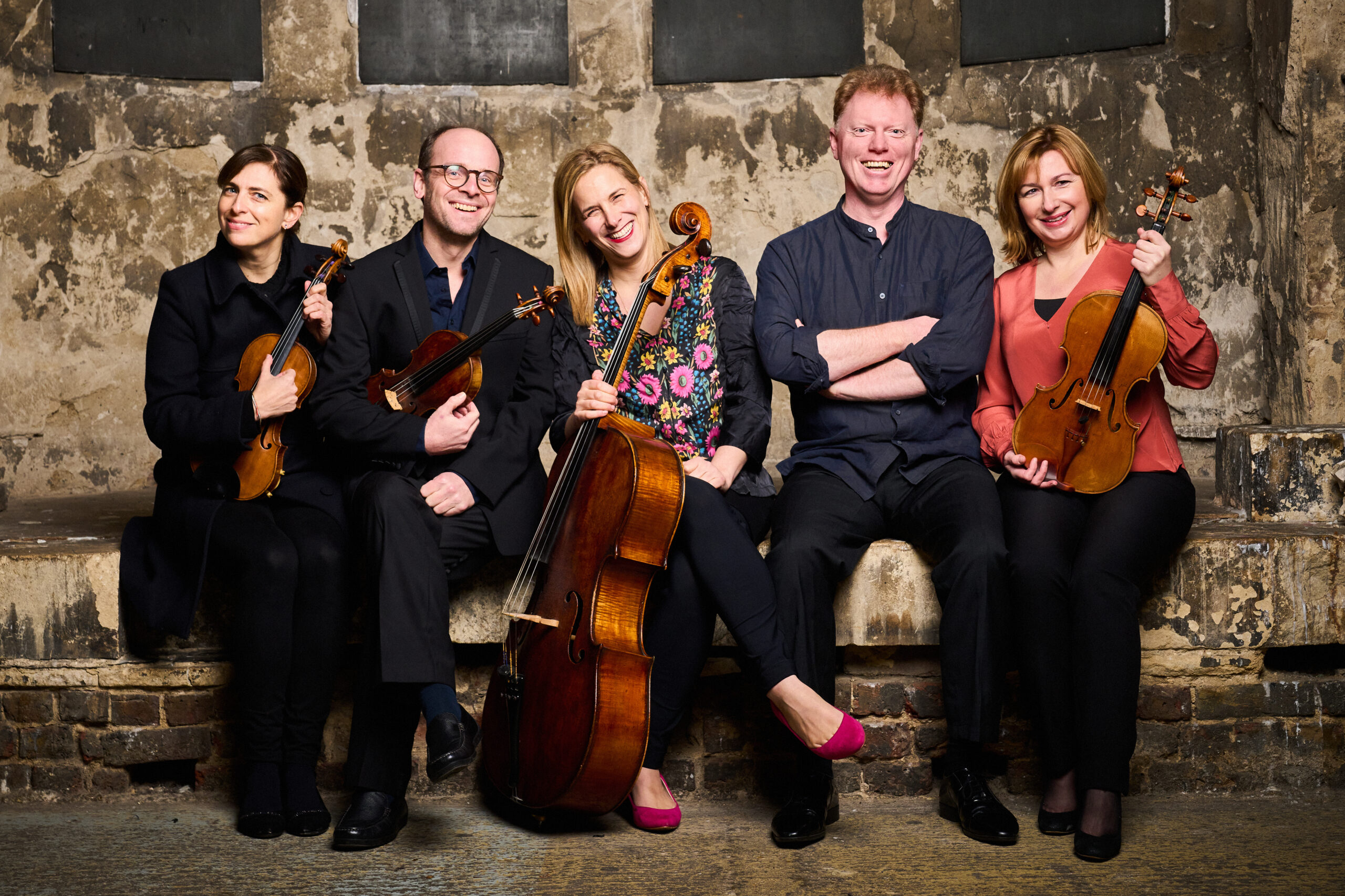
Five classical musicians from Ensemble 360 pose together, seated and smiling. They are our resident musicians in Sheffield and nationally.

BERWALD Grand Septet in B-flat (25′)
MOZART Clarinet Quintet in A K581 (35′)
BEETHOVEN Septet in E-flat, Op.20 (40′)

An evening featuring three celebrated works of chamber music, all on a larger scale.

Beethoven’s Septet was his most popular work; an inventive, celebratory piece, full of youthful energy and generosity of spirit, punctuated by fanfares, solos, cadenzas and exuberant fireworks! The evening begins with a Romantic septet, inspired by Beethoven, and written by his Swedish younger contemporary, Berwald; Mozart’s sublime Clarinet Quintet follows.

BERWALD Franz, Grand Septet in B flat

Adagio
Allegro molto
Poco adagio
Prestissimo
Poco adagio
Finale: Allegro con spirito


The influence and popularity of Beethoven’s Septet spread across Europe and the work was regularly performed in Berwald’s native city of Stockholm. Now widely regarded as the most important Swedish composer of the nineteenth century, during his lifetime Berwald was seldom able to earn a living from his music, working instead as a successful physiotherapist and, later, manager of a glass works. None of this should lead us to underestimate either Berwald’s creative talent or his imaginative handling of musical form. Both are apparent in this Septet. Completed in 1828, it may have been a reworking of an earlier piece for the same forces. Even so, it is a relatively early work, composed two decades before his best-known pieces such as the Symphonie sérieuse and Symphonie singulière. The musical language is consistently appealing, owing something to contemporary opera and to composers such as Spohr, but the melodies and harmonies have an idiosyncratic character that is entirely Berwald’s own (as at the start of the Allegro molto in the first movement, or the opening of the finale). In terms of the Septet’s design, the most striking innovation comes in the second movement which has a very quick Scherzo embedded within a seemingly conventional slow movement.

MOZART Wolfgang Amadeus, Clarinet Quintet in A K581

Allegro 
Larghetto 
Menuetto 
Allegretto con variazioni  

The Clarinet Quintet was completed on 29 September 1789 and written for Mozart’s friend Anton Stadler (1753–1812). The first performance took place a few months later at a concert in Vienna’s Burgtheater on 22 December 1789, with Stadler as the soloist in a programme where the premiere of the Clarinet Quintet was a musical interlude, sandwiched between the two parts of Vincenzo Righini’s cantata The Birth of Apollo, performed by “more than 180 persons.” 

From the start, Mozart is at his most daringly beautiful: the luxuriant voicing of the opening string chords provides a sensuously atmospheric musical springboard for the clarinet’s opening flourish. The rich sonority of the Clarinet Quintet is quite unlike that of any other chamber music by Mozart, but it does have something in common with his opera Così fan tutte (premièred in January 1790), on which he was working at the same time. In particular, the slow movement of the quintet, with muted strings supporting the clarinet, has a quiet rapture that recalls the trio ‘Soave sia il vento’ (with muted strings, and prominent clarinet parts as well as voices) in Così. The finale of the Quintet is a Theme and Variations which begins with folk-like charm, then turns to more melancholy reflection before ending in a spirit of bucolic delight. 

Nigel Simeone © 2012 

CHOPIN: WORKS FOR SOLO PIANO

Tim Horton

Junction, Goole
Thursday 1 December 2022, 7.00pm

£15 per ticket

Book online or call the box office 01405 763652

Past Event

R SCHUMANN Kreisleriana Op.16 (32′)
STOCKHAUSEN Klavierstück VII (7’)
CHOPIN Two Nocturnes Op.27 (12’)
CHOPIN Three Mazurkas Op.59 (11’)
CHOPIN Sonata No.3 in B minor Op.58 (26’) 

Tim Horton continues his exploration into the music of one of the greatest composers for piano, Frédéric Chopin. Few musicians have had an influence on other composers quite like Chopin, and Tim has selected a sequence of some of his most beautiful music to illustrate this. Robert Schumann’s music is of intense passion that leaps without warning from tender to wild melodies, while Karlheinz Stockhausen’s approach to the piano was to find an entirely new world of sound, creating fascinating spine-tingling sonorities. 

Please note the change to the previously advertised programme for this concert.
We apologise for any disappointment this may cause.

SCHUMANN Robert, Kreisleriana Op.16

Writing to a Belgian friend in 1839, Schumann wrote that of all his piano pieces, ‘I love Kreisleriana the most’, though he went on to admit that ‘only Germans will understand the title.’ In the same letter, he explained that ‘Kreisler was created by E.T.A. Hoffmann, an eccentric, wild and ingenious musician. There are many things about him you will like.’ The volatile mood-swings of Kreisleriana and the almost improvised feeling of some pieces are brilliantly imaginative musical evocations of the fictitious Kreisler’s personality. By turns passionate, intimate, capricious, dream-like and dramatic, Schumann wrote the pieces for Clara Wieck (whom he was to marry in 1840). Schumann told her that in Kreisleriana ‘you will play the main role, and I wish to dedicate it to you. You will smile so sweetly when you recognize yourself in them.’ Ultimately, the dedication was changed (Clara was afraid that accepting it would risk worsening the strained relations with her father), and the first edition, published in 1838, had an inscription from Schumann ‘to his friend F. Chopin’. Although Chopin’s reaction to the work was lukewarm, the following year he reciprocated by dedicating his Second Ballade to Schumann.

Nigel Simeone

STOCKHAUSEN Karlheinz, Klavierstück VII

Karlheinz Stockhausen began his series of Klavierstücke in 1952 while he was studying with Olivier Messiaen at the Paris Conservatoire. Klavierstück VII was composed in 1954 (a year after he left Paris) and extensively revised in 1955. One of the most remarkable features of the piece is the use of silently depressed keys allowing sympathetic vibrations to be set up. The result is that different sonorities are created by the same pitch – a technique that can be heard throughout the work.

© Nigel Simeone

CHOPIN Frédéric, Two Nocturnes Op.27

Chopin completed the pair of Nocturnes Op.27 in 1836 and they were dedicated to Countess Thérèse d’Apponyi, wife of the Austrian ambassador in Paris. In the rather desolate first nocturne, in C sharp minor, the Chopin scholar Arthur Hedley detected hesitation and anxiety, and a mood of night-time and mystery. Its companion piece, in D flat major, serves as a complete contrast, bringing light where there had been darkness. The opening melody – described by Hugo Leichentritt as ‘achingly beautiful’ – unfolds over a gently undulating accompaniment. Listening to this magnificent pair of pieces, it is no surprise that Schumann welcomed Chopin’s nocturnes as heralds of a new age in piano composition.

© Nigel Simeone

CHOPIN Frédéric, Three Mazurkas Op.59

Chopin’s mazurkas, inspired by the folk dances of his homeland, are often where he was at his most experimental, particularly with harmonies. The three Mazurkas Op.59 were composed in 1845. The first, in A minor, contains daring modulations, the second (dedicated to Mendelssohn’s wife, Cécile) is richly melodic (the main theme subtly varied and decorated as the piece progresses), while the third presents a rather brittle angular melody, often supported by chromatic harmonies.

© Nigel Simeone

CHOPIN Frédéric, Sonata No.3 in B minor Op.58

Chopin developed many new forms of piano music, from the kind of audacious miniatures found among the mazurkas to extended single-movement works such as the ballades and scherzos. But he also wrote three piano sonatas, drawing on structures inherited from Mozart and Beethoven. The Piano Sonata No.3, Op. 58, was completed in 1844 and its first movement is in sonata form. Even so, the music seems closer to the world of Chopin’s ballades than to any classical models, particularly in the rhapsodic development section. The outer sections of the Scherzo are filled with rapid movement, the ideas delicate and airy, while the slow Trio is richly harmonised but never loses its hints of unease. After a declamatory opening, the slow movement – a Chopin nocturne in all but name – is dominated by the song-like melody heard near the start, the mood changing for a dream-like central section before returning to the opening idea. The finale has a seemingly unstoppable momentum and energy, and for Marceli Antoni Szulc, Chopin’s first Polish biographer, this movement evoked images of the Cossack Mazeppa on a galloping horse.

© Nigel Simeone

VAUGHAN WILLIAMS 150

Ensemble 360

Junction, Goole
Thursday 3 November 2022, 7.00pm

Book online or call the box office 01405 763652

Past Event
Five classical musicians from Ensemble 360 pose together, seated and smiling. They are our resident musicians in Sheffield and nationally.

VAUGHAN WILLIAMS The Lark Ascending (15’)
VAUGHAN WILLIAMS Concerto for Oboe and Strings (19’)
RAVEL Sonatine for piano (12’)
VAUGHAN WILLIAMS Piano Quintet in C minor (30’) 

Celebrating the 150th birthday of the celebrated composer who embodies the sound of English music. The evening opens with Vaughan Williams’ most famous work, The Lark Ascending, recently voted No.1 in the Classic FM Hall of Fame for a record 12th time, in its original version for piano and violin. This is followed by his Concerto for Oboe and Strings, the compact Sonatine by the composer’s friend and mentor Maurice Ravel, and the evening concludes with his expansive Quintet. 

VAUGHAN WILLIAMS Ralph, The Lark Ascending

Vaughan Williams began The Lark Ascending before the outbreak of the First World War, taking his inspiration from George Meredith’s 1881 poem of the same name. But he set this ‘Romance’ aside during the war and only finished it in 1920. The violinist Marie Hall gave the first performance of the original version for violin and piano in Shirehampton Public Hall (a district of Bristol) on 15 December 1920. Vaughan Williams dedicated the work to her, and she went on to give the premiere of the orchestral version six months later, when it was conducted by the young Adrian Boult at a concert in the Queen’s Hall in London. Free, serene and dream-like, this is idyllic music of rare and fragile beauty.

© Nigel Simeone

VAUGHAN WILLIAMS Ralph, Concerto for Oboe and Strings

Rondo pastorale
Minuet and Musette
Finale (Scherzo)

Vaughan Williams started to compose his oboe concerto in 1943, immediately after the Fifth Symphony, and it was completed in 1944. His friend and biographer Michael Kennedy wrote that ‘a discarded scherzo from the symphony was turned into part of the oboe concerto’, and he described it as a ‘satellite work’ to the symphony. It was written for the oboist Léon Goossens and the premiere was planned for the 1944 Proms. That concert was cancelled due to the risk of flying-bombs over London and Goossens gave the first performance in Liverpool on 30 September 1944.

The bucolic first movement – an unconventional rondo – is marked Allegro moderato and it uses both the oboe’s spiky agility and its lyrical capabilities, with short cadenzas near the start and finish. In his book on Vaughan Williams, Frank Howes noted that the Minuet and Musette was ‘wayward in its key scheme’ and described the whole movement as ‘pseudo-classical’ in character. The central ‘Musette’ section is based on drones, played by the oboe. Headed ‘Finale (Scherzo)’, the last movement is predominantly very fast, but perhaps the highlight of the whole Concerto is the slower central section, the soloist musing over richly-harmonised string chords, before a return of the fast material and a quiet, sustained close.

© Nigel Simeone

RAVEL Maurice, Sonatine

Modéré
Mouvement de menuet
Animé

Ravel composed his Sonatine in 1903–5, just after finishing the String Quartet and the song-cycle Shéhérazade. After several fruitless attempts to win the Prix de Rome, Ravel finally decided that he should pursue his own musical path, and the Sonatine was one of the first results – a work of great refinement, on a much smaller scale than the piano cycle Miroirs that he worked on at the same time.

Ravel’s title evokes something of the elegance of the Classical period, though from the very start it is obvious that Ravel is not attempting any kind of pastiche. Even so, the first movement is in a clearly defined sonata form. The opening presents a singing theme in octaves with a shimmering accompaniment in the inner parts. The second theme is gentler, supported by typically luminous harmonies. The Minuet is a graceful dance, and the finale is driven by the almost omnipresent rapid notes heard at the start of the movement. There are moments of repose, but the movement surges to a flamboyant conclusion.

Ravel dedicated the Sonatine to his friends Ida and Cipa Godebski. The premiere was given in Lyon on 10 March 1906 by Mme Paule de Lestaing, and first performed in Paris on 31 March 1906, by Gabriel Grovlez.

© Nigel Simeone

VAUGHAN WILLIAMS Ralph, Quintet in C minor for violin, viola, cello, double bass and piano

Allegro con fuoco
Andante
Fantasia, quasi variazioni

This Quintet in C minor, scored for the same instrumentation as Schubert’s Trout, was composed in 1903 and revised twice before the first performance at the Aeolian Hall on 14 December 1905, but after a performance in 1918 it was withdrawn by Vaughan Williams. It was finally published in an edition by Bernard Benoliel a century after its composition. Vaughan Williams’s friend and biographer Michael Kennedy speaks of ‘the shadow of Brahms looming over’ the work, and this seems especially true of the expansive first movement. The expressive, romantic melody of the Andante second movement is more characteristic of its composer at this stage in his career, and it has some similarity to the song Silent Noon, composed the same year. The finale is a set of five variations, ending with a beautiful bell-like coda.

As Michael Kennedy observes, what matters with an early work such as this is not whether it anticipates Vaughan Williams’s later masterpieces (for the most part, it doesn’t), but that it is impressive in its own right. He does, however, make an intriguing observation: ‘Vaughan Williams may have withdrawn the Quintet but he did not forget it, for in 1954 he used the theme of the finale, slightly expanded, for the variations in the finale of his Violin Sonata.’

© Nigel Simeone

MOZART, SCHUMANN, RACHMANINOV & LISZT

Llŷr Williams

The Guildhall, Portsmouth
Monday 21 November 2022, 7.30pm
Past Event

MOZART Fantasia in C Minor K475 (13’)
R SCHUMANN Fantasy in C Op.17 (30’)
RACHMANINOV Variations on a Theme of Corelli (19’)
LISZT Légende No.1: ‘St François d’Assise: la prédication aux oiseaux’ (10’)
LISZT Mephisto Waltz No.1 (11’) 

Llŷr Williams is known and loved by television and radio audiences the world over for his role as pianist in the finals of BBC Cardiff Singer of the World. In this solo recital, Llŷr brings together some of the most captivating works for piano. The endlessly inventive fantasies of Mozart and Schumann are a prelude to Rachmaninov’s set of Variations that take us deep into the heart of the piano. Llŷr’s recital ends with works by the master of pianistic virtuosity, Franz Liszt, one a work of profound religious sentiment followed by a second diabolical dance.  

MOZART Amadeus, Fantasia in C minor K475

Mozart completed his Fantasia in C minor on 20 May 1785 and it was published in December 1785 (in tandem with the Piano Sonata in C minor K457) with a dedication to Therese von Trattner (1758–96), one of Mozart’s favourite pupils. The Fantasia shows Mozart at his most audacious and the Mozart scholar Alfred Einstein wrote that the work ‘gives us the truest picture of Mozart’s mighty powers of improvisation – his ability to indulge in the greatest freedom and boldness of imagination, the most extreme contrast of ideas, the most uninhibited variety of lyric and virtuoso elements.’ This extraordinary work combines tragic grandeur with a relish for extreme chromaticism and bravura, alongside moments of great tenderness.

© Nigel Simeone

SCHUMANN Robert, Fantasy in C Op.17

In December 1836, Robert Schumann finished a ‘Sonata for Beethoven’ but revised it in 1838 and gave it the new title Fantasie. It was published in 1839 with a dedication to Franz Liszt. Schumann marks the first movement to be played with ‘imagination and passion’. It is a highly original reinvention of sonata form, with unconventional key relationships and structural innovations, notably the interlude placed at the moment when the recapitulation might be expected to arrive. The second movement depicts Schumann’s imaginary army of Davidsbündler marching against the Philistines. Dominated by obsessive dotted rhythms, this colourful movement ends with a vertiginous coda. The third movement is a complete contrast. It is poetic, restrained, and noble – and surely full of quiet longing for Clara. When Clara first received a copy of the Fantasie she wrote to Schumann that it made her ‘half ill with rapture.’ Just over a year later, on 12 September 1840, they were finally able to marry. Liszt was immensely proud of the dedication, considering the Fantasie to be among the greatest of Schumann’s piano works, but he never performed it in public. Only with the next generation of pianists – many of them pupils of Liszt and Clara Schumann – did the Fantasie take its rightful place as a pinnacle of the Romantic piano repertoire.

© Nigel Simeone

RACHMANINOV Sergei, Variations on a Theme of Corelli

Rachmaninov’s Variations on a Theme by Corelli have a singular place in the composer’s output as the only major work for solo piano that he composed after leaving Russia in 1917. The title is slightly misleading since these are variations on La Folia, an ancient tune that was used by Corelli – as well as by Lully and Vivaldi among others – but certainly wasn’t composed by him. This set of twenty variations (with an Intermezzo between the 13th and 14th variations) was composed in Switzerland and the manuscript is dated 19 June 1931. Rachmaninov himself gave the first performance in Montreal on 12 October 1931. Dedicated to his friend Fritz Kreisler, the variations show Rachmaninov at his most concentrated and ingenious.

© Nigel Simeone

LISZT Franz, Légende No.1: St François d’Assise: la prédication aux oiseaux

In 1862–3, Liszt composed two Legends which he dedicated to his daughter, Cosima von Bülow (later Cosima Wagner). The first legend is a brilliantly evocative musical depiction of St Francis of Assisi praying to the birds. Liszt’s inspiration came not only from religious texts but also from the birds he observed on Monte Mario near Rome, while he was on a retreat – an occasion when he was visited by Pope Pius IX who may have been given a private performance of the piece. Liszt first played it in public at a concert in Budapest on 29 August 1865.

© Nigel Simeone

LISZT Franz, Mephisto Waltz No.1

Liszt composed the Mephisto Waltz No.1 in about 1859, at the same time as a version for orchestra. It was dedicated to Carl Tausig, the Polish virtuoso who was considered Liszt’s most gifted pupil, still in his teens at the time. As well as being a dazzling concert waltz that calls on all a pianist’s technical resources, it is also a programmatic work derived from the 1836 Faust by Nikolaus Lenau (indebted to Goethe, and to Byron). Liszt quotes part of Lenau’s preface in the score to explain the story, which is closely mirrored by the music: A wedding feast is in progress with music and dancing. After encouraging Faust to join the festivities, Mephistopheles snatches a violin and draws seductive sounds from it. Faust whirls about with a beautiful woman in a wild dance, out of the hall and into the woods as a nightingale warbles its song.

© Nigel Simeone

MOZART, BRUCH & MORE

Ensemble 360

Emmanuel Church, Barnsley
Friday 21 April 2023, 7.30pm

£14.50
£10 DLA, UC & PIP recipients
£5 Under 35s & Students 

Past Event

MOZART Kegelstatt Trio K498 (20’)
SCHUMANN Märchenerzählungen (16′)
KURTÁG Hommage à R Schumann (11’)
CLARKE Prelude, Allegro and Pastorale (15′)
BRUCH Selection from 8 pieces Op.83 (c.20’)

Pianist Tim Horton is joined by the two newest members of Ensemble 360, Rachel Roberts on viola and Robert Plane on clarinet, for a varied programme. Programme will include a selection of Bruch’s elegiac, lush fragments and Mozart’s innovative Kegelstatt Trio.

The perfect introduction to these fabulous musicians.  

MOZART Amadeus, Trio in E flat K498 Kegelstatt

Andante
Menuetto
Rondo. Allegretto

This is Mozart’s only trio for his three favourite instruments: clarinet, viola and piano. The nickname ‘Kegelstatt’ means ‘skittle alley’, and legend has it that Mozart wrote the work during a game of skittles. This may be far-fetched, especially given the rather noble character of the music, but what is certain is that he wrote the trio in Vienna, and entered it in his own thematic catalogue on 5 August 1786. The first movement is a marvellous example of Mozart’s invention at its most concentrated and unforced: every element in this sonata-form movement derives from the ornamental turn that is such a distinctive feature of the opening. The Minuet surprises by its almost grand character – no mere courtly dance, but something more imposing – and this is followed by an unhurried Rondo that brings this radiant work to a lyrical conclusion.

© Nigel Simeone

SCHUMANN Robert, Märchenerzählungen Op.132

Lebhaft, nicht zu schnell
Lebhaft und sehr markiert
Ruhiges Tempo, mit zartem Ausdruck
Lebhaft, sehr markiert

Schumann wrote his Märchenerzählungen (‘Fairy Tales’) for the unusual combination of clarinet, viola and piano in October 1853. Whether he chose these instruments with Mozart’s ‘Kegelstatt’ Trio in mind is uncertain, though it was the only other significant work for that particular ensemble. The pieces are haunting and enigmatic: if these miniatures were intended to depict particular stories, Schumann never said. Soon after finishing Märchenerzälungen he had a catastrophic breakdown and spent the last years of his life in an asylum. The pieces are dedicated to Albert Dietrich, who studied with Schumann and was a friend of Brahms. All three collaborated on the F-A-E Sonata for Joseph Joachim.

© Nigel Simeone 2015

KURTÁG György, Hommage à R Schumann for clarinet, viola and piano, Op. 15d 

Vivo 
Molto semplice piano e legato 
Feroce agitato 
Calmo scorrevole 
Presto 
Adagio poco andante  

Kurtág scored his Hommage à R. Sch. for the same instrumental combination as Schumann’s Märchenerzählungen, Op. 132, completing the work in 1990. Each of the movements has a subtitle, and most of them refer to the imaginary characters that were such a significant spur to Schumann’s imagination. The first – whimsical and capricious – is headed ‘Kapellmeister Johannes Kreisler’s Curious Pirouettes’, a reference to E.T.A. Hoffmann’s character who inspired Kreisleriana. Next is a quiet canon subtitled ‘Eusebius: the delimited circle’, alluding to the introspective Eusebius figure in Schumann’s own writings. After this comes ‘Florestan’s lips tremble in anguish once more’, evoking Florestan, Eusebius’s outgoing counterpart. The fourth movement has a subtitle in Hungarian which translates as ‘I was a cloud, now the sun is shining’, a quotation from a poem by Attila Jószef (1905–1937). It is followed by ‘In the Night’, an urgent and restless night piece. The sixth movement is much the longest, subtitled ‘Meister Raro discovers Guillaume de Machaut’. Raro was the moderating influence in Schumann’s imaginary brotherhood, between the extremes of Florestan and Eusebius. Here the music resembles a solemn processional recalling both the Medieval spirit and technical procedures of Machaut.   

© Nigel Simeone, 2022 


CLARKE Rebecca, Prelude, Allegro and Pastorale

After studies at the Royal College of Music (where her teachers included Stanford for composition and Lionel Tertis for the viola), Rebecca Clarke began her career as a viola player in Sir Henry Wood’s Queen’s Hall Orchestra, one of London’s first female professional orchestral players. After moving to the United States, Clarke completed her best-known work, the Sonata for Viola and Piano, in 1919. It tied for first place (with a piece by Ernest Bloch) in a composition prize offered by Elizabeth Sprague Coolidge and Clarke followed this with a Piano Trio in 1921. Coolidge commissioned Clarke’s Rhapsody for Cello and Piano in 1923. After returning to London in 1924, Clarke became a busy chamber music performer with less time to devote to composition. When war broke out in 1939, Clarke was in the United States visiting her brothers, one of whom was Hans Clarke, a distinguished biochemist. With the war at its height, she could not return to Britain and in the end she settled in New York. There, by chance, she met James Friskin, a pianist and composer she had known in their student days. They married in 1944 and Clarke stopped composing.

The Prelude, Allegro and Pastorale is one of her last works, written in 1941. It was dedicated to Clarke’s brother Hans and his wife Fietzchen. In an interview in 1978, Rebecca Clarke described the Prelude, Allegro and Pastorale as ‘very simple’ and admitted that she didn’t offer it to any publishers: it ‘came at a time when I was just not bothering about showing things to publishers.’ This was partly due to modesty, but it also reveals something of the obstacles Clarke had to overcome in order to achieve the recognition she deserved (it was eventually published in 2000). Writing for clarinet and viola without piano accompaniment was clearly a challenge Clarke relished and the ingenuity of the dialogue between the two instruments is testimony to her inventiveness and skill. The work is in three sections: the quiet sobriety of Prelude (marked Andante semplice) leads to an angular Allegro vigoroso followed by a rather melancholy Pastorale, marked Poco lento. The quality of the musical ideas here reveals a composer of real character whose career had been blighted by discouragement and depressive illness.

© Nigel Simone 2018

BRUCH Max, Eight Pieces Op.83 for clarinet, viola and piano (extracts)

Bruch composed these pieces in 1908 for his son, Max Felix, who was a clarinettist. Three of the pieces were originally written with an additional harp part, but by the time the work was published in 1910, Bruch had settled on a trio of clarinet, viola and piano. Discussing publication with Simrock in February 1910, Bruch wrote that the pieces had been ‘met with great approval where they were played from the manuscript’ and it’s easy to see why. Bruch always intended separate performances of individual pieces (indeed, he advised against playing all of them together), and selections can be used to make an effective suite.

© Nigel Simeone

SHOSTAKOVICH & BEETHOVEN STRING QUARTETS

Ensemble 360

Emmanuel Church, Barnsley
Friday 27 January 2023, 7.30pm

£14.50
£10 DLA, UC or PIP
£5 Under 35s & Students 

Past Event

STRAVINSKY Three Pieces for String Quartet (7′)
SHOSTAKOVICH String Quartet No.3 Op.73 (32′)
BEETHOVEN String Quartet Op.135 (26′) 

“Must it be? It must be!” Beethoven inscribed these words on the manuscript of his profoundly moving final string quartet. This Op.135 quartet was written towards the very end of his life, and is touched by the wisdom of his years yet as full of contrast, quick wit and struggle as any of earlier works.  

Two masterpieces of the 20th century are presented alongside Beethoven’s quartet: Stravinsky’s wonderfully inventive short pieces and Shostakovich’s masterful third quartet, which encompasses the scope of a symphony in an intimate chamber work. 

STRAVINSKY Igor, Three Pieces for String Quartet

Composed in 1914, Stravinsky revised these pieces in 1918 when he dedicated them to the Swiss conductor Ernest Ansermet. The first performance was given in Paris in May 1915 by a quartet which included the composer Darius Milhaud playing violin, while the 1918 version had its premiere in London on 13 February 1919. The work comprises three short movements without titles or tempo markings. Though the dimensions of the pieces are slight, Stravinsky managed to baffle (and infuriate) early critics with the unusual sound effects and performance markings in places, and the deliberate absence of any conventional forms or traditional thematic development. Instead, the mood is by turns stange and grotesque. The second piece was inspired by the comedian Little Tich (Harry Relph) whose jerky stage act had impressed Stravinsky during a visit to London in 1914. The result might almost be described as an anti-quartet, and as the critic Paul Griffiths later remarked, these little pieces are ‘determinedly not a “string quartet”. The notion of quartet dialogue has no place here, nor have subtleties of blend: the texture is completely fragmented, with each instrument sounding for itself.’  

 Nigel Simeone 

SHOSTAKOVICH Dmitri, String Quartet No.3 in F major Op.73

Shostakovich began his Third String Quartet in January 1946 but made no progress beyond the second movement until May when he went with his family to spend the summer at a dacha near the Finnish border. According to Beria (head of the Soviet secret police) in a letter to Shostakovich, this retreat was a personal gift from Stalin. It was a productive summer and the quartet was completed on 2 August 1946. The same day Shostakovich wrote to Vassily Shirinsky, second violinist of the Beethoven Quartet: ‘I have never been so pleased with a composition as with this Quartet. I am probably wrong, but that is exactly how I feel right now.’ The Beethoven Quartet gave the first performance at the Moscow Conservatory on 16 December 1946. Though there was an ominous silence from official critics, Shostakovich’s reputation was still high among the nation’s leaders: on 28 December he was given the Order of Lenin and each member of the Beethoven Quartet received the Order of the Red Banner of Labour. Just a year later the Third Quartet was denounced in the journal Sovetskaya musika as ‘modernist and false music.’

Although Shostakovich had no overt programme in mind, he invested a great deal of private emotion in the work – sufficient, as Fyodor Druzhinin (violist of the Beethoven Quartet) recalled, for the music to move the composer to tears when he attended a rehearsal in the 1960s, twenty years after he had written it. The start of the first movement, in F major, recalls the Haydn-like mood of the Ninth Symphony (completed in 1945) and this is followed by a contrasting idea, played pianissimo. The development includes some turbulent fugal writing, injecting a sense of unease that hovers over the rest of the movement. The Moderato con moto (in E minor) is based on a series of sinister ostinato figures and frequent repetitions while the third movement is a violent scherzo in G sharp minor. The Adagio is an extended passacaglia (ground bass) that gives way to a Moderato in which some kind of resolution is found in the closing bars, ending with three pizzicato F major chords.


Nigel Simeone

“Vividly present playing and discreet virtuosity”

PlanetHugill.com

SHEFFIELD JAZZ

Fergus McCreadie Trio

Crucible Playhouse, Sheffield
Friday 13 January 2023, 7.30pm

£18
£16 Over 60, Disabled & Unemployed
£9 Students with NUS card
£4 Under 16s 


(Sheffield Jazz tickets do not qualify for any Music in the Round offers or discounts)
 

Past Event

Fergus McCreadie (piano) 
David Bowden (bass) 
Stephen Henderson (drums) 

Award-winning jazz pianist Fergus McCreadie is an improviser of exceptional ability and a composer of elegant, nuanced and captivating music. He burst onto the scene with his self-released debut album Turas in 2018, while his third studio release Forest Floor has been shortlisted for the 2022 Mercury Prize. He cites Keith Jarrett as his greatest inspiration, but his music is rooted in a Scottish folk tradition while honouring the American and Nordic jazz legacies. The Trio’s live performances are exuberant, uplifting and soul-stirring experiences that have prompted comparisons with EST and The Bad Plus for sheer excitement and originality. 

“...his exquisite sense of melody remains undimmed, but the interaction between the pianist and the members of his trio is even more vigorous and vibrant than before, the intensity of their rapport deeply rooted in the jazz tradition ”

Review of Forest Floor album, The Jazz Mann

CHOPIN FOR SOLO PIANO

Tim Horton

Crucible Playhouse, Sheffield
Saturday 14 January 2023, 7.15pm

£21
£14 DLA, UC & PIP
£5 Under 35s & Students 


Save £s when you book for 5 concerts or more at the same time 

Past Event

CHOPIN Prelude in C sharp minor Op.45 (5′)
BACH English Suite No.2 in A minor BWV 807 (15′)
CHOPIN Waltz in A minor Op.34 No.2 (6′)
CHOPIN Fantaisie in F minor Op.49 (13′)
CHOPIN 2 Polonaises Op.26 (13′)
CHOPIN 3 Mazurkas Op.63 (6′)
CHOPIN Polonaise-Fantaisie Op.61 (5′)

For this latest instalment in Tim Horton’s series focusing on Chopin’s music for solo piano, he brings together a range of the composer’s most personal and beautifully intimate works, together with a piece that influenced his music. Johann Sebastian Bach was the composer whom Chopin revered above all others, and his English Suites are works of incredible virtuosity.

CHOPIN Frédéric, Prelude in C sharp minor Op.45

Composed in 1841, the Prelude Op. 45 is quite different from the short pieces that make up the famous collection of Preludes Op. 28. It’s a more extended rather dream-like piece with an unusual and very chromatic cadenza just before the end. According to the Chopin scholar Jean-Jacques Eigeldinger, this is an example of Chopin exploiting ‘colouristic effects unrelated to the thematic material’. Chopin was not known as a great lover of paintings, but he was a close friend of the artist Eugène Delacroix, who was himself passionately interested in music. According to Chopin, Delacroix ‘adores Mozart and knows all his operas by heart; he also spent many hours discussing music with Chopin, a subject about which the composer was famously reticent. Delacroix confided to his journal that Chopin ‘talked music with me … I asked him what establishes logic in music. He made me feel what counterpoint and harmony are; how fugue is like the pure logic in music.’ Eigeldinger has proposed in a fascinating article that the Prelude Op. 45 is a kind of reciprocal gesture: an attempt by Chopin to apply Delacroix’s theories of colour to music. The warm respect these two great creative artists had for each other is demonstrated by an extraordinary account by George Sand of Chopin improvising for Delacroix – the piece that, perhaps, became the Prelude Op. 45:

Chopin is at the piano … He improvises as if haphazardly … ‘Nothing’s coming to me, nothing but reflections, shadows, reliefs that won’t settle. I’m looking for the colour, but I can’t even find the outline.’ ‘You won’t find one without the other’, responds Delacroix, ‘and you’re going to find them both.’ ‘But if I find only the moonlight?’ … Little by little our eyes become filled with those soft colours corresponding to the suave modulations taken in by our auditory senses. And then the note bleue resonates and there we are, in the azure of the transparent night … We dream of a summer night: we await the nightingale. A sublime melody arises.

Nigel Simeone 2010

CHOPIN Frédéric, Waltz in A minor Op.34 No.2

Chopin’s three Grandes valses brillantes Op. 34 were published in 1838. The second waltz in the set suggests that the collective title was a misnomer. Chronologically, it was the first to be composed, probably in 1831, and rather than ‘brilliant’, the mood is lacrymose and melancholic. Marked ‘Lento’, it opens with a melody in the left hand that seems to wander disconsolately, before giving way to an idea in the right hand, at first halting but eventually taking wing. Two brief episodes in A major hint at something more hopeful, but at the end, Chopin returns to the left-hand melody from the opening, and the piece fizzles out in a state of despair.  

 Nigel Simeone, 2021 

CHOPIN Frédéric, Fantaisie in F minor Op.49

Chopin completed his Fantasy in F minor, Op.49, in October 1841 and he wrote about it in touching terms to his friend Julian Fontana: ‘Today I finished the Fantasy – and the sky is beautiful, there’s a sadness in my heart – but that’s alright. If it were otherwise, perhaps my existence would be worth nothing to anyone.In spite of the composer’s self-doubt, the Fantasy is one of his greatest single-movement works, hailed by Chopin’s biographer Frederick Niecks as ‘a masterpiece’ and among the late pieces described by the English Gerald Abraham as ‘the crown of Chopin’s work.’ Vigorous and passionate, it includes allusions to the Polish revolutionary song ‘Litwinka’, sung by patriots at the November Uprising in 1830. The form evolves with apparent freedom recalling the design of Mozart’s C minor Fantasy. The start is a solemn march which gives way to an explosive Agitato section. A plethora of themes follows, and a notable moment comes with the arrival of a chorale-like section (marked Lento sostenuto) in the extremely remote key of B major before a return of material heard earlier and a triumphant conclusion in A flat major.  


Nigel Simeone

CHOPIN Frédéric, Two Polonaises Op.26

Chopin had been fascinated the polonaise, a Polish national dance, since childhood. Both of his Polonaises, Op.26, were published in 1836 and are in minor keys. The first uses polonaise rhythms to fiercely dramatic effect in its outer sections, with a conciliatory and lyrical central Trio. The second is filled with dark passions, whether in the explosive main idea (preceded by fragments of polonaise rhythms) or in the hushed central section in B major.  


Nigel Simeone

CHOPIN Frédéric, Three Mazurkas Op.63

No. 1 in B major
No. 2 in F minor
No. 3 in C sharp minor

This group of three Mazurkas was the last set to be published during Chopin’s lifetime, appearing in 1847 with a dedication to the Countess Laure Czosnowska – a Polish friend of Chopin’s who was reputedly very beautiful and certainly much disliked by George Sand. After a visit to Chopin and Sand at Nohant (in company with the artist Delacroix, the singer Pauline Viardot and Chopin’s old friend Wojciech Grzymala), Sand told Chopin that Laure’s conversation induced migraine, and even that her dog had bad breath. By contrast, Chopin was always delighted by her company, and enjoyed the chance to talk to her in Polish.

Composed the previous year, they form a contrasted group: in terms of speed the three are marked Vivace, Lento and Allegretto. The key contrasts are more extreme: from B major to F minor and C sharp minor. In a long letter to his family dated 11 October 1846 and sent from Nohant, Chopin revealed something of his fastidious and self-critical nature in connection with the composition of these Mazurkas: ‘I have three new mazurkas, I do not think that they are too similar to the old ones … but it takes time to judge properly. When I composed them, it seemed that were good – if it were otherwise I would never write anything. But later comes reflection, and one rejects or accepts it. Time is the best judge, and patience the best master.’ Chopin’s biographer Frederick Niecks marvelled at the originality of these pieces, and he is quoted admiringly by his James Huneker, who add some further praise of his own.

Niecks believes there is a return of the early freshness and poetry in the last three Mazurkas, op. 63. ‘They are, indeed, teeming with interesting matter’, he writes. ‘Looked at from the musician’s point of view, how much do we not see novel and strange, beautiful and fascinating withal? Sharp dissonances, chromatic passing notes, suspensions and anticipations, displacement of accent, progressions of perfect fifths – the horror of schoolmen – sudden turns and unexpected digressions that are so unaccountable, so out of the line of logical sequence, that one’s following the composer is beset with difficulties. But all this is a means to an end, the expression of an individuality with its intimate experiences. The emotional content of many of these trifles – trifles if considered only by their size – is really stupendous.’ Spoken like a brave man and not a pedant! Full of vitality is the first number of op. 63. In B major, it is sufficiently various in figuration and rhythmical life to single it from its fellows. The next, in F minor, has a more elegiac ring … The third, of winning beauty, is in C sharp minor … I defy anyone to withstand the pleading, eloquent voice of this Mazurka.

It was also the mazurkas that produced one of Schumann’s most memorable descriptions of Chopin’s music, presenting them not as experiments in a traditional dance form, but as acts of resistance against the Russian Empire that had suppressed Poland in 1830 (precipitating Chopin’s move to Paris): ‘Fate rendered Chopin still more individual and interesting in endowing him with an original, pronounced nationality: Polish. And because this nationality wanders in mourning robes in the thoughtful artist it deeply attracts us … If the powerful Autocrat of the North knew what a dangerous enemy threatens him in Chopin’s works, in the simple melodies of his mazurkas, he would forbid music. Chopin’s works are cannons buried in flowers.’

Nigel Simeone 2010

CHOPIN Frédéric, Polonaise-Fantaisie Op.6

The Polonaise-Fantasy Op. 61 is a magnificent example of Chopin’s late style. In the mid-1840s he was searching for new forms and the Polonaise-Fantasy was only given a title after the work was finished. By combining heroic elements of the polonaise with the freer, more melancholy mood of the fantasia, the result is a glorious poetic vision summarised by the British Chopin scholar Arthur Hedley, as ‘pride in the past, lamentation for the present, hope for the future.’  


Nigel Simeone

“Tim Horton’s unaffected, heartfelt playing is perfectly judged.”

The Arts Desk