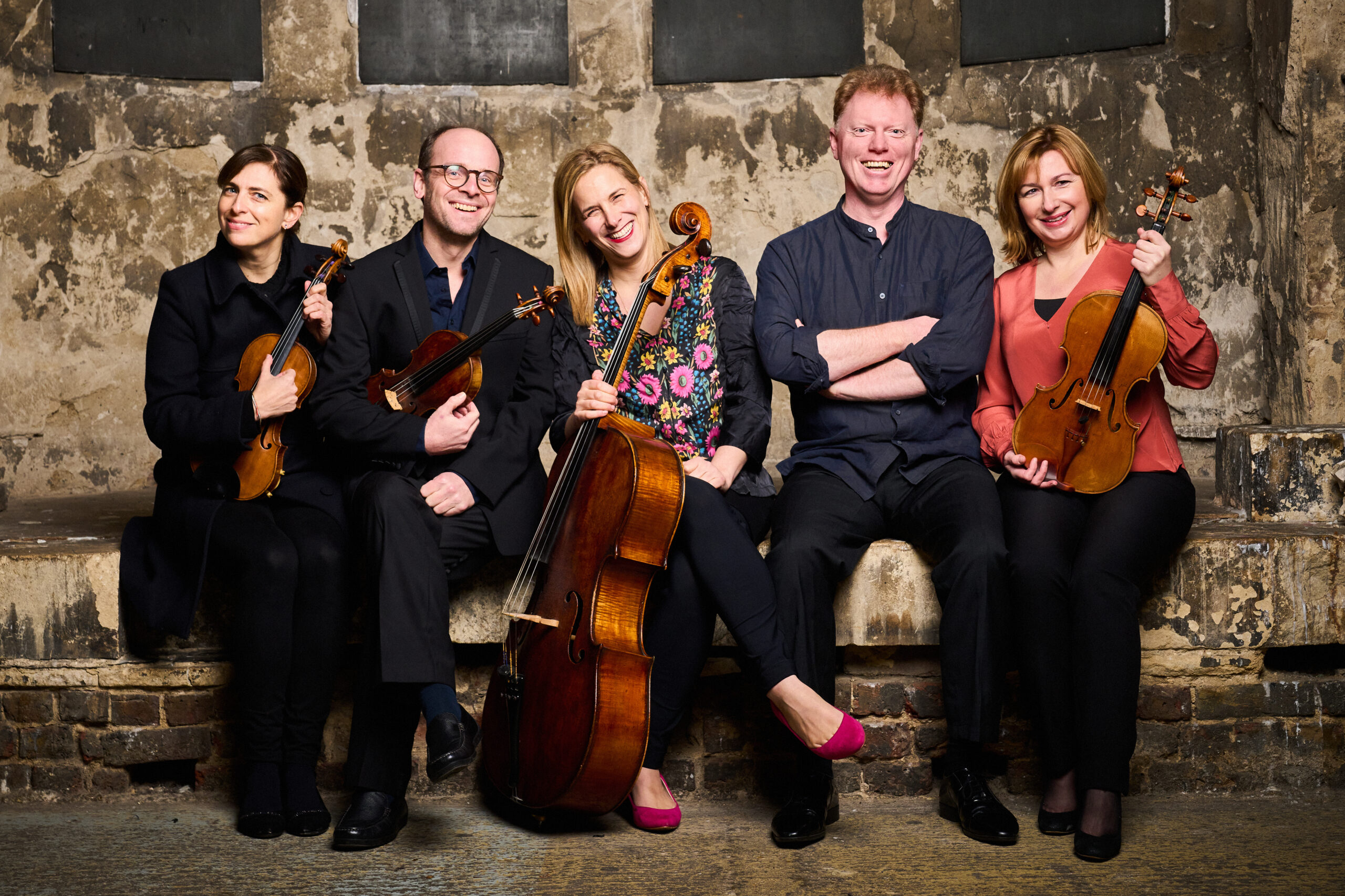
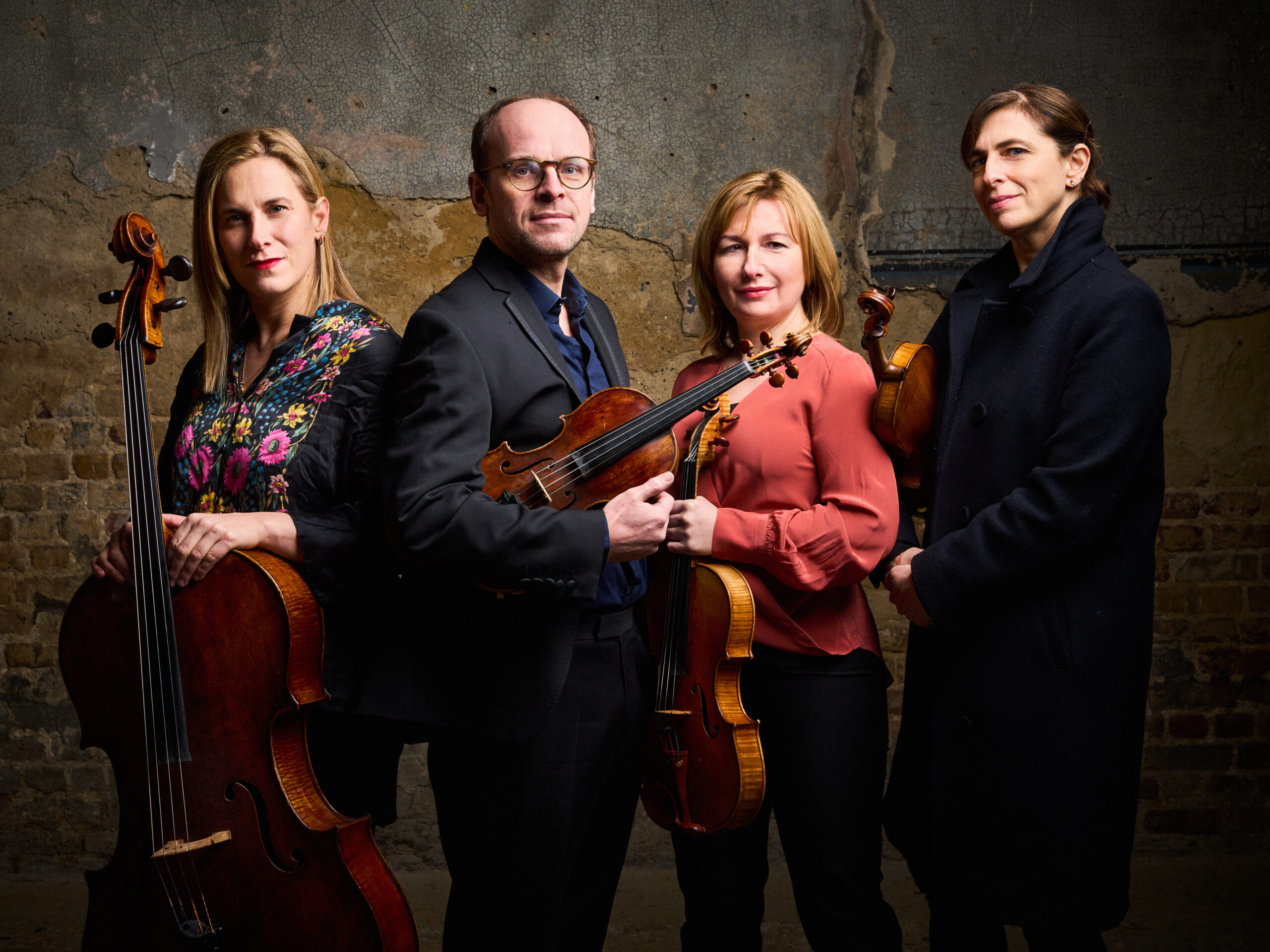
Ensemble 360
VAUGHAN WILLIAMS The Lark Ascending (15’)
VAUGHAN WILLIAMS Concerto for Oboe and Strings (19’)
RAVEL Sonatine for piano (12’)
VAUGHAN WILLIAMS Piano Quintet in C minor (30’)
Celebrating the 150th birthday of the celebrated composer who embodies the sound of English music. The evening opens with Vaughan Williams’ most famous work, The Lark Ascending, recently voted No.1 in the Classic FM Hall of Fame for a record 12th time, in its original version for piano and violin. This is followed by his Concerto for Oboe and Strings, the compact Sonatine by the composer’s friend and mentor Maurice Ravel, and the evening concludes with his expansive Quintet.
Vaughan Williams began The Lark Ascending before the outbreak of the First World War, taking his inspiration from George Meredith’s 1881 poem of the same name. But he set this ‘Romance’ aside during the war and only finished it in 1920. The violinist Marie Hall gave the first performance of the original version for violin and piano in Shirehampton Public Hall (a district of Bristol) on 15 December 1920. Vaughan Williams dedicated the work to her, and she went on to give the premiere of the orchestral version six months later, when it was conducted by the young Adrian Boult at a concert in the Queen’s Hall in London. Free, serene and dream-like, this is idyllic music of rare and fragile beauty.
© Nigel Simeone
Rondo pastorale
Minuet and Musette
Finale (Scherzo)
Vaughan Williams started to compose his oboe concerto in 1943, immediately after the Fifth Symphony, and it was completed in 1944. His friend and biographer Michael Kennedy wrote that ‘a discarded scherzo from the symphony was turned into part of the oboe concerto’, and he described it as a ‘satellite work’ to the symphony. It was written for the oboist Léon Goossens and the premiere was planned for the 1944 Proms. That concert was cancelled due to the risk of flying-bombs over London and Goossens gave the first performance in Liverpool on 30 September 1944.
The bucolic first movement – an unconventional rondo – is marked Allegro moderato and it uses both the oboe’s spiky agility and its lyrical capabilities, with short cadenzas near the start and finish. In his book on Vaughan Williams, Frank Howes noted that the Minuet and Musette was ‘wayward in its key scheme’ and described the whole movement as ‘pseudo-classical’ in character. The central ‘Musette’ section is based on drones, played by the oboe. Headed ‘Finale (Scherzo)’, the last movement is predominantly very fast, but perhaps the highlight of the whole Concerto is the slower central section, the soloist musing over richly-harmonised string chords, before a return of the fast material and a quiet, sustained close.
© Nigel Simeone
Modéré
Mouvement de menuet
Animé
Ravel composed his Sonatine in 1903–5, just after finishing the String Quartet and the song-cycle Shéhérazade. After several fruitless attempts to win the Prix de Rome, Ravel finally decided that he should pursue his own musical path, and the Sonatine was one of the first results – a work of great refinement, on a much smaller scale than the piano cycle Miroirs that he worked on at the same time.
Ravel’s title evokes something of the elegance of the Classical period, though from the very start it is obvious that Ravel is not attempting any kind of pastiche. Even so, the first movement is in a clearly defined sonata form. The opening presents a singing theme in octaves with a shimmering accompaniment in the inner parts. The second theme is gentler, supported by typically luminous harmonies. The Minuet is a graceful dance, and the finale is driven by the almost omnipresent rapid notes heard at the start of the movement. There are moments of repose, but the movement surges to a flamboyant conclusion.
Ravel dedicated the Sonatine to his friends Ida and Cipa Godebski. The premiere was given in Lyon on 10 March 1906 by Mme Paule de Lestaing, and first performed in Paris on 31 March 1906, by Gabriel Grovlez.
© Nigel Simeone
Allegro con fuoco
Andante
Fantasia, quasi variazioni
This Quintet in C minor, scored for the same instrumentation as Schubert’s Trout, was composed in 1903 and revised twice before the first performance at the Aeolian Hall on 14 December 1905, but after a performance in 1918 it was withdrawn by Vaughan Williams. It was finally published in an edition by Bernard Benoliel a century after its composition. Vaughan Williams’s friend and biographer Michael Kennedy speaks of ‘the shadow of Brahms looming over’ the work, and this seems especially true of the expansive first movement. The expressive, romantic melody of the Andante second movement is more characteristic of its composer at this stage in his career, and it has some similarity to the song Silent Noon, composed the same year. The finale is a set of five variations, ending with a beautiful bell-like coda.
As Michael Kennedy observes, what matters with an early work such as this is not whether it anticipates Vaughan Williams’s later masterpieces (for the most part, it doesn’t), but that it is impressive in its own right. He does, however, make an intriguing observation: ‘Vaughan Williams may have withdrawn the Quintet but he did not forget it, for in 1954 he used the theme of the finale, slightly expanded, for the variations in the finale of his Violin Sonata.’
© Nigel Simeone
Tim Horton
R SCHUMANN Kreisleriana Op.16 (32′)
STOCKHAUSEN Klavierstück VII (7’)
CHOPIN Two Nocturnes Op.27 (12’)
CHOPIN Three Mazurkas Op.59 (11’)
CHOPIN Sonata No.3 in B minor Op.58 (26’)
Tim Horton continues his exploration into the music of one of the greatest composers for piano, Frédéric Chopin. Few musicians have had an influence on other composers quite like Chopin, and Tim has selected a sequence of some of his most beautiful music to illustrate this. Robert Schumann’s music is of intense passion that leaps without warning from tender to wild melodies, while Karlheinz Stockhausen’s approach to the piano was to find an entirely new world of sound, creating fascinating spine-tingling sonorities.
Please note the change to the previously advertised programme for this concert.
We apologise for any disappointment this may cause.
Karlheinz Stockhausen began his series of Klavierstücke in 1952 while he was studying with Olivier Messiaen at the Paris Conservatoire. Klavierstück VII was composed in 1954 (a year after he left Paris) and extensively revised in 1955. One of the most remarkable features of the piece is the use of silently depressed keys allowing sympathetic vibrations to be set up. The result is that different sonorities are created by the same pitch – a technique that can be heard throughout the work.
© Nigel Simeone
Chopin completed the pair of Nocturnes Op.27 in 1836 and they were dedicated to Countess Thérèse d’Apponyi, wife of the Austrian ambassador in Paris. In the rather desolate first nocturne, in C sharp minor, the Chopin scholar Arthur Hedley detected hesitation and anxiety, and a mood of night-time and mystery. Its companion piece, in D flat major, serves as a complete contrast, bringing light where there had been darkness. The opening melody – described by Hugo Leichentritt as ‘achingly beautiful’ – unfolds over a gently undulating accompaniment. Listening to this magnificent pair of pieces, it is no surprise that Schumann welcomed Chopin’s nocturnes as heralds of a new age in piano composition.
© Nigel Simeone
Chopin’s mazurkas, inspired by the folk dances of his homeland, are often where he was at his most experimental, particularly with harmonies. The three Mazurkas Op.59 were composed in 1845. The first, in A minor, contains daring modulations, the second (dedicated to Mendelssohn’s wife, Cécile) is richly melodic (the main theme subtly varied and decorated as the piece progresses), while the third presents a rather brittle angular melody, often supported by chromatic harmonies.
© Nigel Simeone
Chopin developed many new forms of piano music, from the kind of audacious miniatures found among the mazurkas to extended single-movement works such as the ballades and scherzos. But he also wrote three piano sonatas, drawing on structures inherited from Mozart and Beethoven. The Piano Sonata No.3, Op. 58, was completed in 1844 and its first movement is in sonata form. Even so, the music seems closer to the world of Chopin’s ballades than to any classical models, particularly in the rhapsodic development section. The outer sections of the Scherzo are filled with rapid movement, the ideas delicate and airy, while the slow Trio is richly harmonised but never loses its hints of unease. After a declamatory opening, the slow movement – a Chopin nocturne in all but name – is dominated by the song-like melody heard near the start, the mood changing for a dream-like central section before returning to the opening idea. The finale has a seemingly unstoppable momentum and energy, and for Marceli Antoni Szulc, Chopin’s first Polish biographer, this movement evoked images of the Cossack Mazeppa on a galloping horse.
© Nigel Simeone
Writing to a Belgian friend in 1839, Schumann wrote that of all his piano pieces, ‘I love Kreisleriana the most’, though he went on to admit that ‘only Germans will understand the title.’ In the same letter, he explained that ‘Kreisler was created by E.T.A. Hoffmann, an eccentric, wild and ingenious musician. There are many things about him you will like.’ The volatile mood-swings of Kreisleriana and the almost improvised feeling of some pieces are brilliantly imaginative musical evocations of the fictitious Kreisler’s personality. By turns passionate, intimate, capricious, dream-like and dramatic, Schumann wrote the pieces for Clara Wieck (whom he was to marry in 1840). Schumann told her that in Kreisleriana ‘you will play the main role, and I wish to dedicate it to you. You will smile so sweetly when you recognize yourself in them.’ Ultimately, the dedication was changed (Clara was afraid that accepting it would risk worsening the strained relations with her father), and the first edition, published in 1838, had an inscription from Schumann ‘to his friend F. Chopin’. Although Chopin’s reaction to the work was lukewarm, the following year he reciprocated by dedicating his Second Ballade to Schumann.
Nigel Simeone
Tim Horton
R SCHUMANN Kreisleriana Op.16 (32′)
STOCKHAUSEN Klavierstück VII (7’)
CHOPIN Two Nocturnes Op.27 (12’)
CHOPIN Three Mazurkas Op.59 (11’)
CHOPIN Sonata No.3 in B minor Op.58 (26’)
Tim Horton continues his exploration into the music of one of the greatest composers for piano, Frédéric Chopin. Few musicians have had an influence on other composers quite like Chopin, and Tim has selected a sequence of some of his most beautiful music to illustrate this. Robert Schumann’s music is of intense passion that leaps without warning from tender to wild melodies, while Karlheinz Stockhausen’s approach to the piano was to find an entirely new world of sound, creating fascinating spine-tingling sonorities.
Please note the change to the previously advertised programme for this concert.
We apologise for any disappointment this may cause.
Chopin completed the pair of Nocturnes Op.27 in 1836 and they were dedicated to Countess Thérèse d’Apponyi, wife of the Austrian ambassador in Paris. In the rather desolate first nocturne, in C sharp minor, the Chopin scholar Arthur Hedley detected hesitation and anxiety, and a mood of night-time and mystery. Its companion piece, in D flat major, serves as a complete contrast, bringing light where there had been darkness. The opening melody – described by Hugo Leichentritt as ‘achingly beautiful’ – unfolds over a gently undulating accompaniment. Listening to this magnificent pair of pieces, it is no surprise that Schumann welcomed Chopin’s nocturnes as heralds of a new age in piano composition.
© Nigel Simeone
Chopin’s mazurkas, inspired by the folk dances of his homeland, are often where he was at his most experimental, particularly with harmonies. The three Mazurkas Op.59 were composed in 1845. The first, in A minor, contains daring modulations, the second (dedicated to Mendelssohn’s wife, Cécile) is richly melodic (the main theme subtly varied and decorated as the piece progresses), while the third presents a rather brittle angular melody, often supported by chromatic harmonies.
© Nigel Simeone
Chopin developed many new forms of piano music, from the kind of audacious miniatures found among the mazurkas to extended single-movement works such as the ballades and scherzos. But he also wrote three piano sonatas, drawing on structures inherited from Mozart and Beethoven. The Piano Sonata No.3, Op. 58, was completed in 1844 and its first movement is in sonata form. Even so, the music seems closer to the world of Chopin’s ballades than to any classical models, particularly in the rhapsodic development section. The outer sections of the Scherzo are filled with rapid movement, the ideas delicate and airy, while the slow Trio is richly harmonised but never loses its hints of unease. After a declamatory opening, the slow movement – a Chopin nocturne in all but name – is dominated by the song-like melody heard near the start, the mood changing for a dream-like central section before returning to the opening idea. The finale has a seemingly unstoppable momentum and energy, and for Marceli Antoni Szulc, Chopin’s first Polish biographer, this movement evoked images of the Cossack Mazeppa on a galloping horse.
© Nigel Simeone
Writing to a Belgian friend in 1839, Schumann wrote that of all his piano pieces, ‘I love Kreisleriana the most’, though he went on to admit that ‘only Germans will understand the title.’ In the same letter, he explained that ‘Kreisler was created by E.T.A. Hoffmann, an eccentric, wild and ingenious musician. There are many things about him you will like.’ The volatile mood-swings of Kreisleriana and the almost improvised feeling of some pieces are brilliantly imaginative musical evocations of the fictitious Kreisler’s personality. By turns passionate, intimate, capricious, dream-like and dramatic, Schumann wrote the pieces for Clara Wieck (whom he was to marry in 1840). Schumann told her that in Kreisleriana ‘you will play the main role, and I wish to dedicate it to you. You will smile so sweetly when you recognize yourself in them.’ Ultimately, the dedication was changed (Clara was afraid that accepting it would risk worsening the strained relations with her father), and the first edition, published in 1838, had an inscription from Schumann ‘to his friend F. Chopin’. Although Chopin’s reaction to the work was lukewarm, the following year he reciprocated by dedicating his Second Ballade to Schumann.
Nigel Simeone
Karlheinz Stockhausen began his series of Klavierstücke in 1952 while he was studying with Olivier Messiaen at the Paris Conservatoire. Klavierstück VII was composed in 1954 (a year after he left Paris) and extensively revised in 1955. One of the most remarkable features of the piece is the use of silently depressed keys allowing sympathetic vibrations to be set up. The result is that different sonorities are created by the same pitch – a technique that can be heard throughout the work.
© Nigel Simeone
Ensemble 360
BRAHMS Clarinet Quintet (40’)
BRAHMS 3 Intermezzi for piano Op.117 (16’)
DOHNÁNYI Sextet (30’)
Ensemble 360’s clarinettist Robert Plane takes centre stage in this programme of sumptuous Brahms and bravura Dohnányi. The concert opens with an autumnal quintet full of subtle turns between languid themes, playful conversation and wistful melodies. Dohnányi’s unusually scored sextet brings together piano, clarinet, horn, violin, viola and cello to create a dramatic and sassy piece that draws on the influences of Brahms, waltzes and dance-like jazz.
Allegro
Adagio
Andantino. Presto non assai, ma con sentimento
Con moto
In 1890, while only in his late fifties, Brahms declared that he was retiring: the String Quintet Op. 111 was to be his farewell from composition. A few months later he heard Richard Mühlfeld, clarinettist of the Meiningen Orchestra, and wrote to Clara Schumann that ‘the clarinet cannot be better played’. It inspired him to carry on composing. In the summer of 1891 Brahms went to stay at Bad Ischl in the Salzkammergut where he wrote the Clarinet Trio and Clarinet Quintet. Mühlfeld gave the premieres of both works on 12 December 1891 in Berlin. On hearing a performance in London the following year, George Bernard Shaw wrote that ‘it surpassed my utmost expectations’, and when the conductor Arthur Nikisch heard the Quintet, he fell to his knees in front of Brahms.
It has a rare and hypnotic beauty, thanks to its pervasive mood of melancholy, occasionally interrupted by quiet rapture, or by fiery gypsy figurations. The opening is played by the strings alone (like Mozart’s Clarinet Quintet), from which the clarinet emerges as if through the mists. Ideas gradually become more fully formed, and Brahms uses the tension between the home key (B minor) and its relative major (D major) to great expressive effect. The slow movement is a song-like Adagio, interrupted by a clarinet outburst in which Brahms evokes the improvisations of gypsy players. The third movement is a gentle interlude, with a more animated central section, and the finale is a theme and variations in which music from the opening movement is recalled at the end, to magical effect.
© Nigel Simeone
Andante moderato
Andante non troppo e con molto espressione
Andante con moto
These three short pieces were composed at the Austrian spa town Bad Ischl in 1892 and first performed in Berlin on 6 January 1893 by the pianist Heinrich Barth. Like the first of the Ballades Op.10, the first Intermezzo is based on a Scottish poem printed in Herder’s collection, this time a lullaby (and, informally, Brahms sometimes called the whole set ‘Lullabies’). Clara Schumann was enchanted by these pieces when she first saw them, telling Brahms that ‘In these pieces I at last feel musical life stir once again in my soul’. When Brahms’s publisher Simrock suggested using Lullabies instead of Intermezzi as the official title, Brahms’s response was endearingly curmudgeonly: ‘It should then say, lullaby of an unhappy mother or of a disconsolate bachelor’.
© Nigel Simeone
Allegro appassionato
Intermezzo
Allegro con sentimento
Presto, quasi l’istesso tempo
Born in Hungary, Dohnányi’s early compositions had been praised by Brahms, and he always had a strong sense of being part of the Austro-German Romantic tradition. In this respect he was very different from his classmate at the Budapest Academy, Béla Bartók, but his music is always beautifully crafted and has very individual harmonic touches. The Sextet for piano, violin, viola, cello, clarinet and horn was completed on 3 April 1935 and it is the most unusually scored of his chamber works. It was first performed in Budapest on 17 June 1935, with the composer at the piano, and received warm reviews. One critic specifically praised the unusual choice of instruments, commenting that ‘the combination … is neither coincidental nor arbitrary.’
The musical structure is unified by Dohnányi’s use of a dramatic rising motif – often on the horn – that is first heard right at the start. The first movement is brooding and tense, but ends with hope (the rising motif returning in triumph). The Intermezzo includes a rather sinister march, while the third movement is a set of variations that includes one that is scherzo-like. This leads directly into the finale – an almost dizzyingly ebullient movement which suggests a kind of jazzed-up Brahms.
Nigel Simeone © 2011
There’s no need to book for any of these free events, just turn up!
Saturday 14 May
10am-4pm
Sheffield Winter Garden
CLASSICAL SHEFFIELD / RAYE HARVEY violin
Musicians from Classical Sheffield perform short concerts throughout the day in Sheffield’s Winter Gardens. Performances include collaborations with violinist Raye Harvey – catch Raye at 1.30pm with CoMA Sheffield and at 2.00pm with violin and cello duo Lucy Philips & Jonny Ingall.
Sunday 15 May
1pm – 1.30pm
Samuel Worth Chapel
COME AND SING PERFORMANCE
SHEFFIELD CHAMBER CHOIR and public participants (CONDUCTED BY ROBERT WEBB)
Singers of all ages and abilities come together for music-making and an informal performance, following a morning of workshopping English composer Tippett’s arrangement of Willis’ Steal Away and American composer Shruthi Rajasekar’s Jayjaykar!.
Wednesday 18 May
1pm – 2pm
Crucible Studio Foyer
POP-UP PERFORMANCES BY LEEDS CONSERVATOIRE
Musicians from Leeds Conservatoire perform short concerts over the hour’s break between concerts.
Wednesday 18 May
4.30pm-6.30pm
Orchard Square
POP-UP PERFORMANCES BY
LEEDS CONSERVATOIRE & THE UNIVERSITY OF SHEFFIELD
Musicians from The University of Sheffield, Leeds Conservatoire, and participants from our recent Bridge weekend for young wind musicians, perform short concerts throughout the afternoon.
Thursday 19 May
5.30pm – 6pm
Site Gallery
SOUNDS OF NOW WORKSHOP PERFORMANCE
COMA SHEFFIELD & SHEFFIELD MUSIC SCHOOL
Sheffield Music School are joined by CoMA Sheffield and musicians from Bastard Assignments in this workshop and informal performance of open scores by Sarah Hennies and Joanna Bailie. The public are welcome to watch the workshop process from 4.30pm, before we open our doors for an informal performance at 5.30pm.
Saturday 21 May
10am – 11am
Crucible Studio Foyer
POP-UP PERFORMANCES BY SHEFFIELD MUSIC ACADEMY
Sheffield Music Academy perform short concerts in the foyer, led by Martin Cropper.
Saturday 21 May
12pm – 1pm
Crucible Studio Foyer & Crucible Adelphi Room
POP-UP PERFORMANCES BY
SHEFFIELD MUSIC ACADEMY & THE UNIVERSITY OF SHEFFIELD MUSIC DEPARTMENT
Musicians from The University of Sheffield and Sheffield Music Academy perform short concerts in the Crucible Studio foyer and Adelphi Room.
R SCHUMANN Kreisleriana Op.16 (32′)
STOCKHAUSEN Klavierstück VII (7’)
CHOPIN Two Nocturnes Op.27 (12’)
CHOPIN Three Mazurkas Op.59 (11’)
CHOPIN Sonata No.3 in B minor Op.58 (26’)
Tim Horton continues his exploration into the music of one of the greatest composers for piano, Frédéric Chopin. Few musicians have had an influence on other composers quite like Chopin, and Tim has selected a sequence of some of his most beautiful music to illustrate this. Robert Schumann’s music is of intense passion that leaps without warning from tender to wild melodies, while Karlheinz Stockhausen’s approach to the piano was to find an entirely new world of sound, creating fascinating spine-tingling sonorities.
Please note the change to the previously advertised programme for this concert.
We apologise for any disappointment this may cause.
Pre-concert talk with Tim Horton and Tom McKinney
6pm – 6.30pm
Tim Horton chats to Music in the Round’s Programme Manager and BBC Radio 3 presenter Tom McKinney.
Free to all ticket-holders for the evening concert. Please request your ticket at time of booking.
Writing to a Belgian friend in 1839, Schumann wrote that of all his piano pieces, ‘I love Kreisleriana the most’, though he went on to admit that ‘only Germans will understand the title.’ In the same letter, he explained that ‘Kreisler was created by E.T.A. Hoffmann, an eccentric, wild and ingenious musician. There are many things about him you will like.’ The volatile mood-swings of Kreisleriana and the almost improvised feeling of some pieces are brilliantly imaginative musical evocations of the fictitious Kreisler’s personality. By turns passionate, intimate, capricious, dream-like and dramatic, Schumann wrote the pieces for Clara Wieck (whom he was to marry in 1840). Schumann told her that in Kreisleriana ‘you will play the main role, and I wish to dedicate it to you. You will smile so sweetly when you recognize yourself in them.’ Ultimately, the dedication was changed (Clara was afraid that accepting it would risk worsening the strained relations with her father), and the first edition, published in 1838, had an inscription from Schumann ‘to his friend F. Chopin’. Although Chopin’s reaction to the work was lukewarm, the following year he reciprocated by dedicating his Second Ballade to Schumann.
Nigel Simeone
Karlheinz Stockhausen began his series of Klavierstücke in 1952 while he was studying with Olivier Messiaen at the Paris Conservatoire. Klavierstück VII was composed in 1954 (a year after he left Paris) and extensively revised in 1955. One of the most remarkable features of the piece is the use of silently depressed keys allowing sympathetic vibrations to be set up. The result is that different sonorities are created by the same pitch – a technique that can be heard throughout the work.
© Nigel Simeone
Chopin completed the pair of Nocturnes Op.27 in 1836 and they were dedicated to Countess Thérèse d’Apponyi, wife of the Austrian ambassador in Paris. In the rather desolate first nocturne, in C sharp minor, the Chopin scholar Arthur Hedley detected hesitation and anxiety, and a mood of night-time and mystery. Its companion piece, in D flat major, serves as a complete contrast, bringing light where there had been darkness. The opening melody – described by Hugo Leichentritt as ‘achingly beautiful’ – unfolds over a gently undulating accompaniment. Listening to this magnificent pair of pieces, it is no surprise that Schumann welcomed Chopin’s nocturnes as heralds of a new age in piano composition.
© Nigel Simeone
Chopin’s mazurkas, inspired by the folk dances of his homeland, are often where he was at his most experimental, particularly with harmonies. The three Mazurkas Op.59 were composed in 1845. The first, in A minor, contains daring modulations, the second (dedicated to Mendelssohn’s wife, Cécile) is richly melodic (the main theme subtly varied and decorated as the piece progresses), while the third presents a rather brittle angular melody, often supported by chromatic harmonies.
© Nigel Simeone
Chopin developed many new forms of piano music, from the kind of audacious miniatures found among the mazurkas to extended single-movement works such as the ballades and scherzos. But he also wrote three piano sonatas, drawing on structures inherited from Mozart and Beethoven. The Piano Sonata No.3, Op. 58, was completed in 1844 and its first movement is in sonata form. Even so, the music seems closer to the world of Chopin’s ballades than to any classical models, particularly in the rhapsodic development section. The outer sections of the Scherzo are filled with rapid movement, the ideas delicate and airy, while the slow Trio is richly harmonised but never loses its hints of unease. After a declamatory opening, the slow movement – a Chopin nocturne in all but name – is dominated by the song-like melody heard near the start, the mood changing for a dream-like central section before returning to the opening idea. The finale has a seemingly unstoppable momentum and energy, and for Marceli Antoni Szulc, Chopin’s first Polish biographer, this movement evoked images of the Cossack Mazeppa on a galloping horse.
© Nigel Simeone
BRAHMS Clarinet Quintet (40’)
BRAHMS 3 Intermezzi for piano Op.117 (16’)
DOHNÁNYI Sextet (30’)
Ensemble 360’s clarinettist Robert Plane takes centre stage in this programme of sumptuous Brahms and bravura Dohnányi. The concert opens with an autumnal quintet full of subtle turns between languid themes, playful conversation and wistful melodies. Dohnányi’s unusually scored sextet brings together piano, clarinet, horn, violin, viola and cello to create a dramatic and sassy piece that draws on the influences of Brahms, waltzes and dance-like jazz.
Allegro
Adagio
Andantino. Presto non assai, ma con sentimento
Con moto
In 1890, while only in his late fifties, Brahms declared that he was retiring: the String Quintet Op. 111 was to be his farewell from composition. A few months later he heard Richard Mühlfeld, clarinettist of the Meiningen Orchestra, and wrote to Clara Schumann that ‘the clarinet cannot be better played’. It inspired him to carry on composing. In the summer of 1891 Brahms went to stay at Bad Ischl in the Salzkammergut where he wrote the Clarinet Trio and Clarinet Quintet. Mühlfeld gave the premieres of both works on 12 December 1891 in Berlin. On hearing a performance in London the following year, George Bernard Shaw wrote that ‘it surpassed my utmost expectations’, and when the conductor Arthur Nikisch heard the Quintet, he fell to his knees in front of Brahms.
It has a rare and hypnotic beauty, thanks to its pervasive mood of melancholy, occasionally interrupted by quiet rapture, or by fiery gypsy figurations. The opening is played by the strings alone (like Mozart’s Clarinet Quintet), from which the clarinet emerges as if through the mists. Ideas gradually become more fully formed, and Brahms uses the tension between the home key (B minor) and its relative major (D major) to great expressive effect. The slow movement is a song-like Adagio, interrupted by a clarinet outburst in which Brahms evokes the improvisations of gypsy players. The third movement is a gentle interlude, with a more animated central section, and the finale is a theme and variations in which music from the opening movement is recalled at the end, to magical effect.
© Nigel Simeone
Andante moderato
Andante non troppo e con molto espressione
Andante con moto
These three short pieces were composed at the Austrian spa town Bad Ischl in 1892 and first performed in Berlin on 6 January 1893 by the pianist Heinrich Barth. Like the first of the Ballades Op.10, the first Intermezzo is based on a Scottish poem printed in Herder’s collection, this time a lullaby (and, informally, Brahms sometimes called the whole set ‘Lullabies’). Clara Schumann was enchanted by these pieces when she first saw them, telling Brahms that ‘In these pieces I at last feel musical life stir once again in my soul’. When Brahms’s publisher Simrock suggested using Lullabies instead of Intermezzi as the official title, Brahms’s response was endearingly curmudgeonly: ‘It should then say, lullaby of an unhappy mother or of a disconsolate bachelor’.
© Nigel Simeone
Allegro appassionato
Intermezzo
Allegro con sentimento
Presto, quasi l’istesso tempo
Born in Hungary, Dohnányi’s early compositions had been praised by Brahms, and he always had a strong sense of being part of the Austro-German Romantic tradition. In this respect he was very different from his classmate at the Budapest Academy, Béla Bartók, but his music is always beautifully crafted and has very individual harmonic touches. The Sextet for piano, violin, viola, cello, clarinet and horn was completed on 3 April 1935 and it is the most unusually scored of his chamber works. It was first performed in Budapest on 17 June 1935, with the composer at the piano, and received warm reviews. One critic specifically praised the unusual choice of instruments, commenting that ‘the combination … is neither coincidental nor arbitrary.’
The musical structure is unified by Dohnányi’s use of a dramatic rising motif – often on the horn – that is first heard right at the start. The first movement is brooding and tense, but ends with hope (the rising motif returning in triumph). The Intermezzo includes a rather sinister march, while the third movement is a set of variations that includes one that is scherzo-like. This leads directly into the finale – an almost dizzyingly ebullient movement which suggests a kind of jazzed-up Brahms.
Nigel Simeone © 2011
ANDY SHEPPARD tenor saxophone
ESPEN ERIKSEN piano
LARS TORMOD JENSET double bass
ANDREAS BYE drums
Multi-award-winning British saxophonist Andy Sheppard, and the Norwegian masters of melody, Espen Eriksen Trio, is a partnership that has resulted in international tours and an acclaimed album. Espen’s trio is a tight unit with a dazzling use of dynamics, ranging from melancholic moods to hypnotic grooves and an almost telepathic level of interplay.
With a career spanning over four decades, working with the likes of George Russell, Gil Evans and Carla Bley, Andy Sheppard is truly one of Europe’s leading saxophonists and composers. Expect absorbing and uplifting music from superb musicians at the top of their game.
With a career spanning over four decades, working with the likes of George Russell, Gil Evans and Carla Bley, Andy Sheppard is truly one of Europe’s leading saxophonists and composers. Expect absorbing and uplifting music from superb musicians at the top of their game.
Please note: Sheffield Jazz concerts are not included in any Music in the Round ticket discount offers.
“The symbiosis between the saxophonist and the trio is truly remarkable.”
All About Jazz
We’re very sorry but this concert has been postponed. Box office staff will be contacting ticket holders over the next few days. Please accept our apologies for any disappointment caused. We look forward to welcoming the artists in a future season.
Programme to include works by HILDEGARD VON BINGEN & HEINRICH BIBER.
Innovative violinist and recently appointed Resident Artist at London’s Southbank Centre, Daniel Pioro, is joined by Katherine Tinker on piano and chamber organ for an exploration flowing from the ancient sacred sounds of Hildegard von Bingen and Heinrich Biber, to a selection of contemporary meditations.
SUK Meditation on an Old Czech Chorale (7’)
SMETANA String Quartet No.1 From My Life (31’)
Arr. BURLEIGH (adapted for string quartet by Jeremy Birchall)
I’ve been in the storm
Oh Lord, what a morning (7′)
DVOŘÁK String Quartet No.12 American Quartet (26’)
Opening with Suk’s Meditation on the Chorale St Wenceslas and including the African-American composer Burleigh’s quartet settings of I’ve been in the storm and Oh Lord, what a morning, this sumptuous evening of music concludes with Dvořák’s most famous quartet.
This turbulent and thrilling selection of music tracks the relationship between nineteenth century quartet writing in eastern Europe and the musical conversations that played a decisive role in the evolution of chamber music.
Allegro vivo appassionato
Allegro moderato à la Polka
Largo sostenuto
Vivace
In 1874 Smetana fell ill with an infection that led within months to total deafness. For peace and quiet he moved to the village of Jabkenice in Central Bohemia, and it was here that he produced this overtly autobiographical quartet in 1876. Smetana supplied his own commentary on the work. It opens with ‘the call of fate (the main motif, first heard on the viola) into the struggle of life. The love of art in my youth; inclination towards romanticism in music as well as in love and life in general; a warning about my future misfortune – that fateful ringing of the highest tones in my ears which told me of my coming deafness.’
The second movement (à la Polka) brings back, according to Smetana, ‘memories of the merry time of my youth’, while the third ‘reminds me of the beauty of my first love for the girl who later became my faithful wife. The struggle with unhappy fate, the final achievement of my goal.’ For the fourth movement Smetana wanted to depict: ‘the recognition of a national awareness of our beautiful art, the pleasure derived from it and the happiness of success along the way until a terrible-sounding high tone starts ringing in my ear (in the quartet a high E) … as a warning of my cruel fate.’
The first performance took place in Prague on 29 March 1879. During his last years, Smetana’s behaviour became increasingly erratic. Early in 1884 he was moved to an asylum in Prague where he died a few months later.
© Nigel Simeone 2015
Henry (Harry) Burleigh was born in Pennsylvania in 1866 – his grandfather had been emancipated from slavery in the 1830s and his father fought for the Union Navy during the American Civil War. As a child, Burleigh’s grandfather taught him the melodies that were commonly sung by enslaved African-Americans. In his teenage years he developed into a fine classical singer, making regular solo appearances at churches and synagogues.
At the age of 26 he moved to New York to study at the National Conservatory of Music, which coincided with the arrival of the Conservatory’s new director, Antonín Dvořák, who’d been brought to America with the specific role of laying the foundations of an authentic national musical style. Dvořák was thrilled by Burleigh’s voice, and there’s some evidence to suggest that it was Burleigh who introduced certain melodies to Dvořák which would find their way into the ‘New World’ Symphony and ‘American’ String Quartet.
Burleigh’s long career was centred around performing and publishing his arrangements, helping to popularise Swing Low, Deep River and Nobody Knows the Trouble I’ve Seen. He died at the age of 82 and his body is interred in Erie, the town where he was born and which celebrates his music and wider legacy with a week-long annual festival.
© Tom McKinney
Allegro ma non troppo
Lento
Molto vivace
Finale. Vivace ma non troppo
Dvořák was teaching in New York in 1893, and for his summer holiday he travelled over a thousand miles westwards, to the village of Spillville in Iowa, set in the valley of the Turkey River. It had been colonized by Czechs in the 1850s and in these congenial surroundings Dvořák quickly wrote the String Quartet in F major. On the last page of the manuscript draft, he wrote: ‘Finished on 10 June 1893, Spillville. I’m satisfied. Thanks be to God. It went quickly.’
Coming immediately after the ‘New World’ Symphony (which was to have its triumphant première in New York later in the year), the quartet has a mood that suggests something of his contentment in Spillville. Dvořák’s assistant Josef Kovařík recalled the composer’s routine: walks, composing, playing the organ for Mass and talking to locals, observing that he ‘scarcely ever talked about music and I think that was one of the reasons why he felt so happy there.’
Just how ‘American’ is the quartet? While remaining completely true to himself, Dvořák admitted that ‘as for my … F major String Quartet and the Quintet (composed here in Spillville) – I should never have written these works the way I did if I hadn’t seen America’. The first performance was given in Boston on New Year’s Day 1894 by the Kneisel Quartet.
© Nigel Simeone
PART Pari Intervallo
CAGE Harmony XVIII (from 44 Harmonies)
ROOSENDAEL Rotations for solo recorder
CAGE Harmony XX (From 44 Harmonies)
LIM slowly, turning WORLD PREMIERE
CAGE Harmony XXXVI & HARMONY XL (From 44 Harmonies)
HOSOKAWA Sen V for solo accordion
CAGE Harmony XII (From 44 Harmonies)
PART Spiegel im Spiegel
A unique programme of music and movement, inspired by the physicality of Roosendael’s Rotations, created by virtuoso recorder player, Tabea Debus and dazzling accordion player Samuele Telari, in collaboration with award-winning choreographer Sally Marie.
Featuring a new commission and works from giants of twentieth century music, the show will make full use of the intimate ‘in the round’ Studio Theatre space for its first ever performance before touring to the United States and beyond.
Presented in partnership with the Young Classical Artists Trust.