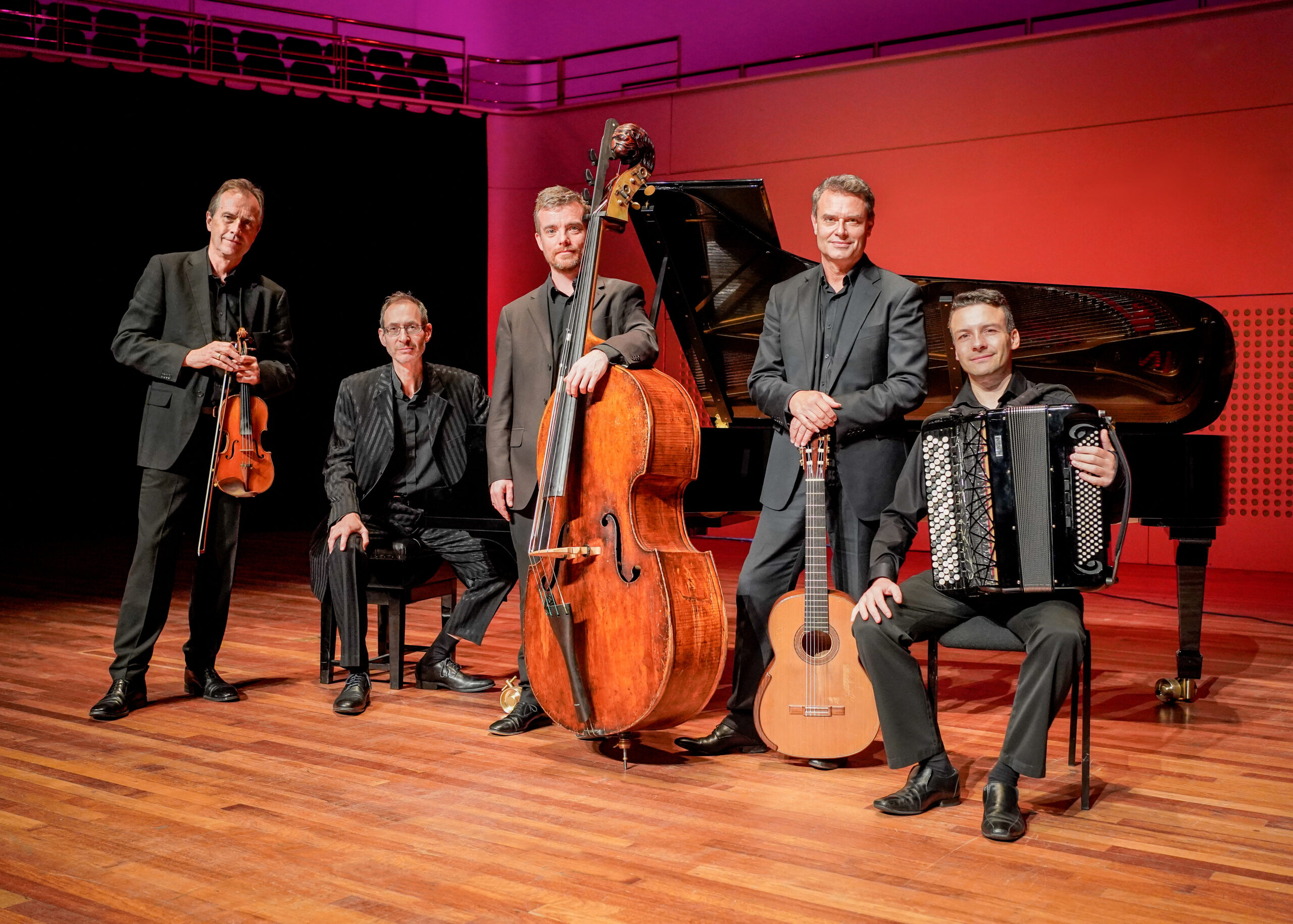
MOONLIGHT SONATA

Kathryn Stott, Tine Thing Helseth & Ensemble 360

Crucible Playhouse, Sheffield
Saturday 13 May 2023, 7.15pm

£21
£14 DLA, UC & PIP
£5 Under 35s & Students 

Save £s when you book for 5 concerts or more at the same time 

Past Event

D SCARLATTI (arr. LIPATTI) Six Sonatas (20’)
PUCCINI Storiella d’amore; Sole e amore; E l’uccellino; Canto d’anime Avanti Urania! (11’)
BEETHOVEN ‘Moonlight’ Sonata (15’)
SHOSTAKOVICH Sonata for viola and piano (35’) 

Beethoven’s beloved ‘Moonlight’ Sonata takes the spotlight, performed by Ensemble 360’s Tim Horton, with echoes of the same piece in Shostakovich’s Viola Sonata – the final notes ever written by the Russian master 

Performances from guest stars Tine Thing Helseth and Kathryn Stott are also woven into the evening, through a selection of Puccini’s songs transformed for trumpet and piano, and Scarlatti’s virtuosic keyboard sonatas brilliantly arranged for wind quintet.  

SCARLATTI Domenico, Six Sonatas arranged for wind quintet by Dinu Lipatti

Allegro marciale in G minor (K.450) 
Andante in C minor (originally Allegro, C sharp minor; K.247) 
Allegro ma non tanto in C major (K.515) 
Allegretto in G major (K.538) 
Allegro moderato in B minor (K.377) 
Allegro molto in G major (K.427) 
 

The Scarlatti sonatas recorded by the great pianist Dinu Lipatti in the late 1940s, during the last few years of his short life, are among the most famous (and admired) of all Scarlatti records. What is much less well known is that in 1938–9, Lipatti also made arrangements of Scarlatti for wind quintet. Lipatti was primarily a pianist, but he studied composition with Nadia Boulanger and Paul Dukas and these extremely ingenious transcriptions are in the spirit of neoclassical works like Stravinsky’s Pulcinella, though much less interventionist.  

Even though Lipatti is generally faithful to his original sources, transcribing such idiomatic keyboard music for wind instruments required imagination and skill – and the finished results sound as much of the sound of the early twentieth century as they do the early eighteenth. These transcriptions were first performed during a radio broadcast on Romanian Radio in April 1940 (apparently the only time Lipatti appeared as a conductor). They were played in public in Paris later in the same year by the Quintette à vent de Paris, the ensemble for which Lipatti started to compose his own wind quintet in 1938 which was destined to remain unfinished.  


© Nigel Simeone

PUCCINI Giacomo, 5 songs for trumpet and piano

Storiella d’amore (1883)
Sole e amore (1888)
E l’uccellino (1899)
Canto d’anime (1904)
Avanti Urania! (1896)

Storiella d’amore was Puccini’s first published work, printed in the magazine La musica popolare on 4 October 1883, with a note from the publisher proudly announcing that it was ‘a work by the young maestro Giacomo Puccini, one of the most distinguished students to graduate this year from the Milan Conservatory.’ Originally a song for voice and piano, it contains some intriguing pre-echoes of Mimi’s Act One aria from La bohème. 

Sole e amore from 1888 has even more explicit links with the same opera: the tune of this song is identical to that of the Quartet in Act Three. 

The charming E l’uccellino was written in 1899 as a cradle song for the infant son of a friend.  

Canto d’anime has links to Puccini’s lifelong fascination with technology – whether fast cars, speedboats or, in this case, the gramophone: this song, with words by Luigi Illica (librettist of Bohème, Tosca and Madama Butterfly) was commissioned by the Gramophone Company who subsequently issued a recording of it. 

Marked ‘Allegro spigliato’ (‘Fast and breezy’), Avanti Urania! was composed in 1896 to celebrate the acquisition of a handsome steamboat called Urania by Puccini’s friend, the industrialist Marchese Ginori-Lisci. 


© Nigel Simeone

BEETHOVEN Ludwig Van, ‘Moonlight’ Sonata: Piano Sonata in C sharp minor, Op.27 No.2

Adagio sostenuto 
Allegretto 
Presto agitato 
 

In 1801 Beethoven was preoccupied for two reasons. The first was the increasing problem he was having with his hearing. The second was altogether happier: “a dear, magical girl who loves me and whom I love”, as he told an old friend in a letter. In the same letter he even spoke of marriage: “this it is the first time that I have felt that marriage might make one happy.” The “magical girl” was Giulietta Guicciardi who had met Beethoven in 1800 when he started to give her piano lesson. Alas, the magic was not to last as Giulietta married a Count in 1803 – but the musical result is one of Beethoven’s most famous piano sonatas. 


The second of his Op.27 sonatas subtitled “quasi una fantasia”, has become universally known as the “Moonlight” – a nickname that derived from a description in 1832 by the critic and poet Ludwig Rellstab who likened the first movement to moonlight shining on Lake Lucerne. The form is unusually free: after the dreamy, slow opening movement, the second is a moment of repose before the angry outburst of the finale – clearly it’s not a portrait of Giulietta, even if Beethoven’s “magical girl” had been the inspiration for this highly original masterpiece. 


Nigel Simeone © 2012 

SHOSTAKOVICH Dmitri, Viola Sonata Op.147

Moderato 
Allegretto 
Adagio 
 

Shostakovich’s Viola Sonata was his last work, composed in June–July 1975, a few weeks before his death. As in the famous 8th String Quartet, there is a complex network of quotations, including from his own works, and also from Beethoven’s ‘Moonlight’ Sonata. Composer Ivan Sokolov reports on Shostakovich’s phone calls from his hospital bed to the viola player Fyodor Druzhinin to whom he was to dedicate the work: ‘In one conversation, noted down immediately afterwards by Druzhinin, Shostakovich suggested titles for each of the three movements: Novella, Scherzo and Adagio in memory of Beethoven.’ Druzhinin gave the first performance on 25 September 1975, on what would have been the composer’s sixty-ninth birthday, and the work was heard in public for the first time a few days later, in the small hall of the Leningrad Philharmonic on 1 October 1975. 


The loosely programmatic titles given by the composer to Druzhinin are helpful. The first movement, ‘Novella’, begins with the open strings of the viola and it is a free-flowing structure in which tension is created by the contrast between the austere open sound of fifths (later fourths) and the use of the twelve-note theme heard in the first entry by the piano. The ‘Scherzo’, marked Allegretto, takes as its starting point music from a much earlier operatic project based on Gogol’s The Gamblers that Shostakovich abandoned in 1942. The character is close to that of a march apart from the eerie and mysterious Trio section. After an introductory viola solo, the finale introduces a quotation from the first movement of Beethoven’s ‘Moonlight’ Sonata, but this long movement also explores Shostakovich’s own works. 


Biographer David Fanning has pointed out that the later part of the movement includes ‘note for note quotations, mainly found in the piano left-hand part, from Shostakovich’s Second Violin Concerto and all fifteen of his symphonies in sequence.’ Fanning concludes from this that ‘there could scarcely be a clearer indication that Shostakovich knew – or at least suspected – that this would be his last work’ 

© Nigel Simeone

“Tine Thing Helseth’s playing is stylish in every way”

Gramophone magazine

FESTIVAL LAUNCH: SONGS AND DANCES

Tine Thing Helseth, Kathryn Stott & Ensemble 360

Crucible Playhouse, Sheffield
Friday 12 May 2023, 7.15pm

£21
£14 DLA, UC & PIP
£5 Under 35s & Students 

Save £s when you book for 5 concerts or more at the same time 

Past Event

MARTINŮ La Revue De Cuisine (15’)
DVOŘÁK Slavonic Dances Nos. 1 and 2 (for piano four hands) (10’)
WEILL  Nanna’s Lied; Youkali; Je ne t’aime pas (8’)
DE FALLA Pantomime and Ritual Fire Dance from ‘El Amore Brujo’ (9’)
FRANÇAIX Dixtuor for string quintet and wind quintet (18’)
SAINT-SAËNS Septet for trumpet, string quintet and piano (18’) 

This concert will put a song in your heart and a dance in your step! International star trumpet player Tine Thing Helseth joins Ensemble 360 to launch Sheffield Chamber Music Festival 2023 in style, with the rhythms of charleston and tango from Martinů, de Falla’s instantly recognisable Fire Dance, and more.  

Festival Curator Kathryn Stott joins the party, playing Dvořák’s sumptuous Slavonic dances for piano four hands with Ensemble 360’s Tim Horton, and the evening comes to a rollicking end as Ensemble 360 are joined by both Tine and Kathy for a tour de force from Saint-Saëns.

Welcome Drinks
Celebrate the start of the Festival with us and enjoy a post-concert complimentary glass of wine or soft drink in the Crucible Foyer (served to all ticket-holders).


DVOŘÁK Antonín, Slavonic Dances Op.46, Nos.1 & 2

Presto (furiant)
Allegretto scherzando (dumka)

It was Brahms who recommended his publisher Simrock to take on the Bohemian composer Antonín Dvořák, then in his thirties but largely unknown outside Prague. After the success of the Moravian Duets in 1878, Simrock immediately asked Dvořák for a set of Czech dances for piano four-hands as companion pieces to Brahms’s Hungarian Dances. Dvořák was delighted at the prospect and wrote them quickly between 18 March and 7 May 1878, producing a set of very stylised pieces drawing on the forms and characteristics of Czech folk dances. The Slavonic Dances immediately enjoyed huge success, and in 1886 Dvořák produced a second set. The first dance is a furious Presto in the style of a furiant (very fast, with syncopations and cross-rhythms). The second is the only one of the set for which the composer took inspiration from beyond Czech lands: its origins were a Ukrainian Dumka, a wistful lament which is intercut with livelier episodes.  

© Nigel Simeone 

WEILL Kurt, Nanna’s Lied; Youkali; Je ne t’aime pas

Nannas Lied (1939) 
Youkali (1934) 
Je ne t’aime pas [I don’t love you] (1934) (arr. for trumpet and piano) 

After Kurt Weill heard Hanns Eisler’s 1936 setting of Bertolt Brecht’s Nannas Lied he decided that he wanted to make a version of his own, and just before Christmas 1939, he produced this song, dedicating it to the singer Lotte Lenya. Youkali, subtitled a ‘Tango-habanera’ was originally an instrumental Tango for Weill’s ill-fated French musical Marie Galante which opened in Paris on 22 December 1934. In 1946 a version for voice and piano was published as Youkali. Je ne t’aime pas was a song for voice and piano, on a text by Maurice Magre, also composed in 1934 during Weill’s time in France. As a prominent Jewish composer – renowned for The Threepenny Opera and The Rise and Fall of the City of Mahagonny – Weill was forced to flee Nazi Germany in 1933 and eventually settled in New York in September 1935 where he was able to rebuild his career with successful Broadway works such as Lady in the Dark, One Touch of Venus, Street Scene and Lost in the Stars.  


© Nigel Simeone 

DE FALLA Manuel, Pantomime and Ritual Fire Dance from ‘El Amore Brujo’

El amor brujo, known in English as Love, the Magician began as gitaneria (danced entertainment) in 1915. In due course, Falla expanded the orchestration and made some other changes before the definitive version of the ballet was given for the first time on 22 May 1925, at the Théâtre du Trianon-Lyrique in Paris, conducted by the composer. Four years before then, Falla’s own piano arrangement of the Ritual Fire Dance was published in London and it immediately became a very popular recital piece with pianists including Arthur Rubinstein and Myra Hess. The Pantomime that precedes it here begins with some bold splashes of Andalusian colour before turning to a lilting theme in 7/8 time. In the ballet, the Ritual Fire Dance is the moment when the gypsy Candela seeks to cast out the malign ghost of her dead husband. During this dance, which grows from sinister beginnings to a ferocious climax, the ghost is drawn into the flames and vanishes forever. Falla made the present arrangement of the Pantomime and Ritual Fire Dance for piano and string quintet in 1926.


© Nigel Simeone 

FRANÇAIX Jean, Dixtuor

Larghetto tranquillo – Allegro 
Andante 
Scherzando 
Allegro 
 

Jean Françaix came from a musical family and took up composing at the age of six. He became a favourite pupil of Nadia Boulanger, and his youthful gifts were also recognised by Ravel. During the 1930s, his output included chamber music, orchestral pieces, ballets, the opera Le diable boiteux and an oratorio, L’Apocalypse selon Saint Jean. After World War Two, Françaix continued to produce a stream of new works, including several film scores. His style remained neo-classical, usually marked by a lightness of touch and wit. 


The Dixtuor, for string quintet and wind quintet, is one of his last major works, the manuscript dated at the end 24 October 1986. It was a commission for the Cologne-based Linos Ensemble which gave the premiere in 1987. The Dixtuor opens with a long, gentle introduction which gives way to a vigorous Allegro. The lyrical Andante opens with a melody shared by oboe and clarinet (over strings) before the rest of the ensemble join gradually. Marked Scherzando, the third movement makes virtuoso demands on the players, but it is music of genuine charm, with a slow (and endearingly odd) central Trio section. The finale is a brisk Allegro 

© Nigel Simeone 

SAINT-SAËNS Camille, Septet Op.65

Préambule. Allegro moderato 
Menuet. Tempo di minuetto moderato 
Intermède. Andante 
Gavotte et Final. Allegro non troppo – Più allegro  
 

Saint-Saëns wrote his Septet for the chamber music society ‘La Trompette’ and dedicated the work to its founder, Émile Lemoine. La Trompette gave the first performance of the ‘Préambule’ at one of its soirées in the rue de Grenelle in January 1880 and the complete work was given its premiere on in December 1880, with Saint-Saëns at the piano.  


The dedicatee, Lemoine, noted down the origins of the piece on Saint-Saëns’s autograph manuscript: ‘For a long time, I’d been pestering my friend Saint-Saëns to compose something for our evenings at La Trompette, a serious work which included a trumpet mixed with the string instruments and piano which we normally had. At first he joked about this bizarre combination of instruments, saying that he would first write something for guitar and 13 trombones. In 1879 he gave me a piece for trumpet, piano, string quartet and double bass entitled Préambule which was played on 6 January 1880. It no doubt pleased Saint-Saëns because he told me afterwards that “you will have your complete piece and the Préambule will be the first movement”. He kept his word, and the Septet was played for the first time on 28 December 1880.’ 


The four movements give a clear indication of Saint-Saëns’s classical leanings and his fondness for ancient dance forms, but what gives the work its delightful individuality is the unusual mixture of instruments combined with particularly fertile melodic invention.  


© Nigel Simeone 

“Tine Thing Helseth’s playing is stylish in every way ”

Gramophone magazine 

SHEFFIELD JAZZ

Fergus McCreadie Trio

Crucible Playhouse, Sheffield
Friday 13 January 2023, 7.30pm

£18
£16 Over 60, Disabled & Unemployed
£9 Students with NUS card
£4 Under 16s 


(Sheffield Jazz tickets do not qualify for any Music in the Round offers or discounts)
 

Past Event

Fergus McCreadie (piano) 
David Bowden (bass) 
Stephen Henderson (drums) 

Award-winning jazz pianist Fergus McCreadie is an improviser of exceptional ability and a composer of elegant, nuanced and captivating music. He burst onto the scene with his self-released debut album Turas in 2018, while his third studio release Forest Floor has been shortlisted for the 2022 Mercury Prize. He cites Keith Jarrett as his greatest inspiration, but his music is rooted in a Scottish folk tradition while honouring the American and Nordic jazz legacies. The Trio’s live performances are exuberant, uplifting and soul-stirring experiences that have prompted comparisons with EST and The Bad Plus for sheer excitement and originality. 

“...his exquisite sense of melody remains undimmed, but the interaction between the pianist and the members of his trio is even more vigorous and vibrant than before, the intensity of their rapport deeply rooted in the jazz tradition ”

Review of Forest Floor album, The Jazz Mann

CHOPIN FOR SOLO PIANO

Tim Horton

Crucible Playhouse, Sheffield
Saturday 14 January 2023, 7.15pm

£21
£14 DLA, UC & PIP
£5 Under 35s & Students 


Save £s when you book for 5 concerts or more at the same time 

Past Event

CHOPIN Prelude in C sharp minor Op.45 (5′)
BACH English Suite No.2 in A minor BWV 807 (15′)
CHOPIN Waltz in A minor Op.34 No.2 (6′)
CHOPIN Fantaisie in F minor Op.49 (13′)
CHOPIN 2 Polonaises Op.26 (13′)
CHOPIN 3 Mazurkas Op.63 (6′)
CHOPIN Polonaise-Fantaisie Op.61 (5′)

For this latest instalment in Tim Horton’s series focusing on Chopin’s music for solo piano, he brings together a range of the composer’s most personal and beautifully intimate works, together with a piece that influenced his music. Johann Sebastian Bach was the composer whom Chopin revered above all others, and his English Suites are works of incredible virtuosity.

CHOPIN Frédéric, Prelude in C sharp minor Op.45

Composed in 1841, the Prelude Op. 45 is quite different from the short pieces that make up the famous collection of Preludes Op. 28. It’s a more extended rather dream-like piece with an unusual and very chromatic cadenza just before the end. According to the Chopin scholar Jean-Jacques Eigeldinger, this is an example of Chopin exploiting ‘colouristic effects unrelated to the thematic material’. Chopin was not known as a great lover of paintings, but he was a close friend of the artist Eugène Delacroix, who was himself passionately interested in music. According to Chopin, Delacroix ‘adores Mozart and knows all his operas by heart; he also spent many hours discussing music with Chopin, a subject about which the composer was famously reticent. Delacroix confided to his journal that Chopin ‘talked music with me … I asked him what establishes logic in music. He made me feel what counterpoint and harmony are; how fugue is like the pure logic in music.’ Eigeldinger has proposed in a fascinating article that the Prelude Op. 45 is a kind of reciprocal gesture: an attempt by Chopin to apply Delacroix’s theories of colour to music. The warm respect these two great creative artists had for each other is demonstrated by an extraordinary account by George Sand of Chopin improvising for Delacroix – the piece that, perhaps, became the Prelude Op. 45:

Chopin is at the piano … He improvises as if haphazardly … ‘Nothing’s coming to me, nothing but reflections, shadows, reliefs that won’t settle. I’m looking for the colour, but I can’t even find the outline.’ ‘You won’t find one without the other’, responds Delacroix, ‘and you’re going to find them both.’ ‘But if I find only the moonlight?’ … Little by little our eyes become filled with those soft colours corresponding to the suave modulations taken in by our auditory senses. And then the note bleue resonates and there we are, in the azure of the transparent night … We dream of a summer night: we await the nightingale. A sublime melody arises.

Nigel Simeone 2010

CHOPIN Frédéric, Waltz in A minor Op.34 No.2

Chopin’s three Grandes valses brillantes Op. 34 were published in 1838. The second waltz in the set suggests that the collective title was a misnomer. Chronologically, it was the first to be composed, probably in 1831, and rather than ‘brilliant’, the mood is lacrymose and melancholic. Marked ‘Lento’, it opens with a melody in the left hand that seems to wander disconsolately, before giving way to an idea in the right hand, at first halting but eventually taking wing. Two brief episodes in A major hint at something more hopeful, but at the end, Chopin returns to the left-hand melody from the opening, and the piece fizzles out in a state of despair.  

 Nigel Simeone, 2021 

CHOPIN Frédéric, Fantaisie in F minor Op.49

Chopin completed his Fantasy in F minor, Op.49, in October 1841 and he wrote about it in touching terms to his friend Julian Fontana: ‘Today I finished the Fantasy – and the sky is beautiful, there’s a sadness in my heart – but that’s alright. If it were otherwise, perhaps my existence would be worth nothing to anyone.In spite of the composer’s self-doubt, the Fantasy is one of his greatest single-movement works, hailed by Chopin’s biographer Frederick Niecks as ‘a masterpiece’ and among the late pieces described by the English Gerald Abraham as ‘the crown of Chopin’s work.’ Vigorous and passionate, it includes allusions to the Polish revolutionary song ‘Litwinka’, sung by patriots at the November Uprising in 1830. The form evolves with apparent freedom recalling the design of Mozart’s C minor Fantasy. The start is a solemn march which gives way to an explosive Agitato section. A plethora of themes follows, and a notable moment comes with the arrival of a chorale-like section (marked Lento sostenuto) in the extremely remote key of B major before a return of material heard earlier and a triumphant conclusion in A flat major.  


Nigel Simeone

CHOPIN Frédéric, Two Polonaises Op.26

Chopin had been fascinated the polonaise, a Polish national dance, since childhood. Both of his Polonaises, Op.26, were published in 1836 and are in minor keys. The first uses polonaise rhythms to fiercely dramatic effect in its outer sections, with a conciliatory and lyrical central Trio. The second is filled with dark passions, whether in the explosive main idea (preceded by fragments of polonaise rhythms) or in the hushed central section in B major.  


Nigel Simeone

CHOPIN Frédéric, Three Mazurkas Op.63

No. 1 in B major
No. 2 in F minor
No. 3 in C sharp minor

This group of three Mazurkas was the last set to be published during Chopin’s lifetime, appearing in 1847 with a dedication to the Countess Laure Czosnowska – a Polish friend of Chopin’s who was reputedly very beautiful and certainly much disliked by George Sand. After a visit to Chopin and Sand at Nohant (in company with the artist Delacroix, the singer Pauline Viardot and Chopin’s old friend Wojciech Grzymala), Sand told Chopin that Laure’s conversation induced migraine, and even that her dog had bad breath. By contrast, Chopin was always delighted by her company, and enjoyed the chance to talk to her in Polish.

Composed the previous year, they form a contrasted group: in terms of speed the three are marked Vivace, Lento and Allegretto. The key contrasts are more extreme: from B major to F minor and C sharp minor. In a long letter to his family dated 11 October 1846 and sent from Nohant, Chopin revealed something of his fastidious and self-critical nature in connection with the composition of these Mazurkas: ‘I have three new mazurkas, I do not think that they are too similar to the old ones … but it takes time to judge properly. When I composed them, it seemed that were good – if it were otherwise I would never write anything. But later comes reflection, and one rejects or accepts it. Time is the best judge, and patience the best master.’ Chopin’s biographer Frederick Niecks marvelled at the originality of these pieces, and he is quoted admiringly by his James Huneker, who add some further praise of his own.

Niecks believes there is a return of the early freshness and poetry in the last three Mazurkas, op. 63. ‘They are, indeed, teeming with interesting matter’, he writes. ‘Looked at from the musician’s point of view, how much do we not see novel and strange, beautiful and fascinating withal? Sharp dissonances, chromatic passing notes, suspensions and anticipations, displacement of accent, progressions of perfect fifths – the horror of schoolmen – sudden turns and unexpected digressions that are so unaccountable, so out of the line of logical sequence, that one’s following the composer is beset with difficulties. But all this is a means to an end, the expression of an individuality with its intimate experiences. The emotional content of many of these trifles – trifles if considered only by their size – is really stupendous.’ Spoken like a brave man and not a pedant! Full of vitality is the first number of op. 63. In B major, it is sufficiently various in figuration and rhythmical life to single it from its fellows. The next, in F minor, has a more elegiac ring … The third, of winning beauty, is in C sharp minor … I defy anyone to withstand the pleading, eloquent voice of this Mazurka.

It was also the mazurkas that produced one of Schumann’s most memorable descriptions of Chopin’s music, presenting them not as experiments in a traditional dance form, but as acts of resistance against the Russian Empire that had suppressed Poland in 1830 (precipitating Chopin’s move to Paris): ‘Fate rendered Chopin still more individual and interesting in endowing him with an original, pronounced nationality: Polish. And because this nationality wanders in mourning robes in the thoughtful artist it deeply attracts us … If the powerful Autocrat of the North knew what a dangerous enemy threatens him in Chopin’s works, in the simple melodies of his mazurkas, he would forbid music. Chopin’s works are cannons buried in flowers.’

Nigel Simeone 2010

CHOPIN Frédéric, Polonaise-Fantaisie Op.6

The Polonaise-Fantasy Op. 61 is a magnificent example of Chopin’s late style. In the mid-1840s he was searching for new forms and the Polonaise-Fantasy was only given a title after the work was finished. By combining heroic elements of the polonaise with the freer, more melancholy mood of the fantasia, the result is a glorious poetic vision summarised by the British Chopin scholar Arthur Hedley, as ‘pride in the past, lamentation for the present, hope for the future.’  


Nigel Simeone

“Tim Horton’s unaffected, heartfelt playing is perfectly judged.”

The Arts Desk

ROMANTIC PIANO TRIOS

Leonore Piano Trio

Crucible Playhouse, Sheffield
Saturday 18 February 2023, 7.00pm

£21
£14 DLA, UC or PIP
£5 Under 35s & Students

Doors open 6.30pm

Save £s when you book for 5 concerts or more at the same time 

Past Event

**Please note the earlier start time for this concert. Doors open at 6.30pm, concert starts at 7pm.**

HAYDN Piano Trio in A Hob:XV No.18 (17′)
TCHAIKOVSKY The Seasons (selection) arr. for piano trio (12′)
TCHAIKOVSKY Piano Trio Op.50 (47′) 

The much-loved Leonores continue their series of great Romantic works for violin, cello and piano alongside Haydn’s joyful piano trios, which sparkle with endless invention and life. Opening with the dazzling brightness of Haydn, the rich colours of Tchaikovsky follow in two works by the celebrated composer.  

The Seasons take us on a journey through a year in St Petersburg, from a crackling fireside, through carnivals, star-filled skies on a summer night and the fall of autumn leaves. Just a few years after The Seasons, Tchaikovsky wrote his Piano Trio, a work steeped in heroic passion and drama that both laments and celebrates the loss of a close friend. Many have called it his greatest piece of chamber music, writing at the peak of his melodic powers. 

HAYDN Joseph, Piano Trio in A major Hob XV:18

Allegro moderato 
Andante 
Allegro 
 

Haydn’s Piano Trio in A major is a work that shows the composer at his most genial and his most inventive. Many of his trios are essentially piano sonatas with accompaniment, but in this work the violin and cello are much more important participants in the ensemble right from the start. After the three arresting chords that open the first movement, Haydn introduces an idea that is taken up in imitation by all three instruments. A few years later, Haydn was to use an almost identical opening gesture to begin one of his greatest string quartets, the G major Quartet Op.76 No.1. The combination of contrapuntal writing – usually thought of as ‘learned’ – with a wonderfully genial spirit makes for a potent mixture in the first movement. The central development section contains some extraordinary harmonic surprises, as fragments of the opening idea are taken into some remote keys. The lilting slow movement – in a minor key – is a wistful interlude that leads directly into a ‘gypsy’ style finale full of syncopations, accents off the main beats, and a driving rhythmic energy, all based on a single theme. Near the end Haydn enjoys a brief excursion into some remote keys, before bringing the movement to a rousing close.  


It’s easy to underestimate Haydn’s trios: more than forty of them survive but relatively few of these are played regularly. This A major Trio is an outstanding example: it’s not only melodically rich but endlessly inventive. It was first published in London by Longman and Broderip in 1794 as one of a set of ‘Three Sonatas’ for piano with accompaniment for violin and cello. In Amsterdam the same year, the firm of J.J. Hummel issued it as one of ‘Three Grand Trios’ – an interesting reflection of what would appeal to different national markets, but in the case of this ebullient little masterpiece the Amsterdam title seems much more appropriate.  


Nigel Simeone 

TCHAIKOVSKY Piotr, The Seasons

In 1875, while working on Swan Lake, Tchaikovsky was commissioned to write a set of twelve piano pieces which were published in monthly instalments by the St Petersburg magazine Nuvellist. In November 1875, Tchaikovksy wrote to the magazine’s editor Nicolay Bernard to thank him for the commission, adding that he was ‘grateful for your courtesy and readiness to pay me such a high fee.’ And in its December issue the magazine announced that ‘Our celebrated composer P. I. Tchaikovsky has promised the editor of Nuvellist, that he will contribute to next year’s issues a whole series of his piano compositions, specially written for our journal, the character of which will correspond entirely to the titles of the pieces, and the month in which they will be published in the journal.’ The twelve pieces were composed between December 1875 and the summer of 1876. 


The composer and pianist Alexander Goedicke – a native of Moscow, student at the Conservatoire there and winner of the Anton Rubinstein Competition in 1900 – made this arrangement of The Seasons for piano trio which is particularly successful: introducing the colours of string instruments while maintaining the intimate character of Tchaikovsky’s original pieces. 


© Nigel Simeone 

TCHAIKOVSKY Piotr, Piano Trio in A minor Op.50

Pezzo elegiaco (Moderato assai. Allegro giusto) 
Tema con variazioni
Andante con moto
Variazioni
Finale e coda 
 

Tchaikovsky’s Piano Trio is subtitled ‘to the memory of a great artist’: a memorial to the composer’s friend and mentor Nicolai Rubinstein who died in 1881. The choice of ensemble for this piece in his memory was surprising since a year earlier Tchaikovsky had told his patron Nazdezhda von Meck, that “to my ears the acoustic combination of piano with violin or cello solo is completely incompatible. In this sonority the instruments seem to repel one another, and I assure you that any kind of trio or sonata with piano or cello is absolute torture for me.” Clearly he changed his mind, since he started work on a trio that was conceived on a positively epic scale. A year later he completed the work in Rome on 9 February 1882. 

It is an expansive lamentation in two long movements. The first, ‘Elegiac piece’, is a large sonata-form that opens with the theme that is to dominate the whole work. The second movement is an extended set of variations on a folk tune. Each of the variations is a kind of character piece, by turns elegant, charming, robustly energetic and darkly moving – at the close the music returns to a mood of despair as the opening theme returns in octaves on the violin and cello before its final transformation into a funeral march.  

© Nigel Simeone 

“a soaring potency and impassioned eloquence”

The Strad

CHOPIN WORKS FOR SOLO PIANO

Tim Horton

Crucible Playhouse, Sheffield
Friday 2 December 2022, 7.15pm

£20 
£14 Disabled / UC and PIP recipients
£5 Under 35s & Students 

Past Event

R SCHUMANN Kreisleriana Op.16 (32′)
STOCKHAUSEN Klavierstück VII (7’)
CHOPIN Two Nocturnes Op.27 (12’)
CHOPIN Three Mazurkas Op.59 (11’)
CHOPIN Sonata No.3 in B minor Op.58 (26’) 

Tim Horton continues his exploration into the music of one of the greatest composers for piano, Frédéric Chopin. Few musicians have had an influence on other composers quite like Chopin, and Tim has selected a sequence of some of his most beautiful music to illustrate this. Robert Schumann’s music is of intense passion that leaps without warning from tender to wild melodies, while Karlheinz Stockhausen’s approach to the piano was to find an entirely new world of sound, creating fascinating spine-tingling sonorities. 

Please note the change to the previously advertised programme for this concert.
We apologise for any disappointment this may cause.

Pre-concert talk with Tim Horton and Tom McKinney
6pm – 6.30pm
Tim Horton chats to Music in the Round’s Programme Manager and BBC Radio 3 presenter Tom McKinney. 
Free to all ticket-holders for the evening concert. Please request your ticket at time of booking.  

SCHUMANN Robert, Kreisleriana Op.16

Writing to a Belgian friend in 1839, Schumann wrote that of all his piano pieces, ‘I love Kreisleriana the most’, though he went on to admit that ‘only Germans will understand the title.’ In the same letter, he explained that ‘Kreisler was created by E.T.A. Hoffmann, an eccentric, wild and ingenious musician. There are many things about him you will like.’ The volatile mood-swings of Kreisleriana and the almost improvised feeling of some pieces are brilliantly imaginative musical evocations of the fictitious Kreisler’s personality. By turns passionate, intimate, capricious, dream-like and dramatic, Schumann wrote the pieces for Clara Wieck (whom he was to marry in 1840). Schumann told her that in Kreisleriana ‘you will play the main role, and I wish to dedicate it to you. You will smile so sweetly when you recognize yourself in them.’ Ultimately, the dedication was changed (Clara was afraid that accepting it would risk worsening the strained relations with her father), and the first edition, published in 1838, had an inscription from Schumann ‘to his friend F. Chopin’. Although Chopin’s reaction to the work was lukewarm, the following year he reciprocated by dedicating his Second Ballade to Schumann.

Nigel Simeone

STOCKHAUSEN Karlheinz, Klavierstück VII

Karlheinz Stockhausen began his series of Klavierstücke in 1952 while he was studying with Olivier Messiaen at the Paris Conservatoire. Klavierstück VII was composed in 1954 (a year after he left Paris) and extensively revised in 1955. One of the most remarkable features of the piece is the use of silently depressed keys allowing sympathetic vibrations to be set up. The result is that different sonorities are created by the same pitch – a technique that can be heard throughout the work.

© Nigel Simeone

CHOPIN Frédéric, Two Nocturnes Op.27

Chopin completed the pair of Nocturnes Op.27 in 1836 and they were dedicated to Countess Thérèse d’Apponyi, wife of the Austrian ambassador in Paris. In the rather desolate first nocturne, in C sharp minor, the Chopin scholar Arthur Hedley detected hesitation and anxiety, and a mood of night-time and mystery. Its companion piece, in D flat major, serves as a complete contrast, bringing light where there had been darkness. The opening melody – described by Hugo Leichentritt as ‘achingly beautiful’ – unfolds over a gently undulating accompaniment. Listening to this magnificent pair of pieces, it is no surprise that Schumann welcomed Chopin’s nocturnes as heralds of a new age in piano composition.

© Nigel Simeone

CHOPIN Frédéric, Three Mazurkas Op.59

Chopin’s mazurkas, inspired by the folk dances of his homeland, are often where he was at his most experimental, particularly with harmonies. The three Mazurkas Op.59 were composed in 1845. The first, in A minor, contains daring modulations, the second (dedicated to Mendelssohn’s wife, Cécile) is richly melodic (the main theme subtly varied and decorated as the piece progresses), while the third presents a rather brittle angular melody, often supported by chromatic harmonies.

© Nigel Simeone

CHOPIN Frédéric, Sonata No.3 in B minor Op.58

Chopin developed many new forms of piano music, from the kind of audacious miniatures found among the mazurkas to extended single-movement works such as the ballades and scherzos. But he also wrote three piano sonatas, drawing on structures inherited from Mozart and Beethoven. The Piano Sonata No.3, Op. 58, was completed in 1844 and its first movement is in sonata form. Even so, the music seems closer to the world of Chopin’s ballades than to any classical models, particularly in the rhapsodic development section. The outer sections of the Scherzo are filled with rapid movement, the ideas delicate and airy, while the slow Trio is richly harmonised but never loses its hints of unease. After a declamatory opening, the slow movement – a Chopin nocturne in all but name – is dominated by the song-like melody heard near the start, the mood changing for a dream-like central section before returning to the opening idea. The finale has a seemingly unstoppable momentum and energy, and for Marceli Antoni Szulc, Chopin’s first Polish biographer, this movement evoked images of the Cossack Mazeppa on a galloping horse.

© Nigel Simeone

CLARINET QUINTET: BRAHMS & MORE

Ensemble 360

Crucible Playhouse, Sheffield
Saturday 26 November 2022, 7.15pm

£20 
£14 Disabled / UC and PIP recipients
£5 Under 35s & Students 

Past Event

BRAHMS Clarinet Quintet (40’)
BRAHMS 3 Intermezzi for piano Op.117 (16’)
DOHNÁNYI Sextet (30’) 

Ensemble 360’s clarinettist Robert Plane takes centre stage in this programme of sumptuous Brahms and bravura Dohnányi. The concert opens with an autumnal quintet full of subtle turns between languid themes, playful conversation and wistful melodies. Dohnányi’s unusually scored sextet brings together piano, clarinet, horn, violin, viola and cello to create a dramatic and sassy piece that draws on the influences of Brahms, waltzes and dance-like jazz. 

BRAHMS Johannes, Clarinet Quintet Op.115

Allegro
Adagio
Andantino. Presto non assai, ma con sentimento
Con moto

In 1890, while only in his late fifties, Brahms declared that he was retiring: the String Quintet Op. 111 was to be his farewell from composition. A few months later he heard Richard Mühlfeld, clarinettist of the Meiningen Orchestra, and wrote to Clara Schumann that ‘the clarinet cannot be better played’. It inspired him to carry on composing. In the summer of 1891 Brahms went to stay at Bad Ischl in the Salzkammergut where he wrote the Clarinet Trio and Clarinet Quintet. Mühlfeld gave the premieres of both works on 12 December 1891 in Berlin. On hearing a performance in London the following year, George Bernard Shaw wrote that ‘it surpassed my utmost expectations’, and when the conductor Arthur Nikisch heard the Quintet, he fell to his knees in front of Brahms.

It has a rare and hypnotic beauty, thanks to its pervasive mood of melancholy, occasionally interrupted by quiet rapture, or by fiery gypsy figurations. The opening is played by the strings alone (like Mozart’s Clarinet Quintet), from which the clarinet emerges as if through the mists. Ideas gradually become more fully formed, and Brahms uses the tension between the home key (B minor) and its relative major (D major) to great expressive effect. The slow movement is a song-like Adagio, interrupted by a clarinet outburst in which Brahms evokes the improvisations of gypsy players. The third movement is a gentle interlude, with a more animated central section, and the finale is a theme and variations in which music from the opening movement is recalled at the end, to magical effect.

© Nigel Simeone

BRAHMS Johannes, Three Intermezzos Op.117

Andante moderato
Andante non troppo e con molto espressione
Andante con moto

These three short pieces were composed at the Austrian spa town Bad Ischl in 1892 and first performed in Berlin on 6 January 1893 by the pianist Heinrich Barth. Like the first of the Ballades Op.10, the first Intermezzo is based on a Scottish poem printed in Herder’s collection, this time a lullaby (and, informally, Brahms sometimes called the whole set ‘Lullabies’). Clara Schumann was enchanted by these pieces when she first saw them, telling Brahms that ‘In these pieces I at last feel musical life stir once again in my soul’. When Brahms’s publisher Simrock suggested using Lullabies instead of Intermezzi as the official title, Brahms’s response was endearingly curmudgeonly: ‘It should then say, lullaby of an unhappy mother or of a disconsolate bachelor’.

© Nigel Simeone

DOHNÁNYI Ernst von, Sextet in C Op.37

Allegro appassionato
Intermezzo
Allegro con sentimento
Presto, quasi l’istesso tempo

Born in Hungary, Dohnányi’s early compositions had been praised by Brahms, and he always had a strong sense of being part of the Austro-German Romantic tradition. In this respect he was very different from his classmate at the Budapest Academy, Béla Bartók, but his music is always beautifully crafted and has very individual harmonic touches. The Sextet for piano, violin, viola, cello, clarinet and horn was completed on 3 April 1935 and it is the most unusually scored of his chamber works. It was first performed in Budapest on 17 June 1935, with the composer at the piano, and received warm reviews. One critic specifically praised the unusual choice of instruments, commenting that ‘the combination … is neither coincidental nor arbitrary.’

The musical structure is unified by Dohnányi’s use of a dramatic rising motif – often on the horn – that is first heard right at the start. The first movement is brooding and tense, but ends with hope (the rising motif returning in triumph). The Intermezzo includes a rather sinister march, while the third movement is a set of variations that includes one that is scherzo-like. This leads directly into the finale – an almost dizzyingly ebullient movement which suggests a kind of jazzed-up Brahms.

Nigel Simeone © 2011

SHEFFIELD JAZZ

Espen Eriksen Trio & Andy Sheppard

Crucible Playhouse, Sheffield
Friday 25 November 2022, 7.30pm

£18
£16 Over 60, Disabled & Unemployed
£9 Students with an NUS card
£4 Under 16s

Past Event

ANDY SHEPPARD tenor saxophone 
ESPEN ERIKSEN piano
LARS TORMOD JENSET double bass
ANDREAS BYE drums 

Multi-award-winning British saxophonist Andy Sheppard, and the Norwegian masters of melody, Espen Eriksen Trio, is a partnership that has resulted in international tours and an acclaimed album. Espen’s trio is a tight unit with a dazzling use of dynamics, ranging from melancholic moods to hypnotic grooves and an almost telepathic level of interplay.  

With a career spanning over four decades, working with the likes of George Russell, Gil Evans and Carla Bley, Andy Sheppard is truly one of Europe’s leading saxophonists and composers. Expect absorbing and uplifting music from superb musicians at the top of their game. 

With a career spanning over four decades, working with the likes of George Russell, Gil Evans and Carla Bley, Andy Sheppard is truly one of Europe’s leading saxophonists and composers. Expect absorbing and uplifting music from superb musicians at the top of their game. 

Please note: Sheffield Jazz concerts are not included in any Music in the Round ticket discount offers.

“The symbiosis between the saxophonist and the trio is truly remarkable.”

All About Jazz

DANIEL PIORO & KATHERINE TINKER

Daniel Pioro & Katherine Tinker

Crucible Playhouse, Sheffield
Thursday 24 November 2022, 7.15pm

£20 
£14 Disabled / UC and PIP recipients
£5 Under 35s & Students 

Past Event

We’re very sorry but this concert has been postponed. Box office staff will be contacting ticket holders over the next few days. Please accept our apologies for any disappointment caused. We look forward to welcoming the artists in a future season.

Programme to include works by HILDEGARD VON BINGEN & HEINRICH BIBER.  

Innovative violinist and recently appointed Resident Artist at London’s Southbank Centre, Daniel Pioro, is joined by Katherine Tinker on piano and chamber organ for an exploration flowing from the ancient sacred sounds of Hildegard von Bingen and Heinrich Biber, to a selection of contemporary meditations. 


SOUNDS OF NOW: ROTATIONS

Tabea Debus & Samuele Telari

Crucible Playhouse, Sheffield
Saturday 12 November 2022, 8.00pm

£10
£8 Disabled / UC and PIP recipients
£5 Under 35s & Students 

Past Event

PART Pari Intervallo
CAGE Harmony XVIII (from 44 Harmonies)
ROOSENDAEL Rotations for solo recorder
CAGE Harmony XX (From 44 Harmonies)
LIM slowly, turning WORLD PREMIERE
CAGE Harmony XXXVI & HARMONY XL (From 44 Harmonies)
HOSOKAWA Sen V for solo accordion
CAGE Harmony XII (From 44 Harmonies)
PART Spiegel im Spiegel


A unique programme of music and movement, inspired by the physicality of Roosendael’s Rotations, created by virtuoso recorder player, Tabea Debus and dazzling accordion player Samuele Telari, in collaboration with award-winning choreographer Sally Marie.  

Featuring a new commission and works from giants of twentieth century music, the show will make full use of the intimate ‘in the round’ Studio Theatre space for its first ever performance before touring to the United States and beyond. 

Presented in partnership with the Young Classical Artists Trust.  

THE FOUR SEASONS OF BUENOS AIRES

LONDON TANGO QUINTET

Crucible Playhouse, Sheffield
Saturday 12 November 2022, 2.30pm

£20 
£14 Disabled / UC and PIP recipients
£5 Under 35s & Students

Sold out; please check with box office for returns.

Past Event

Programme to include:
PIAZZOLLA The Four Seasons of Buenos Aires, Adios Nonino, Milonga del Angel, La Muerte del Angel
ALBENIZ Asturias
DJANGO REINHARDT Nuages 

After their outstanding debut in Sheffield in October 2021, guitarist Craig Ogden (Classic FM recording artist) and accordionist Miloš Milivojević (as heard on Strictly Come Dancing!) return to Sheffield with three friends for an afternoon with the London Tango Quintet.  

These five exceptional musicians will be performing some of the most popular works by the king of Argentinian tango Astor Piazzolla. Amongst the intoxicating rhythms and jaw-dropping virtuosity of the tango, there will be solos and duos ranging from Spanish fire to cool Parisian jazz. 


OBSERVE: COMPOSITION WORKSHOP

Helen Grime, Ensemble 360 & students from The University of Sheffield

Crucible Playhouse, Sheffield
Wednesday 18 May 2022, 11.00am

FREE, please book through box office

Past Event

Join us for the final hour of a morning in which composition students from The University of Sheffield work on their latest compositions with Ensemble 360 as they are coached by Helen Grime.

*Please note the change to the previously advertised venue for this event and the new time. This workshop will now be held in the Crucible Studio Theatre, as originally advertised.

Apologies for any inconvenience this may cause.*