SYMPOSIUM Making the Case for Classical: Research, Insight and Advocacy

Crucible Playhouse, Sheffield
Wednesday 22 May 2024, 10.30am

£50 / £25

Association of British Orchestras non-member academic delegate / non-member student delegate


Past Event

In this challenging period of arts funding, it’s more important than ever that we have the right evidence to make the case for classical music. This one-day symposium will explore the current state of research and data in the classical music sector and help to improve the quality and effectiveness of the evidence we collect.

This symposium will be of interest to:

  • Senior managers and those with evaluation and insight responsibilities in classical music organisations

  • Academics working in arts management, cultural policy, and classical music engagement

  • Arts funders and cultural policy-makers

    The event is presented by the ABO in partnership with Dr Sarah Price at the University of Liverpool and Music in the Round, with funding from the Arts and Humanities Research Council.

DORE OPEN GARDEN: MUSIC & MEMORIES

Sheffield
Sunday 16 June 2024, 2.00pm

Tickets by donation.
Please book in advance.

Past Event

Join us for a summer afternoon (2pm till 5pm) in one of the beautiful gardens of Dore.

Discover a beautifully planted Dore garden in full bloom, accompanied by live music. Explore local artwork and sculptures displayed within the borders, with signage that reflects a family’s memories and amusing stories.

With a raffle and light refreshments, come and spend some time in a gorgeous garden, donating as you feel able to support Music in the Round.

Live music will be provided throughout the afternoon by our own Bridge Ensemble and Sheffield musicians, including Steel City 5 and Endcliffe Flute Trio.

Please note the Eventbrite booking site will ask you to make a donation (minimum £1) when you book your tickets. Please enter the donation amount for your whole party – the next screen will ask you how many people are coming. You will then be issued with a single ticket for the whole group.

Further information:

– Advance booking strongly recommended, as space is limited

– Please note there will not be access to toilet facilities at this event

– On street parking is available on Heather Lea Avenue and the surrounding streets, but please be considerate of our host’s neighbours and park carefully

– No dogs please (except guide dogs)

THE MONSTER IN THE MAZE

Music-Makers of Sheffield

Crucible Theatre, Sheffield
Saturday 2 November 2024, 11.00am / 3.00pm

Tickets 
£5 for everyone  
Carers free 

Past Event
Silhouette of a Minotaur head

DOVE The Monster in the Maze (50’)

An opera production for the people of Sheffield and with the people of Sheffield.

Music: Jonathan Dove
Libretto: Alasdair Middleton
Music Director: John Lyon

Director: Rosie Kat
Theseus: Anthony Flaum
Mother: Camille Maalawy
Daedalus: Robert Gildon
King Minos: Paul Hawkyard

Featuring ENSEMBLE 360, CONSONE QUARTET, BRIDGE ENSEMBLE, SHEFFIELD MUSIC HUB SENIOR STRINGS, SHEFFIELD YOUTH CHOIRS featuring JUNIOR VOICES, YOUTH VOICES & CONCORDIA and SINGERS FROM SHEFFIELD

“Here they are – the children of Athens!
The hope of Athens, the future of Athens!
Deep in the maze, the monster, already
paws the sand and tosses his horns…”

      - libretto, Monster in the Maze

King Minos has a labyrinth in his palace. Inside there lurks a Minotaur. This monster, half man and half bull, feeds on human flesh.  

Minos decrees that the Athenians should provide a regular supply of their young people to be sacrificed to the monster. The Athenian hero Theseus steps in, determined to enter the maze and take on the monster at its heart…

Jonathan Dove’s ‘The Monster in the Maze’ receives its Sheffield premiere on the iconic Crucible stage. Our most ambitious project to date, this will be Music in the Round at its best: a bold collaboration, forged in the crucible of creativity that is our City of Makers. 

Commissioned and first performed in 2015 by the Berlin Philharmonic and London Symphony Orchestra with Simon Rattle, it was praised by the Financial Times as “an exhilarating, visceral take on the ancient Greek myth”.  

This amazing new production will showcase people of all ages coming together from across the city to perform alongside our professional resident artists and guests, highlighting the best of music-making in Sheffield. 

An epic story: millennia in the making and a fitting celebration for our 40th anniversary year! 

With thanks to our funders: Blakemore Foundation, JG Graves Charitable Trust, Music for All, Scops Arts Trust Sheffield Music Hub, Sheffield Mutual and individual donors.

View the brochure online here or download it below.

DOWNLOAD

Save £s when you book for 5 Music in the Round concerts or more at the same time. Find out more here. 

ROMANTIC PIANO TRIOS

Leonore Piano Trio

Crucible Playhouse, Sheffield
Tuesday 8 October 2024, 7.00pm

Tickets
£22
£14 UC, DLA & PIP
£5 Under 35s & Students 

Past Event
Leonore Piano Trio featuring violinist Benjamin Nabarro, pianist Tim Horton and cellist Gemma Rosefield

HAYDN Piano Trio No.44 in E Hob. XV:28 (18’)
BEETHOVEN Piano Trio Op.1 No.2 (33’)
R SCHUMANN Piano Trio No.1 Op.63 (31’) 

The beguiling Leonore Piano Trio continues to trace this most intimate form of music, the piano trio, from its origins in works by Haydn, through the stately trios of Ludwig van Beethoven and onwards to the great Romantic masters.  

This time, Robert Schumann’s celebrated Trio No.1 takes centre stage. From its restless, tumultuous opening full of brooding intensity, to its majestic, triumphant conclusion, this is an epic work full of romance and humanity.  

View the brochure online here or download it below.

DOWNLOAD

Save £s when you book for 5 Music in the Round concerts or more at the same time. Find out more here. 

HAYDN Joseph, Piano trio in E Hob XV:28

Piano sonatas with accompaniments for violin and cello were a popular style of domestic music in the late eighteenth century and were the origin of the form that soon started to be called the piano trio. Haydn’s status as one of the great musical innovators is unassailable: to be known as the ‘Father of…’ both the symphony and the string quartet – and to be a composer of genius – gives him a unique place in the history of music; but the same could be said of his development of the piano trio. The present example is one of a set of three first published in London in 1797 and written for the pianist Therese Jansen. She was a pupil of Clementi, and Haydn was a witness at her wedding to the art dealer Gaetano Bartolozzi. Much admired by musicians, Jansen had little or no public career despite her gifts – a typical state of affairs for female pianists at the time. On the evidence of the virtuoso piano writing in the E major Piano Trio, she must have been an exceptional player. Haydn creates some extraordinary musical effects right from the start: the opening theme is presented by the piano, shadowed by pizzicato strings, over a staccato bass line. After this ethereal start, there’s a complete contrast in the rapid piano figuration that follows.  In the development section, the opening theme is transformed into a kind of chorale, in the remote key of A flat major. The expressive range of this movement is remarkable, as is the striking change of mood for the Allegretto that follows. Written in E minor, it opens with a theme in continuous quavers playing by all three instruments in octaves, and this idea then becomes the bass line for the whole movement. Different ideas are heard over the top of it, and unlike a Baroque ground bass, Haydn’s snaking line evolves and modulates. The finale is just as unpredictable. The opening theme sounds straightforward enough, but Haydn stretches out its second phrase in an unpredictable way. And while a section in E minor is conventional enough for a finale in E major, the brief excursion into E flat minor must have caused consternation at the time. So, too, must the passages near the close where the music pauses on highly chromatic chords before finally heading to an affirmative close.  

Nigel Simeone © 2015 

BEETHOVEN Ludwig van, Piano trio Op.1 No.2

The second of Beethoven’s Op.1 piano trios was first performed along with the other two in the set (in E flat major and C minor) at a private concert in Vienna at the house of Prince Karl von Lichnowsky, to whom the whole set of was dedicated, before they were published by Artaria in 1795. Applauded by Haydn at the private performance, Beethoven’s new trios attracted a starry list of subscribers including Count Appony (who first suggested to Beethoven that he should write a string quartet) Countess Anna Maria Erdödy (dedicatee of the two piano trios Op.70 and the cello sonatas Op.102), Prince Lobkowitz (dedicatee of both the Fifth and Sixth Symphonies), Count Rasumovsky (the Russian Ambassador in Vienna and dedicatee of the three String Quartets Op.59) and Prince Lichnowsky, to whom Beethoven dedicated his Op.1 and in whose home the pieces had first been played.  

The G major Trio is the only one of the set to begin with a slow introduction – an expansive Adagio in which Beethoven gives a foretaste of the main theme of the Allegro vivace, which begins in a state of harmonic uncertainty that is clarified only gradually (the first unambiguous G major tonic chord is not heard until the sixteenth bar of the Allegro). The slow movement, in the remote key of E major, was likened to a passionate love song by Romain Rolland, while the Scherzo is fast but relatively subdued, an ideal prelude to the exciting finale in which the music is driven by incessant repeated semiquavers for much of the movement.  

Nigel Simeone © 2015 

SCHUMANN Robert, Piano trio in D minor Op.63

Schumann spent much of the summer of 1847 at work on his D minor Piano Trio – the work was sketched in June and the movement were completed in August and September. It was probably written as a response to the Trio that his wife Clara had composed the previous year. The first private performance was given on 13 September with Clara at the piano – it was her birthday, and just six days after Schumann had finished the finale. In the first movement (marked ‘with energy and passion’) the music alternates between the volatile minor-key opening and a more serene theme in the major. A remarkable and innovative feature of this movement is Schumann’s writing for the instruments: during a wonderfully evocative passage in the central development section the strings are instructed to play on the bridge (‘sul ponticello’) while the piano uses the una corda (left-hand) pedal. The effect is extraordinary. For all its apparent straightforward high spirits, the second movement – a Scherzo – gave Schumann a lot of trouble, especially the central Trio section where the three instruments play a rising and falling scale-like theme in imitation. The slow movement is back in a minor key, and is marked ‘with intimate expression’. Its opening theme (on the violin) unfolds hesitantly at first, but this initial idea grows into a long, sinuous melody. As in the famous Piano Quintet (written in 1842), the finale of the Trio includes a transformation of the theme that opened the first movement, but now the mood is exultant and untroubled.  

Nigel Simeone © 2010 

JESS GILLAM & FRIENDS

Jess Gillam Ensemble

Crucible Theatre, Sheffield
Thursday 17 October 2024, 7.15pm

Tickets
£22
£14 UC, DLA & PIP
£5 Under 35s & Students 

Past Event
Jess Gillam, classical saxophone player

Jess Gillam shot to fame as the first saxophonist to reach the finals of BBC Young Musician and the youngest ever soloist to perform at the Last Night of the Proms. Her infectious enthusiasm and passion for music lights up every stage.  

Her newly-formed Jess Gillam Ensemble brings together brilliant musicians who share her bold, uplifting and open-minded approach. Including music from Jess’s chart-topping albums and featuring music from Bach to Björk and Boulanger to Bowie, this promises to be an electrifying concert showcasing the versatility of the saxophone. 

MILHAUD (arr. John Harle) Scaramouche ‘Brazileira’ (3’)
CPE BACH  (arr. Simon Parkin) Allegro Assai fromFlute Concerto in A minor  (10’)
BJÖRK (arr. John Metcalfe) Venus as a Boy (4’)
N BOULANGER (arr. Alastair Vennart) Cantique (3’)
DAVID BOWIE (arr. Alastair Vennart) Life on Mars (4’)
MARCELLO Oboe Concerto in D minor (10’)
– interval –
BARBARA THOMPSON A Tribute to Sidney Bechet (4′)
AYANNA WITTER-JOHNSON Lumina (4’)
BARBARA STROZZI (arr. Alastair Vennart) Che si puo fare (4′)
RUNE SORENSEN (arr. Simon Parkin & Jess Gillam Ensemble) Shine You No More (4’)
JS BACH Adagio Ma Non Tanto from Sonata No.3 in E minor BMV1016 (5’)
JOHN HARLE 
Briggflatts (21’)

View the brochure online here or download it below.

DOWNLOAD

Save £s when you book for 5 Music in the Round concerts or more at the same time. Find out more here. 

“A true inspiration…she frankly rocks”

Huffington Post

“Not just one of Britain’s most virtuosic instrumentalists, but also an unstuffy, inspiring personality”

The Times

MENDELSSOHN STRING QUARTETS

Consone Quartet

St Matthews Carver Street, Sheffield
Saturday 26 October 2024, 2.00pm

Tickets 
£17
£10 UC, DLA & PIP
£5 Under 35s & Students 

Past Event
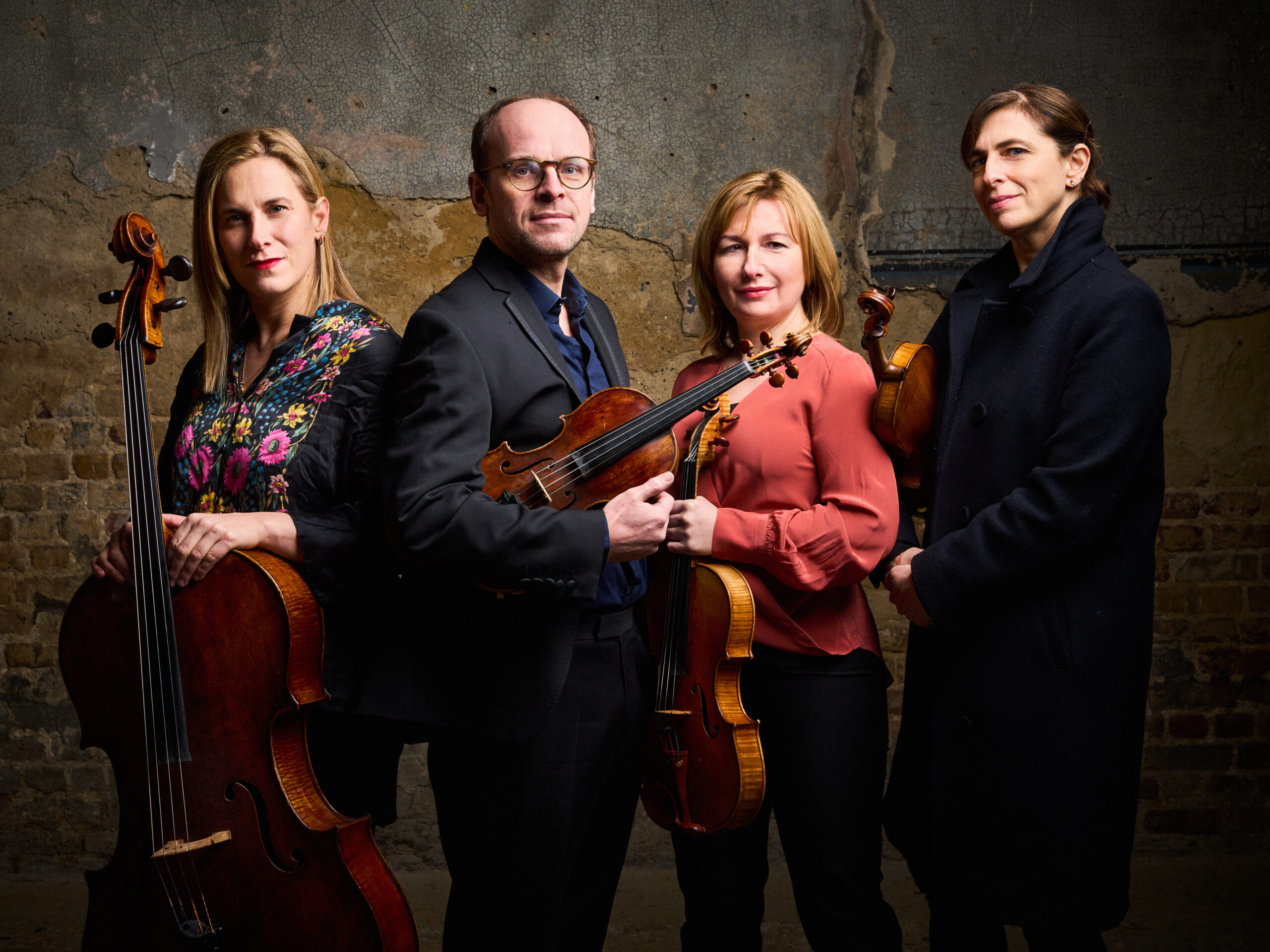
Players from the Consone String Quartet with their instruments

 FELIX MENDELSSOHN
   String Quartet in E flat (1823) (27’)
   Scherzo from Four Pieces Op.81 (3’)
   String Quartet in E minor Op.44 No.2 (30’) 

Music in the Round’s new Visiting String Quartet made their spellbinding Sheffield debut with a rapturously received celebration of the quartets of Fanny and Felix Mendelssohn in spring 2024.  

They return to Sheffield this autumn for an immersive afternoon and evening exploring more of Felix Mendelssohn’s quartets. 

View the brochure online here or download it below.

DOWNLOAD


Save £s when you book for 5 Music in the Round concerts or more at the same time. Find out more here. 

MENDELSSOHN Felix, String Quartet in E Flat (1823)

Mendelssohn was fourteen years old when he composed his E flat major String Quartet in 1823 – two years before Beethoven completed the first of his ‘late’ quartets, and two years before Mendelssohn himself wrote the first version of his Octet. It was published posthumously (in 1879) but is much less well-known than Mendelssohn’s mature quartets. Prodigiously gifted though he was, Mendelssohn was still finding his way stylistically so this work owes much to the models of Haydn and Mozart and, in the finale, to Bach. The Mendelssohn authority R. Larry Todd wrote that the music of the composer’s earliest attempt at writing a full-length string quartet was ‘firmly grounded in the classical tradition’ – but Todd also noted that it was completed in just eleven days: the first page of the autograph manuscript is dated 25 March 1823 and the last page 5 April. The opening Allegro moderato is an elegant, rather Mozartian movement in sonata form, but the Adagio non troppo, in C minor, is darker, with more adventurous chromatic harmony. The Minuet and Trio has distinct echoes of Haydn while the finale is a contrapuntal tour de force: a double fugue which was probably modelled on the fugal finales in three of Haydn’s Op. 20 quartets. 

Nigel Simeone © 2024 

MENDELSSOHN Felix, Scherzo (from Four Pieces for String Quartet), Op. 81, No. 2

The four pieces for string quartet published in 1850 as Mendelssohn’s Op. 81 were assembled from music written over a twenty-year period: the earliest dates from 1827 while the Scherzo was composed in 1847, the year of Mendelssohn’s death. The gossamer lightness of his scherzos was already apparent in the early Octet, and perhaps the most celebrated example was composed in 1842 for the incidental music to A Midsummer Night’s Dream. Marked Allegro leggiero, the same inspired lightness of touch and dazzling flair for the most delicate instrumental writing are both apparent in this late example of a stand-alone Scherzo for string quartet. 

Nigel Simeone © 2024 


MENDELSSOHN Felix, String Quartet in E minor Op.44, No.2

Mendelssohn composed a set of three string quartets first published in 1840 and dedicated to Gustav, Prince of Vasa, Crown Prince of Sweden. The first version of Op.44 No.2 was completed in 1837 and first performed that year, and before publication Mendelssohn revised it two years later. This work shows the most comprehensive command of the medium of the string quartet – demanding but superbly crafted, and beautifully written for the instruments involved. The first movement is dominated by a kind of lyrical melodiousness that hints at the musical language of a more famous work by Mendelssohn in the same key: the Violin Concerto. Where his earlier string quartets were intended as a deliberate homage to Beethoven – reflecting that in their terse, concentrated ideas – in this quartet Mendelssohn is more overtly expressive, while still controlling the form with great concision and skill. The Scherzo in E major is in the dashing, elfin style familiar from the Octet and the incidental music for A Midsummer Night’s Dream and it’s easy to forget just how utterly original Mendelssohn was being in these movements. The slow movement, in G major, is a relaxed song without words, leading to a finale of great intensity and ingenuity in which a consistent level of energetic flow is complemented by a brilliant variety in texture.
© Nigel Simeone

MENDELSSOHN ROUNDTABLE

Consone Quartet & Laura Tunbridge

St Matthews Carver Street, Sheffield
Saturday 26 October 2024, 3.15pm

Free with tickets for the 2.00pm and 7.00pm concerts, please book in advance

Past Event
Musicians from the Consone Quartet with their instruments

Music in the Round’s new Visiting String Quartet made their spellbinding Sheffield debut with a rapturously received celebration of the quartets of Fanny and Felix Mendelssohn in spring 2024.  

They return to Sheffield this autumn for an immersive afternoon and evening exploring more of Felix Mendelssohn’s quartets, including a conversation with Prof. Laura Tunbridge (University of Oxford). 

View the brochure online here or download it below.

DOWNLOAD

MENDELSSOHN OCTET

Ensemble 360 & Consone Quartet

Upper Chapel, Sheffield
Saturday 26 October 2024, 7.00pm

Tickets
£22
£14 UC, DLA & PIP
£5 Under 35s & Students 

Past Event
String quartet players of classical music group Ensemble 360, with their instruments

FELIX MENDELSSOHN
   Theme and Variations from Four Pieces Op.81 (6’)
   String Quartet in E flat Op.44 No.3 (35’)
   Octet Op.20 (34’) 

Music in the Round’s new Visiting String Quartet, the Consone Quartet, made their spellbinding Sheffield debut with a rapturously received celebration of the quartets of Fanny and Felix Mendelssohn in spring 2024.  

They return to Sheffield this autumn for an immersive afternoon and evening exploring more of Felix Mendelssohn’s quartets.  

To conclude the day, the Consone Quartet joins forces with the string players of Ensemble 360 for the composer’s eloquent and warm Octet, full of gusto and joyful invention. 

View the brochure online here or download it below.

DOWNLOAD

Save £s when you book for 5 Music in the Round concerts or more at the same time. Find out more here. 

MENDELSSOHN Felix, Theme and Variations (from Four Pieces for String Quartet), Op. 81, No. 1

This Theme and Variations – composed in 1847 – was published posthumously as the first of Mendelssohn’s Four Pieces for String Quartet, Op. 81. Like its companion Scherzo, the undated manuscript is believed to have been written in the last few weeks of Mendelssohn’s life. Marked Andante sostenuto, the poised, elegant theme is presented by the violin, before being taken over by the viola, against a gentle, syncopated accompaniment. The next variation, in triplets, is slightly faster and gives way to a variation where the first violin plays a florid semiquaver descant over sustained chords. The fast-moving phrases are then transferred to the cello before the tempo changes to a vigorous Presto (in 6/8 time), the key now shifting from major to minor. A brief solo violin cadenza leads to coda back in the home key of E major, based on a varied recollection of the opening material and a serene close.  

Nigel Simeone © 2024 

MENDELSSON Felix, String Quartet in E flat Op. 44 No. 3

In Robert Schumann’s retrospective of concerts in Leipzig during 1837–8, he wrote that concerts of string quartets in the small hall of the Gewandhaus “gave us many artistic treasures this winter.” These innovative chamber music concerts were established by Ferdinand David, a close friend of Mendelssohn’s and leader of the Gewandhaus Orchestra. Schumann singled out Mendelssohn and his two newest string quartets (Op.44 Nos.2 and 3) as works that “wandered through a finely human sphere … in such a sphere we must award the palm to him among all his contemporaries, and only Franz Schubert, had he lived, would have been worthy to award Mendelssohn that palm without disputing it.” The E flat major Quartet Op.44 No.3 was completed in February 1848. The first movement opens with a terse five-note motif and a dotted rhythm. Both these ideas – and the way Mendelssohn uses them to propel the musical argument – show the influence of Beethoven, and they are contrasted with a more lyrical theme. The energy of this movement, and the elegance of its construction, continue into the second movement: a typical Mendelssohn Scherzo, full of dramatic contrasts between loud and soft. After E flat major in the first movement, and the darker C minor in the Scherzo, the rapt, lyrical Adagio is in A flat major. The finale, back in the home key of E flat, is dazzling, full of rapid semiquavers – a virtuoso display written for some of the most gifted quartet players of the time.  

Nigel Simeone © 2012 

MENDELSSOHN Felix, Octet Op. 20

One of the marvels of nineteenth-century chamber music, Mendelssohn’s Octet was originally finished in October 1825, when the composer was 16 years old. He later revised it before publication. The miracle of this work is not the youthfulness of its creator but the astonishing individuality of its music – regardless of how old its composer was at the time. The arching opening theme of the first movement, underpinned by syncopated chords, reveals the originality of Mendelssohn’s creative voice as never before. The way in which he generates a constant stream of musical ideas is all his own, but this was a composer who knew how to draw on the refinement of Mozart, the power of Beethoven and the contrapuntal intricacy of Bach for his own expressive purposes. The slow movement begins gently but becomes increasingly uneasy, while the dizzying Scherzo was inspired by the ‘Walpurgisnacht’ scene from Goethe’s Faust. The Presto finale follows naturally from this, beginning with an energetic fugal subject that generates unstoppable momentum and inspired elation.  

Nigel Simeone © 2015

THE MONSTER IN THE MAZE

Music-Makers of Sheffield

Crucible Theatre, Sheffield
Friday 1 November 2024, 3.00pm / 7.15pm

Tickets 
£5 for everyone  
Carers free 

Past Event
Silhouette of a Minotaur head

DOVE The Monster in the Maze (50’)

An opera production for the people of Sheffield and with the people of Sheffield.

Music: Jonathan Dove
Libretto: Alasdair Middleton
Music Director: John Lyon

Director: Rosie Kat
Theseus: Anthony Flaum
Mother: Camille Maalawy
Daedalus: Robert Gildon
King Minos: Paul Hawkyard

Featuring ENSEMBLE 360, CONSONE QUARTET, BRIDGE ENSEMBLE, SHEFFIELD MUSIC HUB SENIOR STRINGS, SHEFFIELD YOUTH CHOIRS featuring JUNIOR VOICES, YOUTH VOICES & CONCORDIA and SINGERS FROM SHEFFIELD

“Here they are – the children of Athens!
The hope of Athens, the future of Athens!
Deep in the maze, the monster, already
paws the sand and tosses his horns…”

      - libretto, Monster in the Maze

King Minos has a labyrinth in his palace. Inside there lurks a Minotaur. This monster, half man and half bull, feeds on human flesh.  

Minos decrees that the Athenians should provide a regular supply of their young people to be sacrificed to the monster. The Athenian hero Theseus steps in, determined to enter the maze and take on the monster at its heart…

Jonathan Dove’s ‘The Monster in the Maze’ receives its Sheffield premiere on the iconic Crucible stage. Our most ambitious project to date, this will be Music in the Round at its best: a bold collaboration, forged in the crucible of creativity that is our City of Makers. 

Commissioned and first performed in 2015 by the Berlin Philharmonic and London Symphony Orchestra with Simon Rattle, it was praised by the Financial Times as “an exhilarating, visceral take on the ancient Greek myth”.  

This amazing new production will showcase people of all ages coming together from across the city to perform alongside our professional resident artists and guests, highlighting the best of music-making in Sheffield. 

An epic story: millennia in the making and a fitting celebration for our 40th anniversary year! 

With thanks to our funders and supporters: Blakemore Foundation, JG Graves Charitable Trust, Music for All, Scops Arts Trust, Sheffield Music Hub, Sheffield Mutual and individual donors.

View the brochure online here or download it below.

DOWNLOAD

Save £s when you book for 5 Music in the Round concerts or more at the same time. Find out more here. 

PIANO FAVOURITES

Kathryn Stott

Crucible Playhouse, Sheffield
Saturday 14 September 2024, 7.00pm

Tickets
£22
£14 UC, DLA & PIP
£5 Under 35s & Students

Past Event
Classical pianist Kathryn Stott

BACH Prelude and Fugue No.1 in C BWV846 (5’)
L BOULANGER Thème et Variations (9’)
FAURÉ Barcarolle No.4 in A flat Op.44 (4’)
RAVEL Jeux d’eau (5’)
GRIEG Wedding Day at Troldhaugen Op.65 No.6 (6’)
PIAZZOLLA (arr. YAMAMOTO) Milonga (5’)
SHOSTAKOVICH Prelude & Fugue No.24 in D minor Op.87 (12’)
FITKIN Scent (4’)
RODGERS & HAMMERSTEIN (arr. HOUGH) ‘My Favorite Things’ (3’)
SHAW Gustave Le Gray (11’)
CHOPIN Mazurka Op.17 No.4 in A minor (4’)
GRAINGER Molly on the Shore (4’)
VINE Short Story (3’)
FITKIN Rapid Unscheduled Disassembly (8’) 

Acclaimed pianist Kathryn Stott, familiar in Sheffield as a long-term collaborator with the Lindsay String Quartet and Guest Curator of Sheffield Chamber Music Festival 2023, returns for her final recital in the Crucible Playhouse. As Kathy draws her performing career to a close, she brings an eclectic programme spanning four centuries of music, showcasing her diverse musical loves and friendships.  

Opening with exquisite Bach and concluding with a brand-new farewell commission, via a Scandinavian wedding celebration from Grieg, the spirit of Broadway and a masterful Chopin Mazurka, this promises to be a whirlwind tour through a unique musical career from a captivating performer much-loved in Sheffield and across the world. 

Post-concert Q&A – free
Please join us after the concert for a free Q&A with Kathryn Stott.

View the brochure online here or download it below.

DOWNLOAD

Save £s when you book for 5 Music in the Round concerts or more at the same time. Find out more here. 

PIANO FAVOURITES

When Kathryn Stott performed this programme at the Aldeburgh Festival in June 2024, it was billed as a concert of ‘Musical Postcards’. That’s a good description of a recital which explores the huge range of her repertoire, starting with the first prelude and fugue from The Well-Tempered Clavier by Johann Sebastian Bach (1685–1750) and ending with a brand-new piece by Graham Fitkin which was given its world premiere at the Aldeburgh concert on 21 June. Lili Boulanger (1893–1918) composed her Thème et variations in 1914 but the work remained unknown until its rediscovery led to its first performance (and publication) in 1993. The theme (marked ‘avec douleur, mais noble’) is presented without accompaniment and eight variations follow, each treating the theme (or part of it) in imaginative ways that are entirely characteristic of Boulanger.


Caroline Potter has noted that the work was modelled on the Thème et variations, Op. 73 by Gabriel Fauré (1845–1924) who was Boulanger’s teacher and a family friend. Fauré’s Barcarolle No. 4, Op. 44, was composed in 1886 and dedicated to Mme Ernest Chausson. Quietly poetic in mood, it is full of the rich harmonic surprises and fluid melodies that are so typical of Fauré’s music. Maurice Ravel (1875–1937) was one of Fauré’s most imaginative pupils and he wrote Jeux d’eau – among the most evocative and brilliant of all ‘water’ pieces for piano – in 1901, with a dedication ‘à mon cher maître Gabriel Fauré’.


Edvard Grieg (1843–1907) composed Wedding Day at Troldhaugen to celebrate his silver wedding anniversary with his wife Nina in 1896 and it was included in Book VIII of Grieg’s Lyric Pieces the following year, when it acquired its definitive title (Grieg has originally called it ‘The well-wishers are coming’). The Argentine Astor Piazzolla (1921–1992), creator of the nuevo tango which fused traditional tango with elements of jazz and classical styles, composed Milonga del Ángel in 1965, and it is heard here in a later piano transcription by the Japanese pianist Kyoko Yamamoto. Inspired by a visit to Leipzig in 1950 to celebrate the 200th anniversary of Bach’s death, Dmitri Shostakovich (1906–75) modelled his Preludes and Fugues Op. 87 on Bach’s Well-Tempered Clavier, even including some quotations as well as following Bach’s design of preludes and fugues in each of the major and minor keys. Completed on 23 February 1951, the D minor Prelude and Fugue ends the entire set with a stern prelude followed by a highly elaborate double fugue (which also includes allusions to Bach’s Art of Fugue) deploying a formidable array of contrapuntal techniques. The whole set was first performed in April and May 1951 at a private concert for the Soviet Union of Composers and heard in public in December 1952, played by Tatiana Nikolayeva, for whom the Preludes and Fugues had been composed.


Graham Fitikin (b. 1963) composed Scent in 2007, originally for the harpist Ruth Wall. The pianist Stephen Hough (b. 1961) included his hugely entertaining and ingenious transcription of ‘My Favorite Things’ from The Sound of Music by Richard Rodgers (1902–79) on one of his earliest recital discs, bringing Lisztian pyrotechnics to Broadway. When Caroline Shaw (b. 1982) composed Gustave Le Gray in 2012, she was inspired by Chopin’s Mazurka Op. 17 No. 4 – one of his most harmonically inventive earlier pieces – and included direct references to it in her own work. Shaw herself described it as ‘a multi-layered portrait of Op. 17 No. 4 using some of Chopin’s ingredients overlaid and hinged together with my own.’ The original Mazurka by Fryderyk Chopin (1810–49) was first published in Paris in 1834. It is a spellbinding kind of dance poem, full of ambiguity and quiet longing, some astonishingly daring harmonies and a trajectory which begins and ends in uncertain silence. Molly on the Shore by the Australian Percy Grainger (1882–1961) was based on two traditional Irish reels and written in 1907 as a birthday present for Grainger’s mother. He first composed it for strings, then made an orchestral version in 1914 and the present piano transcription in 1918. He later made further versions for military band (1920) and for two pianos (1947).


Carl Vine (b. 1954) is another Australian composer, and his Anne Landa Preludes were written in 2006 in memory of Anne Landa (who died in 2002 at the age of 55), particularly her passionate encouragement of young Australian pianists. The first of the preludes is ‘Short Story’ described by Vine as follows: ‘The prelude contains a story. But the drama emerges through its own internal logic rather than from a specific series of predetermined events’. Graham Fitkin composed Rapid Unscheduled Disassembly specifically for Kathryn Stott’s farewell recitals, taking his title from the euphemism used by Elon Musk’s SpaceX when its rockets blew up in 2015 and 2023 (though the phrase probably goes back to the 1960s when NASA used similar terminology to describe earlier explosions). As Stott said in a recent interview, ‘My one request to Graham was, this will be the last notes I play in public, so keep that in mind!’ 

MLÁDÍ & MORE

Ensemble 360

Crucible Playhouse, Sheffield
Wednesday 18 September 2024, 7.00pm

Tickets
£22
£14 UC, DLA & PIP
£5 Under 35s & Students

Past Event
Ensemble 360 classical musicians - oboe player Adrian Wilson, horn player Naomi Atherton and clarinet player Robert Plane

HAAS Oboe Suite Op.17 (18)
JANÁČEK Mládí (20’)
HAAS Wind Quintet Op.10 (16’)
JANÁČEK In the Mists
(23’) 

Janáček’s beloved Mládí (‘Youth’) was written towards the end of his life as a nostalgic celebration of memories of his youth, drawing on his early writing. Receiving its premiere performances in Autumn 1924, we celebrate the 100th anniversary of this iconic piece for wind, featuring the bass clarinet alongside a regular wind quintet line-up of flute, oboe, clarinet, horn and bassoon.  

View the brochure online here or download it below.

DOWNLOAD

Save £s when you book for 5 Music in the Round concerts or more at the same time. Find out more here. 

HAAS Pavel, Suite for Oboe & Piano Op.17

Furioso 
Con fuoco. Con moto e poco largamente 
Moderato 
 

Pavel Haas, born in Brno into a Jewish family, was a pupil of Leoš Janáček from 1920 to 1922. Though his music doesn’t imitate that of his great teacher, both composers sought inspiration from Moravian folk song and dance. Janáček once declared that ‘a modern composer has to write what he has truly experienced’, but Haas was to experience more and much worse than most. However, in 1939, when he wrote the Suite for Oboe, he had just been awarded the Smetana Prize for his opera, The Charlatan, first performed at Brno in 1938. The musical language of the Suite, occasionally folk-inspired, sometimes recalling the cadences of Synagogue songs, and notable for its energy and drive, marks out Haas as a composer of real individuality, rugged in the first two movements, and more consoling in the third, rising to a grand climax that has occasional echoes of his great teacher. 


Haas was deported to the concentration camp and ghetto at Teresienstadt in 1941 where he met the conductor Karel Ančerl as well as several other Czech Jewish composers such as Gideon Klein (who coaxed Haas back to composition), Hans Krása and Viktor Ullmann. In later years, it was Ančerl who most movingly recalled the appalling circumstances of Haas’s murder after both were transferred to Auschwitz: Ančerl was next in line to be sent to the gas chamber when Haas coughed, thus attracting the attention of the SS Doctor Josef Mengele, who chose to send Haas to his death instead.  


Nigel Simeone 2014 

JANÁČEK Leoš, Mládí

Janáček composed Mládí in July 1924 (the month of his 70th birthday) at his rural retreat in the village of Hukvaldy. He described it to Kamila Stösslová as ‘a sort of memoir of youth’, and a newspaper article in December 1924 described the programme of the suite as follows: ‘In the first movement, [Janáček] remembers his childhood at school in Hukvaldy, in the second the sad scenes of parting with his mother at the station in Brno, in the third in 1866 as a chorister when the Prussians were in Brno; the concluding movement is a courageous leap into life.’ Intended as a nostalgic evocation of Janáček’s youth (his original title was Mladý život – Young Life) it is a typically quirky and ebullient product of his incredibly productive old age. It was first performed in Brno on 24 October 1924, followed a month later by a performance in Prague. Janáček also heard the work during his only visit to England, at a concert in the Wigmore Hall on 6 May 1926 when it was played by British musicians including Leon Goossens and Aubrey Brain. 

Nigel Simeone © 2011 

JANÁČEK Leoš, In the Mists 

Janáček inspiration for In the mists probably came from a recital at the Brno Organ School on 28 January 1912 when Marie Dvořáková played Debussy’s Reflets dans l’eau. In the mists certainly shows the influence of Debussy’s Impressionism, though it is also a nostalgic reflection on childhood: Bohumír Štědroň wrote that ‘Here Janáček sees his youth in a mist and remembers the days spent at Hukvaldy’. Janáček made some revisions to the cycle before publication by the Club of the Friends of Art in Brno (to which Janáček belonged) near the end of 1913. According to the title page of this edition, In the mists was given to members of the club as a gift for the year 1913. The first performance took place on 7 December 1913 at Kroměříž, played by Marie Dvořáková. She played it again, on 24 January 1914, at a Brno Organ School concert in the Lužánky Hall when Janáček himself was present. The first known performance in Prague was not until 16 December 1922, given by the pianist Václav Štěpán and the following year Janáček asked Štěpán to help him prepare an edition incorporating his final versions. An inspired combination of Impressionism and musical ideas derived from Moravian folk music, In the mists is in four movements: the first haunting (and occasionally trouble), the second quite free, the third based on a memorable melody heard at the start, and the fourth hints at the flourishes of gypsy music as well as moments of high drama. All four movements are permeated by tenderness and nostalgia, without any hint of sentimentality.

Nigel Simeone

HAAS Pavel, Wind Quintet Op.10

Pavel Haas who was born in 1899, was a Jewish composer from Czechoslovakia, who had his promising career tragically cut short when he was killed in Auschwitz in 1944. His music, once forgotten, is gradually gaining recognition, thanks to dedicated efforts by surviving colleagues and scholars. Haas was a student of Leoš Janáček, and his music reflects the influence of Moravian folk tunes and Jewish liturgical music. One of his most significant works, the Wind Quintet (1929), showcases his distinct style, blending rhythmic complexity and folk influences, much like his teacher Janáček’s Mládí.

Written on the eve of the tumult of the 1930s and infused with the bleakness and forboding of the period, it remained largely unknown for decades, with nearly all copies lost during World War II. However, Czech musicologist Lubomír Peduzzi, a former student of Haas, discovered the manuscript in the Moravian Museum in Brno. His 1991 edition of the work has helped the piece find its place alongside other important wind quintets of the interwar period, such as those by Nielsen, Schoenberg, and Hindemith.

The Wind Quintet is a four-movement work characterized by its emotional depth and modal melodies. The first movement, Preludio, begins with a folk-like tune, while the second, Pregheira (“Prayer”), conveys a heartfelt spiritual yearning. The third movement, Ballo Eccentrico, is a lively, quirky dance, and the final movement, rooted in Moravian folk music, ends with an expansive, triumphant chord. Despite its predominantly minor tonality, the work is varied in mood, alternating between seriousness and cheerfulness, much like Janáček’s compositions.

Haas’ music, though overshadowed by the atrocities of the Holocaust, is now recognized as a significant contribution to 20th-century chamber music. His Wind Quintet, in particular, stands as a powerful and original work, blending folk traditions with modern compositional techniques, and is gradually earning its place in the standard repertoire.

A BOY WAS BORN

Ensemble 360 & Sheffield Cathedral Choir

Sheffield Cathedral, Sheffield
Friday 13 December 2024, 7.30pm

Tickets
£17
£10 UC, DLA & PIP
£5 Under 35s & Students 

Past Event
Ensemble 360 string musicians in performance

Programme includes
BRITTEN A Boy was Born (31’)
plus seasonal classics 

Intricate, evocative, utterly beautiful, ‘A Boy Was Born’ captures the spirit of Christmas. Drawing on the folk traditions that inspired so much of Britten’s work and characterised by his unique musical imagination, the choir of Sheffield Cathedral brings this exquisite theme and variations for Yuletide to life, before joining forces with Ensemble 360 for a celebration of the joys of the season through a variety of well-known classics. 

View the brochure online here or download it below.

DOWNLOAD

Save £s when you book for 5 Music in the Round concerts or more at the same time. Find out more here.