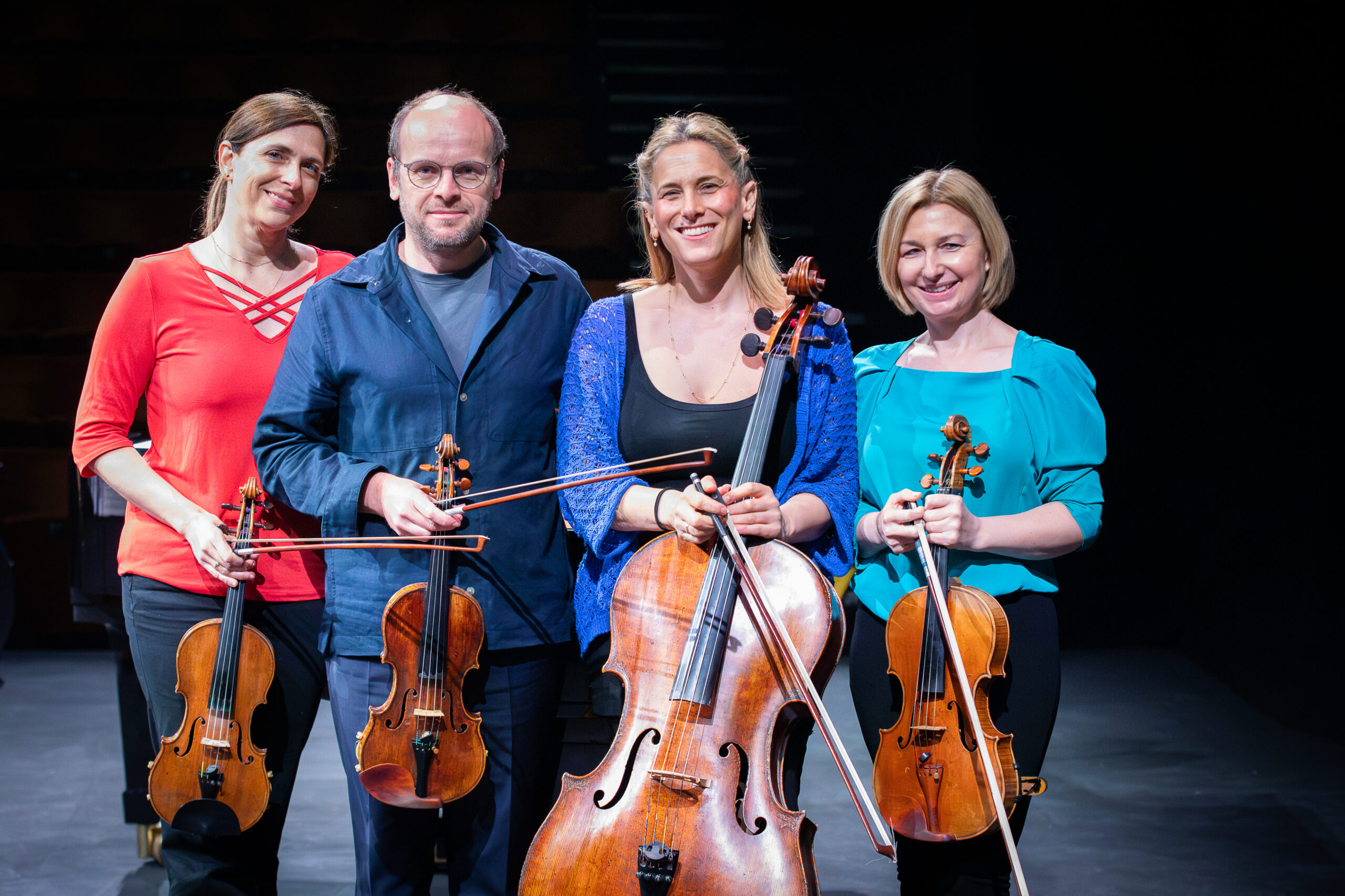
A lively family concert featuring four string musicians (violins, viola and cello) and a presenter. Together they breathe life into the wondrous world of chamber music.
They’ll play well-known classical favourites from Beethoven, Mozart, Schubert and more.
Perfect for 7-11-year-olds, this lively, interactive concert is a great introduction to classical music, and a chance for those who’ve enjoyed our storybook concerts to delve a little deeper.
A brand-new storybook concert, based on the modern classic book series by Benji Davies.
The Storm Whale tells the story of a child, and a whale washed up on the beach, and friendships that will change their lives forever and echo down the generations. These heart-warming tales of friendship, love and courage are brought to life through music specially written to accompany the book by our Children’s Composer-in-Residence, Paul Rissmann.
Perfect for 3– 7-year-olds, this is a fun introduction to a live concert experience, brimming with wonderful music, memorable songs, images from the book and plenty of chances to join in.
“The Storm Whale tells a simple but powerful story about loneliness and the love between a parent and child… The world may be as big and lonely and incomprehensible as the ocean, but still it’s possible to find tremendous, heart-stopping tenderness.” The New York Times on the book
Save 20% when you book for 10 or more Music in the Round concerts in one transaction. Save 10% when you book for 5 or more Music in the Round concerts in one transaction. Find out more.
With many thanks to all our funders, including:
The Sarah Nulty Power of Music Foundation, Gripple Foundation, JG Graves Charitable Trust, Sheffield Town Trust and Wise Music Foundation
“The musicians did a wonderful job of introducing the young audience to enjoyment of the theatre, live music and engaging story-telling. Proof of their success [were] the lines of excited children coming up to meet the musicians who had gathered in the foyer with their instruments.”
The Yorkshire Post (on a previous Music in the Round storybook concert)
CLOSE-UP FAMILY CONCERT: MUSIC FOR CURIOUS YOUNG MINDS
A lively family concert, featuring five wind musicians (flute, clarinet, oboe, bassoon and horn). Together they breathe life into the wondrous world of chamber music.
They’ll play well-known classical favourites from Britten and Debussy to Haydn and Holst, alongside more recent works such as Anna Meredith’s playful portrait of a moth and Valerie Coleman’s celebratory Kwanza dance.
Perfect for 7-11 year olds, this is a lively, interactive concert is a great introduction to music, or chance for those who’ve enjoyed our storybook concerts to delve a little deeper.
Save £s when you book for 5 Music in the Round concerts or more at the same time. Find out more here.
Programme: BRITTENI. Prologue from Serenade for Tenor, Horn and Strings (1’30) HAYDN arr.ParryIV. Rondo-Allegretto from Divertimento No.1 (2’) ONSLOWIV. Finale (extract) from Wind Quintet(3’30) ARNOLDI. Allegro con brio from ‘Three Shanties’(2’30) VAUGHAN WILLIAMS arr. Morton ‘The Vagabond’ from Songs of Travel (3’) LIGETI III. Allegro grazioso from ‘6 Bagatelles’ (2’30) DEBUSSY‘Syrinx’(3’) BACEWICZI. Allegro from Quintet for Wind Instruments (3’) STRAVINSKY II. from ‘Three Pieces for Solo Clarinet’(1’) HOLSTIV. Air and Variations from Wind Quintet (4’) DANZIIV. Allegretto from Wind Quintet No.2(3’) MEREDITH‘Moth’ from ‘Tripotage Miniatures’(2’30) COLEMANUmoja(2’45)
Based on the colourful children’s book, this family concert tells the story of Giddy, a young mountain goat who is scared of heights. A tale of facing fears and making friends, it’s a brilliant way to introduce children to classical music, with visuals from the book and plenty of chances to join in!
Perfect for 3 – 7 year olds and their families!
CLOSE UP: MUSIC FOR CURIOUS YOUNG MINDS
Ensemble 360 & Elinor Moran
The Guildhall, Portsmouth
Monday 17 March 2025, 1.30pm
For tickets, please email hayley.reay@portsmouthguildhall.org.uk
A lively schools concert, presented by Elinor Moran and featuring five wind musicians (flute, clarinet, oboe, bassoon and horn). Together they breathe life into the wondrous world of chamber music.
They’ll play well-known classical favourites from Britten and Debussy to Haydn and Holst, alongside more recent works such as Anna Meredith’s playful portrait of a moth and Valerie Coleman’s celebratory Kwanzaa dance. Perfect for 7-11 year olds, this is a lively and interactive concert.
A lively schools concert, presented by Aga Serugo-Lugo and featuring five wind musicians (flute, clarinet, oboe, bassoon and horn). Together they breathe life into the wondrous world of chamber music.
They’ll play well-known classical favourites from Britten and Debussy to Haydn and Holst, alongside more recent works such as Anna Meredith’s playful portrait of a moth and Valerie Coleman’s celebratory Kwanzaa dance. Perfect for 7-11 year olds, this is a lively and interactive concert.
A lively family concert, presented by Aga Serugo-Lugo and featuring five wind musicians (flute, clarinet, oboe, bassoon and horn). Together they breathe life into the wondrous world of chamber music.
They’ll play well-known classical favourites from Britten and Debussy to Haydn and Holst, alongside more recent works such as Anna Meredith’s playful portrait of a moth and Valerie Coleman’s celebratory Kwanzaa dance. Perfect for 7-11 year olds, this is a lively and interactive concert.
Being a mountain goat is no fun when you are scared of heights!
Stand poor Giddy on a mountain ledge and his head starts spinning and his knees turn to jelly… But can he find the fearless goat inside himself?
Based on the best-selling children’s book by Jamie Rix and Lynne Chapman with original music by Music in the Round’s children’s Composer-in-Residence, Paul Rissmann, this concert features instruments including strings, woodwind, and horn, presented together with storytelling and projected illustrations. Performed by the hugely engaging musicians of Ensemble 360, this concert is a great introduction to live music; full of wit, invention, songs and actions, and plenty of opportunities to join in.
Become musical detectives in the wondrous world of chamber music!
This specially created concert for young audiences combines some of the most well-known music ever written, alongside playful storytelling in Berio’s entertaining Opus Number Zoo.
With thrilling musical adventures told through music, cheeky characters and epic heroes, this concert of marvellous musical games is perfect for children aged 7 – 11.
Programme includes excerpts from:
ASTOR PIAZZOLLA – Libertango (2’30) SCOTT JOPLIN – New Rag for Wind Quintet (3’30) ALEXANDER VON ZEMLINSKY – Humoresque (3’30) LUDWIG VAN BEETHOVEN – Bagatelle Op. 119 No. 3 (2’) PER NØRGÅRD – Whirl’s World (2’) ANTON REICHA – Wind Quintet in D (3’30) CARL NIELSEN – Wind Quintet (3’) EMILY DOOLITTLE – ‘Bobolink’ from Woodwings (4’) AUGUST KLUGHARDT – Wind Quintet Op. 79 (2’30) LUCIANO BERIO – Opus Number Zoo (3’)
Save 20% when you book for 10 or more Music in the Round concerts in one transaction. Save 10% when you book for 5 or more Music in the Round concerts in one transaction. Find out more.
PIAZZOLLA Astor, Libertango (extract for Close Up)
Let’s get our concert off to a dancing start! Libertango is a fun mix of tango and jazz, full of energy and rhythm. Close your eyes and imagine dancers moving quickly—sometimes fast, sometimes slow, but always exciting! It was written by Astor Piazzolla, a musical rule-breaker from Argentina in South America, who loved to take the traditional dance music of the tango and twist it into something new and thrilling
JOPLIN Scott, New Rag arr. for Wind Quintet (extract for Close Up)
A happy, bouncy ragtime tune that makes you want to tap your feet! It’s like a musical puzzle full of repeating patterns. American composer Scott Joplin, is sometimes called ‘the King of Ragtime’. He mostly wrote dancing piano music which you may have heard without knowing it: his music was used in Tom and Jerry cartoons and also in The Lego Movie.
ZEMLINSKY Alexander Von, Humoresque (extract for Close Up)
A musical joke full of skips and hops! Alexander Zemlinsky was an Austrian composer who loved drama and fairy tales, and this piece is like a mischievous character darting around, surprising us with funny twists. Who might they be? How are they moving? What do they look like and what, most importantly, are they up to?
BEETHOVEN Ludwig Van, Bagatelle Op.119 No.3 (extract for Close Up)
Short but sweet and sounding like a musical smile: this cheerful piece was written by Ludwig van Beethoven, a German composer who changed music forever, writing huge symphonies for massive orchestras and tiny musical gems like this one. Like the Scott Joplin piece, this was first written for a piano (which you can hear in the clip on this page) but takes on its own character when played by five wind musicians. How does changing the instruments but playing the same notes change this lovely piece?
NØRGÅRD Per, Whirl’s World (extract for Close Up)
Sometimes, like a thrilling story or film, what makes music exciting, also makes it strange and scary… This piece is like being inside a spinning top! Full of fast, twirling sounds, it’s magical whirlwind of strange, darkness. Like a real-life tornado is starts slowly, becomes furiously fast, and collapses back into silence. Per Nørgård is a Danish musical explorer, who loves creating music that feel like galaxies, storms, or even buzzing insects. This piece, he has described as “a water-world of ripples and bubbles”. Can you hear what he means?
REICHA Antón, Wind Quintet in D Op.91 (extract for Close Up)
This piece is like a musical chase! The flute, oboe, clarinet, horn, and bassoon take turns playing fast, playful tunes, as if they’re chatting like musical friends. The composer, Antón Reicha, loved puzzles and games—and you can hear it in how the instruments weave together in clever ways.
NIELSEN Carl, Wind Quintet (extract for Close Up)
A musical conversation where each instrument has its own personality! Sometimes they agree, sometimes they argue—but it’s always fun. This section is a type of composition called a ‘theme and variations’ in which the Danish composer Carl Nielsen took a beautiful hymn tune he knew from church and used his imagination to change it a bit more each time we hear it, making something new out of something he found. It’s like musical recycling!
DOOLITTLE Emily, Bobolink (extract for Close Up)
A bubbly, chirpy piece that sounds like a bird singing in a meadow! Emily Doolittle is a modern composer writing music today who loves nature, and her music often brings the outdoors to life. Lots of composers have been inspired by birds: some have created musical pictures of them flying or getting up to adventues, others have tried to write down their beautiful song as if it were human music and get the instruments to do their best bird impressions. What sort of bird music do you think Emily Doolittle is writing here?
KLUGHARDT August, Wind Quintet Op.79 (extract for Close Up)
Bright and lively, this music is like a game of tag between the instruments! August Klughardt was a Romantic composer who turned music into storytelling—full of excitement and emotion. Sometimes his work told stories using actors, singers and huge orchestras, sometimes it was inspired by myths and legends. This piece treats our wind players like five characters. What sort of story are they telling?
BERIO Luciano, Opus Number Zoo (extract for Close Up)
Luciano Berio was a musical inventor who loved turning everyday sounds into music. This is the last part of his ‘musical zoo’ where each section is a different animal! In this piece, our wind players have to use different sorts of musical voices: speaking as well as playing. It’s like a musical cartoon of a pair of Tom Cats. How do they instruments bring the fighting cats to life?And what do you think happens in the end?
BARBER Adagio from String Quartet Op.11 (9′) BARBER Canzonetta Op.48 (8′) COPLAND Appalachian Spring (30′)
For this ‘Relaxed’ concert of American music featuring Barber’s much-loved Adagio and Copland’s joyful Appalachian Spring, doors will be left open, lights raised, a break-out space provided and there will be less emphasis on the audience being quiet during the performance. People with an Autism Spectrum, sensory or communication disorder or learning disability, those with age-related impairments and parents/carers with babies are all especially welcome.
BARBER Samuel, Adagio for Strings
It’s an amusing accident of history that Barber’s Adagio, one of the totems of American music, was composed in Austria (where Barber was spending the summer and autumn with Gian-Carlo Menotti) and first performed on 14 December 1936 at a concert in Rome (as the slow movement of the String Quartet Op.11). Barber was delighted with this movement, describing it to his friend Orlando Cole as ‘a knockout!’ While finishing the whole quartet, he arranged the Adagio as an independent movement for string orchestra and this was first performed in 1938 in a broadcast concert in New York given by the NBC Symphony Orchestra conducted by Arturo Toscanini. Barber’s fellow composer Aaron Copland spoke about the piece in 1982 for a BBC radio programme, praising ‘the sense of continuity, the steadiness of the flow, the satisfaction of the arch … from beginning to end. It’s gratifying, satisfying, and it makes you believe in the sincerity which he obviously put into it.’
Nigel Simeone 2014
BARBER Samuel, Canzonetta for Oboe & Strings Op.48
Originally composed for oboe and string orchestra, and here presented in a new chamber arrangement by Ensemble 360’s oboist, Adrian Wilson, Samuel Barber’s Canzonetta for Oboe and Strings was meant to be the slow movement of an oboe concerto commissioned by the New York Philharmonic. However, soon after starting work on the piece (in 1978) Barber was diagnosed with cancer. The other two movements of the concerto were never completed, and this was to be the composer’s final work (Barber died in 1981). The piece was orchestrated posthumously by Barber’s longtime friend and former student, Charles Turner, and was premiered on December 17th, 1981, at Avery Fisher Hall in New York, with the New York Philharmonic conducted by Zubin Mehta. Principle oboist of the New York Philharmonic (and a former classmate of Barber’s at the Curtis Institute of Music), Harold Gomberg played the solo part.
In many ways, the Canzonetta is typical of Barber’s style, with a tendency towards vocal lyricism and neo-romantic tonality. In this regard, Historian and Barber specialist Barbara Heyman calls the Canzonetta an “appropriate elegy to the conclusion of Barber’s career.” The work, like others in Barber’s oeuvre, combines elements of post-Straussian chromaticism with what we might think of as a typically American lyrical simplicity. A simple, meandering melodic line is at times presented in a strictly diatonic context, and at others with a highly chromatic harmonisation. Throughout, the oboe’s melody floats above the string texture, seemingly weightless with Barber showing the instrument at its best. Indeed, Turner quotes Barber (in the preface to the 1993 edition of the work for oboe and piano) as having said, “I like to give my best themes to the oboe”.
Dr. Benjamin Tassie
COPLAND Aaron, Appalachian Spring
It was the patron Elizabeth Sprague Coolidge who commissioned Aaron Copland to compose a new ballet for Martha Graham’s dance company in 1943, for performance in the Coolidge Auditorium (named after her) at the Library of Congress in Washington D.C.. Copland was delighted with the idea, particularly after Graham sent him the first version of her scenario concerning a young married couple in rural Pennsylvania. The ballet went through various titles during the composition process, and Copland’s manuscript was simply headed ‘Ballet for Martha’, but Graham settled on ‘Appalachian Spring’ just before the premiere, taking the title from a poem by Hart Crane. One of the attractions for Copland was the challenge of writing for an ensemble of 12 instruments (the largest group that could fit into the very small pit in the Coolidge Auditorium), and the result was described in a review of the first performance by the ballet critic John Martin as ‘a score of fresh and singing beauty. It is, on its surface, a piece of early Americana, but in reality, it is a celebration of the human spirit.’ Copland himself was typically self-effacing, admitting that ‘people seemed to like it, so I guess it was all right.’ In 1945 he made a very successful arrangement for large orchestra, but the sound of the original has a beauty and intimacy all its own. Copland decided quite early on to use the Shaker tune ‘Simple Gifts’ (written in 1848), and this melody is woven through much of the score, notably in the set of variations. But while the score perfectly matches the ‘local’ elements of the story, it also transcends them to become a piece of universal appeal: Copland’s great achievement in Appalachian Spring is to have created a quiet and heartfelt vision of hope in troubled times.
Being a mountain goat is no fun when you are scared of heights! Stand poor Giddy on a mountain ledge and his head starts spinning and his knees turn to jelly. But can he find the fearless goat inside himself in time to rescue little Edmund, the sheep?
This family concert based on the best-selling children’s book by Jamie Rix and Lynne Chapman features original music by Music in the Round’s Children’s Composer-in-Residence, Paul Rissmann, for strings, wind and piano. Presented together with story-telling and projected illustrations from the book, it’s a great introduction to live music for children aged 3 – 7 and includes plenty of opportunities to join in!
Save 20% when you book for 10 or more Music in the Round concerts in one transaction.
Save 10% when you book for 5 or more Music in the Round concerts in one transaction. Find out more.
Step inside the music of Bach, up-close and reimagined, in this specially created surround-sound installation running alongside Benjamin Nabarro’s recitals in the tranquil setting of Upper Chapel.
To make this innovative, multi-speaker installation, fragments of Ben’s performance of Bach’s Sonata No.1 in G minor were recorded, layered, looped and transformed. Played through eight loudspeakers, visitors will be enveloped in Bach’s life-affirming music, reworked in this unique and immersive sensory experience.
We use cookies on our website to give you the most relevant experience by remembering your preferences and repeat visits. By clicking “Accept All”, you consent to the use of ALL the cookies. However, you may visit "Cookie Settings" to provide a controlled consent. You can find out how we use and process your data by reading our Privacy Policy
This website uses cookies to improve your experience while you navigate through the website. Out of these, the cookies that are categorized as necessary are stored on your browser as they are essential for the working of basic functionalities of the website. We also use third-party cookies that help us analyze and understand how you use this website. These cookies will be stored in your browser only with your consent. You also have the option to opt-out of these cookies. But opting out of some of these cookies may affect your browsing experience.
Necessary cookies are absolutely essential for the website to function properly. These cookies ensure basic functionalities and security features of the website, anonymously.
Cookie
Duration
Description
cookielawinfo-checkbox-analytics
11 months
This cookie is set by GDPR Cookie Consent plugin. The cookie is used to store the user consent for the cookies in the category "Analytics".
cookielawinfo-checkbox-functional
11 months
The cookie is set by GDPR cookie consent to record the user consent for the cookies in the category "Functional".
cookielawinfo-checkbox-necessary
11 months
This cookie is set by GDPR Cookie Consent plugin. The cookies is used to store the user consent for the cookies in the category "Necessary".
cookielawinfo-checkbox-others
11 months
This cookie is set by GDPR Cookie Consent plugin. The cookie is used to store the user consent for the cookies in the category "Other.
cookielawinfo-checkbox-performance
11 months
This cookie is set by GDPR Cookie Consent plugin. The cookie is used to store the user consent for the cookies in the category "Performance".
viewed_cookie_policy
11 months
The cookie is set by the GDPR Cookie Consent plugin and is used to store whether or not user has consented to the use of cookies. It does not store any personal data.
Functional cookies help to perform certain functionalities like sharing the content of the website on social media platforms, collect feedbacks, and other third-party features.
Performance cookies are used to understand and analyze the key performance indexes of the website which helps in delivering a better user experience for the visitors.
Analytical cookies are used to understand how visitors interact with the website. These cookies help provide information on metrics the number of visitors, bounce rate, traffic source, etc.
Advertisement cookies are used to provide visitors with relevant ads and marketing campaigns. These cookies track visitors across websites and collect information to provide customized ads.





 DOWNLOAD


