BEETHOVEN, BERWALD & MOZART

Ensemble 360

The Guildhall, Portsmouth
Monday 30 January 2023, 7.30pm

Tickets £10 – £20

Past Event

BERWALD Grand Septet in B-flat (25′)
MOZART Clarinet Quintet in A K581 (35′)
BEETHOVEN Septet in E-flat, Op.20 (40′)

An evening featuring three celebrated works of chamber music, all on a larger scale.

Beethoven’s Septet was his most popular work; an inventive, celebratory piece, full of youthful energy and generosity of spirit, punctuated by fanfares, solos, cadenzas and exuberant fireworks! The evening begins with a Romantic septet, inspired by Beethoven, and written by his Swedish younger contemporary, Berwald; Mozart’s sublime Clarinet Quintet follows.

BERWALD Franz, Grand Septet in B flat

Adagio
Allegro molto
Poco adagio
Prestissimo
Poco adagio
Finale: Allegro con spirito


The influence and popularity of Beethoven’s Septet spread across Europe and the work was regularly performed in Berwald’s native city of Stockholm. Now widely regarded as the most important Swedish composer of the nineteenth century, during his lifetime Berwald was seldom able to earn a living from his music, working instead as a successful physiotherapist and, later, manager of a glass works. None of this should lead us to underestimate either Berwald’s creative talent or his imaginative handling of musical form. Both are apparent in this Septet. Completed in 1828, it may have been a reworking of an earlier piece for the same forces. Even so, it is a relatively early work, composed two decades before his best-known pieces such as the Symphonie sérieuse and Symphonie singulière. The musical language is consistently appealing, owing something to contemporary opera and to composers such as Spohr, but the melodies and harmonies have an idiosyncratic character that is entirely Berwald’s own (as at the start of the Allegro molto in the first movement, or the opening of the finale). In terms of the Septet’s design, the most striking innovation comes in the second movement which has a very quick Scherzo embedded within a seemingly conventional slow movement.

MOZART Wolfgang Amadeus, Clarinet Quintet in A K581

Allegro 
Larghetto 
Menuetto 
Allegretto con variazioni  

The Clarinet Quintet was completed on 29 September 1789 and written for Mozart’s friend Anton Stadler (1753–1812). The first performance took place a few months later at a concert in Vienna’s Burgtheater on 22 December 1789, with Stadler as the soloist in a programme where the premiere of the Clarinet Quintet was a musical interlude, sandwiched between the two parts of Vincenzo Righini’s cantata The Birth of Apollo, performed by “more than 180 persons.” 

From the start, Mozart is at his most daringly beautiful: the luxuriant voicing of the opening string chords provides a sensuously atmospheric musical springboard for the clarinet’s opening flourish. The rich sonority of the Clarinet Quintet is quite unlike that of any other chamber music by Mozart, but it does have something in common with his opera Così fan tutte (premièred in January 1790), on which he was working at the same time. In particular, the slow movement of the quintet, with muted strings supporting the clarinet, has a quiet rapture that recalls the trio ‘Soave sia il vento’ (with muted strings, and prominent clarinet parts as well as voices) in Così. The finale of the Quintet is a Theme and Variations which begins with folk-like charm, then turns to more melancholy reflection before ending in a spirit of bucolic delight. 

Nigel Simeone © 2012 

SIR SCALLYWAG & THE GOLDEN UNDERPANTS Schools concert

Ensemble 360 & Polly Ives

The Guildhall, Portsmouth
Monday 30 January 2023, 1.30pm
Sold Out

When King Colin’s golden underpants go missing, it’s Sir Scallywag to the rescue! Brave and bold, courageous and true, he’s the perfect knight for the job… even if he is only six years old! 

Original music by our children’s Composer-in-Residence, Paul Rissmann, features instruments including strings, woodwind, and horn, presented together with story-telling and projected illustrations from the best-selling children’s book by Giles Andreae and Korky Paul.  

Performed by the wonderfully dynamic and hugely engaging Ensemble 360 and Polly Ives, this concert is a great introduction to live music for children. It’s full of wit, invention, songs and actions, and plenty of opportunities to join in. 

SHOSTAKOVICH & BEETHOVEN STRING QUARTETS

Ensemble 360

Cast, Doncaster
Saturday 10 June 2023, 7.00pm

£14.50

£10 Under 26s

Past Event
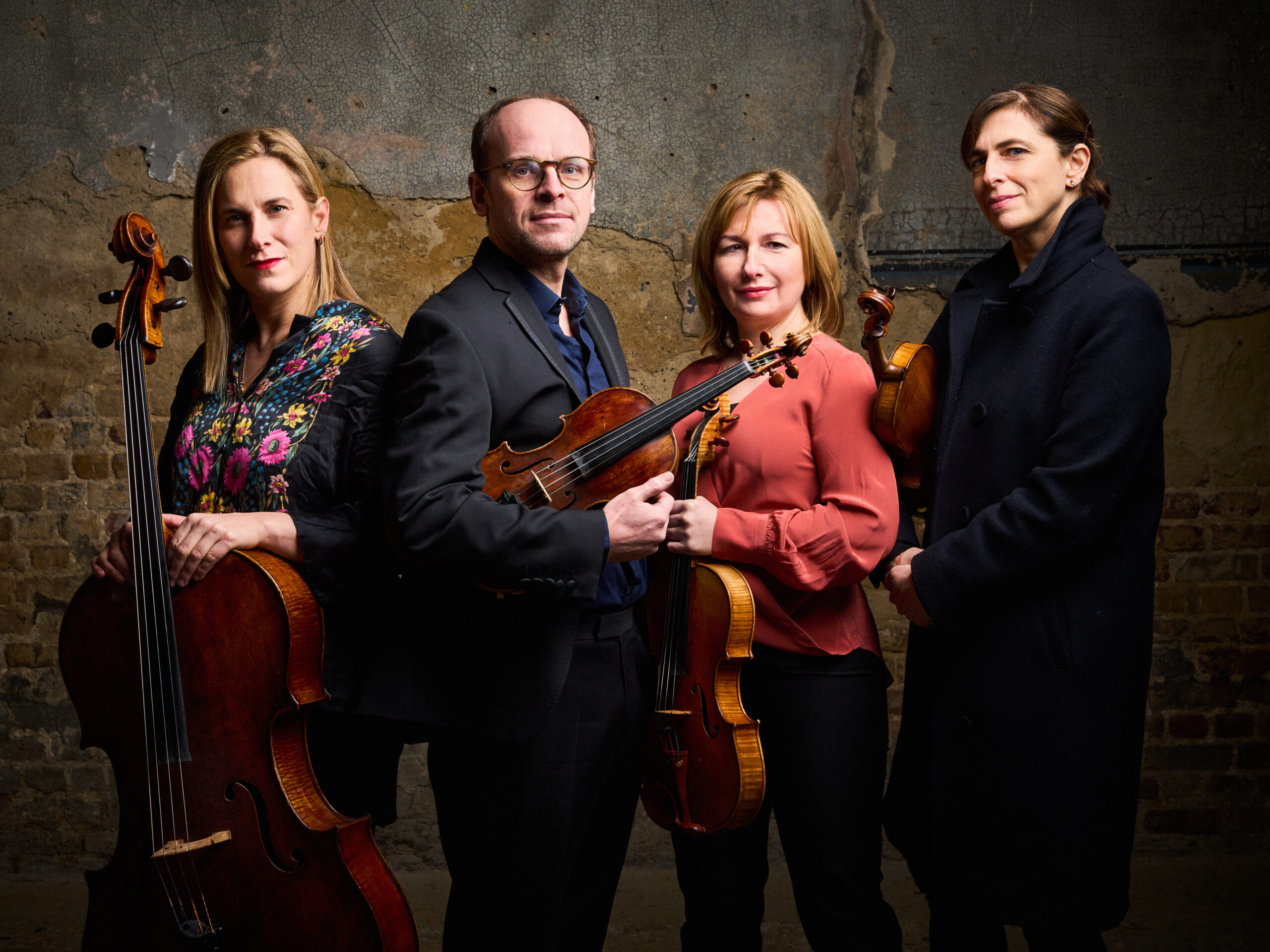
String players of Ensemble 360

STRAVINSKY Three Pieces for String Quartet (7′)
SHOSTAKOVICH String Quartet No.3 Op.73 (32′)
BEETHOVEN String Quartet Op.135 (26′) 

“Must it be? It must be!” Beethoven inscribed these words on the manuscript of his profoundly moving final string quartet. This Op.135 quartet was written towards the very end of his life, and is touched by the wisdom of his years yet as full of contrast, quick wit and struggle as any of earlier works.  

Two masterpieces of the 20th century are presented alongside Beethoven’s quartet: Stravinsky’s wonderfully inventive short pieces and Shostakovich’s masterful third quartet, which encompasses the scope of a symphony in an intimate chamber work. 

STRAVINSKY Igor, Three Pieces for String Quartet

Composed in 1914, Stravinsky revised these pieces in 1918 when he dedicated them to the Swiss conductor Ernest Ansermet. The first performance was given in Paris in May 1915 by a quartet which included the composer Darius Milhaud playing violin, while the 1918 version had its premiere in London on 13 February 1919. The work comprises three short movements without titles or tempo markings. Though the dimensions of the pieces are slight, Stravinsky managed to baffle (and infuriate) early critics with the unusual sound effects and performance markings in places, and the deliberate absence of any conventional forms or traditional thematic development. Instead, the mood is by turns stange and grotesque. The second piece was inspired by the comedian Little Tich (Harry Relph) whose jerky stage act had impressed Stravinsky during a visit to London in 1914. The result might almost be described as an anti-quartet, and as the critic Paul Griffiths later remarked, these little pieces are ‘determinedly not a “string quartet”. The notion of quartet dialogue has no place here, nor have subtleties of blend: the texture is completely fragmented, with each instrument sounding for itself.’  

 Nigel Simeone 

SHOSTAKOVICH Dmitri, String Quartet No.3 in F major Op.73

Shostakovich began his Third String Quartet in January 1946 but made no progress beyond the second movement until May when he went with his family to spend the summer at a dacha near the Finnish border. According to Beria (head of the Soviet secret police) in a letter to Shostakovich, this retreat was a personal gift from Stalin. It was a productive summer and the quartet was completed on 2 August 1946. The same day Shostakovich wrote to Vassily Shirinsky, second violinist of the Beethoven Quartet: ‘I have never been so pleased with a composition as with this Quartet. I am probably wrong, but that is exactly how I feel right now.’ The Beethoven Quartet gave the first performance at the Moscow Conservatory on 16 December 1946. Though there was an ominous silence from official critics, Shostakovich’s reputation was still high among the nation’s leaders: on 28 December he was given the Order of Lenin and each member of the Beethoven Quartet received the Order of the Red Banner of Labour. Just a year later the Third Quartet was denounced in the journal Sovetskaya musika as ‘modernist and false music.’

Although Shostakovich had no overt programme in mind, he invested a great deal of private emotion in the work – sufficient, as Fyodor Druzhinin (violist of the Beethoven Quartet) recalled, for the music to move the composer to tears when he attended a rehearsal in the 1960s, twenty years after he had written it. The start of the first movement, in F major, recalls the Haydn-like mood of the Ninth Symphony (completed in 1945) and this is followed by a contrasting idea, played pianissimo. The development includes some turbulent fugal writing, injecting a sense of unease that hovers over the rest of the movement. The Moderato con moto (in E minor) is based on a series of sinister ostinato figures and frequent repetitions while the third movement is a violent scherzo in G sharp minor. The Adagio is an extended passacaglia (ground bass) that gives way to a Moderato in which some kind of resolution is found in the closing bars, ending with three pizzicato F major chords.


Nigel Simeone

BEETHOVEN, BERWALD & MOZART

Ensemble 360

Cast, Doncaster
Saturday 22 April 2023, 7.00pm

£14.50

£10 Under 26s

Past Event

BERWALD Grand Septet in B-flat (25′)
MOZART Clarinet Quintet in A K581 (35′)
BEETHOVEN Septet in E-flat, Op.20 (40′)

An evening featuring three celebrated works of chamber music, all on a larger scale.

Beethoven’s Septet was his most popular work; an inventive, celebratory piece, full of youthful energy and generosity of spirit, punctuated by fanfares, solos, cadenzas and exuberant fireworks! The evening begins with a Romantic septet, inspired by Beethoven, and written by his Swedish younger contemporary, Berwald; Mozart’s sublime Clarinet Quintet follows.

BERWALD Franz, Grand Septet in B flat

Adagio
Allegro molto
Poco adagio
Prestissimo
Poco adagio
Finale: Allegro con spirito


The influence and popularity of Beethoven’s Septet spread across Europe and the work was regularly performed in Berwald’s native city of Stockholm. Now widely regarded as the most important Swedish composer of the nineteenth century, during his lifetime Berwald was seldom able to earn a living from his music, working instead as a successful physiotherapist and, later, manager of a glass works. None of this should lead us to underestimate either Berwald’s creative talent or his imaginative handling of musical form. Both are apparent in this Septet. Completed in 1828, it may have been a reworking of an earlier piece for the same forces. Even so, it is a relatively early work, composed two decades before his best-known pieces such as the Symphonie sérieuse and Symphonie singulière. The musical language is consistently appealing, owing something to contemporary opera and to composers such as Spohr, but the melodies and harmonies have an idiosyncratic character that is entirely Berwald’s own (as at the start of the Allegro molto in the first movement, or the opening of the finale). In terms of the Septet’s design, the most striking innovation comes in the second movement which has a very quick Scherzo embedded within a seemingly conventional slow movement.

MOZART Wolfgang Amadeus, Clarinet Quintet in A K581

Allegro 
Larghetto 
Menuetto 
Allegretto con variazioni  

The Clarinet Quintet was completed on 29 September 1789 and written for Mozart’s friend Anton Stadler (1753–1812). The first performance took place a few months later at a concert in Vienna’s Burgtheater on 22 December 1789, with Stadler as the soloist in a programme where the premiere of the Clarinet Quintet was a musical interlude, sandwiched between the two parts of Vincenzo Righini’s cantata The Birth of Apollo, performed by “more than 180 persons.” 

From the start, Mozart is at his most daringly beautiful: the luxuriant voicing of the opening string chords provides a sensuously atmospheric musical springboard for the clarinet’s opening flourish. The rich sonority of the Clarinet Quintet is quite unlike that of any other chamber music by Mozart, but it does have something in common with his opera Così fan tutte (premièred in January 1790), on which he was working at the same time. In particular, the slow movement of the quintet, with muted strings supporting the clarinet, has a quiet rapture that recalls the trio ‘Soave sia il vento’ (with muted strings, and prominent clarinet parts as well as voices) in Così. The finale of the Quintet is a Theme and Variations which begins with folk-like charm, then turns to more melancholy reflection before ending in a spirit of bucolic delight. 

Nigel Simeone © 2012 

BREATHTAKING SAX

Amy Dickson & Kathryn Stott

Crucible Playhouse, Sheffield
Thursday 18 May 2023, 7.15pm

£21
£14 DLA, UC or PIP
£5 Under 35s & Students 

Save £s when you book for 5 concerts or more at the same time 

Past Event

SCOTT Respectfully Yours (4’)
SCHULHOFF Hot Sonata (15’)
RODNEY BENNETT Four Country Dances (13’)
FITKIN Gate (8’)
GLASS (arr. DICKSON) Sonata for violin and piano (22’)
FRANÇAIX Cinq danses exotiques (6’)
MILHAUD Scaramouche (10’) 

Czech jazz, Brazilian influences, and a thrilling and emotional sonata by a minimalist master are explored by the Australian Classical BRIT award-winning saxophonist Amy Dickson in the company of our Festival Curator, Kathryn Stott.  

Amy is celebrated internationally for her “individual and unusual tone: luscious, silky smooth, sultry and voluptuous” (Gramophone Magazine), and this eclectic programme showcases the subtlety, range and beauty of her instrument.  


SCOTT Andy, Respectfully Yours

Andy Scott is a composer and saxophonist who worked on several occasions with composer Richard Rodney Bennett, and Respectfully Yours was written in memory of Bennett, who died in December 2012. For Scott himself, ‘it was appropriate to write a piece that was melodic with jazz-influenced harmony that I think of as a simple “thank you” to Richard Rodney Bennett, for being an inspirational musician and a kind and generous person.’ Originally written for euphonium and piano, Scott subsequently arranged it for saxophone and piano. Over tender, melting piano harmonies, the saxophone weaves a lyrical melody in music that is both reflective and heartfelt. 


© Nigel Simeone

SCHULHOFF Erwin, Hot Sonata

Schulhoff composed his Hot Sonata (subtitled ‘Jazz Sonata’) in 1930, while he was working on his opera Flammen. In a series of pieces from the 1920s, he was one of the first composers to attempt a serious integration of jazz idioms into concert works, and the Hot Sonata is a particularly impressive example. It was commissioned by the German radio station Funkstunde A.G. in Berlin and the commission specified that the music should meet ‘the particular musical requirements of radio’ – in short, that it should appeal to a large audience. The first performance was given in Berlin on 10 April 1930 by the American saxophonist Billy Barton with Schulhoff himself at the piano, and the Hot Sonata was published in August 1930 by Schott in Mainz. 


In an advertisement for the new work, the firm announced that ‘today’s scant number of chamber music works for saxophone is augmented by this valuable composition. The name of Schulhoff guarantees the serious, artistic form of this sonata.’ This was not just publishing hyperbole: by 1930, Schulhoff had written several outstanding chamber works – including two string quartets and two violin sonatas – as well as a ballet (Ogelala), a jazz-inspired piano concerto and a number of piano pieces. The Hot Sonata is in four movements, with only metronome marks to indicate tempo. The first is moderately fast, the saxophone underpinned by a loping piano part which also introduces the deliciously spicy harmonies and syncopated rhythms that characterise the whole work. The short second movement is fast and scherzo-like. The third movement is a kind of blues, the opening saxophone melody marked ‘lamentuoso ma molto grottesco’ and this gives way to an ebullient finale. 


© Nigel Simeone

BENNETT Richard Rodney, Four Country Dances

New Dance 
Lady Day 
The Mulberry Garden 
Nobody’s Jig 
 

Richard Rodney Bennett’s Four Country Dances for saxophone and piano are part of larger series of pieces inspired by tunes found in John Playford’s The English Dancing Master first published in 1651, with numerous later editions which changed the title to The Dancing Master and added new tunes. Bennett has taken these folk-like melodies and added piano accompaniments of his own to create pieces that have a very individual character. This is particularly apparent in the last dance, where the piano part is at first spiky, then enters into a dialogue with the saxophone with fragments of the melody. The results are fresh, spirited and charming. 


© Nigel Simeone

FITKIN Graham, Gate

In a brief note on this work, Graham Fitkin writes that ‘this piece started from one thing – a trill. The alternation of two adjacent notes gives rise to a simple and constant grouping of beats. Place it in different temporal contexts and the inherent quality of the trill is questioned.’ These are the essential component parts of Gate, but what makes the piece so compelling is the vitality and creative imagination with which these ostensibly simple ideas are expanded and mutated in a piece that moves forward with seemingly unstoppable impetus to a dizzying close. 


© Nigel Simeone

FRANÇAIX Jean, Cinq danses exotiques

Pambiche. Risoluto 
Baiao. Com morbidezza 
Mambo. Allegrissimo 
Samba lenta. Tranquillo 
Merengue. Vivo com spirito 
 

Jean Françaix’s Cinq danses exotiques were dedicated to the great French saxophonist Marcel Mule. While the music is Françaix’s own, the characteristic rhythms of all five dances draw on traditional music from Latin America. The first, a lively ‘Pambiche’, has its origins in the island nation of Dominica, while the second, a languid ‘Baiao’ is a popular form in north-eastern Brazil. The fast ‘Mambo’ has an obsessive repeating figure in the bass which drives the music along, while the Brazilian ‘Samba lenta’ is perhaps the most expressive of the set, its music in slow, swaying 5/8 time. The Merengue is a dance from the island of Hispaniola (comprising the Dominican Republic and Haiti). Françaix’s version is quick and highly syncopated. 


© Nigel Simeone

MILHAUD Darius, Scaramouche

Vif 
Modéré 
Brasileira 
 

In May 1937 Milhaud wrote the incidental music for a production of Charles Vildrac’s play Le médecin volant (after Molière’s play of the same name), which opened at the Théâtre Scaramouche. He quickly repurposed pieces from it to create part of a suite – Scaramouche – for two pianos. As for the title, Milhaud almost certainly took it from the Scaramouche theatre and it was a particularly apt choice: in the traditional commedia dell’arte, Scaramouche is the clown, and the mood of the work is decidedly jovial, particularly the riotous Brazilian-inspired finale. 


Milhaud also made an arrangement of Scaramouche for saxophone (an instrument he had already used to great effect in La création du monde) which he dedicated to Marcel Mule, who first played it in public. Both versions were published by Raymond Deiss, famous for only printing pieces he liked. During the French Occupation, when Milhaud was exiled in America, Deiss used his presses to produce Resistance literature, paying for this with his life when he was executed by the Nazis in 1943. 


© Nigel Simeone

“Dickson shows the saxophone is capable of subtlety and great beauty”

BBC Music Magazine

FINALE

Kathryn Stott & Ensemble 360

Crucible Playhouse, Sheffield
Saturday 20 May 2023, 7.15pm

£21
£14 DLA, UC or PIP
£5 Under 35s & Students 

Save £s when you book for 5 concerts or more at the same time 

Past Event

JACOBSEN & AGHAEI Ascending Bird (5’)
SCHUBERT Piano Quintet in A ‘Trout’ (40’)
SAINT-SAËNS Caprice on Danish and Russian Airs (12’)
COLERIDGE TAYLOR Nonet (25’) 

Bringing Sheffield Chamber Music Festival to a fabulous conclusion, Kathryn returns to play Schubert’s enduringly joyful ‘Trout’ Quintet with Ensemble 360, a piece she last played in the Crucible with the Lindsay String Quartet at their Farewell Concert in 2005.  

After a folk-inspired string quartet charting the attempts of a mythical bird to reach the sun, and Saint-Saëns’ virtuoso showcase for flute, oboe and clarinet, comes Coleridge-Taylor’s dazzling Nonet, full of swagger, rich texture and brimming with optimism. 

JACOBSEN Colin & AGHAEI Siamak, Ascending Bird

American composer and violinist Colin Jacobsen spoke about the background to this exhilarating piece before a performance in 2011: ‘I wrote Ascending Bird with my friend Siamak Aghaei, a wonderful musician from Iran. The piece tells the story of a mythic bird that tries to reach the sun. It tries at first and falls back down. It tries again, then finally on the third time it receives the radiant embrace of the sun and loses its physical body, in a metaphor for spiritual transcendence.’ Written in 2007, the music is an arrangement of an old Persian folk tune, starting gently and working up to a thrilling close. 


© Nigel Simeone

SCHUBERT Franz, Piano Quintet in A major D667, ‘The Trout’

Allegro vivace 
Andante 
Scherzo: Presto 
Theme and Variations: Andante 
Allegro giusto 
 

Silvester Paumgartner was a wealthy amateur cellist who lived in Steyr, Upper Austria, and an enthusiastic supporter of Schubert and his music. After playing Hummel’s Piano Quintet Paumgartner wanted a quintet for the same combination of instruments (violin, viola, cello, double bass and piano) from Schubert, who visited in the summer of 1819 (and again in 1823 and 1825). Paumgartner also wanted a work that included reference to Schubert’s song Die Forelle, The Trout, which had been composed in 1817. For Schubert, his visits to Paumgartner in the Upper Austrian countryside were a delight, a chance to make music, enjoy good company and revel in the spectacular scenery. 


Willi Kahl, writing in Cobbett’s Cyclopedic Survey of Chamber Music wrote that ‘the fundamental tone of the piece is defined by the persistence of a major key throughout’ – underlining that this is among Schubert’s most genial chamber works. The first movement is brilliant but never flashy while the Andante is the expressive core of the work, suggesting, Kahl believed, ‘a moonlit night-song from the Styrian landscape’. The Scherzo is muscular and energetic, with a more easy-going central Trio section. In the first three variations, the theme is heard in its original form (on a different instrument each time) and remains clearly recognisable in the more freely worked fourth and fifth variations. In the last variation, Schubert brings the Quintet back to the original song as the unmistakable figurations of the song’s piano accompaniment are heard for the first time, to utterly enchanting effect. The finale is amiable and untroubled (though not without a couple of surprises), bringing this most affable of works to a properly jubilant close. 


© Nigel Simeone  

SAINT-SAËNS Camille, Caprice sur des Airs Danois et Russes, Op.79

Saint-Saëns wrote this piece for a series of concerts that he gave for the Red Cross in St Petersburg in April 1887. It is dedicated to Maria Feodorovna, Empress of Russia, and the composer wrote it for himself to play on piano with three other specific players in mind: flautist Paul Taffanel, oboist Georges Gillet and clarinettist Charles Turban. For the sources of the tunes, Saint-Saëns wrote to Julien Tiersot, the leading French expert on traditional music at the time, requesting suitable Danish and Russian themes. Before leaving for Russia, the work was rehearsed in Paris, and Saint-Saëns invited the singer and composer Pauline Viardot to hear the new piece, after which he travelled to Russia with Taffanel, Gillet and Turban. 


Following a flamboyant introduction, Saint-Saëns introduces a succession of traditional themes, varies and repeats them, and occasionally mixes them together, all composed with his characteristic inventiveness and skill.  

Nigel Simeone © 2012 

COLERIDGE-TAYLOR Samuel, Nonet in F minor Op.2

Allegro energico 

Andante con moto 

Scherzo. Allegro 

Finale. Allegro vivace 


Coleridge-Taylor composed his Nonet in 1893–4, while he was a student at the Royal College of Music, and it was first performed there in July 1894. Still in his teens, Coleridge-Taylor has modestly headed the score ‘Gradus ad Parnassum’ (Steps to Parnassus), suggesting he realised that he still had plenty to learn. His teacher at the RCM was Charles Villiers Stanford, and the work reveals the clear influence of Brahms – a composer Stanford himself admired enormously. 


The Nonet is conceived on quite a grand scale. The first movement immediately reveals Coleridge-Taylor’s skill in writing for nine instruments: at times the textures are almost orchestral while at others he reduces the forces to evoke the more private world of chamber music. There’s a similar kind of contrast in the main themes: the first of these, broad and expansive, is initially heard on the clarinet before being taken up by the whole ensemble. The second theme is livelier, with dotted rhythms, and it is introduced by the piano. The Andante reveals Coleridge-Taylor’s gift for song-like melodies (with some phrases suggesting the influence of Dvořák on the young composer), while the Scherzo (in duple rather than triple time) is highly animated, with a warm Trio section led by the horn. Again, the benign shadow of Dvořák seems to hover over this movement. The instrumental writing in the ebullient finale is particularly colourful, with some magical effects. 


A review appeared in the August 1894 issue of Musical Times where the un-named critic commented that ‘the whole Nonet is most interesting, its themes are fresh and vigorous, and their treatment proves that the writer has learnt to compose with skill. The scherzo is unquestionably the most striking movement, and few would guess it to be the work of one still a student.’ 

© Nigel Simeone, 2021 

COME & SING: KATE RUSBY

Kate Shipway

Crucible Theatre, Sheffield
Saturday 13 May 2023, 1.00pm / 3.30pm

Workshop: SOLD OUT
Performance tickets:
Free
Tickets for the public performance must be booked in advance through Sheffield Theatres box office here.


Sold Out

Workshop: 1.00pm – 3.30pm SOLD OUT (register on our waitlist via the Eventbrite Page)
Performance: 3.30pm – 4.30pm

The workshop portion of this event is now sold out. Please keep an eye on our Eventbrite page for details of any returned spaces or to join the waiting list.

Tickets for the public performance must be booked in advance through Sheffield Theatres box office here.

This workshop for singers of all ages and abilities is a chance to come together for music-making and an informal performance of brand new choral settings of songs by folk superstar Kate Rusby.  

Choral leader and arranger Kate Shipway will lead a workshop on the iconic Crucible Theatre stage, featuring her own arrangements of Rusby’s much-loved songs. Either learn by ear or from provided notation. This event is for both beginners and experienced singers alike (although some experience of singing in a choir will be helpful). 

CLOSE UP: MUSIC FOR CURIOUS YOUNG MINDS

Ensemble 360 & Elinor Moran

Crucible Playhouse, Sheffield
Saturday 20 May 2023, 11.00am

£12
£7 DLA, UC & PIP
£5 Under 16s

Save £s when you book for 5 concerts or more at the same time 

Past Event

A tour through the wondrous world of chamber music, specially created for young audiences, combining well-known classical favourites with new works from surprising places. This concert for 7-11 year-olds includes thrilling musical adventures told through music, cheeky characters and epic heroes, mind-blowing musical games, and the chance to join in and make music together.   

Ideal for 7-11 year olds.

The concert includes extracts from:

SCHUBERT String Quartet in D Minor ‘Death And The Maiden’
STRAVINSKY Three Pieces
HAYDN Op.33 No.3 ‘Russian Quartet’
MOZART String Quartet In E Flat
WEIR String Quartet
MEREDITH Short Tribute to Teenage Fanclub
Arr. BURLEIGH Oh Lord, What a Morning
SUK  Meditation on an Old Czech Chorale
BEETHOVEN String Quartet No. 16 Op.135
DVOŘÁK String Quartet No.12 ‘American Quartet’

SCHUBERT String Quartet in D Minor (excerpt for ‘Close Up’)

Hey Presto! We begin with a twitchy chase from Franz Schubert, which he told the string players should be played ‘presto’ meaning ‘very quick or very fast’. How does the sound change when each musician plays on their own? How do you feel when they all play the same tune together? This tense piece kicks off an exciting hour of music…

HAYDN Russian Quartet No.3 (excerpt for ‘Close Up’)

Haydn was the composer who did most to first create a form of music for two violins, a viola and a cello: a group we know as a string quartet. This piece has the nickname ‘The Bird’ — can you hear why?

MOZART String Quartet In E Flat K428 (excerpt for ‘Close Up’)

This beautiful tune is almost like a lullaby and shows how gentle the sound of the strings can be. Listen to the way the first violin plays a tune and the other three instruments rock gently back and forth underneath, creating a warm blanket of sound. This is music to wrap up warm within. How does it make you feel?

WEIR String Quartet (excerpt for ‘Close Up’)

This string quartet was written by a composer who is making music today, the wonderful Judith Weir. A piece full of mysteries, inspired by a medieval Spanish tune. This quartet sounds like a strange landscape where it’s easy to get lost among these lopsided rhythms where nothing is quite as it seems…

SUK Josef, Meditation on an Old Czech Chorale (excerpt for ‘Close Up’)

This piece was written at the start of the first world war and is full of the drama and sadness of a scary time. But it ends full of hope with long notes seeming to climb into the air. Look and listen out for all the times the musicians play across the strings to make two or more notes sound at once — a technique called double stopping.

MEREDITH Anna, Short Tribute to Teenage Fanclub (excerpt for ‘Close Up’)

Anna Meredith is another musician writing music today. She makes music for her band as well as for classical musicians, often mixing up instruments usually seen in an orchestra with rock and pop instruments. This piece combines the two and is a tribute to one of her favourite bands performed by string quartet who don’t use their bows at all but pluck their instruments in a technique called ‘pizzicato’.

BEETHOVEN ‘The Harp’ Quartet (excerpt for ‘Close Up’)

This beautiful quartet is known as ‘the harp’ because in the first part, all four musicians have sections where they pluck the strings their instruments rather than using the bow. Can you hear the difference?

BURLEIGH Henry Thacker, Oh Lord, What A Morning (excerpt for ‘Close Up’)

This is a traditional song created by enslaved Africans in America. The composer and singer Harry Burleigh was the grandchild of slaves who became a famous musician and helped share music by black people with the rest of the world. This simple song looks forward to a better time when injustices like slavery and racism will end. Perhaps you can hear both the sadness and the hope in this beautiful music.

STRAVINSKY Igor, Three Pieces for String Quartet (excerpt for ‘Close Up’)

This spiky, short piece of music was created in Russia at the same time Suk wrote the piece we heard earlier. Stravinsky uses the plucking technique we heard in the Meredith and Beethoven, as well clashing notes and unexpected changes in pulse and speed. Stravinsky keeps us guessing what he’ll do next!

DVOŘÁK ‘American’ String Quartet (excerpt for ‘Close Up’)

This piece brings our concert to a celebratory end, from Czech composer Anton Dvořák. Listen out for all the places it gets louder, or faster — or both! — or where the quartet hang back to build tension. This piece uses folk tunes from Czechoslovakia, where Dvořák was born and started writing, and includes a native American tune, and music from all the people like him who had travelled to live and work in the USA. Bringing these together, our concert ends with an explosion of joy!

RACHMANINOV 150

Tim Horton & Kathryn Stott

Crucible Playhouse, Sheffield
Friday 19 May 2023, 7.15pm

£21
£14 DLA, UC or PIP
£5 Under 35s & Students 

Save £s when you book for 5 concerts or more at the same time 

Past Event

RACHMANINOV
Fantasia Tableaux Suite No. 1 (24’)
Vocalise for four hands (6’)
Suite No.2 (23’)
Symphonic Dances for two pianos (32’) 

In a spectacular celebration of the 150th birthday of the Russian giant of twentieth century piano-writing, Kathryn Stott and Tim Horton perform a breathtaking programme of Rachmaninov on two pianos.  

Rachmaninov’s writing for piano is legendary, with lush melodies sitting on glorious harmonies, and this concert has it all.  Original works for two pianos nestle alongside an arrangement of his celebrated song without words for four hands.  

To close, the showstopper Symphonic Dances, an epic orchestral favourite, is brought to life on two pianos – a spellbinding rare treat to end the evening! 

RACHMANINOV Sergei, Music for Two Pianos

Suite No.1: Fantaisie (Tableaux), Op.5
Vocalise, Op.34 No.14
Suite No.2, Op.17
Symphonic Dances, Op.45
 

When Rachmaninov was a sixteen-year-old student at the Moscow Conservatory, Tchaikovsky declared: ‘I predict a great future for him’ and he watched with interest as Rachmaninov’s career developed. At a private soirée in September 1893, Tchaikovsky heard a preview performance (on piano four-hands) of his Pathétique Symphony (a month before its premiere) and that same evening, Rachmaninov showed Tchaikovsky his new Suite for two pianos. It turned out to be their last meeting: by the time Rachmaninov and Pavel Pabst gave the public premiere of the Suite on 30 November 1893, Tchaikovsky was dead. When the work was published the following year, it was headed with a dedication ‘À Monsieur P. Tchaikowsky’. The original title was Fantaisie (Tableaux) pour deux pianos, and in the score, each movement is prefaced by a poem. While working on the piece in June 1893, Rachmaninov had written to a friend that it was ‘a fantasy representing a series of musical pictures.’ Accompanying the opening ‘Barcarolle’ (Allegretto) is a poem by Lermontov that begins: ‘At dusk the chill waves lap gently beneath the gondola’s slow oar’, and ends on a reflective note: ‘time glides over the surge of love; the water will grow smooth again and passion will rise no more.’ For ‘Night…Love’ (Adagio sostenuto), Rachmaninov turned to Byron: the poem beginning ‘It is the hour when from the boughs the nightingale’s high note is heard.’ The third movement is a lament (Largo di molto) entitled ‘Tears’, accompanied by Fyodor Tyutchev’s poem beginning ‘Tears, human tears, you flow both early and late.’ The finale is ‘Easter’ (Allegro maestoso), a musical evocation of Aleksey Khomyakov’s words: ‘Across the earth a mighty bell is ringing … exulting in that holy victory.’  


The Vocalise was first written in 1915 for wordless soprano voice and piano, but Rachmaninov himself soon made orchestral arrangements (with and without voice) and others followed, including a solo piano arrangement by Alexander Siloti (1921) and several different transcriptions for piano four-hands. This short piece found Rachmaninov on inspired form, with a memorable melody unfolding over gently shifting harmonies.  


The Suite No.2 was composed between December 1900 and April 1901 – written simultaneously with the Second Piano Concerto – and first performed by Rachmaninov and Alexander Siloti in Moscow on 24 November 1901. Unlike the Suite No.1, this work has no programmatic element. The first movement, headed ‘Introduction’, is marked Alla marcia, the second is a quick Waltz, the third an ardent ‘Romance’ (Andantino), and the fourth a ‘Tarantella’ (Presto) which brings the work to a dazzling close. 


On one memorable occasion in 1942, Rachmaninov and Vladimir Horowitz played the Suite No.2 at a private concert for family and friends, and at another private performance the same legendary duo played the Symphonic Dances. This work was composed in 1940: the two-piano score is dated 10 August 1940, and the more familiar orchestral version was completed two months later. It turned out to be Rachmaninov’s last composition. Originally, he planned to call it Fantastic Dances and to give each movement a title (‘Noon’, ‘Twilight’ and ‘Midnight’) but settled on the more neutral ‘Symphonic Dances’ and gave the movements simple tempo indications: Non allegro, Andante con moto (Tempo di valse) and Lento assai – Allegro vivace. This work is the supreme example of Rachmaninov’s more astringent late style, though there are also nostalgic self-quotations from earlier works: at the end of the first movement, a serene recollection of the main theme from the First Symphony (1895); and in the finale the chant ‘Blessed art thou, Lord’ from the All-Night Vigil (1915). At the end of the manuscript score, Rachmaninov bade farewell to his composing career with the words: ‘I thank Thee, Lord’.  


© Nigel Simeone

LA MER: TWO PIANOS AND SAX

Amy Dickson, Tim Horton & Kathryn Stott

Crucible Playhouse, Sheffield
Friday 19 May 2023, 1.00pm

£16
£10 DLA, UC & PIP
£5 Under 35s & Students 

Save £s when you book for 5 concerts or more at the same time 

Past Event

WU TONG Rain Falling from the roof (5’)
YOSHIMATSU Fuzzy Bird Sonata (16’)
DEBUSSY (arr. CAPLET) La Mer (for two pianos) (25’) 

In an arrangement for two pianos, this concert spotlights Debussy’s celebrated ‘symphonic sketches’ of the sea; an impressionistic, symbolist masterpiece, drawn from childhood memories and the composer’s abiding interest in Japanese art.  

Before this, award-winning saxophonist Amy Dickson shares a thrilling and highly virtuosic sonata by Japanese composer Yoshimatsu and a piece by Chinese composer Wu Tong, which reflects on life during lockdown and was written for performance with Kathryn’s friend and frequent collaborator, cellist Yo-Yo Ma. 


WU TONG, Rain falling from the roof

Wu Tong is a Chinese composer and performer (primarily on the Chinese bawu and sheng) who became a founder member of the Silk Road Ensemble, led by cellist Yo-Yo Ma, and has appeared as a virtuoso soloist with orchestras including the Chicago Symphony and New York Philharmonic. An extremely versatile musician, he was also the vocalist in the first rock band to broadcast on Chinese television. 


Rain Falling on the Roof is a kind of song without words with flexible instrumentation. It has been played by Wu Tong himself on the sheng, and recorded by Yo-Ya Ma and Kathryn Stott in a version for cello and piano. Wu Tong himself has written that his inspiration was a very contemporary response, during the Coronavirus pandemic, to an ancient Buddhist story: ‘Upon hearing the sound of the falling raindrops, I was reminded that people depend upon peaceful coexistence with each other and with Mother Nature to live in true harmony. No one exists in isolation.’ 


© Nigel Simeone

YOSHIMATSU Takashi, Fuzzy Bird Sonata

Run, Bird 
Sing, Bird 
Fly, Bird 
 

The Fuzzy Bird Sonata was composed in 1991 and dedicated to the Japanese saxophonist Nobuya Sugawa. Yoshimatsu was initially self-taught as a composer, inspired by hearing European classical composers, but his own style developed into a distinctive musical language which also draws on elements of jazz. The first movement of the Fuzzy Bird Sonata (‘Run, Bird’) is propulsive and exciting (with a moment of calm at its centre), making virtuoso demands on both players. In the second movement (‘Sing, Bird’), an expansive saxophone melody is heard over piano chords. ‘Fly, Bird’ begins hesitantly, before gradually gaining momentum, enabling the bird to take flight.   


© Nigel Simeone

DEBUSSY Claude, La Mer arr. for two pianos by André Caplet

De l’aube à midi sur la mer (From dawn to midday on the sea) 
Jeu de vagues (Play of the waves) 
Dialogue du vent et de la mer (Dialogue of the wind and the sea) 
 

The sea’s central importance to Debussy is well documented in his letters. In September 1903 he wrote to his close friend and fellow composer Andre ́Messager about La mer, noting the amusing irony of composing the piece in the resolutely landlocked department of the Yonne in north-west Burgundy, and describing his approach to the work with an interesting analogy to landscape painting: 

‘I’m working on three symphonic sketches … the whole to be called La mer. You’re unaware, maybe, that I was intended for the noble career of a sailor and have only deviated from that path thanks to the quirks of fate. Even so, I’ve retained a sincere devotion to the sea. To which you’ll reply that the Atlantic doesn’t exactly wash the foothills of Burgundy, and that the result could be one of those hack landscapes done in the studio! But I have innumerable memories, and those, in my view, are worth more than a reality which tends to weigh too heavily on the imagination.’ 


In July 1904 Debussy left his first wife Lilly Texier and eloped to Jersey with the singer Emma Bardac. In an undated letter from the Grand Hotel in St Helier he wrote to his publisher Durand that ‘The sea has behaved beautifully towards me and shown me all her guises.’ He returned to the subject while staying at the Grand Hotel in Eastbourne, where he was correcting the proofs of La mer: ‘It’s a charming, peaceful spot. The sea unfurls itself with an utterly British correctness.’ 


The English critic Edward Lockspeiser was unhesitating in describing La mer as ‘the greatest example of an orchestral Impressionist work’ and it does not seem unduly far-fetched to see a parallel in Claude Monet’s seascapes from the 1890s. The three movements form a magnificent large-scale symphonic whole which is fully maintained in André Caplet’s brilliant arrangement for two pianos. A gifted composer in his own right and a trusted friend of Debussy’s, Caplet has transcribed the work with dazzling effectiveness, remaining entirely true to the spirit of Debussy’s orchestral original. 


© Nigel Simeone

HAYDN & FISCHER: STRING QUARTETS

Pavel Fischer & Ensemble 360

Crucible Playhouse, Sheffield
Thursday 18 May 2023, 1.00pm

£16
£10 DLA, UC & PIP
£5 Under 35s & Students 

Save £s when you book for 5 concerts or more at the same time 

Past Event

HAYDN String Quartet Op.20 No.4 (25’) 
TRADITIONAL (arr. FISCHER) Two Songs from the Moravian Highlands (8’)
FISCHER String Quartet No.3 ‘Mad Piper’ (17’) 

Pavel Fischer, composer and former first violin of the Škampa  Quartet, joins Ensemble 360’s string players Claudia Ajmone-Marsen, Rachel Roberts and Gemma Rosefield. Fischer will lead his third string quartet inspired by Moravian folk music, evoking ‘Piper Bill’, who played while under fire during the D-Day landings in Normandy.  

Led by Ensemble 360’s Benjamin Nabarro, Haydn’s innovative, folk-inspired D major quartet precedes Fischer’s works, with its hymn-like opening, joyous variations and complex, chromatic conclusion. 


HAYDN Joseph, String Quartet in D, Op.20 No.4

Allegro di molto 
Un poco adagio. Affetuoso 
Allegretto alla zingarese 
Presto scherzando 
 

The ‘Sun’ string quartets Op.20 (so named because of the sunrise on the title page of an early edition) were composed in 1772 and the manuscript was one of the prize possessions of Johannes Brahms. The English musicologist Donald Francis Tovey wrote that ‘No document in the history of music is more important than Haydn’s Op.20, with its three fugues (which secure autonomy and equality of parts by a return to the old polyphony), its passages of turn-about solo, its experiments in rich and special effects, and, most important of all, its achievements in quite normal quartet-writing such as pervades the remaining forty-odd quartets.’ In short, with Op.20, Haydn established himself as the master of the string quartet genre. Surprisingly, it was another decade before he composed more quartets (Op.33 followed in 1781).  


The String Quartet Op.20 No.4 is one of the less troubled and anguished of the set, but it is endlessly ingenious. The opening is subdued and rather chorale-like until it is interrupted by flashing violin arpeggios, and the whole movement is marked by sudden and unexpected contrasts. The slow movement is a beautiful set of variations in D minor, notable for its harmonic richness and for the distribution of the variations among all four instruments. The Minuet ‘in gypsy style’ has plenty of surprises – a dazzling display of ambiguous cross-rhythms that only settles into regular patterns of triple time in the Trio. The finale is anything but predictable with modulations to strange keys, moments of ‘exotic’ colouring, and a delectably nihilistic ending.  


Nigel Simeone © 2011 

FISCHER Pavel, String Quartet No.3 Mad Piper

Mad Piper 
Carpathian 
Sad Piper 
Ursari 
 

Pavel Fischer was a founder member and leader of the Škampa Quartet and after an extremely successful performing career, has turned increasingly to teaching and composition. His String Quartet No.3 was written in 2011 and demonstrates his fascination with integrating elements of music from different parts of the world into his work. The ‘Mad Piper’ of the title (and the first movement), evokes the Canadian bagpiper Bill Millin who continued to play while under fire on Sword Beach during the initial stages of the D-Day Landings in 1944. 


After a fast, aggressive opening (the heat of battle, perhaps?), a plaintive viola melody leads to a reprise of the initial material, followed by a serene coda. The second movement, ‘Carpathian’, is a vigorous folk dance with an unceasing, breathless drive. The slow movement, ‘Sad Piper’, was inspired by the plaintive song of a Bulgarian piper, here transformed into an eloquent viola solo, supported by quiet sustained chords. The title of the finale, ‘Ursari’ recalls the nomadic Romani bear handlers of Eastern Europe, in particular their bear dances (Bartok also composed a ‘Bear Dance’ for piano which he later orchestrated). Here the quartet takes on the role of a percussion section as well as string instruments, the music driving forwards until a brief respite for a reflective passage before the dance is taken up again with renewed energy. 


© Nigel Simeone

THE MUSIC OF STRANGERS Film Screening

Wu Man & Kathryn Stott

Showroom, Sheffield
Wednesday 17 May 2023, 8.00pm

£10
£8 Concession (Over 60s, Students & Claimants)*

Past Event

Introduced by Kathryn Stott and followed by a  Q& A with Wu Man of the Silk Road Ensemble 

The extraordinary story of the renowned international musical collective, The Silkroad Ensemble, created by Kathryn’s friend and long-term collaborator, the legendary cellist Yo-Yo Ma, is told in this Grammy-nominated documentary.  

It follows members of the Silkroad Ensemble as they gather in locations across the world, exploring the ways art can both preserve traditions and shape cultural evolution. 

Blending performance footage, personal interviews, and archival film, Oscar-winning director Morgan Neville and producer Caitrin Rogers focus on the personal journeys of a small group of Silkroad Ensemble mainstays — Kinan Azmeh (Syria), Kayhan Kalhor (Iran), Yo-Yo Ma (France/United States), Wu Man (China), and Cristina Pato (Spain) — to chronicle passion, talent, and sacrifice.  

Through these moving individual stories, the filmmakers paint a vivid portrait of a bold musical experiment and a global search for the ties that bind. 


*26 yr olds and under: £4.50 Cine26 tickets can be booked through the Showroom box office only.


“Musically delightful”

The Hollywood Reporter