VIENNESE MASTERWORKS: BRAHMS & MORE FOR SOLO PIANO

Tim Horton

Upper Chapel, Sheffield
Saturday 8 February 2025, 7.00pm

Tickets:
£22
£14 UC, PIP & DLA
£5 Students & Under 35s 

Past Event
Pianist Tim Horton

HAYDN Andante and Variations in F minor Hob. XVII:6 (15’)
BERG Sonata Op.1 (11’)
MOZART Piano Sonata No.4 in E flat K282 (12’)
WEBERN Variations Op.27 (6’)
BRAHMS Variations and Fugue on a Theme by Handel Op.24 (26’) 

Tim Horton returns for the second instalment of his popular recital series exploring music from Vienna, a city famed for its history of classical music-making. Popular works by Haydn and Mozart are presented alongside 20th-century gems from Second Viennese School composers Berg and Webern, and the concert concludes with Brahms’s extraordinarily inventive Variations and Fugue on a Theme by Handel.  

Post-concert Q&A FREE to all ticket-holders
Please join us after the concert for an informal Q&A with Tim Horton and Music in the Round’s Programme Manager for Sheffield, Benjamin Tassie. 

Save 20% when you book for 10 or more Music in the Round concerts in one transaction.
Save 10% when you book for 5 or more Music in the Round concerts in one transaction. Find out more. 

Browse the full programme online, explore the seasons with our digital brochure or download a copy of our 2025 brochure.

Download

HAYDN Joseph, Andante with Variations in F minor, Hob.XVII/6

One of Haydn’s most remarkable piano works, this set of variations is on two themes, the first in F minor, the second in F major. The autograph manuscript (in New York Public Library) is headed ‘Sonata’ and dated 1793, while a manuscript copy with a title page in Haydn’s hand title calls it ‘Un piccolo divertimento scritto e composto per la stimatissima Signora de Ployer’ (Barbara von Ployer, for whom Mozart composed the Piano Concerto K453). Haydn took the work with him to London on his second visit (1794–5) where he played it on one of Broadwood pianos that he had come to admire on his first trip to England. It was not published until 1799, when it was given the title ‘Variations’, and a new dedication: to Baroness Josephine von Braun, wife of the director of the court theatres in Vienna and also the dedicatee of Beethoven’s Piano Sonatas Op. 14. Haydn originally ended the work with the second F major variation and a short coda. He then had second thoughts, adding a reprise of the F minor theme and a long, harmonically adventurous coda that ends in despair. It has been suggested – not unreasonably – that the tragic mood of this work may owe something to the sudden death in January 1793 of Haydn’s close friend Maria Anna von Genzinger.

BERG Alban, Piano Sonata, Op.1

Alban Berg first met Schoenberg in 1904 and continued to study with his until 1910. It’s not certain exactly when he composed the Piano Sonata, but towards the end of his studies Berg started to work on exercises in sonata structures and it is likely that the work emerged from these in 1907–8. Published in 1910 by Schlesinger in Berlin and Haslinger in Vienna, the first public performance took place in Vienna on 24 April 1911, given by Etta Werndorff, another member of the Schoenberg circle who also gave the premiere of Schoenberg’s Klavierstücke Op. 11 (Schoenberg also painted her portrait twice). Douglas Jarman (in New Grove) described Berg’s Sonata as ‘the last work he wrote directly under his teacher’s guidance … in effect his graduation piece, the work in which he set out to demonstrate what he had learned from both Schoenberg’s teaching and Schoenberg’s music.’ The Sonata is a single movement, highly concentrated, in which Berg generates a number of distinctive ideas from short motifs (heard at the start) which serve as the musical seeds for a work of powerful originality. Following the precepts of his teacher, Berg is not afraid to look to the past for inspiration and the structure is broadly in sonata form (exposition–development–recapitulation). The musical language is more uncompromising, stretching the possibilities of post-Wagnerian harmonies to breaking point, but always with a highly expressive trajectory that is as much emotional as it is architectural. Berg’s Sonata is an outstanding ‘Opus One’, the young composer’s creative voice emerging more or less fully formed. 


Nigel Simeone 2024

MOZART Wolfgang Amadeus, Piano Sonata in E flat K282

Adagio 
Menuetto I, Menuetto II 
Allegro 
 

Mozart composed his first set of six solo piano sonatas in 1774 and 1775. The 18-year-old composer spent three months in Munich working on his opera La finta giardinera (first performed on 13 January 1775) and the last of the set (K.284) was written for Baron von Dürnitz in Munich. The other five (including K.282) were composed either in Salzburg during 1774, or in Munich on Mozart’s arrival in the city. Each of the sonatas in this set is in three movements, but K.282 is the only one to begin with a slow movement. This is an expansive Adagio based on two themes and incorporating a development of the first theme as part of the second half of the movement, after which this theme is only heard again in the coda. This is followed by a Minuet, in B flat major with a contrasting second Minuet at the centre of the movement in the work’s home key of E flat. The main theme of the finale is notable for its leaping octaves and a mood of high spirits.   

WEBERN Anton, Variations, Op.27

Sehr mäßig (Very moderate) 
Sehr schnell (Very fast) 
Ruhig fließend (Calmly flowing) 
 

Almost thirty years after Berg’s Sonata, Webern’s Variations, Op. 27 is a work which demonstrates twelve-tone technique at its most refined and distilled. The title only tells part of the story. The third movement – and the first to be finished, in July 1936 – was described by René Leibowitz (the leading French apostle for the Second Viennese School) as a set of five variations. This is confirmed by Webern himself: ten days after finishing the third movement he wrote that ‘the completed part is a set of variations. The whole work will be a kind of Suite.’ According to Webern himself, the first movement (completed in August 1936) is in sonata form, while the second (November 1936) is a kind of scherzo. In other words, Webern’s idea of calling the complete piece a ‘Suite’ is perhaps a better description of the overall structure than ‘Variations’. The first performance was given in 1937 by Peter Stadlen who worked closely with Webern while preparing the premiere. His copy, marked up by Webern (published in 1979) contains several revelations. The most important of these is that Webern did not see this piece as an exercise in chilly abstraction – the very first page is covered in markings suggesting highly expressive music: ‘coolly passionate lyricism’ at the start, ‘molto espressivo’ a few bars later, and so on. Always conscious of his musical heritage, Webern likened the first movement to a late Brahms intermezzo, and the second movement to the ‘Badinerie’ from Bach’s Orchestral Suite No. 2. The result is music that is challenging for listener and player, but enormously rewarding too. 

BRAHMS Johannes, Variations and Fugue on a Theme by Handel, Op.24

Brahms composed the Handel Variations in 1861, when he was in his late twenties. The dedication is to Clara Schumann to whom Brahms presented the variations as a birthday present. Comprising twenty-five concise variations and a much more expansive closing fugue, the work is ingeniously structured in what Nicholas Cook described as ‘a series of waves, both in terms of tempo and dynamics, leading to the final fugue.’ The theme was drawn from the third movement of Handel’s Harpsichord Suite No. 1 in B flat. Intriguingly, this is entitled ‘Aria con varizioni’: in other words, Brahms created a new set of variations on a theme that was originally intended to be treated that way. Brahms wrote that for him the most important feature of a variation theme was not the melody but the bass line: ‘it is the firm foundation on which I can build my stories … Over the given bass, I invent something new and discover new melodies about it.’ The essential point here is not that the bass line should be unchanged (Brahms makes plenty of changes) but that he viewed it as the way to control the overall structure. The expressive range of the Handel Variations – their emotional ebb-and-flow – is remarkable: the first five variations move from the lively syncopated accents of Variation 1, to the sinuous lines of Variation 2, the elegance of Variation 3, the powerful octaves of Variation 4 and the lyrical minor-key contrasts of Variation 5. These are all wonderful examples of the ‘new melodies’ Brahms was able to discover in Handel’s theme, and the process is continued with astonishing imagination in all the variations that follow, culminating in the magnificent final fugue, its subject derived from the opening phrase of Handel’s theme. Combining pianistic virtuosity and the most imaginative handling of counterpoint, it is a heroic peroration. 

Nigel Simeone 2024 

SOUNDS OF NOW: QUARTET FOR HEART & BREATH

Phaedra Ensemble & Lotte Betts-Dean

Upper Chapel, Sheffield
Saturday 25 January 2025, 8.00pm

Tickets:
£17
£10 UC, PIP & DLA
£5 Students & Under 35s

Past Event
Mezzo-soprano Lotte Betts-Dean

RICHARD REED PARRY Quartet for Heart and Breath (6’)
KATE WHITLEY Six Charlotte Mew Settings (16’)
JOHN TAVENER The World (10’)
New Commission (8’)
MEREDITH MONK String Songs (20’)
CASSANDRA MILLER Thanksong (12’) 

Music by Arcade Fire’s Richard Reed Parry opens this concert of sumptuous, 21st century compositions for string quartet, performed by Phaedra Ensemble with Lotte Betts-Dean, a vocalist praised by The Guardian for her “unmissable, urgent musicality”.  

Following its collaboration with American composer Meredith Monk, performer and Godmother of the New York experimental music scene, Phaedra performs the composer’s only string quartet, String Songs. Mezzo-soprano Lotte Betts-Dean then joins the quartet to present works by Kate Whitley and John Tavener, as well as Cassandra Miller’s modern masterpiece Thanksong, a tender reflection on Beethoven’s late Quartet in A minor (Op.132).  

Save 20% when you book for 10 or more Music in the Round concerts in one transaction.
Save 10% when you book for 5 or more Music in the Round concerts in one transaction. Find out more. 

Browse the full programme online, explore the seasons with our digital brochure or download a copy of our 2025 brochure.

Download

PARRY Richard Reed, Quartet for Heart & Breath

Richard Reed Parry is best known as a guitarist in the Canadian rock band Arcade Fire. Quartet for Heart and Breath is one of a series of pieces that Parry began work on during the band’s mammoth 2004-5 tour, that all have the same conceptual starting point: every note is played in sync with the heartbeat or breath of the musicians. While they are performing, the musicians wear stethoscopes under their clothes so they can clearly hear their own heartbeats, which in turn regulate their individual tempos. 


The idea for Parry’s concept came about through reaction. After listening to a tranche of electroacoustic music that didn’t he didn’t feel any profound connection to, Parry sought a way to make music intimately connected to musicians’ bodies. Rather than opting for repetitive rhythms or dance figures, he decided to go deeper, beyond the skill of trained musicians, and straight for corporeal intuition. He began conceiving music directly related to the involuntary aspects of bodily functions: the speed of breath, eyes blinking, hearts beating. 


When composing for others, Parry’s musical world brings together the minimal musical palettes of Steve Reich and Brian Eno, and the musical systems of John Cage. Parry was interested in the latter through his pieces like I Ching, which use chance procedures to gradually relinquish the control the composer has over the realisation of the work. The result here is a naturally jumbled collection of tumbling rhythms, that manages to find a surprisingly soothing character amid the chaos. 


Hugh Morris 2024 

WHITLEY Kate, Mew Settings

“I think her very good and interesting and unlike anyone else,” Virginia Woolf remarked of the poet Charlotte Mew. Born in 1869, Mew lived precariously in London; a life punctuated by tragic family circumstances, and with an aversion to any kind of publicity, she nevertheless possessed a selection of high-profile admirers from the city’s literary scene, including Thomas Hardy and Siegried Sassoon. Mew’s poem The Farmer’s Bride (1912) brought her wider acclaim. In that verse, a farmer takes a bride, and laments that she won’t reciprocate his desires. The folksy metre and bucolic imagery disguise what is a creepy, at times startling poem on a young woman’s objectification at the hands of an older man maddened by desire. 


In 2020, Whitley, a composer and founder of Peckham’s Multi-Story Orchestra, reworked two separate collections of Mew settings (for male and female voice) into a new six-movement work for soprano and quartet. (“I like how the gender of the speaker in Mew’s poems is often ambiguous, so it has seemed to make sense,” she wrote in 2020.) Sea Love reminisces on a lover through a folk dialect, accompanied by waves of solo violin arpeggios. The folk-tinged feeling continues in The Farmer’s Bride, with scuttling string figures giving this movement a darkly theatrical quality. The sea returns as a theme in Rooms; where in Sea Love, it’s “everlastin,’” by Rooms, the sea becomes a “maddening” sound, outside a room “with a seaweed smell.” (Some of Mew’s artistic preoccupations involve confinement, feeling trapped, and longing to explore, themes that crop up in the first three settings.) 


The fourth movement, I so liked Spring, works in a mirror form. For voice and solo violin once more, the two stanzas give reflections on a season before and after a lover. Where there’s a slight defiance to the previous text, Absence speaks to the intense anguish of the narrator’s loss; Whitley’s setting is sparse and spacious, with soprano accompanied mostly by gently plucked strings. There’s more pain in the final poem, Moorland Night, but it’s a pain that arrives through searching rather than inward reflection. Travelling through a harsh-weathered landscape, the narrator describes the search for “The Thing.” Mew’s narrator soon finds this Thing, yet, after such anguish, seems to find solace as she vows to return that Thing to the earth. Whitley’s animated setting is similarly journeying. 


Hugh Morris 2024 

TAVENER John, The World

The World for string quartet and soprano solo should be performed at maximum intensity throughout. White hot, white cold – intensely loud, intensely soft – almost unbearable – that which is nowhere and everywhere – not human but divine – theanthropic.” These, the words of the piece’s composer, John Tavener. His ten-minute setting of the poet Kathleen Raine for soprano and quartet certainly lends itself to such extremities of thinking. 


Despite the serene timbres, The World works in a currency of simple gestures taken to their limits, but the extremes Tavener finds comes through austerity rather than exuberance. The piece is built around a few key ideas: beginning with striking plucked chords, the soprano introduces a coupletted stepping motion which is passed around the ensemble. The fiendish soprano part finishes this theme with a flourish—a long, quiet, sustained note, suspended above the ensemble. A squiggly chorale-like passage brings the strings back together in rhythmic unison around an anchoring mid-range drone, and the whole sequence repeats again. Through these kinds of creative austerity, Tavener achieves a steely focus. 


Hugh Morris 2024 

MONK Meredith, Stringsongs

Meredith Monk’s string quartet Stringsongs was written in 2004, and premiered at the Barbican in 2005 by the Kronos Quartet. Her first creation for these forces represented yet another strand for an artist whose uninhibited creating has seen her touch disciplines as varied as singing, composing, dance, choreography, visual art and playwriting. 


In creating this extremely coherent yet slightly strange quartet, Monk got to know the players of the Kronos Quartet intimately. “The music came to life in surprising ways, colored by the distinctive ‘voice’ of each musician,” she wrote in a programme note. Perhaps the best example of this is Tendrils, the beautifully drawn-out, delicately crafted second movement which serves as the piece’s emotional core. Each player plays a wistful monologue, woven into an ensemble texture that spins forward for nine unbroken minutes. 


Tendrils follows Cliff Edge; Monk’s straightforward harmonic and melodic building blocks never quite move as you expect, creating dissonances that are unexpectedly raw, while further intensifying the austere double-stopped chords that become a theme of the movement. The third movement, Obsidian Chorale, is the most ostensibly vocal of the four movements—after the unbroken polyphony of Tendrils, the quartet moves through a sequence of dark, quiet chords in unison, for barely two minutes. Phantom Strings, a fast final movement based on a chugging, uneven ostinato, doesn’t so much conclude as stop, ending this enigmatic piece with more questions than answers. 


Hugh Morris 2024

MILLER Cassandra, Thanksong

Over the course of her career, Cassandra Miller, a Canadian composer currently living in London, has developed her own idiosyncratic way of composing that she calls “transformative mimicry.” Her music is usually rooted in other music that already exists; she listens to it, sings back a version of the parts, and then either sketches them using musical notation, or, in the case of Thanksong, creates an aural score out of her recordings. In a performance of Thanksong, each member of the ensemble listens to their own part on headphones, and plays by ear. 


For this piece, her source material was the third movement of Beethoven’s String Quartet No. 15 Op. 132 in A minor, known as the Heiliger Dankgesang, after the thankful message Beethoven put at the heading of this movement. He had recently recovered from an intense intestinal illness, and described the third, a slow movement, as a “Holy song of thanksgiving of a convalescent to the Deity.” 


Miller’s piece is one to get lost in. It has few grand milestones, preferring instead a more intimate language of blurred, burbling lines, encoding the feeling of players feeling their way through the piece into the composition. It’s delicate, and personal. 


Hugh Morris 2024 

MENDELSSOHN OCTET

Ensemble 360 & Consone Quartet

Upper Chapel, Sheffield
Saturday 26 October 2024, 7.00pm

Tickets
£22
£14 UC, DLA & PIP
£5 Under 35s & Students 

Past Event
String quartet players of classical music group Ensemble 360, with their instruments

FELIX MENDELSSOHN
   Theme and Variations from Four Pieces Op.81 (6’)
   String Quartet in E flat Op.44 No.3 (35’)
   Octet Op.20 (34’) 

Music in the Round’s new Visiting String Quartet, the Consone Quartet, made their spellbinding Sheffield debut with a rapturously received celebration of the quartets of Fanny and Felix Mendelssohn in spring 2024.  

They return to Sheffield this autumn for an immersive afternoon and evening exploring more of Felix Mendelssohn’s quartets.  

To conclude the day, the Consone Quartet joins forces with the string players of Ensemble 360 for the composer’s eloquent and warm Octet, full of gusto and joyful invention. 

View the brochure online here or download it below.

DOWNLOAD

Save £s when you book for 5 Music in the Round concerts or more at the same time. Find out more here. 

MENDELSSOHN Felix, Theme and Variations (from Four Pieces for String Quartet), Op. 81, No. 1

This Theme and Variations – composed in 1847 – was published posthumously as the first of Mendelssohn’s Four Pieces for String Quartet, Op. 81. Like its companion Scherzo, the undated manuscript is believed to have been written in the last few weeks of Mendelssohn’s life. Marked Andante sostenuto, the poised, elegant theme is presented by the violin, before being taken over by the viola, against a gentle, syncopated accompaniment. The next variation, in triplets, is slightly faster and gives way to a variation where the first violin plays a florid semiquaver descant over sustained chords. The fast-moving phrases are then transferred to the cello before the tempo changes to a vigorous Presto (in 6/8 time), the key now shifting from major to minor. A brief solo violin cadenza leads to coda back in the home key of E major, based on a varied recollection of the opening material and a serene close.  

Nigel Simeone © 2024 

MENDELSSON Felix, String Quartet in E flat Op. 44 No. 3

In Robert Schumann’s retrospective of concerts in Leipzig during 1837–8, he wrote that concerts of string quartets in the small hall of the Gewandhaus “gave us many artistic treasures this winter.” These innovative chamber music concerts were established by Ferdinand David, a close friend of Mendelssohn’s and leader of the Gewandhaus Orchestra. Schumann singled out Mendelssohn and his two newest string quartets (Op.44 Nos.2 and 3) as works that “wandered through a finely human sphere … in such a sphere we must award the palm to him among all his contemporaries, and only Franz Schubert, had he lived, would have been worthy to award Mendelssohn that palm without disputing it.” The E flat major Quartet Op.44 No.3 was completed in February 1848. The first movement opens with a terse five-note motif and a dotted rhythm. Both these ideas – and the way Mendelssohn uses them to propel the musical argument – show the influence of Beethoven, and they are contrasted with a more lyrical theme. The energy of this movement, and the elegance of its construction, continue into the second movement: a typical Mendelssohn Scherzo, full of dramatic contrasts between loud and soft. After E flat major in the first movement, and the darker C minor in the Scherzo, the rapt, lyrical Adagio is in A flat major. The finale, back in the home key of E flat, is dazzling, full of rapid semiquavers – a virtuoso display written for some of the most gifted quartet players of the time.  

Nigel Simeone © 2012 

MENDELSSOHN Felix, Octet Op. 20

One of the marvels of nineteenth-century chamber music, Mendelssohn’s Octet was originally finished in October 1825, when the composer was 16 years old. He later revised it before publication. The miracle of this work is not the youthfulness of its creator but the astonishing individuality of its music – regardless of how old its composer was at the time. The arching opening theme of the first movement, underpinned by syncopated chords, reveals the originality of Mendelssohn’s creative voice as never before. The way in which he generates a constant stream of musical ideas is all his own, but this was a composer who knew how to draw on the refinement of Mozart, the power of Beethoven and the contrapuntal intricacy of Bach for his own expressive purposes. The slow movement begins gently but becomes increasingly uneasy, while the dizzying Scherzo was inspired by the ‘Walpurgisnacht’ scene from Goethe’s Faust. The Presto finale follows naturally from this, beginning with an energetic fugal subject that generates unstoppable momentum and inspired elation.  

Nigel Simeone © 2015

BACH FOR SOLO VIOLIN

Ensemble 360

Upper Chapel, Sheffield
Friday 4 October 2024, 1.00pm / 7.00pm

Tickets
£17
£10 UC, DLA & PIP
£5 Under 35s & Students 

Past Event
Classical violinist Benjamin Nabarro from Ensemble 360

JS BACH 
   Sonata No. 1 in G minor (18’)
   Partita No. 1 in B minor (28’)

Benjamin Nabarro performs the first in a new series of concerts celebrating JS Bach’s much-loved music for solo violin. Centred on the intricate and expansive partitas and sonatas, Ben’s recitals explore the wonder of Bach through some of the most enduring and joyous works ever written for the violin. The pieces are presented together with a short, informal conversation about Bach’s celebrated works between Benjamin Nabarro and Benjamin Tassie, Music in the Round’s Programme Manager for Sheffield.

View the brochure online here or download it below.

DOWNLOAD

Save £s when you book for 5 Music in the Round concerts or more at the same time. Find out more here. 

BACH J.S., Sonata No.1 for solo violin, BWV 1001

On Bach’s autograph fair copy of the Sonatas and Partitas he calls them ‘Six Solos for violin without bass accompaniment’. They were completed in 1720, the date Bach added beneath his signature on the title page, though it is likely that he had been working on them before then. These magnificent pieces stand as one of the greatest monuments of Baroque instrumental music, but it is worth considering some of the precursors that might have inspired him – all works with which Bach was almost certainly familiar. First, a suite for solo violin without bass and a set of six partitas by Johann Paul von Westhoff (1656–1705), the movements based on dance forms, making extensive use of ‘multiple-stops’ (playing more than one string at the same time) to create the illusion of a solo instrument in dialogue with itself. Westhoff spent his last few years as a violinist at the court in Weimar where Bach met him in 1703, and this encounter may well have given Bach the idea of trying something similar. The unaccompanied Passacaglia which Heinrich Biber (1644–1704) composed as an epilogue to his Rosary Sonatas in about 1676 could well have provided a model (particularly for the Chaconne of the D minor Partita), and Biber’s pupil Johann Joseph Vilsmaÿr (1663–1722) published a set of Six Partitas for solo violin in 1715. In 1717, Vivaldi’s pupil Johann Georg Pisendel (1687–1755) showed Bach his Sonata for solo violin without bass – and later performed Bach’s sonatas and partitas.

The overall design of Bach’s Six Solos alternates Sonatas with Partitas. Each Sonata is in four movements, with a slow opening movement followed by a faster fugue. The finales are characterised by fast, continuous writing full of the kind of kinetic energy that fuels so much of Bach’s music. The third movements are more varied – and each is in a different key from the rest of the sonata. In the First Sonata (in G minor), Bach’s third movement is a gently lilting Siciliano in B flat major. But some of Bach’s most innovative writing in this work is to be found in the fugue (second movement), a marvel of ingenuity which demands from the player a combination of virtuosity and musical insight: Bach was writing here for extremely skilled musicians and may have played the Sonata and Partitas himself (he was a fine violinist as well as a superb keyboard player). There’s a brilliant kind of musical conjuring trick involved in the fugue: the violin is essentially a melodic instrument intended to play a single line, but here, through the use of double-stops and incredibly ingenious part-writing, Bach presents two or more musical lines at once. The result is a compositional sleight of hand with the violin functioning as more than one part, sometimes supported by bass lines that it also supplies itself. The G minor Sonata demonstrates Bach’s ability to create music of the greatest imagination within quite a strict, formal structure: at its most expressive in the first and third movements (Adagio and Siciliana), at its most technically brilliant (and demanding) in the fugue, and at its most energetic and direct in the Presto finale.

Nigel Simeone © 2024 

BARTÓK Béla, Sonata for solo violin

Written for the renowned violinist Yehudi Menuhin, Hungarian composer Béla Bartók’s (1881-1945) Sonata for Solo Violin is widely considered one of the most challenging and expressive works for the instrument. It sits well in this programme, inspired, as it was, by Menhuin’s performance of Bach’s solo violin sonatas. Indeed, Bartók blends elements of the Baroque – the striking triple- and quadruple ‘stops’ of the opening, for example, in which the violinist plays three or four notes simultaneously – with the composer’s signature folk-inspired melodies; angular, sometimes discordant tunes drawn from the folk traditions of Eastern Europe, for which he is perhaps best known. The Sonata is in four movements: the intense and lyrical Tempo di ciaccona, the haunting Fuga, the delicate Melodia, and the virtuosic Presto. Each movement explores the violin’s capabilities, demanding both technical mastery and profound musicality.

BACH J.S., Partita No.1 for solo violin, BWV 1002

The Partitas are very different in terms of their structures. While each is, broadly speaking, a suite of dances, Bach treats this idea with considerable freedom. The First Partita presents four dances – Allemanda, Corrente, Sarabande and Tempo di borea (i.e. Bourée) – but each of them is followed by a ‘Double’, a kind of variation which Bach uses either to create contrast (as in the Allemanda and Corrente) or to intensify a particular mood, something he does to memorable effect in the Sarabande and its ‘double’, or to create still greater musical momentum, as in the Tempo di borea and its double.  

After Bach’s death, a few expert performers continued to play the Sonatas and Partitas from manuscript copies, notably Haydn’s friend Johann Peter Salomon. The whole collection was published for the first time in 1802. In the nineteenth century, Mendelssohn and Schumann both felt the need to ‘enhance’ Bach’s original by adding piano accompaniments. Joseph Joachim was perhaps the first great virtuoso since Salomon to present Bach’s Sonatas and Partitas in concerts, and even in the recording studio (some extraordinarily evocative records from 1903). Thanks to Joachim’s efforts and those of his successors such as Georges Enescu, the Sonatas and Partitas finally came to be recognised as creative pinnacles of the violin repertoire. 

Nigel Simeone © 2024 

CHOPIN FOR SOLO PIANO

Tim Horton

Upper Chapel, Sheffield
Saturday 6 April 2024, 7.00pm

Tickets
£21 
£14 UC, DLA or PIP
£5 Under 35s & Students

Past Event
Pianist Tim Horton

CHOPIN     
Polonaise in F sharp minor Op.44 (10’)
Waltz in A flat Op.42 (4’)
Three Mazurkas Op.56 (12’)
Nocturne in B Op.62 No.1 (7’)
Barcarolle in F sharp Op.60 (8’)
Polonaise in C minor Op.40 No.2 (9’)
Three Waltzes Op.64 (8’)
Impromptu No.2 in F sharp Op.36 (6’)
Nocturne in E Op.62 No.2 (5’)
Andante Spianato and Grand Polonaise brillante Op.22 (14’) 

Tim Horton’s series focusing on Chopin reaches a spectacular conclusion with a sequence of the composer’s works that confirm his music as some of the finest ever written for the piano. Tim will be our guide through Chopin’s powerful Polish mazurkas and polonaises, atmospheric nocturnes and whirling waltzes, including the ever-popular ‘Minute Waltz’. To send us off into the spring evening, Tim will play the Andante Spianato and Grand Polonaise brillante, a perfect summary of Chopin’s genius that pairs beauty with thrilling virtuosity. 

Includes free post-concert Q&A 

Save £s when you book for 5 Music in the Round concerts or more at the same timeFind out more here.

View the brochure for our Sheffield 2024 concerts online here or download it below.

Download

CHOPIN Frédéric, Polonaise in F sharp minor Op.44

Chopin’s ability to reimagine traditional dance forms in the most startling ways is nowhere more apparent than in the Polonaise in F sharp minor, Op.44. Beginning with a mysterious and sinister opening phrase, the main polonaise theme emerges with music that is marked by a kind of restless rage. At the centre of the piece there is relief in the form of a tender mazurka, but the polonaise returns as fierce as ever until it seems to collapse, exhausted, rousing itself for the brutal final bare octaves. After finishing the work in 1841, Chopin wrote to his publisher to announce that ‘I have a manuscript for your disposal. It is a kind of fantasy in polonaise form. But I call it a Polonaise.’ 


© Nigel Simeone 

CHOPIN Frédéric, Waltz in A flat Op.42

The Waltz in A flat, Op.42, was written in 1840. Wilhelm von Lenz recalled Chopin playing it: ‘The waltz, springing from the eight-bar trill, should evoke a musical clock, according to Chopin himself. In his own performances … he would play it as a continuous stretto prestissimo with the bass maintaining a steady beat – a garland of flowers winding amidst the dancing couples!’ 


© Nigel Simeone

CHOPIN Frédéric, Three Mazurkas Op.56

The mazurka was the Polish dance form Chopin chose for some of his most experimental pieces, combining nostalgia with innovation. The set of Three Mazurkas Op.56 was published in 1844. The B major mazurka begins with a restless theme in the left hand, answered with more confidence by the right hand. There are two contrasting sections (in different keys, E flat and G) before the last return of the opening idea brings resolution. The C major mazurka is boisterous and rustic, with bare open fifths in the bass and a theme full of Polish inflections. The third mazurka has been described as a kind of ‘dance poem’: the musical elements of the mazurka are pared down to produce something which one commentator described as ‘the music of memories rather than of reality’ while another saw its audacious harmonies as providing ‘the foundations for the music of the future.’ 

CHOPIN Frédéric, Nocturne in B Op.62 No.1

The Two Nocturnes published as Op. 62 were composed in 1845–6. The song-like main theme of the B major Nocturne frames a central section (marked sostenuto) and when it is reprised Chopin adds decorations in the manner of an operatic aria – reflecting his admiration for Bellini’s operasThe E major Nocturne was Chopin’s farewell to the form and while it has moments of agitation, the main feeling is of quiet nobility. 


© Nigel Simeone

CHOPIN Frédéric, Barcarolle in F sharp Op.60

The Barcarolle in F sharp, Op.60 was written in the summer of 1845. Chopin never went to Venice to hear an authentic barcarolle, but inspiration may have come from Mendelssohn’s Venetian Gondola Song which Chopin used to give his pupils to play. Described by the German musicologist Hugo Leichtentritt as ‘a work of bewildering beauty’, it was taken up by Chopin’s near-contemporaries such as Clara Schumann and Hans von Bülow. Carl Tausig – a Liszt pupil – even invented a fanciful programme for it in which two lovers met secretly in a gondola. Chopin’s wonderful exploration of piano colours and sonorities in the Barcarolle had a powerful appeal for later composers: Ravel described it as ‘magical’ while Olivier Messiaen declared that its rich and resonant piano writing influenced his own music – a century after Chopin. 


© Nigel Simeone

CHOPIN Frédéric, Polonaise in C minor Op.40 No.2

The Polonaise in C minor, Op. 40 No. 2 was completed in 1839 and is another work in this form which explores the darker side of Chopin’s musical character. Its mood was well summarised over a century ago by the Chopin scholar Ferdinand Hoesick who described it as ‘gloomy’ with a ‘tragic loftiness’. Chopin dedicated it to his friend Julian Fontana.  


© Nigel Simeone

CHOPIN Frédéric, Three Waltzes Op.64

Chopin’s Three Waltzes, Op.64 were composed in 1846–7. The first of them, the so-called ‘Minute’ Waltz’, looks back to Chopin’s earlier ‘brilliant’ style and was said by one contemporary to be a musical portrait of its dedicatee, Chopin’s friend and pupil Delfina Potocka. The second, in C sharp minor, is an exquisite miniature combining intimacy and melancholy in the most concise, unsentimental way. The last of the Op.64 waltzes is more enigmatic: its moods shifting uneasily at times, but finding repose in the central Trio. 


© Nigel Simeone

CHOPIN Frédéric, Impromptu No.2 in F sharp Op.36

Like the earlier Barcarolle, the Impromptu Op.36 is in the key of F sharp major. Written in 1839, it combines elements of favourite Chopin forms such as the nocturne and ballade to create a freer and more improvisatory work where wonderment and heroism sit side-by-side. 


© Nigel Simeone

CHOPIN Frédéric, Nocturne in E Op.62 No.2

Marked Lento sostenuto, this Nocturne (composed in 1846) is in E major and opens with a long-breathed melody – lyrical but never sentimental – and this is contrasted with a much more turbulent middle section. By this late stage in his career, Chopin had complete mastery of his preferred forms, and this Nocturne – the last to be published during his lifetime – is a beautifully balanced structure which perfectly suits the changing moods of the music, and Chopin’s careful control of emotion: this is music that never wears its heart on its sleeve, but which seems, instead, to be a noble contemplation.


Nigel Simeone

CHOPIN Frédéric, Andante Spianato and Grand Polonaise brillante Op.22

The Andante spianato and Grande Polonaise brillante began as the polonaise alone, composed in 1831. Chopin added the Andante spianato in 1834 and the combined work was published in 1836, in versions for piano solo or with orchestral accompaniment. The two sections complement each other: the Andante rippling gently and the Polonaise bursting into exuberant life. 


© Nigel Simeone

“Tim Horton’s unaffected, heartfelt playing is perfectly judged.”

The Arts Desk

DVOŘÁK FOR STRINGS

Ensemble 360

Upper Chapel, Sheffield
Thursday 4 April 2024, 7.00pm

Tickets
£21 
£14 UC, DLA or PIP
£5 Under 35s & Students

Past Event

BRITTEN Three Divertimenti for String Quartet (12’)
DVOŘÁK Quartet No.11 in C Op.61 (39’)
DVOŘÁK String Quintet No.2 in G, Op.77 (35’) 

Dvořák’s exceptional and unusually scored String Quintet No.2 is operatic in scope and richly textured, earning the dedication ‘For my country’ from the Czech composer, who yearned to create a distinctly bohemian musical language in a time of turmoil across eastern Europe. His celebrated Quartet No.11 features the thrilling, turbulent writing that has placed him at the heart of the chamber music repertoire.  

Save £s when you book for 5 Music in the Round concerts or more at the same timeFind out more here.

View the brochure for our Sheffield 2024 concerts online here or download it below.

Download

BRITTEN Benjamin, Three Divertimenti for String Quartet

Britten planned these movements as part of a five-movement Quartetto serioso with a subtitle from Shakespeare’s Winter’s Tale: “Go play, boy, play!” An earlier version of the opening March was written for a suite inspired by the film Emil and the Detectives (the children’s novel by Erich Kästner was a great favourite of Britten’s), but this was never completed. Eventually he settled on a work in three movements, and the first performance was given by the Stratton Quartet at the Wigmore Hall on 25 February 1936. The audience response was chilly and a hurt Britten withdrew the Three Divertimenti, which were only published after his death. His brilliant gift for idiomatic quartet writing is already apparent in this early work – from the arresting rhythms and textures of the March to the beguiling central Waltz, and the driving energy of the closing Burlesque.


© Nigel Simeone

DVOŘÁK Antonin, Quartet No.11 in C Op.61

In 1881, the Viennese violinist Joseph Hellmesberger asked Dvořák to write a new work for his quartet. In October, while working on the opera Dimitrij, Dvořák was alarmed to read an announcement in the Viennese press that the first performance of this quartet would be given on 15 December. He wrote to a friend on 5 November: ‘It still doesn’t exist! … I now have three movements prepared and am working on the finale.’ In fact, Dvořák had no reason to panic: he worked quickly and the C major quartet was written between 25 October and 10 November 1881. 


It has fewer overtly Slavonic elements than its immediate predecessor (the E flat Quartet, Op.51), and, perhaps in a nod to Hellmesberger’s commission, the main influences are from Viennese masters: Beethoven and, especially, Schubert. The spacious first movement transforms its two main themes with great ingenuity and harmonic imagination. The Adagio opens with a fervent theme presented as an intimate dialogue between the two violins; its second idea has what Dvořák’s biographer Otakar Šourek described as a ‘veiled expression of melancholy’. The influence of Beethoven is most apparent in the rather terse Scherzo while the falling theme of the central Trio provides a delightful contrast. The finale (a sonata-rondo) brings the work to a joyous conclusion, with Dvořák at his most inimitably Czech. 


After all the rush, Hellmesberger’s advertised December premiere in Vienna had to be cancelled due to a catastrophic fire at the Ringtheater, and the earliest known performance was given by Joseph Joachim’s quartet on 2 November 1882 in Berlin. 


© Nigel Simeone

DVOŘÁK Antonin, String Quintet No.2 in G, Op.77

Scored for the unusual combination of string quartet and double bass, Dvořák’s String Quintet in G major was first performed on 18 March 1876 as the composer’s Op.18 – a number that was changed when the work was first published by Simrock twelve years later in 1888. Originally the work had five movements (with an ‘Intermezzo’ before the Scherzo, reworked as the Nocturne in B major for string orchestra), and despite the published opus number, it is one of the composer’s first chamber works to be fully characteristic of his mature style. The first movement opens with a motif played first by the viola (Dvořák’s own instrument) that dominates much of the musical argument – the triplet figure in it is to be heard in the second theme too. The Scherzo finds Dvořák writing in the style of a folk dance, the opening theme consists of a lively opening motif that contrasts with a gentler idea over which Dvořák later introduces a warmly expressive new tune. The third movement has been described by the great Dvořák scholar Otakar Šourek as ‘one of the most entrancing slow movements in the whole of Dvořák’s chamber music … a flowing stream of passionate warmth [and] depth of feeling’. The finale has the same kind of sunny mood as the first movement, but with an even greater sense of joyful energy. Though there are moments of repose (during which the thematic material is treated to some ingenious transformations), the work ends with what Dvořák’s biographer Otakar Šourek aptly described as ‘high-spirited verve’.  


© Nigel Simeone 

SOUNDS OF NOW: DEDICATED TO ENSEMBLE 360

Ensemble 360

Upper Chapel, Sheffield
Saturday 9 March 2024, 7.00pm

Tickets
£16
£10 UC, DLA or PIP
£5 Under 35s & Students

Past Event
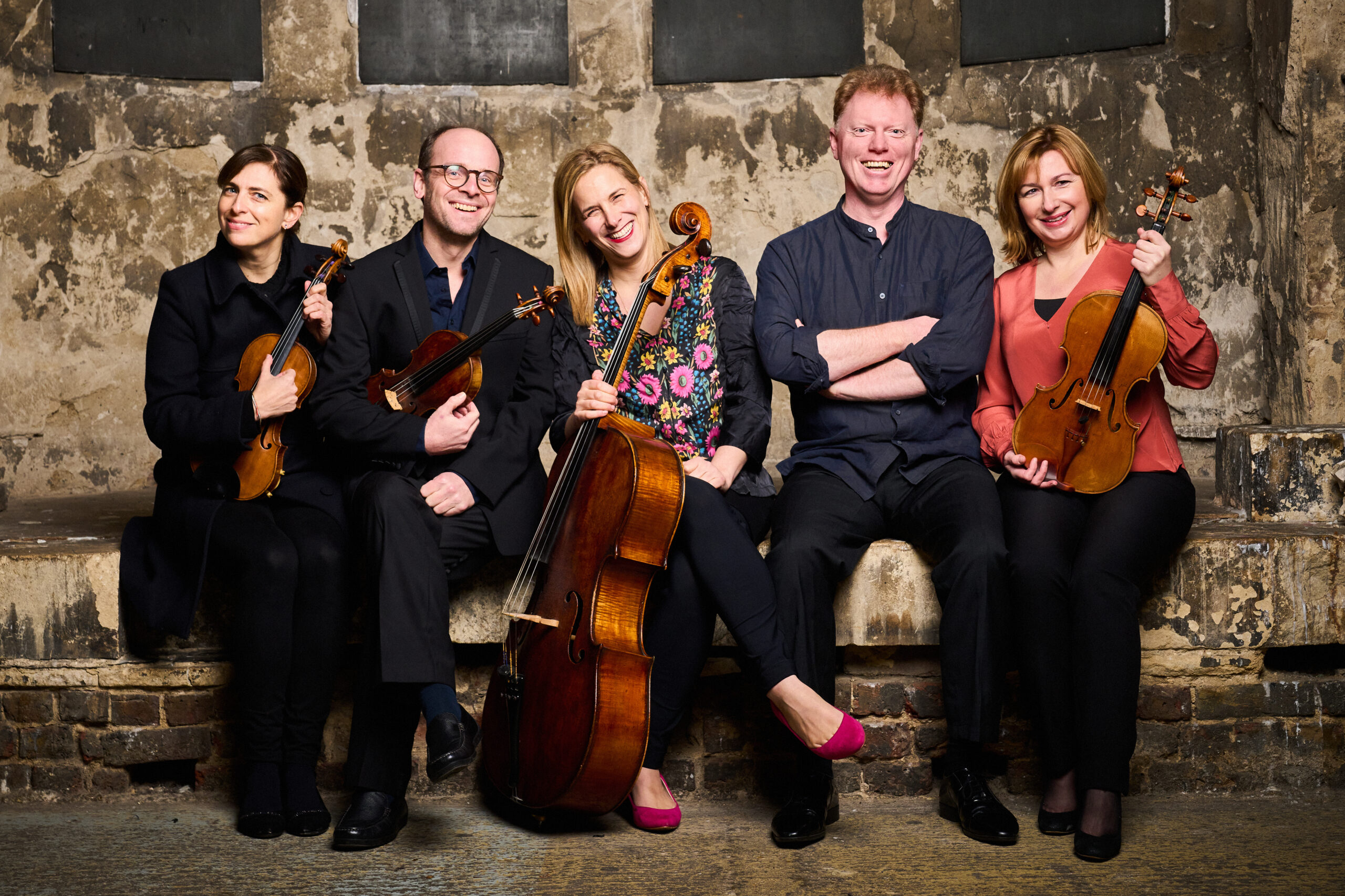
Five classical musicians from Ensemble 360 pose together, seated and smiling. They are our resident musicians in Sheffield and nationally.

L OSBORN Me and 4 Ponys for Piano Quintet (15’)
P WILSON Piano Quintet (16’)
R VITKAUSKAITĖ Nanga (14’)
B LUNN String Trio [world premiere] (15’) (RPS Composer 2023 Commission for Music in the Round)

A celebration of Ensemble 360 and Music in the Round’s collaboration with composers commissioned through the Royal Philharmonic Society. Alongside a world premiere of a new string trio by Ben Lunn, whose evocative music has already marked him out as a distinctive new voice, the Ensemble revisits some of their favourite works from recent commissions. Laurence Osborn’s playful piece inspired by children’s drawings went down a storm when Ensemble 360 first played it in 2018, as did Rūta Vitkauskaitė’s eruption of musical energy inspired by the Scottish landscape, while Peter Wilson’s wonderfully rhapsodic quintet was described as ‘Elgar in a hall of mirrors’. 

Save £s when you book for 5 Music in the Round concerts or more at the same timeFind out more here.

View the brochure for our Sheffield 2024 concerts online here or download it below.

Download

Thanks to the Hinrichsen Foundation for supporting Sounds of Now.

OSBORN, Laurence Me and 4 Ponys

Me and 4 Ponys is about drawings by children. I love drawings by children because they are completely unconcerned with consequence or correction. The first mark on paper is always part of the final piece. Each line is fearlessly drawn. Form, scale, and subject change constantly throughout the creative process, at the whim and intuition of the artist. The results are always endearing and grotesque in equal measure. Me and 4 Ponys wasn’t made in this way – I rewrote and scrapped a lot of music while writing it. But it musicalises aspects of children’s drawings – hard, wax-crayon-like textures, and big, unannounced gestures like handprints or blobs of paint. There’s a jig-like pulse that persists throughout the piece, which is why the title refers to ponies.

© Laurence Osborn

VITKAUSKAITE Ruta, Nanga

I started writing NANGA in Autumn during long walks through rainy fields, and continued into the tired Winter nights, through Spring, with bursting energy of slowly returning postlockdown traffic, and completing it finally in the generously sunny Summer. It has been a strange year, with long periods of isolation, very little social life, prolonged moments of stillness and refection, while I was living a very active inner life of ideas, thoughts, memories, creative flow and frustrations. All of that sank into the musical landscape of this composition: a record of a crisp delicacy of the first frost, sentimental afternoon memories provoked by scattered sunbeam, the burst of thoughts in the deep, dark Scottish winter nights. Overall, NANGA is a very active piece. I imagined it as a wave of energy, an unrelenting force embodying the constant change from ever passing time. The wave returns in its cycle three times, finally being taken over by violoncello Cadenza (co-written with Gemma Rosefield), and settling onto the long rumbling Coda in the lowest register of the instrument. I have chosen the title, NANGA, for its sound rather than meaning. The sound of this word can be found in a variety of cultures, it will mean the highest compliment in one language, and an insult in another, a musical instrument on one part of the planet, and a mountain on another. For me, nanga sounds like a soft but strong jump forwards, an assertive start with strong and direct aim, a peaceful pool of water dropping into a powerful waterfall on its end. It is very versatile; it can unlock many contradictory meanings within the piece, all of them united, however, by the flow of one musical stream aiming towards the grounded finale.

© Ruta Vitkauskaite

LUNN Ben, String Trio

When composing this work, my thoughts had splintered down many roads – considering the history of the trio, contemplating the dynamics of counterpoint and conversation in three parts, thinking about intellectual music, questioning how music reaches people, and what do we gain from music. Because of this, the work is full of contradictions, well maybe they aren’t. Its a work, where I want to engage with the history of the trio but also to change it and challenge it. I want to connect to people, but also compose something challenging. Overall, I feel that historically composers have used the string quartet as a way to demonstrate their talents in a microcosm. I wanted to see if I can use the string trio in that manner – especially as it is my second such trio.

© Ben Lunn, 2024

BEETHOVEN CELLO SONATAS

Ensemble 360

Upper Chapel, Sheffield
Friday 8 March 2024, 1.00pm / 7.00pm

Tickets
£16 
£10 UC, DLA or PIP
£5 Under 35s & Students 

Past Event

BEETHOVEN Cello Sonata Op.102 No.1 (15’)
BEETHOVEN 12 Variations on ‘See the conqu’ring hero comes’ from Handel’s Judas Maccabaeus  (13’)
BEETHOVEN Cello Sonata Op.102 No.2 (20’) 

No interval 

Gemma Rosefield and Tim Horton presented Beethoven’s first two cello sonatas in sell-out concerts that launched Sheffield’s Classical Weekend 2023. They return to present the final pair of sonatas , interspersed with Beethoven’s charming and inventive variations on a theme from Handel’s oratorio ‘Judas Maccabaeus’. These two phenomenal musicians, with a deep understanding and enjoyment of the great composer, are sure to bring to life these absolute glories of virtuosic music for cello and piano. 

Save £s when you book for 5 Music in the Round concerts or more at the same timeFind out more here.

View the brochure for our Sheffield 2024 concerts online here or download it below.

Download

BEETHOVEN Ludwig Van, Cello Sonata Op.102 No.1

Beethoven’s two cello sonatas Op.102 (in C major and D major) were composed in 1815 and dedicated to Beethoven’s friend, Countess Anna Maria Erdödy. They were published in Vienna (by Artaria) and Bonn (by Simrock) in 1817. The first of the two sonatas is one of Beethoven’s most unusual structures, consisting of two fast movements, each of them preceded by an extended slow introduction.  


The first movement opens gently, with a lyrical melody in the upper register of the cello, to which the piano responds with an answering phrase, establishing the instrumental dialogue that is so often a feature of this sonata. After subsiding on to a C, the lowest note of the cello, there is an abrupt change of mood and tempo with the arrival of a stern idea in A minor, marked by dotted rhythms. The movement remains in A minor for most of the movement, ending tersely. The second movement begins with an elaborate slow introduction which gives way to a radiant recollection of the first movement – an unusual procedure that Beethoven was to use again in the finale of his Ninth Symphony. The main theme of the Allegro begins strangely, with a four-note rising fragment and a held note, but this idea quickly develops dramatic momentum, interrupted on several occasions by passages where the cello plays sustained notes and the piano is silent. The movement ends by appearing to fizzle out (using the four-note idea), before a triumphant closing flourish. 


© Nigel Simeone

BEETHOVEN Ludwig Van, 12 Variations on ‘See the conqu’ring hero comes’ from Handel’s Judas Maccabaeus

In 1796, the young Beethoven set out on a concert tour (the only one of his career) that took him to Prague, Dresden, Leipzig and Berlin. While in Berlin, he visited the court of the Friedrich Wilhelm II, the King of Prussia. During this visit, Beethoven composed several works for cello and piano, including the two Op. 5 Sonatas, and this set of variations on the famous tune ‘See the conqu’ring hero comes’ from Handel’s Judas Maccabaeus. Beethoven once described Handel as ‘the greatest composer that ever lived’ and copied out Messiah in order ‘to unravel its complexities’. His choice of theme is therefore no surprise, and the words of the tune may have seemed an appropriate tribute to King Friedrich Wilhelm. The first performance was probably given by Beethoven and Jean–Louis Duport in Berlin in 1796, at the same time as the premiere of the Op. 5 cello sonatas. The theme is presented on the piano, modestly accompanied by the cello. The twelve variations that follow explore the tune with great wit and ingenuity, including a plaintive version of the theme in G minor (Variation 4), great dramaitc intensity in Variation 8 (the other variation in a minor key), presenting the theme in canon between the two instruments (Variation 10) and, following a rhapsodic Adagio, reworking it as an invigorating dance to end the work in suitably triumphant mood.


Nigel Simeone 2016

BEETHOVEN Ludwig van, Sonata for Cello and Piano in D Op.102 No.2

Allegro con brio
Adagio con molto sentimento d’affetto
Allegro – Allegro fugato

Beethoven’s last two cello sonatas were composed in 1815 dedicated to the Countess Anna Maria Erdödy. The initial critical response was one of bewilderment, one critic declaring that “these two sonatas are definitely among the strangest and most unusual works … ever written for the pianoforte. Everything about them is completely different from anything else we have heard, even by this composer.” Indeed, the D major Cello Sonata Op.102 No.2 is a work that points forward to some of Beethoven’s final instrumental works – the late piano sonatas and quartets – in significant ways. The Beethoven scholar William Kinderman has suggested that the solemnity and austerity of the slow movement (in D minor) has pre-echoes of the ‘Heiliger Dankgesang’ from the Quartet Op.132, while fugal finale is the one of a series of such movements in Beethoven’s late instrumental pieces (followed by the ‘Hammerklavier’ Sonata and the Grosse Fuge among others). The whole sonata, from the brusque opening of its first movement, to the extraordinary culmination of the fugue, is characterized by wild emotional contrasts: the stern, profoundly serious Adagio is flanked by two faster movements that are dominated by a fiery, even angry, dialogue between the two instruments.

Nigel Simeone © 2012

MEET THE CONSONE QUARTET

Consone Quartet

Upper Chapel, Sheffield
Saturday 2 March 2024, 7.00pm

Tickets
£21 
£14 UC, DLA or PIP
£5 Under 35s & Students 

Past Event
Players from the Consone String Quartet with their instruments

HAYDN String Quartet in D ‘The Lark’ (15’)
HENSEL-MENDELSSOHN String Quartet in E flat (21’)
R SCHUMANN Bilder aus Osten, Op.66 (extracts arr. Friedrich Hermann) (8’)
MENDELSSOHN String Quartet in F minor, Op.80 (26’) 

Recent BBC New Generation Artists, the Consone Quartet comprises four sensitive and spirited musicians who have formed a dynamic ensemble prized for expressive interpretations of Classical and Romantic repertoire rooted in a profound understanding of the music and its time. They perform music by Fanny Mendelssohn and her brother Felix, alongside one of Haydn’s most popular string quartets and some glorious lyrical writing from Robert Schumann.   

“I’ve really enjoyed the sound of their gut strings with period bows, the almost viol-like melancholy it adds in places alongside the velvety clarity of textures and lovingly applied expressive slides elsewhere.” Andrew McGregor on BBC Radio 3 Record Review

Save £s when you book for 5 Music in the Round concerts or more at the same timeFind out more here.

View the brochure for our Sheffield 2024 concerts online here or download it below.

Download

HAYDN Joseph, String Quartet in D Op.64, No.5 ‘Lark’

It was the soaring violin theme at the start of the first movement which gave this quartet its nickname, in a movement which wears its learning lightly, transforming the main melody in inventive ways right up to its final appearance. The hymn-like Adagio cantabile (with a contrasting minor-key central section) is followed by a Minuet which combines the feeling of a rustic dance with sophisticated motivic development. The finale is an exciting virtuoso display with almost continuous activity, but also some ingenious elements of contrast (such as the passage where the rushing main idea is treated fugally). 


Composed in 1790, Haydn’s Op.64 quartets were the earliest to receive their premieres at public concerts rather than at intimate gatherings of connoisseurs, and the finale of The Lark must have electrified its large audience – and delighted the composer himself: at the invitation of Johann Peter Salomon, Haydn arrived in England on New Year’s Day 1791 and remained there for the next 18 months. When the Quartets were published by the London firm of John Bland in June 1791, the title page announced that they had been ’composed by Giuseppe Haydn and perform’d under his direction at Mr Salomon’s concert, the Festino Rooms, Hanover Square’.  


© Nigel Simeone 

HENSEL-MENDELSSOHN Fanny, String Quartet in E flat

In the last couple of decades, the increasing interest in Fanny Hensel-Mendelssohn’s music has demonstrated beyond doubt that her brother Felix was not the only member of the family with extraordinary gifts. 


Fanny’s only String Quartet dates from 1834 but has its origins in an earlier piano sonata from 1829. That was never completed but its first two movements were reworked as the Adagio and Scherzo of the present quartet which was given its first performance at her Berlin salon in 1834. The formal freedom of this quartet is one of its most remarkable features, beginning with an intense, fantasia-like Adagio that begins in C minor before gradually working towards the home key of E flat by the end of the movement. The Scherzo in C minor, with a Trio section in C major, has something an elfin quality, whereas the following Romanze is a deeply-felt movement that shifts between G minor and major with some surprising detours into remote keys. The finale is a Rondo whose main theme (in tumbling thirds on the violins) dominates this movement, an exciting moto perpetuo. 


© Nigel Simeone 

SCHUMANN Robert, Bilder aus Osten, Op.66

Robert Schumann wrote Bilder aus Osten (‘Pictures from the East’) for piano four-hands in December 1848, as a Christmas present for his wife Clara. According to a preliminary note by Robert in the first edition, the pieces were inspired by the poet Friedrich Rückert’s German translations of Arabic Maqāmāt (tales of Arabic life). The central character of Rückert’s selection, Abu Seid, was likened by Robert to Germany’s own folk character Till Eulenspiegel and Schumann wrote that his aim in these pieces was to ‘express oriental poetry and thinking in our own art, as has already been done in German poetry’. 


Violinist Friedrich Hermann (1828–1907) studied with Felix Mendelssohn and Ferdinand David, played in the Leipzig Gewandhaus Orchestra and became professor of violin at the Leipzig Conservatory. His string quartet transcriptions of Bilder aus Osten demonstrate great skill in reimagining Schumann’s piano duets for entirely different forces, with thoroughly convincing results.  


© Nigel Simeone 

MENDELSSOHN Felix, String Quartet in F minor, Op.80

The last of Felix Mendelssohn’s string quartets was composed in August–September 1847 at Interlaken, a few months after the death of his sister, Fanny Hensel-Mendelssohn. Written as an instrumental Requiem in her memory, it was completed shortly before Mendelssohn’s own death. The first movement is defiant and agitated, while the Scherzo is most unlike Mendelssohn’s usual Scherzo style: this is earnest, dark and intense music. The deeply-felt Adagio is the emotional heart of the work, and the movement that is most obviously elegiac in character. The uneasy start of the finale, marked by syncopations and trills, finds moments of lyricism (including some self-quotations) as well as outbursts of anger. Few works in Mendelssohn’s output are so personal, and so overtly emotional. Though Mendelssohn heard the work played privately, the first public performance took place after his death. It was given in Leipzig by a quartet led by Joseph Joachim at a memorial concert on 4 November 1848 – the first anniversary of Mendelssohn’s death.  


© Nigel Simeone 

EXPLORING THE REED TRIO

Ensemble 360

Upper Chapel, Sheffield
Friday 9 February 2024, 1.00pm / 7.00pm

Tickets
£16 
£10 UC, DLA or PIP
£5 Under 35s & Students 

Past Event
Adrian Wilson (oboe)

KOECHLIN Trio for Oboe, Clarinet and Bassoon (14’)
TOMASI Évocations for oboe (8′)
LUTOSŁAWSKI Trio for oboe, clarinet and bassoon (12′)
POULENC Sonata for clarinet and bassoon (8′)
IBERT Cinq pièces en trio (9′) 

No interval 

The reed trio brings together the colourful expression of the oboe, the warmth and versatility of the clarinet and the rich depth of the bassoon. Lutosławski’s precise and carefully sculpted trio is followed by Poulenc’s spiky and tender duo and Ibert’s five glorious technicolour pieces.  

Watch Adrian Wilson, one of the stars of this concert, in a fun oboe trio recorded specially for our lockdown Festival in May 2020.  

Save £s when you book for 5 Music in the Round concerts or more at the same timeFind out more here.

View the brochure for our Sheffield 2024 concerts online here or download it below.

Download

KOECHLIN Charles, Trio for Oboe, Clarinet and Bassoon

Charles Koechlin was an extremely prolific composer, but much of his music remains to be rediscovered. A pupil of Fauré, he was on friendly terms with many of his contemporaries including Ravel and Debussy, and for a time he served as a kind of mentor to Poulenc. His ‘Trio d’anches’ – Trio for reed instruments – was completed in December 1945 and first performed in a French Radio broadcast on 3 May 1946, played by Paul Taillefer (oboe), André Dupont (clarinet) and André Gaby (bassoon). The first movement is slow-moving and serious and it is followed by a spiky Allegro, its main theme introduced by the solo bassoon and then taken up in imitation, first by the oboe, then the clarinet. The Andante begins with the oboe alone, playing a lyrical idea which dominates the movement. The fast finale is playful in mood and technically demanding with rapid scales and angular rhythms, rushing to an exciting close where all three instruments play together in octaves.  


© Nigel Simeone 

TOMASI Henri Frédien, Évocations for oboe

Henri Tomasi was born in Marseille and by his mid-teens was earning a good living from playing piano in the city’s restaurants and hotels. The First World War meant that Tomasi had to postpone his studies, but when he finally enrolled at the Paris Conservatoire, his composition teachers included Vincent D’Indy and the flautist Philippe Gaubert – music for wind instruments would later dominate Tomasi’s output. Tomasi divided his career between conducting radio and theatre orchestras, and composing his own works, and he once said: “I’ve always been a melodist at heart. I write for the public at large. Music that doesn’t come from the heart isn’t music.”  

His Évocations for solo oboe were first published in 1969 and are sonic postcards depicting the landscape and music of four very different countries and their cultures. 

 © Tom McKinney 

LUTOSŁAWSKI Witold, Trio for oboe, clarinet and bassoon

Following the Warsaw Rising in August 1944, Lutosławski fled to the town of Komorów (20km south-west of Warsaw) and worked on his Trio for oboe, clarinet and bassoon in the attic of a house belonging to one of his uncles. He later wrote that he chose three wind instruments because such an ensemble was ‘the simplest way’ to realise his ‘research into pitch, rhythm and the organisation of sounds’. In short, it was a kind of experiment in compositional discipline, written under extremely difficult circumstances. By the time Lutosławski returned to Warsaw more than 150,000 Polish lives had been lost as a result of brutal Nazi suppression of the Rising. 


The Trio was first performed at the Festival of Contemporary Music held in Cracow in September 1945. Writing shortly after the premiere, the Polish critic Stefan Kisielewski described this three-movement work as ‘a laboratory piece, a composer’s étude displaying some of the elements from which Lutosławski constructs his work … and a world of sound combinations which is personal and absolutely original.’ 


© Nigel Simeone 

POULENC Francis, Sonata for clarinet and bassoon

Poulenc wrote this Sonata in September 1922 – it is one of his three early sonatas for wind instruments without piano. The first performance took place at a concert on 4 January 1923, in which Poulenc’s music was played alongside Satie’s La Belle Excentrique and Socrate. Among those present (along with Satie and Poulenc) were two of the great patrons of modern music, Misia Sert and Serge Diaghilev. The Sonata was particularly admired by Stravinsky (not always a fan of Poulenc’s music), who wrote to fellow composer Georges Auric in November 1922 after seeing the manuscript of this work and another of Poulenc’s sonatas from the same time. “I very much loved the music of these two sonatas,” Stravinsky said, “very fresh music where the originalist of Poulenc manifests itself as it does in none of his other works. Moreover, this music is very, very French.” 


© Nigel Simeone

IBERT Jacques, Cinq pièces en trio

After serving in the French Navy during the First World War, Ibert won the Prix de Rome for composition in 1919 and his early successes included the orchestral pieces called Escales (‘Ports of Call’), written in 1922. His best-known work, the Divertissement for orchestra followed in 1929 and secured his position as an inventive neoclassicist (who, in the Divertissement, demonstrated that he also had a sense of humour). 


He composed the elegantly crafted set of Cinq pièces en trio in 1935 for the Trio d’Anches de Paris, the same ensemble who premiered Martinů’s Four Madrigals, as well as works by Milhaud, Roussel, Françaix and others. The score has a dedication ‘To Fernand Oubradous and the Trio d’Anches de Paris’, and as well as giving the premiere, these players also made the first recording, issued by Louise Dyer’s L’Oiseau-lyre label in 1938. The five short pieces are all written in a charming style which is well-suited to the three wind instruments.  


© Nigel Simeone

HAYDN TO BEAMISH

Trio Gaspard

Upper Chapel, Sheffield
Thursday 25 January 2024, 7.00pm

Tickets
£21 
£14 UC, DLA or PIP
£5 Under 35s & Students

Past Event

HAYDN Piano Trio in A, Hob.XV:9 (13’)
BRAHMS Piano Trio No.2 (29’)
HAYDN Piano Trio in G minor, Hob.XV:1 (14’)
BEAMISH ‘TRANCE’ for piano trio (new work for Trio Gaspard’s Haydn Project) (c.10’)
LISZT Hungarian Rhapsody No.9 ‘Carnival in Pest(10’) 

Trio Gaspard comprises three virtuoso musicians from Germany, Greece and the UK, who came together as students and have now established themselves as a major presence in classical concert halls and festivals throughout Europe. Having signed to the Chandos label, they are now recording all of Haydn’s piano trios, and their concert will showcase two of his masterpieces alongside the intense drama of Schumann and Liszt, plus a recent work from Sally Beamish, one of the UK’s best-known living composers. 

Save £s when you book for 5 Music in the Round concerts or more at the same timeFind out more here.

View the brochure for our Sheffield 2024 concerts online here or download it below.

Download

HAYDN Joseph, Piano Trio in A, Hob.XV:9

Haydn composed this trio in 1785 – the year when he also wrote the ‘Paris’ Symphonies. It was first published in February 1786 by the London firm of William Forster as one of Three Sonatas for the Harpsichord or Piano-Forte with an Accompaniment for a Violin & Violoncello and further editions appeared soon afterwards in Germany and Austria. It is cast in two movements, both in A major. The first is a spacious Adagio in which Haydn can be heard developing the notion of an ‘accompanied’ piano sonata into music where the string parts begin to emerge as more equal partners. Near the end of the movement, Haydn inserts a short cadenza-like passage before the music winds down to a gentle close. The second movement is fast and florid, with its fair share of harmonic quirks, as well as Haydn’s endless melodic invention and his irresistible flair for generating energetic momentum.  


© Nigel Simeone 

BRAHMS Johannes, Piano Trio No.2

Brahms composed the first movement of the C major Piano Trio at Bad Ischl in Austria’s Salzkammergut region in June 1880. It was always one of the composer’s favourite spots, where he was able to compose in peace. The other works to emerge from the 1880 visit were Brahms’s two concert overtures: the Academic Festival Overture and the Tragic Overture, and when he returned in 1882, his summer produced not only the rest of the C major Trio, but also the String Quintet Op.88 and the Song of the Fates Op.89 for chorus and orchestra. 

Brahms’s earlier piano trio (in B major, Op.8) was a large-scale and rhapsodic work from his early years (to which he returned in 1889, making extensive revisions), but the C major Trio shows the composer in a much more concise frame of mind. The striding opening theme – first heard in octaves on the violin and cello – has a strong sense of rhythmic energy that is used to propel much of the first movement. The ‘Andante con moto’ similarly opens with a theme in octaves on the strings, but this time it’s a plangent melody in the minor which becomes almost defiant at the movement’s climax. The ghostly ‘Scherzo’ is complemented by a radiant swaying theme in the central Trio section. The main theme of the finale is marked by the use of a sharpened fourth note of the scale (F sharp in C major) that gives it a particular character, and this memorable tune drives the movement to a thrilling conclusion. 

The first performances were given in Cologne and Frankfurt am Main in December 1882, with Brahms himself at the piano in the Frankfurt concert.  


© Nigel Simeone 

HAYDN Joseph, Piano Trio in G minor, Hob.XV:1

There’s some debate around the year in which Haydn composed this piano trio. It was certainly in existence by 1766 but it’s likely to date back as early as 1760, making it one of his very first piano trios, a form that Haydn pioneered and eventually completely mastered. If it was composed on the earlier date, Haydn would have still been in his twenties and yet to make his life-changing move to the Palace of Esterháza. Around that time, he was also composing his first symphonies and string quartets, and Haydn’s early style owed much to C.P.E. Bachthat influence is prevalent throughout these three pocket-sized movements. But it’s apparent that Haydn already understood the real potential of combining a piano, violin and cello, and his ability to pack such a short piece of music with so many ideas, is a premonition of how he would develop the piano trio with extraordinary genius throughout the rest of his life. 

BEAMISH Sally, Trance

This piece was commissioned by the Trio Gaspard to sit alongside Haydn’s piano trios. The sound of these wonderful players was in my head as I wrote. Haydn’s trios famously give a pretty subordinate role to the cello, so my first idea was to make the cello a soloist in my piece. My relationship with Haydn’s F sharp minor trio goes back to childhood, when my mother, violinist Ursula Snow, performed it many times with her trio. I must have heard hours of rehearsal.  This led me to think of my mother, and how much I miss her, and feel I understand her better as I get older. This short piece is dedicated to her memory.  


I took F sharp as my starting point, and threaded in occasional notes taken from Haydn’s Andante cantabile movement. The harmonies, which form a repeated chaconne-like pattern in the piano part, are also derived from the Haydn, but in my own way, and not necessarily audible to the listener. The music is like a series of fragmented memories; the violin at first ghost-like, while the cello has an improvisatory line; the violin then drawing the cello into its falling 5th motif, while the piano has the solo line. The three instruments become equal as the music comes to a head, before dissolving into a quiet final statement of the chord sequence.  


The melancholic nature of Haydn’s trio affected my approach, combined with memories of my mother and her gradual disappearance into dementia. The title, Trance, indicates a meditative state, but also a ‘passageway’, or departure – the confusing journey of my relationship with my mother as her personality shifted, changed and faded. 


Trance was commissioned by the Trio Gaspard, and first performed at the West Cork Festival on 28th June, 2023. 

© Sally Beamish 

LISZT Franz, Hungarian Rhapsody No.9 ‘Carnival in Pest’

Liszt composed his Carnival in Pest in 1847 for solo piano, the ninth of his Hungarian Rhapsodies in which he aimed to compose virtuoso works in which he could incorporate traditional music from his homeland. Carnival in Pest is dedicated to the Brno-born violinist Heinrich Wilhelm Ernst, It was therefore a particularly appropriate idea for Liszt to compose a version for piano trio which includes a flamboyant violin part – in fact all three instruments are given some dazzling writing. 

Dating from 1848, the autograph manuscript of the trio version (in the collection of the Juilliard School in New York) is covered in revisions and deletions, suggesting that Liszt rethought much of the work when he made this transcription. It is a piece that is largely celebratory in mood and Liszt presents a succession of stirring Hungarian Gypsy themes with frequent changes of tempo, interspersed with cadenzas. It culminates in a triumphant reprise of the opening idea on the strings, in octaves, followed by a dizzying coda. It is unclear why Liszt did not publish the trio version during his lifetime, but it eventually appeared posthumously in 1892. 

© Nigel Simeone 

AN AMERICAN IN PARIS

Calefax Reed Quintet

Upper Chapel, Sheffield
Monday 22 January 2024, 7.00pm

Tickets 

£21 
£14 UC, DLA or PIP
£5 Under 35s & Students 

Past Event

HANDEL Suite for keyboard No.5 The Harmonious Blacksmith (9’)
FRANCK Chorale No.2 (9’)
ALKAN Comme le vent (5’)
DEBUSSY Préludes for piano (selection) (10’)
GERMANUS Le tourne-disque antique (7’)
DVOŘÁK String Quintet No.3 Op.97 (extracts) (15’)
GERSHWIN An American in Paris (13’) 

Saxophones, clarinets, oboe and bassoon combine to make the sensational sound of Calefax, five exceptional Dutch musicians whose lively and entertaining performances have won them loyal fans all over the world. George Gershwin’s ‘An American in Paris’ is a vivid portrait of the Roaring ’20s, and in Calefax’s unique arrangement the musical colours of Paris are even more vibrant. They’ll also be treating us to music ranging from the joy of Handel to the rich melodies of Dvořák and the shimmering beauty of Debussy. 

Watch a gorgeous example of Calefax’s music, in their trailer from their recent album:


Save £s when you book for 5 Music in the Round concerts or more at the same timeFind out more here.

View the brochure for our Sheffield 2024 concerts online here or download it below.

Download

HANDEL George Frideric, Suite for keyboard No.5 The Harmonious Blacksmith (arr. for Calefax)

When Calefax was founded in 1985, the available repertoire was virtually non-existent for such an unconventional ensemble: a reed quintet, comprising oboe, clarinet, saxophone, bass clarinet and bassoon. As a consequence, it was necessary to commission brand new works and a large number of arrangements. The earliest music in the present programme is a transcription of music originally written for harpsichord by George Frideric Handel (1685–1759): the Air and Variations from his Keyboard Suite No. 5, known as ‘The Harmonious Blacksmith’ and first published in 1720. As an inveterate recycler and rearranger of his own music for different instrumental combinations, Handel would surely have been delighted to find this work reimagined for reed instruments. 

© Nigel Simeone 

FRANCK César, Chorale No.2 (arr. for Calefax)

César Franck (1822–1890) served as the organist of Sainte-Clotilde in Paris for over 30 years at the same time as composing utterly distinctive chamber music (Violin Sonata, Piano Quintet) and orchestral works (Symphony, Symphonic Variations). His music for organ is particularly significant and he composed his Three Chorales for organ in the last year of his life. The organist Dame Gillian Weir has described the Second Chorale as ‘a giant passacaglia, suggesting the tolling of a great bell as it moves from sombre genesis through an avalanche of sound to its peaceful end.’ 

© Nigel Simeone 

ALKAN Charles-Valentin, Comme le vent (arr. for Calefax)

Charles-Valentin Alkan (1813–1888) was a prodigy, described as a child with ‘amazing abilities’ at his audition for the Paris Conservatoire in 1820. In the 1830s he established friendships with Liszt and Chopin and gave concerts with both of them. After experiencing bitter professional disappointments in the late 1840s, Alkan became a virtual recluse between 1850 and 1873 when he reappeared unexpectedly and his playing excited a younger generation including Saint-Saëns. An extraordinary pianist (Liszt said that Alkan possessed the finest technique he had ever known) he was also a strikingly original composer. ‘Comme le vent’ is the first of his 12 études in all the minor keys, first published in 1857 during his years of retreat. Marked prestissimamente it is a dizzying tour de force. 

© Nigel Simeone 

DEBUSSY Claude, Piano Preludes (selection) (arr. for Calefax)

Claude Debussy (1862–1918) composed twenty-four préludes in all, published in two books in 1910 and 1913. Unusually, the titles are only printed at the end of each piece, underlining Debussy’s wish that this was music to be understood on its own terms as well as through descriptive or programmatic means. Each of them is a beautifully conceived entity: some are tender or alluring, some are capricious, while others are flamboyant and even elemental. But whether taken individually or collectively (Debussy himself was happy either way, often playing individual préludes in recitals), they represent the composer at his most distinctive.  

© Nigel Simeone 

GERMANUS Sander, Le tourne-disque antique

Sander Germanus (b.1972) completed Le Tourne-disque Antique (‘The Antique Gramophone’) in 2001, specially commissioned by the Calefax Reed Quintet. Opening with increasingly agitated syncopated rhythms, the title is perhaps an allusion to the kind of dance music that might be heard on a wind-up gramophone before it runs down to a standstill at the end. 

© Nigel Simeone 

DVOŘÁK Antonin, String Quintet No.3 Op.97 (extracts) (arr. for Calefax)

Antonín Dvořák (1841–1904) composed his String Quintet Op.97 in 1893, starting it a month after completing the New World Symphony. The two works share many of the same characteristics, including a fondness for melodies based on pentatonic (black-note) scales, syncopated rhythms, melodies inspired by Dvořák’s discovery of African-American spirituals and hints of the Native American music which he heard during his stay in Spillville, Iowa in Summer 1893. 

© Nigel Simeone

GERSHWIN George, An American in Paris (arr. for Calefax)

When George Gershwin (1898–1937) introduced An American in Paris he wrote that ‘My purpose here is to portray the impressions of an American visitor in Paris as he strolls about the city, listens to the various street noises, and absorbs the French atmosphere.’ On the title page of the manuscript, Gershwin called it ‘a tone poem for orchestra’, adding that it was ‘begun early in 1928 and finished November 18, 1928.’ Mixing French touches and American elements Gershwin himself said ‘It’s a humorous piece, nothing solemn about it. It’s not intended to draw tears. If it pleases audiences as a light, jolly piece, a series of impressions musically expressed, it succeeds.’  

© Nigel Simeone