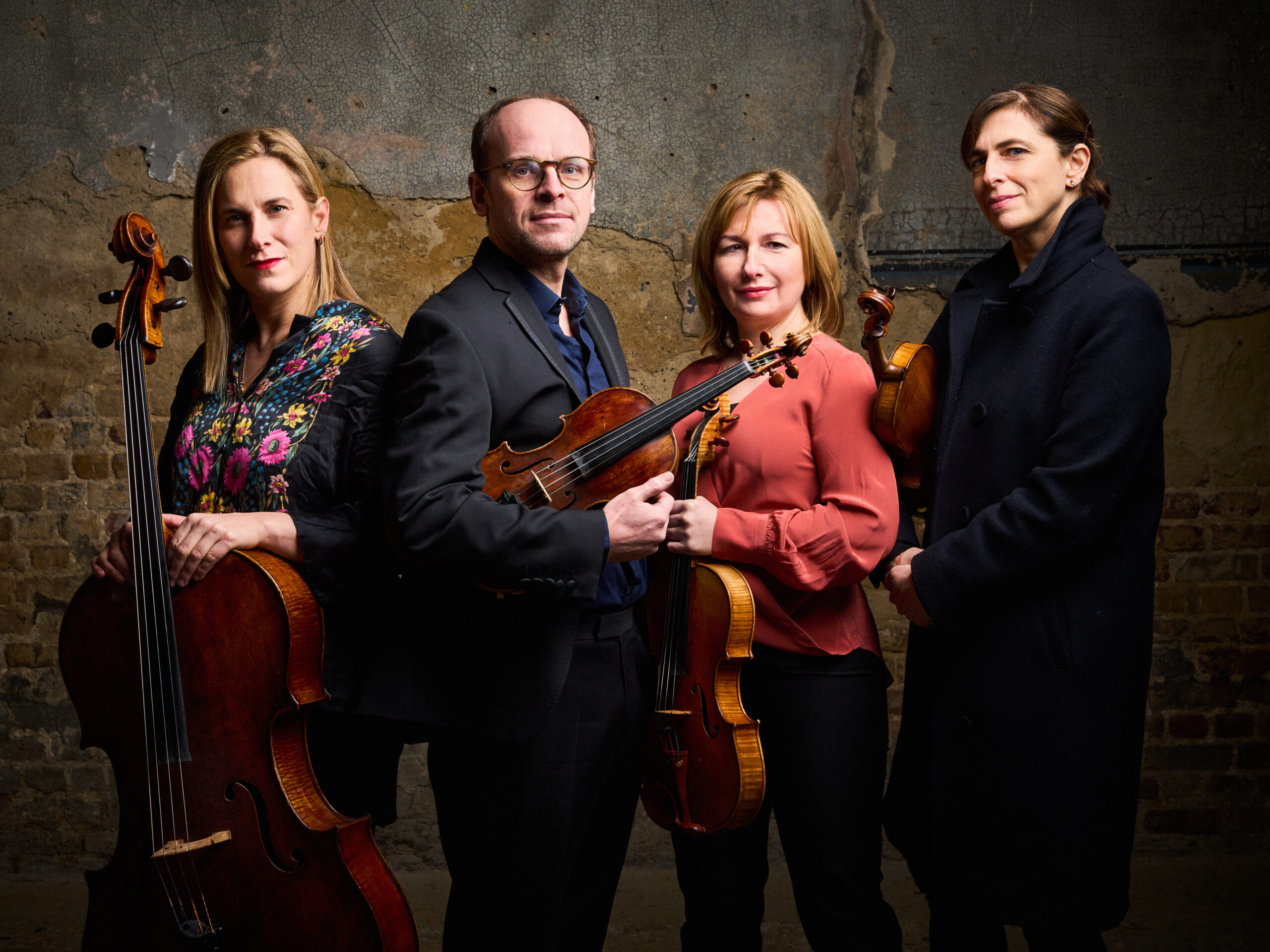
Music in the Round’s new Visiting String Quartet made their spellbinding Sheffield debut with a rapturously received celebration of the quartets of Fanny and Felix Mendelssohn in spring 2024.
They return to Sheffield this autumn for an immersive afternoon and evening exploring more of Felix Mendelssohn’s quartets, including a conversation with Prof. Laura Tunbridge (University of Oxford).
View the brochure online here or download it below.
FELIX MENDELSSOHN Theme and Variations from Four Pieces Op.81 (6’) String Quartet in E flat Op.44 No.3 (35’) Octet Op.20 (34’)
Music in the Round’s new Visiting String Quartet, the Consone Quartet, made their spellbinding Sheffield debut with a rapturously received celebration of the quartets of Fanny and Felix Mendelssohn in spring 2024.
They return to Sheffield this autumn for an immersive afternoon and evening exploring more of Felix Mendelssohn’s quartets.
To conclude the day, the Consone Quartet joins forces with the string players of Ensemble 360 for the composer’s eloquent and warm Octet, full of gusto and joyful invention.
View the brochure online here or download it below.
Save £s when you book for 5 Music in the Round concerts or more at the same time. Find out more here.
MENDELSSOHN Felix, Theme and Variations (from Four Pieces for String Quartet), Op. 81, No. 1
This Theme and Variations – composed in 1847 – was published posthumously as the first of Mendelssohn’s Four Pieces for String Quartet, Op. 81. Like its companion Scherzo, the undated manuscript is believed to have been written in the last few weeks of Mendelssohn’s life. Marked Andante sostenuto, the poised, elegant theme is presented by the violin, before being taken over by the viola, against a gentle, syncopated accompaniment. The next variation, in triplets, is slightly faster and gives way to a variation where the first violin plays a florid semiquaver descant over sustained chords. The fast-moving phrases are then transferred to the cello before the tempo changes to a vigorous Presto (in 6/8 time), the key now shifting from major to minor. A brief solo violin cadenza leads to coda back in the home key of E major, based on a varied recollection of the opening material and a serene close.
MENDELSSON Felix, String Quartet in E flat Op. 44 No. 3
In Robert Schumann’s retrospective of concerts in Leipzig during 1837–8, he wrote that concerts of string quartets in the small hall of the Gewandhaus “gave us many artistic treasures this winter.” These innovative chamber music concerts were established by Ferdinand David, a close friend of Mendelssohn’s and leader of the Gewandhaus Orchestra. Schumann singled out Mendelssohn and his two newest string quartets (Op.44 Nos.2 and 3) as works that “wandered through a finely human sphere … in such a sphere we must award the palm to him among all his contemporaries, and only Franz Schubert, had he lived, would have been worthy to award Mendelssohn that palm without disputing it.” The E flat major Quartet Op.44 No.3 was completed in February 1848. The first movement opens with a terse five-note motif and a dotted rhythm. Both these ideas – and the way Mendelssohn uses them to propel the musical argument – show the influence of Beethoven, and they are contrasted with a more lyrical theme. The energy of this movement, and the elegance of its construction, continue into the second movement: a typical Mendelssohn Scherzo, full of dramatic contrasts between loud and soft. After E flat major in the first movement, and the darker C minor in the Scherzo, the rapt, lyrical Adagio is in A flat major. The finale, back in the home key of E flat, is dazzling, full of rapid semiquavers – a virtuoso display written for some of the most gifted quartet players of the time.
One of the marvels of nineteenth-century chamber music, Mendelssohn’s Octet was originally finished in October 1825, when the composer was 16 years old. He later revised it before publication. The miracle of this work is not the youthfulness of its creator but the astonishing individuality of its music – regardless of how old its composer was at the time. The arching opening theme of the first movement, underpinned by syncopated chords, reveals the originality of Mendelssohn’s creative voice as never before. The way in which he generates a constant stream of musical ideas is all his own, but this was a composer who knew how to draw on the refinement of Mozart, the power of Beethoven and the contrapuntal intricacy of Bach for his own expressive purposes. The slow movement begins gently but becomes increasingly uneasy, while the dizzying Scherzo was inspired by the ‘Walpurgisnacht’ scene from Goethe’s Faust. The Presto finale follows naturally from this, beginning with an energetic fugal subject that generates unstoppable momentum and inspired elation.
An opera production for the people of Sheffield and with the people of Sheffield.
Music: Jonathan Dove
Libretto: Alasdair Middleton
Music Director: John Lyon Director: Rosie Kat Theseus: Anthony Flaum Mother: Camille Maalawy Daedalus: Robert Gildon
King Minos: Paul Hawkyard
Featuring ENSEMBLE 360, CONSONE QUARTET, BRIDGE ENSEMBLE, SHEFFIELD MUSIC HUB SENIOR STRINGS, SHEFFIELD YOUTH CHOIRS featuring JUNIOR VOICES, YOUTH VOICES & CONCORDIA and SINGERS FROM SHEFFIELD
“Here they are – the children of Athens! The hope of Athens, the future of Athens! Deep in the maze, the monster, already paws the sand and tosses his horns…”
- libretto, Monster in the Maze
King Minos has a labyrinth in his palace. Inside there lurks a Minotaur. This monster, half man and half bull, feeds on human flesh.
Minos decrees that the Athenians should provide a regular supply of their young people to be sacrificed to the monster. The Athenian hero Theseus steps in, determined to enter the maze and take on the monster at its heart…
Jonathan Dove’s ‘The Monster in the Maze’ receives its Sheffield premiere on the iconic Crucible stage. Our most ambitious project to date, this will be Music in the Round at its best: a bold collaboration, forged in the crucible of creativity that is our City of Makers.
Commissioned and first performed in 2015 by the Berlin Philharmonic and London Symphony Orchestra with Simon Rattle, it was praised by the Financial Times as “an exhilarating, visceral take on the ancient Greek myth”.
This amazing new production will showcase people of all ages coming together from across the city to perform alongside our professional resident artists and guests, highlighting the best of music-making in Sheffield.
An epic story: millennia in the making and a fitting celebration for our 40th anniversary year!
With thanks to our funders and supporters: Blakemore Foundation, JG Graves Charitable Trust, Music for All, Scops Arts Trust, Sheffield Music Hub, Sheffield Mutual and individual donors.
View the brochure online here or download it below.
BACH Prelude and Fugue No.1 in C BWV846 (5’) L BOULANGER Thème et Variations (9’) FAURÉ Barcarolle No.4 in A flat Op.44 (4’) RAVEL Jeux d’eau (5’) GRIEG Wedding Day at Troldhaugen Op.65 No.6 (6’) PIAZZOLLA (arr. YAMAMOTO) Milonga (5’) SHOSTAKOVICH Prelude & Fugue No.24 in D minor Op.87 (12’) FITKIN Scent (4’) RODGERS & HAMMERSTEIN (arr. HOUGH) ‘My Favorite Things’ (3’) SHAW Gustave Le Gray (11’) CHOPIN Mazurka Op.17 No.4 in A minor (4’) GRAINGER Molly on the Shore (4’) VINE Short Story (3’) FITKIN Rapid Unscheduled Disassembly (8’)
Acclaimed pianist Kathryn Stott, familiar in Sheffield as a long-term collaborator with the Lindsay String Quartet and Guest Curator of Sheffield Chamber Music Festival 2023, returns for her final recital in the Crucible Playhouse. As Kathy draws her performing career to a close, she brings an eclectic programme spanning four centuries of music, showcasing her diverse musical loves and friendships.
Opening with exquisite Bach and concluding with a brand-new farewell commission, via a Scandinavian wedding celebration from Grieg, the spirit of Broadway and a masterful Chopin Mazurka, this promises to be a whirlwind tour through a unique musical career from a captivating performer much-loved in Sheffield and across the world.
Post-concert Q&A – free Please join us after the concert for a free Q&A with Kathryn Stott.
View the brochure online here or download it below.
Save £s when you book for 5 Music in the Round concerts or more at the same time. Find out more here.
PIANO FAVOURITES
When Kathryn Stott performed this programme at the Aldeburgh Festival in June 2024, it was billed as a concert of ‘Musical Postcards’. That’s a good description of a recital which explores the huge range of her repertoire, starting with the first prelude and fugue from The Well-Tempered Clavier by Johann Sebastian Bach (1685–1750) and ending with a brand-new piece by Graham Fitkin which was given its world premiere at the Aldeburgh concert on 21 June. Lili Boulanger (1893–1918) composed her Thème et variations in 1914 but the work remained unknown until its rediscovery led to its first performance (and publication) in 1993. The theme (marked ‘avec douleur, mais noble’) is presented without accompaniment and eight variations follow, each treating the theme (or part of it) in imaginative ways that are entirely characteristic of Boulanger.
Caroline Potter has noted that the work was modelled on the Thème et variations, Op. 73 by Gabriel Fauré (1845–1924) who was Boulanger’s teacher and a family friend. Fauré’s Barcarolle No. 4, Op. 44, was composed in 1886 and dedicated to Mme Ernest Chausson. Quietly poetic in mood, it is full of the rich harmonic surprises and fluid melodies that are so typical of Fauré’s music. Maurice Ravel (1875–1937) was one of Fauré’s most imaginative pupils and he wrote Jeux d’eau – among the most evocative and brilliant of all ‘water’ pieces for piano – in 1901, with a dedication ‘à moncher maître Gabriel Fauré’.
Edvard Grieg (1843–1907) composed Wedding Day at Troldhaugen to celebrate his silver wedding anniversary with his wife Nina in 1896 and it was included in Book VIII of Grieg’s Lyric Pieces the following year, when it acquired its definitive title (Grieg has originally called it ‘The well-wishers are coming’). The Argentine Astor Piazzolla (1921–1992), creator of the nuevo tango which fused traditional tango with elements of jazz and classical styles, composed Milonga del Ángel in 1965, and it is heard here in a later piano transcription by the Japanese pianist Kyoko Yamamoto. Inspired by a visit to Leipzig in 1950 to celebrate the 200th anniversary of Bach’s death, Dmitri Shostakovich (1906–75) modelled his Preludes and Fugues Op. 87 on Bach’s Well-Tempered Clavier, even including some quotations as well as following Bach’s design of preludes and fugues in each of the major and minor keys. Completed on 23 February 1951, the D minor Prelude and Fugue ends the entire set with a stern prelude followed by a highly elaborate double fugue (which also includes allusions to Bach’s Art of Fugue) deploying a formidable array of contrapuntal techniques. The whole set was first performed in April and May 1951 at a private concert for the Soviet Union of Composers and heard in public in December 1952, played by Tatiana Nikolayeva, for whom the Preludes and Fugues had been composed.
Graham Fitikin(b. 1963)composed Scent in 2007, originally for the harpist Ruth Wall. The pianist Stephen Hough (b. 1961) included his hugely entertaining and ingenious transcription of ‘My Favorite Things’ from The Sound of Music by Richard Rodgers (1902–79) on one of his earliest recital discs, bringing Lisztian pyrotechnics to Broadway. When Caroline Shaw (b. 1982) composed Gustave Le Gray in 2012, she was inspired by Chopin’s Mazurka Op. 17 No. 4 – one of his most harmonically inventive earlier pieces – and included direct references to it in her own work. Shaw herself described it as ‘a multi-layered portrait of Op. 17 No. 4 using some of Chopin’s ingredients overlaid and hinged together with my own.’ The original Mazurka by Fryderyk Chopin (1810–49) was first published in Paris in 1834. It is a spellbinding kind of dance poem, full of ambiguity and quiet longing, some astonishingly daring harmonies and a trajectory which begins and ends in uncertain silence. Molly on the Shore by the Australian Percy Grainger (1882–1961) was based on two traditional Irish reels and written in 1907 as a birthday present for Grainger’s mother. He first composed it for strings, then made an orchestral version in 1914 and the present piano transcription in 1918. He later made further versions for military band (1920) and for two pianos (1947).
Carl Vine (b. 1954) is another Australian composer, and his Anne Landa Preludes were written in 2006 in memory of Anne Landa (who died in 2002 at the age of 55), particularly her passionate encouragement of young Australian pianists. The first of the preludes is ‘Short Story’ described by Vine as follows: ‘The prelude contains a story. But the drama emerges through its own internal logic rather than from a specific series of predetermined events’.Graham Fitkin composed Rapid Unscheduled Disassemblyspecifically for Kathryn Stott’s farewell recitals, taking his title from the euphemism used by Elon Musk’s SpaceX when its rockets blew up in 2015 and 2023 (though the phrase probably goes back to the 1960s when NASA used similar terminology to describe earlier explosions). As Stott said in a recent interview, ‘My one request to Graham was, this will be the last notes I play in public, so keep that in mind!’
HAAS Oboe Suite Op.17 (18’) JANÁČEK Mládí (20’) HAAS Wind Quintet Op.10 (16’)
JANÁČEK In the Mists (23’)
Janáček’s beloved Mládí (‘Youth’) was written towards the end of his life as a nostalgic celebration of memories of his youth, drawing on his early writing. Receiving its premiere performances in Autumn 1924, we celebrate the 100th anniversary of this iconic piece for wind, featuring the bass clarinet alongside a regular wind quintet line-up of flute, oboe, clarinet, horn and bassoon.
View the brochure online here or download it below.
Save £s when you book for 5 Music in the Round concerts or more at the same time. Find out more here.
HAAS Pavel, Suite for Oboe & Piano Op.17
Furioso Con fuoco. Con moto e poco largamente Moderato
Pavel Haas, born in Brno into a Jewish family, was a pupil of Leoš Janáček from 1920 to 1922. Though his music doesn’t imitate that of his great teacher, both composers sought inspiration from Moravian folk song and dance. Janáček once declared that ‘a modern composer has to write what he has truly experienced’, but Haas was to experience more and much worse than most. However, in 1939, when he wrote the Suite for Oboe, he had just been awarded the Smetana Prize for his opera, The Charlatan, first performed at Brno in 1938. The musical language of the Suite, occasionally folk-inspired, sometimes recalling the cadences of Synagogue songs, and notable for its energy and drive, marks out Haas as a composer of real individuality, rugged in the first two movements, and more consoling in the third, rising to a grand climax that has occasional echoes of his great teacher.
Haas was deported to the concentration camp and ghetto at Teresienstadt in 1941 where he met the conductor Karel Ančerl as well as several other Czech Jewish composers such as Gideon Klein (who coaxed Haas back to composition), Hans Krása and Viktor Ullmann. In later years, it was Ančerl who most movingly recalled the appalling circumstances of Haas’s murder after both were transferred to Auschwitz: Ančerl was next in line to be sent to the gas chamber when Haas coughed, thus attracting the attention of the SS Doctor Josef Mengele, who chose to send Haas to his death instead.
Nigel Simeone 2014
JANÁČEK Leoš, Mládí
Janáček composed Mládí in July 1924 (the month of his 70th birthday) at his rural retreat in the village of Hukvaldy. He described it to Kamila Stösslová as ‘a sort of memoir of youth’, and a newspaper article in December 1924 described the programme of the suite as follows: ‘In the first movement, [Janáček] remembers his childhood at school in Hukvaldy, in the second the sad scenes of parting with his mother at the station in Brno, in the third in 1866 as a chorister when the Prussians were in Brno; the concluding movement is a courageous leap into life.’ Intended as a nostalgic evocation of Janáček’s youth (his original title was Mladý život – Young Life) it is a typically quirky and ebullient product of his incredibly productive old age. It was first performed in Brno on 24 October 1924, followed a month later by a performance in Prague. Janáček also heard the work during his only visit to England, at a concert in the Wigmore Hall on 6 May 1926 when it was played by British musicians including Leon Goossens and Aubrey Brain.
Janáček inspiration for In the mists probably came from a recital at the Brno Organ School on 28 January 1912 when Marie Dvořáková played Debussy’s Reflets dans l’eau. In the mists certainly shows the influence of Debussy’s Impressionism, though it is also a nostalgic reflection on childhood: Bohumír Štědroň wrote that ‘Here Janáček sees his youth in a mist and remembers the days spent at Hukvaldy’. Janáček made some revisions to the cycle before publication by the Club of the Friends of Art in Brno (to which Janáček belonged) near the end of 1913. According to the title page of this edition, In the mists was given to members of the club as a gift for the year 1913. The first performance took place on 7 December 1913 at Kroměříž, played by Marie Dvořáková. She played it again, on 24 January 1914, at a Brno Organ School concert in the Lužánky Hall when Janáček himself was present. The first known performance in Prague was not until 16 December 1922, given by the pianist Václav Štěpán and the following year Janáček asked Štěpán to help him prepare an edition incorporating his final versions. An inspired combination of Impressionism and musical ideas derived from Moravian folk music, In the mists is in four movements: the first haunting (and occasionally trouble), the second quite free, the third based on a memorable melody heard at the start, and the fourth hints at the flourishes of gypsy music as well as moments of high drama. All four movements are permeated by tenderness and nostalgia, without any hint of sentimentality.
Nigel Simeone
HAAS Pavel, Wind Quintet Op.10
Pavel Haas who was born in 1899, was a Jewish composer from Czechoslovakia, who had his promising career tragically cut short when he was killed in Auschwitz in 1944. His music, once forgotten, is gradually gaining recognition, thanks to dedicated efforts by surviving colleagues and scholars. Haas was a student of Leoš Janáček, and his music reflects the influence of Moravian folk tunes and Jewish liturgical music. One of his most significant works, the Wind Quintet (1929), showcases his distinct style, blending rhythmic complexity and folk influences, much like his teacher Janáček’s Mládí.
Written on the eve of the tumult of the 1930s and infused with the bleakness and forboding of the period, it remained largely unknown for decades, with nearly all copies lost during World War II. However, Czech musicologist Lubomír Peduzzi, a former student of Haas, discovered the manuscript in the Moravian Museum in Brno. His 1991 edition of the work has helped the piece find its place alongside other important wind quintets of the interwar period, such as those by Nielsen, Schoenberg, and Hindemith.
The Wind Quintet is a four-movement work characterized by its emotional depth and modal melodies. The first movement, Preludio, begins with a folk-like tune, while the second, Pregheira (“Prayer”), conveys a heartfelt spiritual yearning. The third movement, Ballo Eccentrico, is a lively, quirky dance, and the final movement, rooted in Moravian folk music, ends with an expansive, triumphant chord. Despite its predominantly minor tonality, the work is varied in mood, alternating between seriousness and cheerfulness, much like Janáček’s compositions.
Haas’ music, though overshadowed by the atrocities of the Holocaust, is now recognized as a significant contribution to 20th-century chamber music. His Wind Quintet, in particular, stands as a powerful and original work, blending folk traditions with modern compositional techniques, and is gradually earning its place in the standard repertoire.
A BOY WAS BORN
Ensemble 360 & Sheffield Cathedral Choir
Sheffield Cathedral, Sheffield
Friday 13 December 2024, 7.30pm
Tickets £17 £10 UC, DLA & PIP £5 Under 35s & Students
Programme includes BRITTEN A Boy was Born(31’) plus seasonal classics
Intricate, evocative, utterly beautiful, ‘A Boy Was Born’ captures the spirit of Christmas. Drawing on the folk traditions that inspired so much of Britten’s work and characterised by his unique musical imagination, the choir of Sheffield Cathedral brings this exquisite theme and variations for Yuletide to life, before joining forces with Ensemble 360 for a celebration of the joys of the season through a variety of well-known classics.
View the brochure online here or download it below.
** Please note that the change in venue for this concert.**
MOZART 12 Variations ‘Ah vous dirai-je, Maman’ K265 (8′) SCHOENBERG Drei Klavierstücke Op.11 (14′) HAYDN Piano Sonata in D Hob.XVI:42 (11′) BRAHMS Drei Intermezzi Op.117 (14′) BEETHOVEN Piano Sonata No.23 Op. 57 ‘Appassionata’ (24′)
In his new recital series, Tim Horton celebrates the music of Vienna, a city famous for its classical music, through works by Haydn, Mozart, Beethoven, Brahms and more.
Alongside this showcase of the city’s musical traditions and the composers who link them, Tim presents some richly inventive offerings from the dawn of the 20th century. This promises to be a fresh and compelling new exploration of the dazzling musical variety derived from the City of Dreams.
Post-concert Q&A – free Please join us after the concert for a free Q&A with Tim Horton.
View the brochure online here or download it below.
Save £s when you book for 5 Music in the Round concerts or more at the same time. Find out more here.
MOZART Wolfgang Amadeus Mozart, 12 Variations on ‘Ah, vous dirai-je maman’, K265
Originally thought to have been written in about 1776, more recent research on the manuscript of these delightful variations has led to a dating of 1781–2, during Mozart’s first year in Vienna, possibly written for some of his more advanced piano pupils. The earliest published edition (issued by the Viennese firm of Torricella in 1785) has a dedication to Josepha Barbara Auerhammer (1758–1820) about whom Mozart had mixed feelings, writing to his father that ‘the girl is a fright! But she plays charmingly.’ Clearly Mozart admired his pupil’s gifts as a player since they gave concerts together in Vienna. The anonymous tune and text of ‘Ah, vous dirai-je maman’ first appeared in song collections in the 1760s. In English-speaking countries, the melody eventually came to be associated with Jane Taylor’s nursery rhyme ‘Twinkle, twinkle, little star’ though that was originally set to a different tune (the earliest appearance of words and music together was in 1838).
Following a straightforward presentation of the theme, Mozart embarks on a series of variations, ingenious and playful in mood until Variation VIII when the key changes into the minor for a rather sterner reworking of the tune. A return to the major for Variation IX marks the start of the later variations in which Mozart becomes more creative with his treatment of the theme, particularly in Variation XI – a lyrical Adagio – and the final Variation XII, marked Allegro, in which the tune is transformed into triple time to bring the work to a brilliant close.
Schoenberg wrote a famous essay called ‘Brahms the Progressive’, and he drew much inspiration from the intimate sound-world of Brahms’s late piano pieces. But by 1909 he had started to abandon conventional tonality in favour of a free atonal language, without anchoring the music in traditional keys or harmonies. But through the use of recurring motifs, Schoenberg creates a unified work of extraordinary boldness. The composer likened his music to Wassily Kandinsky’s paintings, describing it as ‘an ever-changing, unbroken succession of colours, rhythms and moods’.
Composed in 1784, this two-movement sonata was originally published as part of a triptych of piano sonatas dedicated to 15-year-old Princess Marie Esterházy to celebrate her marriage the previous year to Prince Nikolaus II (then 17 years old; he later became Haydn’s patron after the death of his father in 1790). The first movement, marked Andante con espressione, is a set of variations. The theme itself is punctuated by silences and by a harmonic scheme which takes some characteristically surprising turns as the writing becomes increasingly florid. The most dramatic variation comes with a shift from D major to minor before a return to the music of the opening. The second movement, Vivace assai, is also full of harmonic quirks, but now the music is energetic and Haydn develops his ideas with conciseness and subtlety, including a good deal of imitative writing, right up to the delightfully inconsequential ending.
Andante moderato
Andante non troppo e con molto espressione
Andante con moto
These three short pieces were composed at the Austrian spa town Bad Ischl in 1892 and first performed in Berlin on 6 January 1893 by the pianist Heinrich Barth. Like the first of the Ballades Op.10, the first Intermezzo is based on a Scottish poem printed in Herder’s collection, this time a lullaby (and, informally, Brahms sometimes called the whole set ‘Lullabies’). Clara Schumann was enchanted by these pieces when she first saw them, telling Brahms that ‘In these pieces I at last feel musical life stir once again in my soul’. When Brahms’s publisher Simrock suggested using Lullabies instead of Intermezzi as the official title, Brahms’s response was endearingly curmudgeonly: ‘It should then say, lullaby of an unhappy mother or of a disconsolate bachelor’.
BEETHOVEN Ludwig van, Piano Sonata in F minor Op.57 ‘Appassionata’
The Sonata in F minor Op.57 only acquired its famous nickname ‘Appassionata’ after Beethoven’s death – an invention by a Hamburg publisher that has stuck. The work was mostly sketched in 1805, finished the following year, and first published in 1807. The manuscript, in the Bibliothèque Nationale de France, came from the family of the French pianist Marie Bigot, to whom Beethoven had given it after she sight-read it for him. Her husband recalled that just before Beethoven’s visit, during his journey back to Vienna from Silesia, he was ‘surprised by a storm and driving rain, which soaked through the case in which he carried the Sonata in F minor which he had just composed’ and, indeed, the manuscript has many water stains, presumably made by this downpour. The Appassionata is recognized as one of the greatest of Beethoven’s middle-period piano sonatas (alongside the Waldstein), and its turbulent emotional world moves from the gloom of the opening to a quotation from a folk song (for the second theme), a set of variations on a deceptively simple chordal theme for the slow movement, leading via a chromatic diminished seventh chord to the finale.
***Sadly, due to illness and the adverse weather further south, the musicians are unable to go ahead with tonight’s concert. The Crucible box office will be in touch with all ticket holders over the course of today. If you have any questions or concerns, please contact marketing@musicintheround.co.uk ***
Separated by a few short years and the turn of a century, this concert features two utterly different string quartets from two modernist giants who typify the staggering range of fin de siècle classical music.
Schoenberg’s visionary second quartet sees Ensemble 360 joined by superstar soprano Claire Booth for a surprisingly accessible and personal work that stretches from the intimate to the interstellar. Debussy’s sensual and impressionistic quartet shimmers with life and light between opening storms and a grand conclusion.
View the brochure online here or download it below.
Save £s when you book for 5 Music in the Round concerts or more at the same time. Find out more here.
SCHOENBERG Arnold, String Quartet No. 2, Op. 10
The earliest sketch for this quartet is dated 9 March 1907 and the work was completed in the summer of 1908. It was written at a turbulent time in Schoenberg’s private life – his wife Mathilde was having an affair with the painter Richard Gerstl – but the finished work was dedicated to her. The first performance was given at the Bösendorfer-Saal in Vienna on 21 December 1908. The occasion was recalled by the composer almost thirty years later, when he wrote that it caused ‘riots which surpassed every previous and subsequent happenings of this kind.’ He went on to admit that the riots were ‘a natural reaction of a conservatively educated audience to a new kind of music.’ This was a work Schoenberg identified as an important turning point in his creative development: a move away from reliance on traditional keys. As Schoenberg himself put it in a 1949 lecture – choosing his words carefully – the quartet marked ‘the transition to the second period, this period which renounces a tonal centre and is falsely called atonality.’ The composer’s irritation with the use of the ‘atonal’ label is understandable: as he pointed out in the same lecture, in every movement of the quartet ‘the key is presented distinctly at all crossroads of the formal organization.’ Even so, it was a work which shocked early audiences – and at the premiere the second, third and fourth movements were all interrupted by audience jeers and laughter until the coda of the fourth movement, which was heard without disturbance. As Schoenberg commented, ‘perhaps even my enemies and adversaries might have felt something here?’
As well as its harmonic innovations, perhaps the most startling aspect of this work is the addition of a soprano voice in the third and fourth movements, which are settings of two poems by Stefan George. The first movement is loosely in sonata form with five thematic ideas, all of them related to each other. Beginning clearly in the home key of F sharp minor before moving away into remoter harmonic territory, the movement eventually finds repose on quiet F sharp minor chords. The second movement is a kind of Scherzo marked Sehr rasch (very quickly) in D minor, but with frequent changes of tempo – and a Trio section which quotes the Viennese folk song ‘O du lieber Augustin’. The third movement, ‘Litanei’ (Litany) – the first of the two song settings – is loosely in E flat minor though highly chromatic. Schoenberg’s own account of the last movement, ‘Entrückung’ noted that it ‘begins with an introduction, depicting the departure from earth to another planet.’ From this literally other-worldly opening, the voice and instruments in this movement develop the music with a brilliantly imagined and highly expressive array of unusual sonorities before finally arriving on a sublime and radiant chord of F sharp major.
Nacht [Night] (Carl Hauptmann) Schilflied [Song among the reeds] (Nikolaus Lenau) Die Nachtigall [The nightingale] (Theodor Storm) Traumgekrönt [Crowned in a dream] (Rainer Maria Rilke) Im Zimmer [Indoors] (Johannes Schalf) Liebesode [Ode to love] (Otto Erich Hartleben) Sommertage [Summer days] (Paul Hohenberg)
Berg composed these songs during his time as a student of Schoenberg (between 1905 and 1908) – so they are almost exactly contemporary with Schoenberg’s Second String Quartet. Altogether during this period, Berg wrote more than eighty songs. The present selection was assembled by the composer in 1928 when he also made versions with orchestral accompaniment. Three of the songs were performed at a concert of music by Schoenberg’s pupils in 1907 – the first public hearing of any music by Berg. Stylistically they owe much to the legacy of Wolf and Mahler as well as Schoenberg’s earlier songs, and the influence of Wagner, Strauss and Debussy. But even though they are student works, they reveal a composer with a superb natural affinity with the human voice: Berg went on to write several mature sets of songs, as well as the operas Wozzeck and Lulu, and that understanding of the expressive potential of the voice can already be heard in the Seven Early Songs. They range from relatively simple writing to almost expressionistic music which borders on atonality. Often intoxicating, sometimes shimmering, the ravishing opulence of these songs have love as their central obsession, so it is no surprise that Berg later dedicated the set to his wife Helena – recalling the blissful time when they first got to know each other. The soprano Diana Damrau has commented that the songs are ‘about a great love, and also physical love … the happiness of fulfilled togetherness. You don’t need anything else, and the circle closes with the last song, ‘Sommertage’. There he goes back to nature and what particularly characterises the romantic soul: the quest for freedom’.
Debussy’s String Quartet was first performed at the Société Nationale de Musique on 29 December 1893 – almost exactly a year before he shocked Paris with the Prélude à l’après-midi d’un faune, the most laconic manifestation of his revolutionary creative spirit. The Quartet, composed just after the Prélude, is one of his earliest mature works – a piece that still has some roots in the musical language of César Franck but in which a fresh and brilliant imagination can be heard, not just in the free handling of forms, but also in the spectacularly inventive writing for string instruments – something absorbed by Ravel in the Quartet he wrote a decade later. The first movement is robust and confident, while the second, with its extensive use of pizzicato, hints at the Javanese music that Debussy heard at the 1889 Exposition. The slow movement begins with fragments of the theme split between the lower instruments before being introduced in full by the first violin, over rich chromatic harmonies. The finale has clear thematic links with the first. It starts hesitantly, gradually building up both tension and speed, on a melodic idea that is presented in different guises before reaching the dazzling conclusion in G major.
Recognised as one of the world’s leading guitar quartets, the Aquarelle Guitar Quartet is a dynamic and innovative group known for its extraordinary performances and glorious range of sound.
Their newest member, Classic FM chart-topping artist Craig Ogden, will be familiar to many, following his sell-out recitals in Sheffield in 2022 and 2023.
Featuring everything from classical favourites to irresistible tango and famous movie hits, this afternoon concert is a perfect treat for music-lovers of all ages.
View the brochure online here or download it below.
Save £s when you book for 5 Music in the Round concerts or more at the same time. Find out more here.
BELLINATI Paulo, Baião de Gude
Regarded as one of the leading Brazilian guitarists of the younger generation, Bellinati is hailed by many as successor in the lineage of great Brazilian guitarist/composers such as Jobim, Powell and Gnattali. In his compositions, he recreates Brazilian styles such as Baião, Maxixe and Frevo, blending influences from contemporary jazz and classical music. Baião de Gude draws its inspiration from a game of marbles called ‘Bolos de Gude’, which is played in the street by the children of Brazil.
GISMONTI Egberto (arr. J Jervis), Baião Malandro
Baião Malandro (Smart Baião) by Egberto Gismonti is a mischievous, rhythmically engaging as well as ambiguous, and aggressive composition. The popular baião rhythm originated in the north-east of Brazil and was pioneered by the folk-singer Luiz Gonzaga. Like many of Gismonti’s works, Baião Malandro differs in each of its incarnations due to the improvisatory nature of the composer’s performances. The particular version that James Jervis has chosen to arrange appears on Gismonti’s album ‘Alma’ where it can be heard in the form of a piano solo with synthesised sounds.
BIZET Georges (arr. W Kanengiser), Carmen Suite
In addition to being one of the most beloved and enduring operas of all time, this work has found a home on the symphonic stage, most notably with an orchestral suite of some of its most popular excerpts. In this arrangement of six movements from Carmen for guitar quartet, a special emphasis was put on retaining the distinctly Spanish sound of the music, which finds a natural home on the guitar.
The current suite begins with the Aragonaise, with strumming fanfares and imitations of castanets. Next is the timeless Habanera, a sensual aria based on a melody by Iradier that explores the lyric possibilities of a single line melody on the guitar. It is followed by the flamenco-inspired Seguidilla, which explores a wide range of articulations and colors available on guitar quartet. The ever-popular Toreadors features boisterous strummed chords and extended trills, while the delicate Entr’Acte is a gradually unfolding masterwork of lyric counterpoint. The final Gypsy Dance creates a slowly building tension with repeated staccato figures, finally erupting in the famous and furious coda.
Alfonsina y el mar is a song by pianist Ariel Ramirez and writer Félix Luna. Alfonsina and the sea, as it translates to English, is a tribute to Argentine poet Alfonsina Storni who tragically took her own life by jumping into the sea. This is a unique version for four guitars expertly woven together by master arranger, composer and guitarist Roland Dyens.
SCOTT Andy (arr. M Baker), Salt of the Earth
Andy Scott is a Northwest (UK) based composer, saxophonist and educator with a distinctive musical voice that encompasses elements of jazz, world and contemporary classical styles. He is a founder member of the Apollo Saxophone Quartet and teaches at the Royal Northern College of Music in Manchester.
One of Andy’s most popular compositions, ‘Salt of the Earth’ started life as a three-movement Concerto for Tuba with Brass Band! Andy has arranged the piece for a number of ensembles and soloists, and in this case was delighted to continue his collaboration with the AGQ, with Mike Baker undertaking the arranging duties.
The composer writes “Influenced heavily by jazz & latin music, ‘Salt of the Earth’ is fast and furious. The main melody moves over changing chords that are underpinned by a pedal note before the release of a montuno-inspired B section. Moving away from chord changes, the introduction, bridge and coda are written as two virtuosic single-line parts.
The title of the piece was inspired by the salt mining industry in my home county of Cheshire East. Underground networks of roads stretch for miles, whilst overground, huge football pitch-size salt mountains provide a surreal landscape.”
LEDESMA Ismael (arr. M Baker), A Mi Pueblo
A Mi Pueblo (For my people) is a haunting piece of music, written by the Paraguayan harpist Ismael Ledesma. This arrangement for four guitars captures the textures achieved by the harp along with the beautifully simple melody.
BONFÁ Luiz (arr. V Bessas), Manhã de Carnaval
Manhã de Carnaval is the principal song in the 1959 Brazilian film Black Orpheus. It became one of the first Bossa Nova compositions to gain popularity worldwide and it is considered one of the most important songs of that style.
MARTÍN Eduardo, Hasta Alicia Baila
Hasta Alicia Baila (Until Alicia Dances), a Cuban rumba (guaguancó), was written by Eduardo Martín for Alicia, a friend of the composer’s, in an attempt to get her up and dancing! The guaguancó is a traditional ‘call and response’ form of the rumba, featuring percussive effects from instruments such as the tumba, llamador, and quinto. The guitars imitate these drums throughout the piece, giving it its rhythmic drive and authentic flavour.
JOBIM Antonio Carlos (arr. M Tardelli), Lamento no Morro (Cry from the Hills)
Antonio Carlos Jobim is one of the most celebrated and influential Latin American musicians of all time. Largely credited with the creation of Bossa Nova (an amalgam of samba and ‘cool jazz’), some of his songs have become all time classics, famous throughout the world, including ‘The Girl from Ipanema’, ‘Desafinado’ and ‘A felicidade’.
‘Lamento no Morro’ first appeared in 1956 on the album ‘Orfeu da Conceição’. Originally a play by Vinícius de Moraes, ‘Orfeu da Conceição’ was set to music by Antônio Carlos Jobim who also conducted the 35 piece Grande Orchestra Odeon featuring legendary musicians, Roberto Piava on vocals and Luiz Bonfá on guitar.
SANTAOLALLA Gustavo (arr. V Bessas), De Ushuaia a la Quiaca
De Ushuaia a la Quiaca is the Argentinian equivalent of Land’s End to John o’ Groats and is part of the soundtrack of the movie ‘Motorcycle Diaries’. The film is a biopic about the written memoir of Ernesto Guevara, best known as the Marxist guerrilla leader Che Guevara. The composer, Gustavo Santaolalla, won a BAFTA for his work on this film and later went on to compose the music for other successful films such as ‘Brokeback Mountain’, ‘Bebel’ and most recently ‘The Last of Us’.
REINHARDT Django (arr. M Baker), Minor Swing
‘Minor Swing’ (composed in 1937) is one of the most popular and celebrated compositions of legendary gypsy jazz guitarist, Django Reinhardt (1910-1953). He recorded the piece six times throughout his career in various different guises, most famously with Stéphane Grappelli and the Quintette du Hot Club de France in 1937, and it is considered to be one of his most covered works. It was included on the Aquarelle Guitar Quartet’s 2012 Chandos Records CD, ‘Final Cut’ inspired by the inclusion of ‘Minor Swing’ in the film ‘Chocolat’ (2000). Johnny Depp’s performance of ‘Minor Swing’ makes up a memorable part of the Golden Globe-winning soundtrack (for Best Original Score) by Rachel Portman (b.1960), and perfectly depicts the gypsy origins of Depp’s character.
BELLINATI Paulo, A Furiosa
The playful and almost cheeky opening to ‘A Furiosa’ is slightly deceptive as to the character of the rest of the piece. What ensues is a wonderfully catchy and fun melody based around the energetic dance rhythm of the Brazilian Maxixe. Bellinati wrote this piece as a tribute to the incredibly virtuosic and talented street musicians of Brazil, known affectionately as ‘The Furious Ones’ on account of their astonishing technique and speed. This fun dance is full of rhythmic excitement and flair.
“High-octane virtuosity, relaxed lyricism, tonal richness and perfection of ensemble.”
NATHANIEL FACEY alto sax TOM FARMER double bass SHANEY FORBES drums JASON REBELLO piano JONNY MANSFIELD vibraphone
Multi-award winners Empirical are celebrated for their distinctive signature sound, a combination of complex, thoughtful writing and spontaneous improvisation.
Having started in 2007 they went on to become one the UK’s most acclaimed jazz outfits, with the band personnel remaining the same for fifteen years.
For this concert they are joined by rising star Jonny Mansfield and Jason Rebello, an award winner with a reputation built over a thirty-five-year international career. It will feature material from their new album, their first full-length release since 2016.
Expect forward looking, creative music as Empirical re-take their place at the centre of the UK scene.
View the brochure online here or download it below.
Chart-topping Maya Youssef is hailed as ‘the queen of the qanun’, the Middle Eastern 78-stringed plucked zither. Based on Arabic classical traditions, her innovative sound has echoes of everything from jazz to flamenco, infused with warmth, humour and optimism.
The Damascus-born musician’s global reputation continues to grow as an artist of the highest quality and as a musical ambassador building connections across borders and between peoples and traditions. Maya’s 2022 album, ‘Finding Home’, included commissions for Opera North and the British Museum and was praised for both the range of influences and the intensity and emotion of her playing.
A performer of complexity and charisma, Maya’s welcome return to Sheffield promises to be a thrilling musical evening.
View the brochure online here or download it below.
CHAMINADE Automne CHAMINADE L’Autre Fois CHAMINADE Les Sylvains R SCHUMANN Fantasie in C (33′) STEPHEN HOUGH Sonatina Nostalgica (10′) CHOPIN Sonata No.3 in B minor (30′)
Described by The Guardian as “a master pianist who lines up with the greats” and voted one of Classic FM’s top 25 greatest pianists ever, Stephen Hough returns to the Crucible Playhouse for the first time in five years. He performs works including Schumann’s Fantasie in C and Chopin’s breathtaking final piano sonata.
Schumann’s Fantasie in C was described by Liszt, its dedicatee, as “a work of the highest kind” and here it sits alongside Stephen’s own work and Chopin’s final piano sonata, a breathtaking and dramatic work.
View the brochure online here or download it below.
Save £s when you book for 5 Music in the Round concerts or more at the same time. Find out more here.
CHAMINADE Cécile, Automne
The second of her 6 Études de concert Op.35, Cécile Chaminade’s (1857-1944) ‘Automne’ was composed in 1886 in Périgord (the regional name of the Dordogne), where the composer holidayed with her family each year during September and October. Beginning tenderly with a stepwise melody in the middle of the piano’s rocking, accompaniment-texture, the music grows to a contrasting middle section marked ‘con fuoco’ (‘with passion’). This is poignant and characterful music that reflects the beauty of Autumn, evoking images of falling leaves, fading light, and a sense of nostalgia. A quintessential example of Chaminade’s ability to blend technical virtuosity with rich expressiveness, ‘Automne’ encapsulates the romantic spirit of the late 19th century in a voice that is distinctively the composer’s own. The piece is dedicated to Polish-French pianist and composer, the Countess ‘Mademoiselle Hélène Kryzanowska’.
Benjamin Tassie, 2024
CHAMINADE Cécile, L’Autre Fois
Cécile Chaminade’s (1857-1944) ‘Autrefois’ is the fourth piece in the composer’s collection, 6 Pièces humoristiques Op.87 (Six humorous pieces). Translated as ‘in the past’ or ‘formerly’, ‘Autrefois’ is nostalgic and bittersweet in character. Composed in 1897, the compisition begins with a gentle, ornamented theme, marked by subtle shifts in harmony. This music is then contrasted with a middle section comprised of cascading figures and rich chromatic textures, before the piece then returns to the tranquillity of its opening musical idea. Appoggiaturas (short notes that ‘decorate’ the melody), dynamic contrasts, and chromatic voice-leading – within the work’s formal structure – make this a piece rich with expressive and interpretive potential, typifying Chaminade’s talents with deeply characterful and pianistic writing.
Benjamin Tassie, 2024
CHAMINADE Cécile, Les Sylvains
Composed in 1892, Cécile Chaminade’s (1857-1944) Les Sylvains (commonly translated as ‘The Fauns’) is a characterful miniature built around two contrasting musical ideas – the first, a gravely lyrical melody with gently pulsating accompaniment; the second, a playful and capricious texture in the piano’s higher register, perhaps reminiscent of the mythical faun’s exuberant flute music. ‘Sylvains’ means ‘of the forest’ and this is music that richly evokes an enchanted woodland: arpeggios and glissandi cascade playfully and brightly, alternating in contrast with the darker colours of the piano’s lower register before, finally, the music gradually disappears ‘al niente’ (to nothing) into the forest’s depths.
Benjamin Tassie, 2024
SCHUMANN Robert, Fantasie in C, Op. 17
In December 1836, Schumann finished what he called his ‘Sonata for Beethoven’, inspired by an appeal published in 1835 (to mark what would have been Beethoven’s 65th birthday) for a monument to the composer in Bonn. Schumann suggested to his publisher Kistner that the proceeds from sales should go towards the appeal. Kistner turned the work down and Schumann made a number of revisions, calling the work Dichtungen (‘Poems’) until shortly before sending it to Breitkopf & Härtel in January 1839, at which point he settled on Fantasie. While any explicit Beethoven link had been dropped, and the work now carried a dedication to Franz Liszt, at least one Beethovenian allusion remains in the third movement: a passage in the left hand is a slowed-down version of the persistent rhythm from the Allegrettoof the Seventh Symphony. Moreover, Kenneth Hamilton has detected ‘the ghost of Beethoven’s Sonata Op. 101 hovering over certain elements of the work’, adding that the sonata was a favorite of both Schumann and Mendelssohn.
It is unusual to have a fantasy in three distinct movements and perhaps Schumann had in mind the ‘quasi una fantasia’ subtitles of Beethoven’s Op. 27 sonatas. The first movement, marked to be played with ‘imagination and passion’, is an innovative reinvention of sonata form, with unconventional key relationships (suggestive of Schubert), and striking structural innovations, notably the seemingly self-contained interlude placed at the moment where the recapitulation might be expected to arrive. The second movement depicts Schumann’s imaginary army of Davidsbündler (League of David) marching against the Philistines. Dominated by an obsessive dotted rhythm, this is Schumann at his most flamboyant, with a vertiginous coda where the leaps become ever wider before the grandest of conclusions. The third movement is a complete contrast: the music is poetic, restrained, and noble – and surely full of quiet longing for Clara (whom he was finally to marry in 1840). When she received a copy in May 1839, she reported that she was ‘half ill with rapture’. The demands of the work are formidable and Clara never played it during Schumann’s lifetime. Liszt was immensely proud of the dedication, considering the Fantasie to be among the greatest of Schumann’s piano works, but while he played to Schumann and taught it to students, he never performed it in a public concert. It was only with the next generation – many of them pupils of Liszt and Clara Schumann – that the Fantasie was established as one of the masterpieces of the Romantic piano repertoire.
This little sonatina, lasting under five minutes, was written for my friend (and fellow Gordon Green student) Philip Fowke in celebration of his 70th birthday. It is ‘nostalgica’ on three levels: firstly, it was commissioned by my old school, Chetham’s; secondly, it deliberately utilises a romantic musical language of yesteryear; but most importantly it evokes literal homesickness for the places of our youth, in this case the little ‘sonatina’ village of Lymm in Cheshire.
The first movement is in ABA form and is made up of two contrasting but equally lyrical motives. A dotted rhythm gesture appears in the final bar and becomes the theme of the second movement. The Finale plays with these three ideas, tossing them around in a spirit of celebration.
I The road from Danebank
Danebank was a grand country house which gave its name to today’s Dane Bank Road. Along and about this road are places resonant with memories for me, not least the nursing home where my mother lived her final years. By happy coincidence some of Philip Fowke’s forebears, the Watkin family, lived at … Danebank.
II The bench by the Dam
Lymm Dam is the picturesque source of the village, a calm lake whose surface reflects mature trees and the handsome steeple of the parish church. I had a bench installed there commemorating my parents. Drive a few miles down the road and you’ll find the birthplace of John Ireland whose musical shadow falls over this pastoral movement.
III A gathering at the Cross
Lymm Cross is a monument at the heart of the village and this movement is an affectionate tribute to the countless friends and family members who have gathered for parties and dinners and carol-singing within striking distance of its crumbling sandstone structure over many years.
Sir Stephen Hough, May 2022
CHOPIN Frédéric, Sonata No.3 in B minor Op.58
Chopin developed many new forms of piano music, from the kind of audacious miniatures found among the mazurkas to extended single-movement works such as the ballades and scherzos. But he also wrote three piano sonatas, drawing on structures inherited from Mozart and Beethoven. The Piano Sonata No.3, Op. 58, was completed in 1844 and its first movement is in sonata form. Even so, the music seems closer to the world of Chopin’s ballades than to any classical models, particularly in the rhapsodic development section. The outer sections of the Scherzo are filled with rapid movement, the ideas delicate and airy, while the slow Trio is richly harmonised but never loses its hints of unease. After a declamatory opening, the slow movement – a Chopin nocturne in all but name – is dominated by the song-like melody heard near the start, the mood changing for a dream-like central section before returning to the opening idea. The finale has a seemingly unstoppable momentum and energy, and for Marceli Antoni Szulc, Chopin’s first Polish biographer, this movement evoked images of the Cossack Mazeppa on a galloping horse.
We use cookies on our website to give you the most relevant experience by remembering your preferences and repeat visits. By clicking “Accept All”, you consent to the use of ALL the cookies. However, you may visit "Cookie Settings" to provide a controlled consent. You can find out how we use and process your data by reading our Privacy Policy
This website uses cookies to improve your experience while you navigate through the website. Out of these, the cookies that are categorized as necessary are stored on your browser as they are essential for the working of basic functionalities of the website. We also use third-party cookies that help us analyze and understand how you use this website. These cookies will be stored in your browser only with your consent. You also have the option to opt-out of these cookies. But opting out of some of these cookies may affect your browsing experience.
Necessary cookies are absolutely essential for the website to function properly. These cookies ensure basic functionalities and security features of the website, anonymously.
Cookie
Duration
Description
cookielawinfo-checkbox-analytics
11 months
This cookie is set by GDPR Cookie Consent plugin. The cookie is used to store the user consent for the cookies in the category "Analytics".
cookielawinfo-checkbox-functional
11 months
The cookie is set by GDPR cookie consent to record the user consent for the cookies in the category "Functional".
cookielawinfo-checkbox-necessary
11 months
This cookie is set by GDPR Cookie Consent plugin. The cookies is used to store the user consent for the cookies in the category "Necessary".
cookielawinfo-checkbox-others
11 months
This cookie is set by GDPR Cookie Consent plugin. The cookie is used to store the user consent for the cookies in the category "Other.
cookielawinfo-checkbox-performance
11 months
This cookie is set by GDPR Cookie Consent plugin. The cookie is used to store the user consent for the cookies in the category "Performance".
viewed_cookie_policy
11 months
The cookie is set by the GDPR Cookie Consent plugin and is used to store whether or not user has consented to the use of cookies. It does not store any personal data.
Functional cookies help to perform certain functionalities like sharing the content of the website on social media platforms, collect feedbacks, and other third-party features.
Performance cookies are used to understand and analyze the key performance indexes of the website which helps in delivering a better user experience for the visitors.
Analytical cookies are used to understand how visitors interact with the website. These cookies help provide information on metrics the number of visitors, bounce rate, traffic source, etc.
Advertisement cookies are used to provide visitors with relevant ads and marketing campaigns. These cookies track visitors across websites and collect information to provide customized ads.


 DOWNLOAD