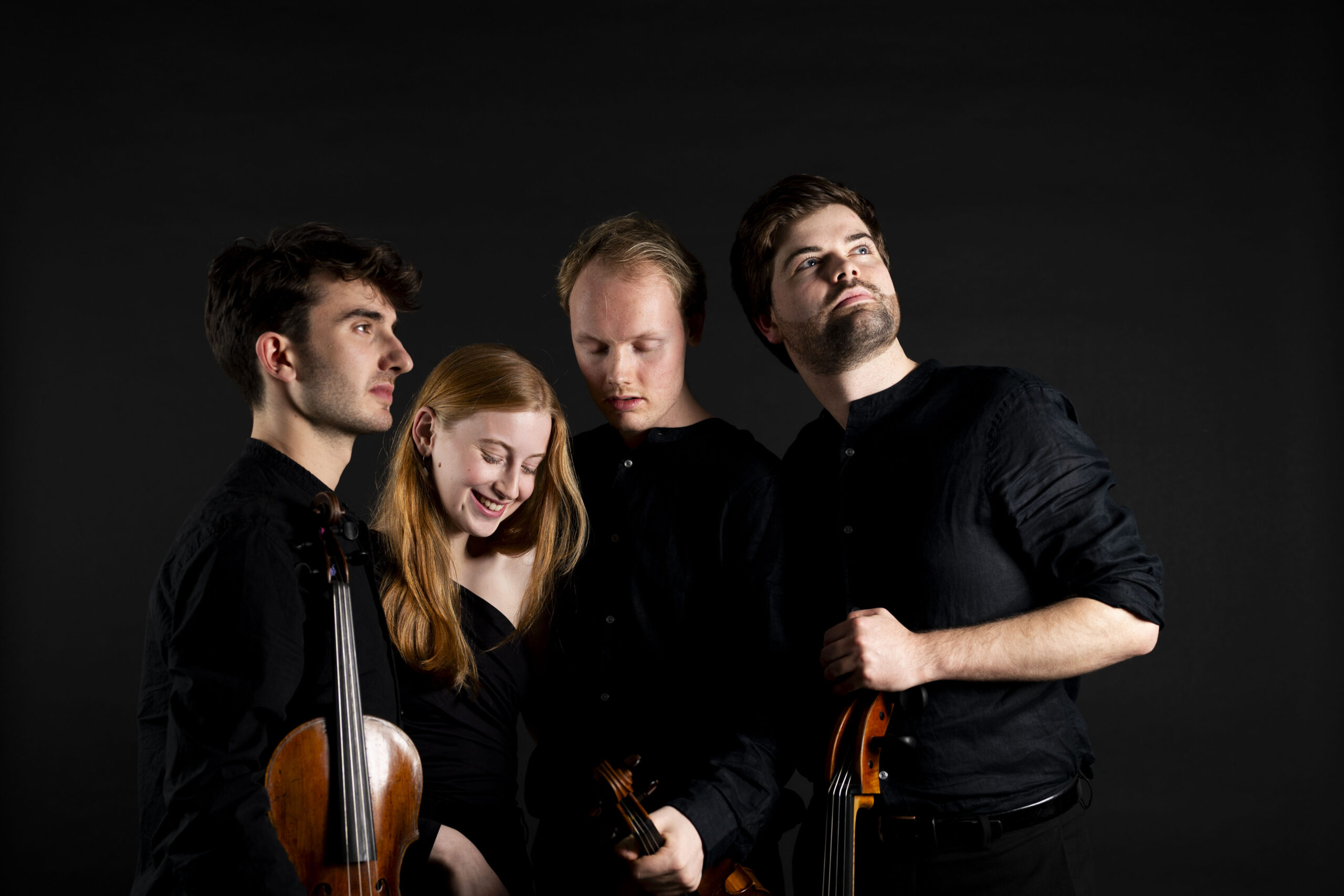
MOZART QUINTETS

Ensemble 360

Crucible Playhouse, Sheffield
Thursday 15 January 2026, 7.00pm

Tickets:
£23
£14 UC, PIP & DLA
£5 Students & Under 35s 

Past Event

MOZART
  Horn Quintet (16’)
  Clarinet Quintet (31’)
  String Quintet in G minor (35’) 

Three Mozart favourites are brought together in this celebration of one of the best-loved composers of all time. Each quintet showcases the exuberance, elegance and humanity that mark the enduring appeal of Mozart’s music. The virtuosic Horn Quintet sits alongside the lyrical Clarinet Quintet, in which Mozart explored his musical friendships and the capacity of an exciting, new instrument. The haunting yet hopeful string quintet in G minor is perhaps the crowning achievement in his writing for strings. 


Save 20% when you book for 10 or more Music in the Round Sheffield concerts in one transaction. 
Save 10% when you book for 5 or more Music in the Round Sheffield concerts in one transaction. Find out more. 

MOZART Wolfgang Amadeus, Horn Quintet K407

1. Allegro
2. Andante
3. Rondo: Allegro


The inspiration for Mozart’s famous horn concertos and the Horn Quintet was the Austrian virtuoso Joseph Ignaz Leutgeb (1732–1811). Though sometimes remembered as the victim of some of Mozart’s cruder practical jokes, Leutgeb was by all accounts a magnificent player, and had known the Mozart family ever since joining the Salzburg court orchestra in the early 1760s. When he moved back to Vienna, Leutgeb supplemented his income as a musician by running a cheese and wine shop – but he never stopped performing, and Mozart produced several major works for him to play. The Quintet is in many ways like a horn concerto in miniature. The musicologist Sarah Adams has pointed out that – given Leutgeb’s involvement – it is ‘not surprising that the horn plays a soloistic role, especially in the first movement [which] heightens the impact of the horn’s lyrical entrance by preceding it with tutti fanfares in the strings, a gesture evocative of a concerto’s preparation for the soloist’s entrance.’ This solo role is rather less apparent in the central movement of the Quintet, though it did require Leutgeb’s use of hand-stopping to obtain particular notes on the natural horn of the time (with no valves) – a technique that had attracted praise from critics all over Europe. Scored for horn, violin, two violas and cello, the Quintet was written in Vienna in 1782 – the composer’s first year in the city after his move from Salzburg.


NIGEL SIMEONE 2010

MOZART Wolfgang Amadeus, Clarinet Quintet in A K581

Allegro 
Larghetto 
Menuetto 
Allegretto con variazioni  

The Clarinet Quintet was completed on 29 September 1789 and written for Mozart’s friend Anton Stadler (1753–1812). The first performance took place a few months later at a concert in Vienna’s Burgtheater on 22 December 1789, with Stadler as the soloist in a programme where the premiere of the Clarinet Quintet was a musical interlude, sandwiched between the two parts of Vincenzo Righini’s cantata The Birth of Apollo, performed by “more than 180 persons.” 

From the start, Mozart is at his most daringly beautiful: the luxuriant voicing of the opening string chords provides a sensuously atmospheric musical springboard for the clarinet’s opening flourish. The rich sonority of the Clarinet Quintet is quite unlike that of any other chamber music by Mozart, but it does have something in common with his opera Così fan tutte (premièred in January 1790), on which he was working at the same time. In particular, the slow movement of the quintet, with muted strings supporting the clarinet, has a quiet rapture that recalls the trio ‘Soave sia il vento’ (with muted strings, and prominent clarinet parts as well as voices) in Così. The finale of the Quintet is a Theme and Variations which begins with folk-like charm, then turns to more melancholy reflection before ending in a spirit of bucolic delight. 

Nigel Simeone © 2012 

MOZART Amadeus, String Quintet in G minor K516

1. Allegro
2. Menuetto: Allegretto
3. Adagio ma non troppo
4. Adagio – Allegro


Mozart’s string quintets are all for the combination of two violins, two violas and cellos, with the two violas allowing for particularly rich inner parts. The Quintet in G minor K516 was completed on 16 May 1787, four weeks after his C major Quintet – and during the final illness of his father Leopold, who on 28 May. Though Mozart and his father had a strained relationship by this time, the composer was alarmed at Leopold’s illness and reacted with the now famous letter written on April 1787 in which he declared that ‘death, when we come to consider it closely, is the true goal of our existence, I have formed during the last few years such close relations with this best and truest friend of mankind that his image is not only no longer terrifying to me, but is indeed very soothing and consoling!’

The G minor Quintet – written by an estranged son who knew that his father was dying – is probably the most tragic of all Mozart’s chamber works. W.W. Cobbett described it as a ‘struggle with destiny’ and found it ‘filled with the resignation of despair’ – though this is rather to overlook the major-key ebullience of the finale. The first movement is full of restrained pathos, both themes melancholy and understated – and all the more wrenching for that. The minuet is sombre and reflective while the slow movement was, for the great Mozart scholar Alfred Einstein, the desolate core of the work. He likened it to ‘the prayer of a lonely one surrounded on all sides by the walls of a deep chasm.’ The element of tragedy is still very apparent in the slow introduction to the finale; but finally Mozart unleashes a more joyous spirit. The French poet Henri Ghéon found an eloquent description for this turning point: ‘Mozart has had enough. He knew how to cry but he did not like to cry or to suffer for too long.’


NIGEL SIMEONE 2010

RELAXED CONCERT: MOZART QUINTETS

Ensemble 360

Crucible Playhouse, Sheffield
Thursday 15 January 2026, 2.00pm

Tickets:
£5
Carers free

Past Event

MOZART
   Clarinet Quintet (31′)
   String Quintet in G minor (35’) 

For this ‘Relaxed’ concert featuring two of Mozart’s best loved quintets, doors will be left open, lights raised, a break-out space provided, and there will be less emphasis on the audience being quiet during the performance. People with an Autism Spectrum, sensory or communication disorder or learning disability, those with age-related impairments and parents/carers with babies are all especially welcome. 

MOZART Wolfgang Amadeus, Clarinet Quintet in A K581

Allegro 
Larghetto 
Menuetto 
Allegretto con variazioni  

The Clarinet Quintet was completed on 29 September 1789 and written for Mozart’s friend Anton Stadler (1753–1812). The first performance took place a few months later at a concert in Vienna’s Burgtheater on 22 December 1789, with Stadler as the soloist in a programme where the premiere of the Clarinet Quintet was a musical interlude, sandwiched between the two parts of Vincenzo Righini’s cantata The Birth of Apollo, performed by “more than 180 persons.” 

From the start, Mozart is at his most daringly beautiful: the luxuriant voicing of the opening string chords provides a sensuously atmospheric musical springboard for the clarinet’s opening flourish. The rich sonority of the Clarinet Quintet is quite unlike that of any other chamber music by Mozart, but it does have something in common with his opera Così fan tutte (premièred in January 1790), on which he was working at the same time. In particular, the slow movement of the quintet, with muted strings supporting the clarinet, has a quiet rapture that recalls the trio ‘Soave sia il vento’ (with muted strings, and prominent clarinet parts as well as voices) in Così. The finale of the Quintet is a Theme and Variations which begins with folk-like charm, then turns to more melancholy reflection before ending in a spirit of bucolic delight. 

Nigel Simeone © 2012 

MOZART Amadeus, String Quintet in G minor K516

1. Allegro
2. Menuetto: Allegretto
3. Adagio ma non troppo
4. Adagio – Allegro


Mozart’s string quintets are all for the combination of two violins, two violas and cellos, with the two violas allowing for particularly rich inner parts. The Quintet in G minor K516 was completed on 16 May 1787, four weeks after his C major Quintet – and during the final illness of his father Leopold, who on 28 May. Though Mozart and his father had a strained relationship by this time, the composer was alarmed at Leopold’s illness and reacted with the now famous letter written on April 1787 in which he declared that ‘death, when we come to consider it closely, is the true goal of our existence, I have formed during the last few years such close relations with this best and truest friend of mankind that his image is not only no longer terrifying to me, but is indeed very soothing and consoling!’

The G minor Quintet – written by an estranged son who knew that his father was dying – is probably the most tragic of all Mozart’s chamber works. W.W. Cobbett described it as a ‘struggle with destiny’ and found it ‘filled with the resignation of despair’ – though this is rather to overlook the major-key ebullience of the finale. The first movement is full of restrained pathos, both themes melancholy and understated – and all the more wrenching for that. The minuet is sombre and reflective while the slow movement was, for the great Mozart scholar Alfred Einstein, the desolate core of the work. He likened it to ‘the prayer of a lonely one surrounded on all sides by the walls of a deep chasm.’ The element of tragedy is still very apparent in the slow introduction to the finale; but finally Mozart unleashes a more joyous spirit. The French poet Henri Ghéon found an eloquent description for this turning point: ‘Mozart has had enough. He knew how to cry but he did not like to cry or to suffer for too long.’


NIGEL SIMEONE 2010

FESTIVAL LAUNCH

Claire Booth & Ensemble 360

Crucible Playhouse, Sheffield
Friday 15 May 2026, 7.00pm

Tickets:
£23
£14 UC, PIP & DLA
£5 Students & Under 35s

Book Tickets

WEIR King Harald’s Saga (15’)
BIRTWISTLE Cortege for 14 musicians (15’)
BRAHMS Serenade Op.11 (46’)  

Claire Booth kicks off the 2026 Sheffield Chamber Music Festival in style!  

Our Guest Curator, and RPS Singer of the Year 2025, opens with a one-woman opera retelling the story of ‘the last real Viking’, Harald Hardrada, by Judith Weir. The forces of Ensemble 360 follow, with Birtwistle’s highly theatrical procession of musicians and one of their favourites, Brahms’s brilliant and beloved Serenade, a swaggering, celebratory launch to nine days of chamber music, song and high theatre.  

Post-concert drinks 
To celebrate the start of the Festival, ticket-holders are invited to join us for a free glass of wine or soft drink in the Crucible bar after the concert.  

Save 20% when you book for 10 or more Music in the Round Sheffield concerts in one transaction. 
Save 10% when you book for 5 or more Music in the Round Sheffield concerts in one transaction. Find out more. 

WEIR Judith, King Harald’s Saga

King Harald’s Saga is a 3-act opera based, as is a good deal of 19th century opera, on an actual historical event; in this case, the Norwegian invasion of England in 1066 led by King Harald ‘Hardradi’, which ended in defeat at the battle of Stamford Bridge, 19 days before the successful Norman invasion at the Battle of Hastings.

As King Harald’s Saga is scored for solo soprano and lasts just under ten minutes, a certain amount of compression has been necessary. The soprano sings 8 solo roles, as well as the part of the Norwegian army; and none of the work’s musical items lasts over a minute. Furthermore, since it would be difficult to stage a work which progresses so quickly, the soprano gives a short spoken introduction to each act to establish the staging, as might happen in a radio broadcast of a staged opera.

The musical items are as follows: Act 1 – Harald (aria), Fanfare, Tostig (aria); Act 2 – St Olaf (aria), Harald (aria), Harald’s wives (duet); Act 3 – the Norwegian Army (chorus), Messenger (recit), Soldier (aria); Epilogue – the Icelandic sage (recit).

Much of the detail in the libretto has been taken from the account of the invasion in the 13th century Icelandic saga Heimskringla by Snorri Sturluson (1179-1241).

King Harold’s Saga was written in 1979 and commissioned by Jane Manning with funds provided by the Arts Council of Great Britain.

© Judith Weir

BIRTWISTLE Harrison, Cortege for 14 musicians

Fourteen virtuoso instrumentalists arrange themselves into a semicircle and a number of them hand round from one to another a continuous, but changing solo line, many of the players thus exploring the roles of both soloist and accompanist within this one piece. A central position on the stage is reserved for whoever is carrying the solo at any one time, creating a fascinating drawn-out dance as players move to the front of the stage and then peregrinate around the outer semicircle as others fill the physical and musical space they have just vacated. 

Such an original ritualised game in sound immediately suggests the pre-eminent hand of Sir Harrison Birtwistle, who has made such a specialisation of combining ritual, theatre and music through more than half a century of spectacular output. Cortege, written to celebrate the reopening of the Royal Festival Hall, is based on a previous piece, Ritual Fragment (1990) – will become a signature piece for the London Sinfonietta. This is only fitting: both pieces are dedicated to the memory of Michael Vyner, the tireless, visionary idealist who was the London Sinfonietta’s first Artistic Director and who died in 1989 at the age of 46. Those who knew Michael well will recognise much of him in Cortege: the restless and almost exotic intensity, the constant concern with talent, dedication and modernity; all these qualities will surely be present in conjuring his memory from the sounds of this world premiere. 


Marshall Marcus © 


BRAHMS Johannes, Serenade No. 1 in D Op. 11, nonet version reconstructed by David Walter

Allegro Molto
Scherzo: Allegro non troppo
Adagio non troppo
Minuet
Scherzo: Allegro
Rondo: Allegro

Brahms’s D major Serenade is well known as his first orchestral work – but, like the D minor Piano Concerto from the same period, it had a complicated genesis. It was first conceived in 1857 as a Serenade for eight instruments in three or four movements, and a year later it had become a work in six movements, now scored for nine instruments. By 1860, it had been rewritten for full orchestra – the version that survives today (though Brahms even considered developing that into his first symphony, but decided to leave well alone). The nonet version was performed in public on 28 March 1859 at a concert in Hamburg, and a year later the orchestral version was given its premiere in Hannover. Whether Brahms destroyed the chamber version, or whether the material simply vanished is not known, but a skilful reconstruction reveals something of Brahms’s original conception: a work much closer in spirit to the serenades and divertimentos of Mozart than the reworked orchestral version.

© Nigel Simeone 2013

SCHOOLS’ CONCERT: THE STORM WHALE

Ensemble 360 & Lucy Drever

Crucible Theatre, Sheffield
8-10 October 2025, 10.45am / 1.30pm

To book, please email lucy@musicintheround.co.uk

Music in the Round invites your class to take part in a brilliant music project, culminating in a live concert at the Crucible Theatre this October.

Paul Rissmann (composer) has created a brand-new piece of music based around the modern-classic children’s books by Benji Davies, which includes songs for your class to learn and join in with in the concert.

The Storm Whale tells the story of a boy, a whale washed up on the beach and friendships that will change their lives forever and echo down the generations. Benji Davies’ heart-warming tales of friendship, love and courage are brought to life through music specially written to accompany the book. 

Our EY and KS1 practitioners will support you to embed singing and music-making in classroom learning throughout the project, with training, resources, and in-school support newly developed around The Storm Whale books. The project introduces young children to classical music in a fun and educational setting, including a concert featuring strings, woodwind and horn, presented together with story-telling and projected illustrations.

Performed by the wonderfully dynamic and hugely engaging musicians from Ensemble 360, this concert is a great introduction to live music for early years and KS1 children. It’s full of wit, invention, songs and actions, and plenty of opportunities to join in.

Current availability for tickets (each concert is 55 mins):
Weds 8 Oct, 10.45am low availability
Weds 8 Oct, 1.30pm limited availability
Thurs 9 Oct, 10.45am sold out
Thurs 9 Oct, 1.30pm good availability
Fri 10 Oct, 10.45am low availability
Fri 10 Oct, 1.30pm good availability

These schools concerts are supported with an in-person training session at the Crucible Theatre on Thursday 4 September. Please choose from 1pm–3pm or 4pm–6pm. 

An educators’ classroom pack and other resources are available here.

The Storm Whale tells a simple but powerful story about loneliness and the love between a parent and child… The world may be as big and lonely and incomprehensible as the ocean, but still it’s possible to find tremendous, heart-stopping tenderness.” The New York Times on the book

With many thanks to all our funders, including:

The Sarah Nulty Power of Music Foundation, Gripple Foundation, JG Graves Charitable Trust, Sheffield Town Trust and Wise Music Foundation

“The musicians did a wonderful job of introducing the young audience to enjoyment of the theatre, live music and engaging story-telling. Proof of their success [were] the lines of excited children coming up to meet the musicians who had gathered in the foyer with their instruments.”

The Yorkshire Post (on a previous Music in the Round storybook concert)

MOONLIGHT

Isata Kanneh-Mason

Upper Chapel, Sheffield
Thursday 11 December 2025, 7.00pm

Tickets:
£23
£14 UC, PIP & DLA
£5 Students & Under 35s

Past Event

Please be aware that balcony tickets for this concert offer a restricted view, and any words spoken by the artist will not be amplified by the microphone to the balcony area. If you would like further clarification about these seats, please contact the Music in the Round office at info@musicintheround.co.uk

BEETHOVEN Piano Sonata No.14 in C sharp minor Op.27 No.2 ‘Moonlight’ (18’) 
RAVEL Gaspard de la nuit (23’)
TABAKOVA Nocturne (3’) 
TABAKOVA Halo (10’) 
BEETHOVEN Piano Sonata No.21 in C Op.53 ‘Waldstein’ (24’) 

Described as “a born musician with a virtuoso technique”, Isata Kanneh-Mason has been praised for “her ability to engage your emotions from first note to last – and to think outside the box” (Gramophone). For this recital, Kanneh-Mason presents two of Beethoven’s best-loved works for solo piano: the ‘Moonlight’ Sonata, with its famous extraordinarily beautiful opening movement, and the dazzlingly virtuosic ‘Waldstein’ Sonata. Ravel’s expressionistic masterpiece Gaspard de la nuit and works by award-winning Bulgarian-British composer, Dobrinka Tabakova, complement this evening of glorious melodies.

Save 20% when you book for 10 or more Music in the Round concerts in one transaction.
Save 10% when you book for 5 or more Music in the Round concerts in one transaction. Find out more.

BEETHOVEN Ludwig van, Piano Sonata in C sharp minor ‘Moonlight Sonata’

i. Adagio sostenuto 
ii. Allegretto 
iii. Presto agitato 
 

In 1801 Beethoven was preoccupied for two reasons. The first was the increasing problem he was having with his hearing. The second was altogether happier: “a dear, magical girl who loves me and whom I love”, as he told an old friend in a letter. In the same letter he even spoke of marriage: “this it is the first time that I have felt that marriage might make one happy.” The “magical girl” was Giulietta Guicciardi who had met Beethoven in 1800 when he started to give her piano lesson. Alas, the magic was not to last as Giulietta married a Count in 1803 – but the musical result is one of Beethoven’s most famous piano sonatas. 

The second of his Op.27 sonatas subtitled “quasi una fantasia”, has become universally known as the “Moonlight” – a nickname that derived from a description in 1832 by the critic and poet Ludwig Rellstab who likened the first movement to moonlight shining on Lake Lucerne. The form is unusually free: after the dreamy, slow opening movement, the second is a moment of repose before the angry outburst of the finale – clearly it’s not a portrait of Giulietta, even if Beethoven’s “magical girl” had been the inspiration for this highly original masterpiece. 


Nigel Simeone © 2012 

RAVEL Maurice, Gaspard de la Nuit

i. Ondine 
ii. Le Gibet 
iii. Scarbo 
 

Written in 1908, the three movements of Maurice Ravel’s Gaspard de la nuit (‘Treasurer of the Night’) are each based on a poem or fantaisie from the collection Gaspard de la Nuit – Fantaisies à la manière de Rembrandt et de Callot (‘Gaspard of the night – Fantasies in the manner of Rembrandt and Callot’) by the French Romantic poet, playwright and journalist, Aloysius Bertrand. Indeed, Ravel subtitles the work: ‘Trois poèmes pour piano d’après Aloysius Bertrand’. 

Premiered in Paris on 9th January 1909 by Ricardo Viñes, the work is famous for its difficulty. The critic Charles Rosen wrote, for example, that “The third and last piece, ‘Scarbo’, is the most sensational work for piano of the early twentieth century. ‘Scarbo’ is a demon dwarf goblin that suddenly swells to gigantic size, and Ravel achieves an unprecedented effect of terror. It has the reputation of being technically one of the most difficult pieces ever written.” 

The first piece in the suite, ‘Ondine’, is based on the poem of the same name. Telling of the water nymph Undine, who sings to seduce the observer into visiting her kingdom deep at the bottom of a lake, Ravel conjures the sounds of water falling and flowing in woven cascades.  

The second movement, ‘Le Gibet’ (‘The gallows’), evokes a mournful, morbid scene. Bertrand’s poem begins, “Ah! ce que j’entends, serait-ce la bise nocturne qui glapit, ou le pendu qui pousse un soupir sur la fourche patibulaire?” (“Ah! that which I hear, was it the north wind that screeches in the night, or the hanged one who utters a sigh on the forked gallows?”). A repeated, ostinato B-flat in octaves is played in the middle of the keyboard throughout, around which a plaintive melody grows and subsides. This imitates the tolling of a bell; “C’est la cloche qui tinte aux murs d’une ville sous l’horizon” (“It is the bell that tolls from the walls of a city, under the horizon”). 

Of the final piece in the set, Ravel remarked, “I wanted to make a caricature of romanticism. Perhaps it got the better of me”. ‘Scarbo’ depicts the nighttime mischief of a small goblin flitting in and out of the darkness, disappearing and suddenly reappearing. With its repeated notes and two terrifying climaxes, this is the high point in technical difficulty of all the three movements.  

TABAKOVA Dobrinka, Halo

Written in 1999 and premiered by the composer on 9th January 2000 in the Queen Elizabeth Hall foyer, Dobrinka Tabakova says of her solo piano piece Halo,The inspiration for this suite came from a beautiful halo which had formed around the moon one summer’s night. Exploring a range of techniques for achieving harmonics on the piano, the piece describes a hypothetical life of a halo. The first movement sees its birth from darkness, in the second the full strength of light is evoked through rapid repetitive figures, and the extreme registers of the piano; and the final movement portrays a mature and settled halo”.

BEETHOVEN Ludwig van, Piano Sonata in C ‘Waldstein’

i. Allegro con brio
ii. Introduzione: Adagio molto (attacca)
iii. Rondo. Allegretto moderato – Prestissimo
Count Ferdinand Ernst von Waldstein was a leading figure in Bonn’s political life at the end of the eighteenth century, and it was Waldstein who arranged for the young Beethoven to be given a scholarship to study with Haydn. In 1792, he wrote to Beethoven: “You go to realise a long-desired wish : the genius of Mozart is still in mourning and weeps for the death of its disciple … Receive Mozart’s spirit from Haydn’s hands.” Waldstein was a talented amateur musician and a generous patron, and he also encouraged an old friend from Military Academy to support Beethoven: Prince Lichnowsky soon became Beethoven’s most important Viennese patron. In short, Beethoven had ample reason to be grateful to Waldstein, and dedicated one of the greatest works of his middle period to him. The Waldstein” Sonata was composed in 1803–4, and first published in 1805. Originally Beethoven wrote a conventional slow movement, but substituted it with “Introduzion” that leads to the finale. He quickly published the original movement as a stand-alone piece that we now know as the Andante favori. It was an inspired revision: among the many moments of heart-stopping beauty in this masterpiece, none is more magical than the pianissimo emergence of the Rondo theme.


Nigel Simeone © 2013

THE GENIUS OF BEETHOVEN

Ensemble 360

Crucible Playhouse, Sheffield
Saturday 6 December 2025, 7.00pm

Tickets:
£23
£14 UC, PIP & DLA
£5 Students & Under 35s

Past Event
Ensemble 360 musicians

BEETHOVEN
Sonata for Cello and Piano No.3 Op.69 (26’) 

   Trio for Piano, Clarinet and Cello Op.11 (20’) 
   String Quartet in A minor Op.132 (45’) 

Ludwig van Beethoven – a true genius, and one of the greatest composers to have ever lived – is celebrated in this concert showcasing the ingenuity and inventiveness of his chamber works. The Cello Sonata was written when Beethoven was at the height of his musical powers, beloved by performers and audiences alike. Known as the ‘Gassenhauer Trio’, the unusual combination of cello, clarinet and piano shows brilliant writing for all the instruments and has always been well-received for its use of a popular operatic tune in the final movement. His late String Quartet – with its spellbinding, elegiac third movement, subtitled the ‘Holy Song of Thanksgiving’ – concludes an evening that will captivate, astonish and amaze.

Save 20% when you book for 10 or more Music in the Round concerts in one transaction.
Save 10% when you book for 5 or more Music in the Round concerts in one transaction. Find out more.

BEETHOVEN Ludwig van, Cello Sonata in A

i. Allegro ma non tanto
ii. Scherzo. Allegro molto
iii. Adagio cantabile – Allegro vivace
On 14 September 1808, the publisher Gottfried Christoph Härtel signed a remarkable contract with Beethoven for his most recent works: the document signed by the two of them that day shows that Breitkopf and Härtel had acquired the rights to the Fifth Symphony, the Pastoral Symphony, the two Piano Trios Op.70 and the Cello Sonata in A major. The Cello Sonata had been written in the winter of 1807–8 and by the time of its publication it bore a dedication to Baron Ignaz von Gleichenstein, a friend of the composer who helped him with financial matters as well as a being a talented amateur cellist. The first performance was given in Vienna on 5 March 1809, at a concert by the cellist Nikolaus Kraft with Baroness Dorothea von Ertmann (to whom Beethoven later dedicated his Piano Sonata Op.101). As in the Kreutzer Sonata for violin and piano, Beethoven begins this Cello Sonata with the string soloist unaccompanied, introducing the simple but utterly memorable opening idea, answered by the piano. The spacious melodic material of this movement shows Beethoven at his most flowing and song-like. The Scherzo, in A minor, is full of tense syncopation, followed by an Adagio that begins as if it is to be one of Beethoven’s most serene slow movements, but it turns out to be a mere eighteen bars long, leading straight into the finale – a brilliant combination of structural tension and sunny lyricism.


Nigel Simeone © 2011

BEETHOVEN Ludwig van, Clarinet Trio in B flat

The Trio in B flat Op.11 for clarinet, cello and piano is one of Beethoven’s least-serious works. By 1798 he had settled in Vienna and had become so successful as a composer that the majority of his works were being written in response to commissions. A couple of years later Beethoven admitted that he had been receiving more commissions than he could fulfil.

The scoring is very unusual and although Beethoven may not have divined the soul of the clarinet with the unerring instinct of Mozart, the alternative version that Beethoven made for violin – a shrewd piece of salesmanship – is less colourful.

The unison opening of the first movement is arresting and the approach to the second theme is also striking, recalling as it does a comparable passage in Haydn’s Symphony No.102, also in B flat. The Adagio highlights the cello in a reflective theme which is related to the minuet of Beethoven’s Piano Sonata in G, Op.49 No.2 and indeed to the Septet of 1800.

In Beethoven’s hands the decidedly trivial could become a catalyst for the most imaginative art of transformation – the Diabelli Variations is perhaps the most extreme example – and for the finale of his Trio, Op.11, Beethoven took one of the popular tunes from a recent opera for his inspiration. In fact it is the only one of Beethoven’s major instrumental works to contain a set of variations on a theme by another composer. Joseph Weigl’s comic opera L’amor marinaro (“Love at sea”) was first performed at the Burgtheater in Vienna in October 1797, and the aria “Pria ch’io l’impegno” was an instant success. In addition to Beethoven, this frequently-hummed tune was also used by Joseph Eybler, Hummel and Paganini, who wrote an elaborate concert piece for violin and orchestra based on it.

Beethoven’s Op.11 acquired the nickname of Gassenhauer or “Street song” Trio as the result of his use of this theme, and the idea of using Weigl’s melody seems to have come from the clarinettist for whom Beethoven wrote the trio, Joseph Bähr. Although Beethoven considered writing another finale he never did so, presumably because he thought this finale too lightweight, but the nine variations are among the young Beethoven’s most inspired, witty and amusing. After the surprise of the opening variation being for piano solo, it stays silent in the second one, a duet for clarinet and cello. The fourth and seventh variations are in B flat minor – the latter’s dotted rhythms and blocks of chords reminiscent of a funeral march. After the last variation there is an amusing diversion from the home key of B flat to G major and to six-eight, the situation being saved and the original tempo regained just in the nick of time.


Jeremy Hayes © 2010

BEETHOVEN Ludwig van, String Quartet in A minor

i. Assai sostenuto–Allegro
ii. Allegro ma non tanto
iii. Heiliger Dankgesang eines Genesenen an die Gottheit, in der lydischen Tonart. Molto adagio (‘A Holy Song of Thanksgiving offered by a convalescent to the Divinity, in the Lydian Mode’)
iv. Alla Marcia, assai vivace (attacca)
v. Allegro appassionato–Presto
‘I have the A minor Quartet on the gramophone, and I find it quite inexhaustible to study. There is a sort of heavenly, or at least more than human gaiety, about some of his later things which one imagines might come to oneself as the fruit of reconciliation and relief after immense suffering; I should like to get something of that into verse before I die.’ These were the words of T.S. Eliot, writing to his friend Stephen Spender in 1931. Whether any or all of the Four Quartets, started in 1935, were inspired by Beethoven’s Op.132 is open to speculation, but given the letter to Spender and the fact that each of Eliot’s Quartets is in five parts, the evidence is certainly intriguing. (Incidentally, in 1931 Eliot had a very limited choice of recordings to have on his gramophone; the Léner Quartet recorded Op.132 in 1924, and the Deman Quartet recorded it in 1927). In a lecture delivered in New Haven in 1933, Eliot spoke again of his quest ‘to get beyond poetry, as Beethoven, in his later works, strove to get beyond music’, a remark prompted by D.H. Lawrence’s comment that ‘the essence of poetry’ was its ‘stark, bare, rocky directness of statement’. This phrase could equally well be applied to Beethoven’s late works. Composed in 1825, Op.132 is an extraordinary work even by the standards his late music.

William Kinderman has described the whole work as ‘laden with pathos of a particularly painful, agonized quality’ and at its heart is long central movement, in which Beethoven gives thanks for recovery from a serious illness. This ‘Song of Thanksgiving’ is interrupted by a ray of hope and recovery, marked ‘with renewed strength’, and on either side of it there are short, dance-like movements to provide contrast – though until a very late stage in the work’s composition Beethoven planned to use what became the ‘Alla danza tedesca’ movement familiar from Op.130 as the fourth movement of Op.132, before deciding to move it (and transpose it down a tone). There was equally intriguing traffic the other way, importing an idea into Op.132 from another work: the main theme for the finale was originally intended as a possible instrumental finale for the Ninth Symphony, and was only once Beethoven decided to write a choral movement and subsequently used in this astonishing string quartet.


Nigel Simeone © 2010

RELAXED CONCERT: THE GENIUS OF BEETHOVEN

Ensemble 360

Crucible Playhouse, Sheffield
Saturday 6 December 2025, 2.00pm

Tickets:
£5 / carers free

Past Event
Ensemble 360 musicians

BEETHOVEN Sonata for Cello and Piano No.3 Op.69 (26’)
BEETHOVEN Trio for Piano, Clarinet and Cello Op.11 (20’) 

For this ‘Relaxed’ concert featuring Beethoven, doors will be left open, lights raised, a break-out space provided, and there will be less emphasis on the audience being quiet during the performance. People with an Autism Spectrum, sensory or communication disorder or learning disability, those with age-related impairments and parents/carers with babies are all especially welcome.

BEETHOVEN Ludwig van, Cello Sonata in A

i. Allegro ma non tanto
ii. Scherzo. Allegro molto
iii. Adagio cantabile – Allegro vivace
On 14 September 1808, the publisher Gottfried Christoph Härtel signed a remarkable contract with Beethoven for his most recent works: the document signed by the two of them that day shows that Breitkopf and Härtel had acquired the rights to the Fifth Symphony, the Pastoral Symphony, the two Piano Trios Op.70 and the Cello Sonata in A major. The Cello Sonata had been written in the winter of 1807–8 and by the time of its publication it bore a dedication to Baron Ignaz von Gleichenstein, a friend of the composer who helped him with financial matters as well as a being a talented amateur cellist. The first performance was given in Vienna on 5 March 1809, at a concert by the cellist Nikolaus Kraft with Baroness Dorothea von Ertmann (to whom Beethoven later dedicated his Piano Sonata Op.101). As in the Kreutzer Sonata for violin and piano, Beethoven begins this Cello Sonata with the string soloist unaccompanied, introducing the simple but utterly memorable opening idea, answered by the piano. The spacious melodic material of this movement shows Beethoven at his most flowing and song-like. The Scherzo, in A minor, is full of tense syncopation, followed by an Adagio that begins as if it is to be one of Beethoven’s most serene slow movements, but it turns out to be a mere eighteen bars long, leading straight into the finale – a brilliant combination of structural tension and sunny lyricism.


Nigel Simeone © 2011

BEETHOVEN Ludwig van, Clarinet Trio in B flat

The Trio in B flat Op.11 for clarinet, cello and piano is one of Beethoven’s least-serious works. By 1798 he had settled in Vienna and had become so successful as a composer that the majority of his works were being written in response to commissions. A couple of years later Beethoven admitted that he had been receiving more commissions than he could fulfil.

The scoring is very unusual and although Beethoven may not have divined the soul of the clarinet with the unerring instinct of Mozart, the alternative version that Beethoven made for violin – a shrewd piece of salesmanship – is less colourful.

The unison opening of the first movement is arresting and the approach to the second theme is also striking, recalling as it does a comparable passage in Haydn’s Symphony No.102, also in B flat. The Adagio highlights the cello in a reflective theme which is related to the minuet of Beethoven’s Piano Sonata in G, Op.49 No.2 and indeed to the Septet of 1800.

In Beethoven’s hands the decidedly trivial could become a catalyst for the most imaginative art of transformation – the Diabelli Variations is perhaps the most extreme example – and for the finale of his Trio, Op.11, Beethoven took one of the popular tunes from a recent opera for his inspiration. In fact it is the only one of Beethoven’s major instrumental works to contain a set of variations on a theme by another composer. Joseph Weigl’s comic opera L’amor marinaro (“Love at sea”) was first performed at the Burgtheater in Vienna in October 1797, and the aria “Pria ch’io l’impegno” was an instant success. In addition to Beethoven, this frequently-hummed tune was also used by Joseph Eybler, Hummel and Paganini, who wrote an elaborate concert piece for violin and orchestra based on it.

Beethoven’s Op.11 acquired the nickname of Gassenhauer or “Street song” Trio as the result of his use of this theme, and the idea of using Weigl’s melody seems to have come from the clarinettist for whom Beethoven wrote the trio, Joseph Bähr. Although Beethoven considered writing another finale he never did so, presumably because he thought this finale too lightweight, but the nine variations are among the young Beethoven’s most inspired, witty and amusing. After the surprise of the opening variation being for piano solo, it stays silent in the second one, a duet for clarinet and cello. The fourth and seventh variations are in B flat minor – the latter’s dotted rhythms and blocks of chords reminiscent of a funeral march. After the last variation there is an amusing diversion from the home key of B flat to G major and to six-eight, the situation being saved and the original tempo regained just in the nick of time.


Jeremy Hayes © 2010

VIENNESE MASTERWORKS: BRAHMS & MORE FOR SOLO PIANO

Tim Horton

Crucible Playhouse, Sheffield
Thursday 4 December 2025, 7.00pm

Tickets:
£23
£14 UC, PIP & DLA
£5 Students & Under 35s

Past Event

HAYDN Piano Sonata in E flat major Hob.XVI:52 (17’)
BRAHMS Four Ballades Op.10 (25’)
SCHOENBERG Suite Op.25 (15’)
BEETHOVEN Piano Sonata No.15 Op.28, ‘Pastoral’ (25’) 

Tim Horton returns to Sheffield for the latest in his popular series celebrating the long musical history of Vienna. Beethoven’s well-known Piano Sonata No.15, nicknamed the ‘Pastoral’, is showcased alongside Brahms’s emotional and romantic Four Ballades, which relate stories through poetic references. Written by one of the 20th century’s most important composers based in Vienna, Arnold Schoenberg, the Suite is a landmark collection of Baroque dances with a difference.

IN CONVERSATION with Tim Horton
Crucible Playhouse, 5.30pm – 6.15pm
Tickets: £5 / Free to all ticket holders for the evening concert, but please book in advance

Save 20% when you book for 10 or more Music in the Round concerts in one transaction.
Save 10% when you book for 5 or more Music in the Round concerts in one transaction. Find out more.

HAYDN Joseph, Piano Sonata in E flat

i. Allegro
ii. Adagio
iii. Finale. Presto
Composed in 1794, this is the last and most imposing of Haydn’s piano sonatas. Donald Francis Tovey (who devoted the first five pages of his essay on the work to an analysis of the first twelve bars) wrote that ‘neither Haydn nor Mozart succeeded in writing many mature pianoforte solo of such importance as this sonata’. Haydn wrote it in London for one of the capital’s finest pianists, Therese Jansen. He conceived on a grand scale, but was also daringly original – even by his own standards. from the thick, almost orchestral sound of the opening chords of the large sonata for first movement. The slow movement is in the remotest possible key – E major – and it is a rich, hymn-like piece which is derived almost entirely from the figure heard in its first bar. The finale begins with a series of repeated Gs from which the main theme stutters into life, and the harmonies return to the work’s home key of E flat – a brilliant shock tactic from Haydn who proceeds to transform the start of the main theme into the movement’s main accompaniment figure, and to drive towards an exciting close.

BRAHMS Johannes, Ballades

i. Andante, after the Scottish ballad ‘Edward’
ii. Andante, espressivo e dolce – Allegro non troppo
iii. Intermezzo. Allegro
iv. Andante con moto
Brahms composed this set of four Ballades in Düsseldorf in 1854 (when he was 20), at a time when Robert and Clara Schumann were promoting the young Brahms’s career. The poetic ballad on which the musical form was based involved a verse narrative with refrains. Chopin’s famous group of Ballades had been written between 1831 and 1842 and treated this idea very freely. As Charles Rosen has pointed out, Brahms was more faithful to the medieval origins of the poetic form, describing his approach as ‘more thoroughly neo-Gothic’. The four Ballades are in two pairs, linked by related keys. The first two are in D minor and D major, while the third and fourth are in B minor and B major. The first Ballade was directly inspired by an ancient Scottish ballad that had been published in German by the poet Johann Gottfried Herder. It is a gruesome tale of Edward’s sword dripping with the blood of his father and ending with him cursing his mother, though Brahms’s piece – although stormy and passionate in the middle section – does not really evoke the mood of the poem. Instead, there’s a sense of its formal qualities and its symmetry. The second Ballade begins slowly, but the main Allegro non troppo section is dramatic, dominated by an obsessive rhythm of four quavers that returns later to provide a kind of ghostly knocking. The third Ballade is headed ‘Intermezzo’ and it is a Scherzo-like piece in B minor, with a central Trio section that introduces an ethereal idea in F sharp major. The final Ballade begins as sweeping triple-time movement, but Brahms introduces a remarkable contrasting idea, with a marking worthy of late Beethoven: Più lento. Col intimissimo sentimento, ma senza troppo marcare la melodia (Slower. With most intimate feeling, but without heavily marking the melody)

SCHOENBERG Arnold, Suite for Piano

Composed between 1921 and 1923, Arnold Schoenberg’s Suite for Piano Op. 25 is the earliest work in which the composer deployed his 12-tone technique in every movement. Earlier compositions – the Five Pieces for Piano, Op. 23 (1920–23) and the Serenade, Op. 24 (1920-1923) – make use of tone rows only in a single movement. Rather than deploying traditional tonal relationships, the Suite is constructed of permutations of a sequence of all 12 chromatic pitches. The basic ‘tone row’ (order of the pitches) is: E–F–G–D♭–G♭–E♭–A♭–D–B–C–A–B♭. For the first time, Schoenberg employs transpositions and inversions of this tone row; beginning the row on a different pitch but following the same contour, and presenting the row as a mirror image (a step up of a tone becomes a step down of a tone, and so on). 

In other regards, however, the Suite is quite traditional. In form and style, it echos the Baroque Suite; an popular form for instrumental music in the 17th Century consisting of a series of dances. Schoenberg’s suite has six movements or dances: 

i. Präludium (or prelude) 
ii. Gavotte (characterized by a moderately quick quadruple meter, a distinctive upbeat, and often involving hopping or skipping steps) 
iii. Musette (a lively dance) 
iv. Intermezzo  
v. Menuett. Trio (a dance in triple time) 
vi. Gigue (a lively concluding movement) 

The suite was first performed by Schoenberg’s pupil Eduard Steuermann in Vienna on 25 February 1924.   

BEETHOVEN Ludwig van, Piano Sonata in D ‘Pastoral’

i. Allegro
ii. Andante
iii. Scherzo. Allegro vivace
iv. Rondo. Allegro ma non troppo
The so-called ‘Pastoral’ Sonata was composed in 1801, and the nickname is justified by the generally sunny mood of parts of the work, especially its finale. In fact it could hardly have been written at a more traumatic time in Beethoven’s life: this was the year in which he confessed to a few of his closest friends that he was losing his hearing. Published by the Bureau des Arts et d’Industrie in Vienna, it was described as a ‘Grande Sonate’ and dedicated to Joseph Freiherr von Sonnenfels (1732–1817), a friend of Mozart and a liberal thinker whose chief claim to fame was bringing about the abolition of torture in Austria in 1776. After a first movement that shows signs of real stress and tension in the turbulent development, the slow movement, in D minor, is restrained and rather despondent. The Scherzo is a startling contrast to this – playful in parts and also dramatic in the central Trio section. The last movement is a gentle and bucolic Rondo.


Nigel Simeone ©2014

MOZART GRAN PARTITA

Ensemble 360

Upper Chapel, Sheffield
Saturday 22 November 2025, 2.00pm

Tickets:
£23
£14 UC, PIP & DLA
£5 Students & Under 35s

Past Event
Ensemble 360 musicians

Please be aware that balcony tickets for this concert offer a restricted view, and any words spoken by the artists will not be amplified by the microphone to the balcony area. If you would like further clarification about these seats, please contact the Music in the Round office at info@musicintheround.co.uk

ARRIEU Suite en quatre (10’)
GOUNOD Petite symphonie (20’)
MOZART Serenade No.10 K361 ‘Gran Partita’ (50’) 

Mozart’s Serenade No.10 – immortalised in the 1984 film Amadeus – is considered one of the composer’s greatest works, and is a masterpiece of wind writing. Nicknamed the ‘Gran Partita’ (or ‘big wind symphony’), it is breathtaking in its beauty.

Described by English music critic Noël Goodwin as “virtually an ‘operatic’ ensemble of passionate feeling and sensuous warmth”, the work’s emotional core is the third movement’s Adagio, a lyrical, intense melody that tugs at the heartstrings.

This is chamber music on a large scale, with an array of oboes, bassoons, horns, clarinets, basset horns and a double bass playing one of the undisputed highlights of classical music.

Save 20% when you book for 10 or more Music in the Round concerts in one transaction.
Save 10% when you book for 5 or more Music in the Round concerts in one transaction. Find out more.

ARRIEU Claude, Suite en quatre

i. Andante cantabile
ii. Scherzando
iii. Adagio
iv. Presto
 

Claude Arrieu was the pen name used by composer Louise-Marie Simon and was considered one of the most versatile French composers writing during the second half of the 20th century. Having trained at the Paris conservatoire, Arrieu became well known for both her operas and for her woodwind compositions, the latter giving her a freedom to explore playful and carefree character, whilst keeping the main elements of her neoclassical style. Imagery through rhythm and melodic lines are staples of her writing, expressed especially well through her Suite en quatre. Composed for Flute, Oboe, Clarinet and Bassoon, the first movement introduces the listener to each instrument through a solo theme that begins to interweave, before moving into a lively, mischievous section. The third movement contrasts the playfulness of the other three, being much more reflective and somber, yet still retaining the lilting nature present in the rest of the pieces. 

GOUNOD Charles, Petite symphonie

i. Adagio–Allegro 
ii. Andante cantabile (quasi adagio) attacca 
iii. Scherzo. Allegro moderato 
iv. Finale. Allegretto 
 

The Petite symphonie is the only nonet composed by Gounod, being better known for his operas and religious music. Written in 1885, it was commissioned by flautist Paul Taffenel, a renowned musician and professor at the Paris Conservatoire, who also happened to be a friend of Gounod’s. Woodwind instruments had recently been revolutionised thanks to Theobald Boehm, making them more structurally consistent and therefore more reliable as instruments. This led to the founding of a chamber music society by Taffenel to promote music for these improved instruments, sparking the creation of the Petite symphonie. The symphony is very typical of its kind, having four movements, and being greatly inspired by Mozart and Haydn’s wind pieces. Each movement contrasts in character and contains clear musical structures and flowing melodies that are characteristic of Gounod’s works. 

MOZART Wolfgang Amadeus, Serenade in B flat ‘Gran Partita’, K361

Harmoniemusik or wind band music was extremely popular in the last twenty-five years of the eighteenth century, a time when the Austrian Empire found it fashionable to keep a private wind band, called a Harmonie, and when Emperor Joseph II added a Harmonie to the royal court, the success of this kind of musical organisation was assured. The function of such ensembles was to provide music for social, not military occasions, and the bulk of the music they played were arrangements of popular songs, operas, symphonies and ballets, though there were original compositions too, for outdoor or indoor entertainment, more often than not of a divertimento or serenade-like character. Nearly all of Mozart’s music for wind band dates from this period, when there was a seemingly insatiable demand for such music in Vienna

Apart from the ever-popular Septet, Beethoven’s chamber music with wind scarcely approaches the grandeur and splendour of Mozart’s Serenade in C minor, K.388 or the Serenade in B flat, K.361, possibly the most influential work for wind instruments ever composed.

It has been suggested that this ‘Gran Partita’, as it is called on Mozart’s autograph manuscript – although this title was added at a later date and was probably nothing to do with Mozart – may have been his wedding present to his wife Constanza in 1782. If so, with Wagner’s Siegfried Idyll it must be one of the greatest gifts of music a composer has ever made to his wife. Anton Stadler, the player for whom Mozart wrote his Clarinet Concerto and Clarinet Quintet was one of the two clarinettists in Emperor Joseph’s Harmonie and in 1784 he organised a private concert for his own benefit, which included the first public performance of sections from the Serenade, K.361 which was described in the Wienerblättchen advertisement for the concert as a “great wind piece of a very special kind”.

“A master sat at every instrument – and oh, what an effect! – magnificent and grand. Mozart. That’s a life here, like the land of the blessed, the land of music…” wrote one critic who was present at the concert.

The Serenade in B flat is a seven-movement work scored for six pairs of wind instruments: oboes, clarinets, basset horns, bassoons, horns in F and horns in B flat. To this group of twelve players Mozart adds a string bass to double the second bassoon at the octave as well as having an independent part. For many years before Mozart’s autograph manuscript was consulted, this part was usually performed on a contrabassoon, giving rise to its other nickname, the Serenade for thirteen wind instruments. However, the autograph specifically identifies the instrument as “contrabasso” and the performance instructions “arco” and “pizzicato” also appear in the score.

In K.361 – and of course in the two other wind band serenades he wrote around the same time, those in E flat, K.375 and C minor, K.388 – Mozart shows that he has assimilated perfectly the language and mastered the problems of writing for wind band. This is particularly true of the brooding slow movements of K.361, with their undulating inner lines showing an extraordinary sense of what groups of wind instruments can create in the way of smooth, legato sound. Indeed, this work displays an almost luxuriant character which is missing in K.388 and very much refined in K.375.

The opening movement of K.361 begins with an extensive slow introduction which leads to a festive Molto allegro, typically serenade-like in character. The following minuet has two contrasting trio sections and the Adagio third movement, in E flat major, is an operatic ensemble of passionate feeling and sensuous warmth.

The fourth movement is a second minuet and once again it has two trio sections, after which the Romanze returns to the same key and slow tempo of the third movement, but with a contrasting Allegretto central section in C minor. The sixth movement is a set of six variations on an Allegretto theme in B flat major, and Mozart rounds off this extraordinary work with a high-spirited rondo.


© Jeremy Hayes 2010

DEATH & THE MAIDEN

Dudok Quartet

Upper Chapel, Sheffield
Thursday 20 November 2025, 7.00pm

Tickets:
£23
£14 UC, PIP & DLA
£5 Students & Under 35s

Past Event

Please be aware that balcony tickets for this concert offer a restricted view, and any words spoken by the artists will not be amplified by the microphone to the balcony area. If you would like further clarification about these seats, please contact the Music in the Round office at info@musicintheround.co.uk

SAARIAHO Terra Memoria (18’)
GESUALDO Moro, lasso, al mio duolo (4’)
MUSSORGSKY Songs and Dances of Death (selection) (10’)
LISZT Via Crucis (selection) (10’)
SCHUBERT String Quartet No.14 in D minor, ‘Death & the Maiden’ (35’) 

Described as “quite simply revelatory” (The Irish Times) and “stylish, open-minded and adventurous” (The Guardian), the Dudok Quartet Amsterdam has made its name as playful, inventive interpreters of the string quartet repertoire. Coached by Peter Cropper (first violin of the Lindsay String Quartet and founder of Music in the Round) in the early years of their collaboration, they have since gone from strength to strength. Presenting Schubert’s extraordinary and profound ‘Death and the Maiden’ String Quartet alongside their own arrangement of a 17th century Italian madrigal by Carlo Gesualdo and Kaija Saariaho’s modern masterpiece, Terra Memoria (‘Earth Memory’), this concert promises to thrill, intrigue and delight.

Save 20% when you book for 10 or more Music in the Round concerts in one transaction.
Save 10% when you book for 5 or more Music in the Round concerts in one transaction. Find out more.

SAARIAHO Kaija, Terra Memoria

“I feel when writing for a string quartet that I’m entering into the intimate core of musical communication,” the late Kaija Saariaho wrote of her second string quartet, Terra Memoria, in 2006. Twenty years separated her first and second outings for these forces, and while the electronics have departed in the journey from the initial Nymphéa to here (and the acute focus on timbre has relaxed), the pieces share a common musical argument. For one, there’s Saariaho’s continued fascination with the particular timbres and textures available to stringed instruments, like tremolandos, trills, and bowing techniques like playing at the bridge. What the two quartets also share is the sense of the music gleaming, resulting from these carefully chosen combinations. 


Terra Memoria is a pretty straightforward title. “Earth refers to my material, and memory to the way I’m working on it,” Saariaho wrote. “The piece is dedicated “for those departed,” she continued. “Those of us who are left behind are constantly reminded of our experiences together: our feelings continue to change about different aspects of their personality, certain memories keep on haunting us in our dreams. Even after many years, some of these memories change, some remain clear flashes which we can relive.” 


Saariaho died from brain cancer in 2023, so the piece becomes a kind of meta memorial today. But Terra Memoria is no redolent, misty-eyed tribute. Score indications vacillate frequently and distinctly, between misterioso, espressivo, and dolce (sweetly), followed by rasping sections called things like con violenza, impetuoso. The piece aches like a piece written a century before, full of expressive anguish and volatility. Listen for the waterfall-like constructions of limpid textures, and the stunning moment halfway through when the tiny, sky-high texture is delicately snuffed out.  


© Hugh Morris 2025

GESUALDO Carlo, Moro, lasso, al mio duolo

The name of Carlo Gesualdo, Prince of Venosa, first spread across Italy because of a grand scandal. In 1590, after discovering his wife and her lover in flagrante, Gesualdo killed them both on the spot. Given all of the actors in this honour killing were drawn from nobility, news of the murder travelled particularly quickly; only later did his idiosyncratic corpus of strange harmonies emerge. 


Moro, lasso, al mio duolo, a morose yet sparkily inventive madrigal for five voices, comes from Gesualdo’s sixth and most stylistically adventurous book of madrigals, published in 1611, two years before his death aged 47. Gesualdo’s late madrigals are notable for their harmonic ingenuity. They are heavily chromatic, emotionally volatile, and utilise false relations—chromatic contradictions, where two voices overlap by a semitone at the same time to create a particularly scrunchy moment—frequently. The effect is polarising. Eminent 18th century music historian Charles Burney described the opening of Moro, lasso as “extremely shocking and disgusting.” But, over 400 years since Gesualdo’s death, it still sounds strikingly unlike anything else in the musical canon. 


© Hugh Morris 2025

MUSSORGSKY Modest, Songs and Dances of Death

Like Pictures at an Exhibition and his opera Khovanshchina, Mussorgsky’s Songs and Dances of Death number among the many works that required finishing or orchestrating by his composer friends. Today, they exist in many orchestrated versions, even serving as a jump-off point for Shostakovich’s Fourteenth Symphony, but the first version to exist was completed by Alexander Glazunov and Nikolai Rimsky-Korsakov, published in 1882, a year after Mussorgsky’s death. 

Each of the four songs—Lullaby, Serenade, Trepak, and Field Marshal—are a poetic snapshot of a specific death; respectively, of a child, a girl, a drunken peasant, and a soldier. Mussorgsky set texts by Arseniy Golenishchev-Kutuzov, a younger friend of the composer, who lodged with Mussorgsky in the mid 1870s. 

In some ways the collection is a tale of Mussorgsky’s domestic situation, setting words by one housemate, and later having it orchestrated by another, in Rimsky-Korsakov. It also tells of Mussorgsky’s preoccupations. Death was firmly on his mind, having experienced the loss of friends—the death of painter Victor Hartmann inspired him to write Pictures at an Exhibition—as well as suffering from frequent alcohol-induced health problems himself.  

This cycle is certainly shadowed by death, but it’s interesting to note how death becomes an inevitable, inescapable fact, and in that way, a figure approaching the benign. (In this way, it bears a resemblance to Schubert’s calm, consoling figure who appears in the second stanza of Death and the Maiden.) In the first setting, Death appears at the door of a mother, then as a mysteriously seductive knight in the second, an enticing figure to a drunken figure in the third, and finally, the inevitable consequence of battle. 


© Hugh Morris 2025

LISZT Franz, Via Crucis

One of the great surprises of 19th century musical history was the about turn of Franz Liszt, the flamboyant pianist and supporter of radical progressive motion in music, who later took minor orders at the Vatican in 1865, and closed out his life as Abbé Liszt. However, Liszt approached church music with the much the same spirit that he sought the music of the future among the members of Allgemeiner Deutscher Musikverein in his earlier years; writing in 1835 in De la musique religieuse, Liszt sought a “regeneration” of religious music, and saw the composer’s social role extending into the church as well as secular musical contexts. 

Though there is a continuation of spirit, this is a Liszt unlike the fireworks of the B Minor sonata, the symphonic poems or the piano concerti. Via Crucis is a collaged work of musical pictures corresponding to the stations of the cross found in many Catholic churches. He finds a passionate if contained expressivity in this collection, which draws on plainchant and Bach’s Passion settings. 


© Hugh Morris 2025

SCHUBERT Franz, String Quartet in D minor ‘Death and the Maiden’

i. Allegro
ii. Andante
iii. Scherzo
iv. Presto
The beginning of 1824 was a very difficult period for an ill, penniless and depressed Franz Schubert. “I find myself to be the most unhappy and wretched creature in the world,” he wrote to his friend Josef Kupelwieser. “I might as well sing every day now, for upon retiring to bed each night I hope that I may not wake again, and each morning only recalls yesterday’s grief.” 

But he succeeded in channeling this moroseness into creation, and Schubert produced some of his most celebrated contributions to chamber music literature during this sorrow-filled period. Not only did he produce the String Quartet in A Minor D804, he returned—perhaps driven by his own reckoning with mortality—to his 1817 setting of Matthias Clodius’s Death and the Maiden, a two-stanza text which opens with the maiden’s frightened plea and closes with Death’s calm response. 

This music forms the basis of the second movement, a theme which spins out in variations before turning towards its somber home. It follows an explosive first movement which introduces the composition’s underlying principles: a throbbing, unrelenting triplet figure, and a hewing towards minor tonalities. This is a work that plumbs the depths of despair. 

The triplet theme returns as an accompaniment to the first violin’s descant in the first variation of the second movement. Then, two dances of death: A fast, jolting Scherzo, with a rare glimpse of the major mode sets up a galloping tarantella-rondo finale. It ends, completely spent, with two huge chords. 


© Hugh Morris 2025

SOUNDS OF NOW: KONNAKOL, DRUM KIT & CODE

BC Manjunath, Alex McLean & Matt Davies

Crucible Playhouse, Sheffield
Saturday 8 November 2025, 8.00pm

Tickets:
£17
£10 UC, PIP & DLA
£5 Students & Under 35s

Past Event

A newly-composed work for Konnakol (vocal percussive music from the South Indian Carnatic tradition), live-coded electronic music and percussion. Common to these disparate traditions is an interest in pattern, texture and complex rhythm, which mridangam and konnakol artist BC Manjunath, live-coder Alex McLean and drummer Matt Davies will explore through a unique and virtuosic live performance.

Save 20% when you book for 10 or more Music in the Round concerts in one transaction.
Save 10% when you book for 5 or more Music in the Round concerts in one transaction. Find out more.

PIANO CLASSICS

Libby Burgess

Crucible Playhouse, Sheffield
Saturday 8 November 2025, 2.00pm

Tickets:
£23
£14 UC, PIP & DLA
£5 Students & Under 35s

Past Event

SCHUBERT (arr. Liszt) Standchen (6’)
JS BACH (arr. Bauer) Die Seele ruht in Jesu Handen (6’)
LISZT Liebeslied (after Schumann’s ‘Widmung’) (4’)
SCHUBERT Four Impromptus (28′)
RACHMANINOV Prelude in D Op.23 (5’)
RACHMANINOV Moments Musicaux in B minor Op.16 No.3 (4’)
RACHMANINOV Prelude in G sharp minor Op.32 No.12 (3’)
RACHMANINOV Elegie (from ‘Morceaux de Fantaisie’) Op.3 No.1 (5’)
RACHMANINOV Prelude in G Op.32 No.5 (3’)
BINGEN (arr. Marie-Luise Hinrichs) O frondens virga (2’)
C SCHUMANN Notturno Op.6 No.2 (5’)
PUCCINI Piccolo valzer (3’)
S COLERIDGE-TAYLOR Deep River (6’)
BONDS Troubled Water (5’) 

Praised for her “warm, sensitive pianism” (The Observer), and for performances that are “a masterclass in the art of holding an audience’s attention” (Cherwell), Libby Burgess returns to Sheffield for a recital of some of the best-loved music for solo piano. From the dazzling inventiveness of Schubert’s Four Impromptus to the lush romanticism of Rachmaninov’s Morceaux de Fantaisie, this concert showcases some of the finest writing for the instrument.

This concert is dedicated to Julia Wilton, a Friend and generous supporter of Music in the Round for many years

Save 20% when you book for 10 or more Music in the Round concerts in one transaction.
Save 10% when you book for 5 or more Music in the Round concerts in one transaction. Find out more.

Piano Classics

Franz Schubert’s ‘Ständchen’ (‘A serenade’) was originally a lied for solo voice and piano. Composed in 1826, it is a setting of the ‘song’ in Act 2, Scene 3 of Shakespeare’s Cymbeline. Evoking the coming of morning, the song begins: “Hark, hark, the lark at heaven’s gate sings, / and Phoebus ‘gins arise, / His steeds to water at those springs / on chalic’d flowers that lies”. Franz Liszt arranged Schubert’s ‘Ständchen’ for solo piano in 1838, including it as “Ständchen von Shakespeare” in his 12 Lieder von Franz Schubert. 

Another arrangement of vocal music, J. S. Bach’s ‘Die Seele ruht in Jesu Händen’ (‘The soul rests in Jesus’ hands’) was originally composed as an aria for his Cantata BWV 127. Written for a service on Estomihi (the Sunday before Lent), it is performed here in a transcription by the distinguished English-born American pianist and teacher, Harold Bauer.   

Liszt’s arrangement of Robert Schuman’s ‘Widmung’ (‘dedication’) for his ‘Liebeslied’ (or ‘Love Song’) preserves the lyrical emotion of the original while adding his own pianistic virtuosity. Gifted to his fiancé Clara as a wedding present, Schuman’s song is expanded and transformed; whereas Schuman’s ‘Widmung’ ends quietly, Liszt’s ‘Liebeslied’ finishes with a final pianistic flurry.  

Schubert wrote eight Impromptus, published in two sets of four – the first set (op. 90) was published during the composer’s lifetime, the second was published posthumously as Op. 142. Composed in 1827, the Four Impromptus Op. 90 D. 899 are a cornerstone of the piano repertoire. The first, in C minor, blends elements of sonata, variation, and through-composed structures. The second Impromptu in E♭ major is a swift ‘moto perpetuo’ with a ternary (or ABA) form. The third is a flowing and meditative piece in G♭ major, characterized by long melodic lines, while the fourth and final Impromptu, in A♭ major, is characterized by cascading arpeggios and a chordal response. 

Like Liszt, Sergei Vasilyevich Rachmaninov was a virtuoso pianist as well as a composer. Widely considered one of the finest pianists of his day, Rachmaninov’s pianistic talents can be heard in his writing for the instrument. The Ten Preludes, Op. 23, composed in 1901 and 1903, is part of a full suite of 24 preludes in all the major and minor keys. The Prelude in D Major is No. 4 in the collection. Marked andante cantabile (moderate and flowing with a lyrical quality), the short composition is in ternary form with an opening theme, developed in a middle section, returning at the end. Also performed is the Prelude in G Sharp minor Op.32 No.12. Among the composer’s most atmospheric pieces for piano, opening right-hand arpeggios fall across a distinctly Russian melody. The Prelude in G Major Op.32 No.5 is the most famous of the set, with its march-like outer sections contrasted by a more lyrical middle section. Rachmaninov himself had huge hands – stretching a 13th (an octave plus a 6th, or from middle C to a high A) – so would have had no difficulty bringing out the melody in the inner voice of the middle section.  

Rachmaninov’s set of Six moments musicaux were composed when he was just 23 years old. Keen to demonstrate his mastery of musical forms, as well as his virtuosity as a pianist, the third movement (in B minor) is the emotional heart of the set with a brooding melody played low on the piano, under wide, open chords. The 5 Morceaux de fantaisie (or ‘fantasy pieces’) were composed when Rachmaninov was younger still (aged 19) in 1892 and are dedicated to Anton Arensky, Rachmaninov’s harmony teacher at the Moscow Conservatory. The opening Elegy consists of gentle arpeggios and a deeply melancholic melody. 

Hildegard von Bingen was a 12th-century abbess and polymath, active as a composer, writer, and mystic. Her piece ‘O frondens virga’ (‘O blossoming branch’) was composed as a psalm antiphon for the Virgin Mary. It is performed here in an arrangement by the pianist, Marie-Luise Hinrichs.  

Giacomo Puccini’s ‘Piccolo Valzer’ (‘Little Waltz’) was published in 1894. The inspiration for the work was said to be the rocking of a boat on Lake Massaciuccoli, where Puccini loved to go fishing. It was subsequently re-elaborated by the composer and became one of the best-known opera arias, Musetta’s solo ‘Quando me n’vo’ in La Bohème. 

Samuel Coleridge-Taylor’s ‘Deep River’ was written in 1904 as part of the composer’s 24 Negro Spirituals. Coleridge-Taylor is reported to have said of the collection: “what Brahms has done for the Hungarian folk music, Dvorak for the Bohemian, and Grieg for the Norwegian, I have tried to do for these Negro Melodies”. 

Margaret Bonds arranged over fifty African-American spirituals for various instruments. The piano work ‘Troubled Water’ is based on the spiritual ‘Wade in the Water’ which was associated with Songs of the Underground Railroad, work songs used by slaves in the nineteenth century to share coded information for escape. Beginning with energetic, syncopated rhythms in the left hand, leading into the recognizable theme in the spiritual, the piece then thickens, with Bonds weaving in jazz-inspired sonorities.