BEETHOVEN, BARTÓK & SCHUMANN

Fibonacci Quartet

Upper Chapel, Sheffield
Saturday 28 March 2026, 7.00pm

Tickets:
£23
£14 UC, PIP & DLA
£5 Students & Under 35s

Past Event
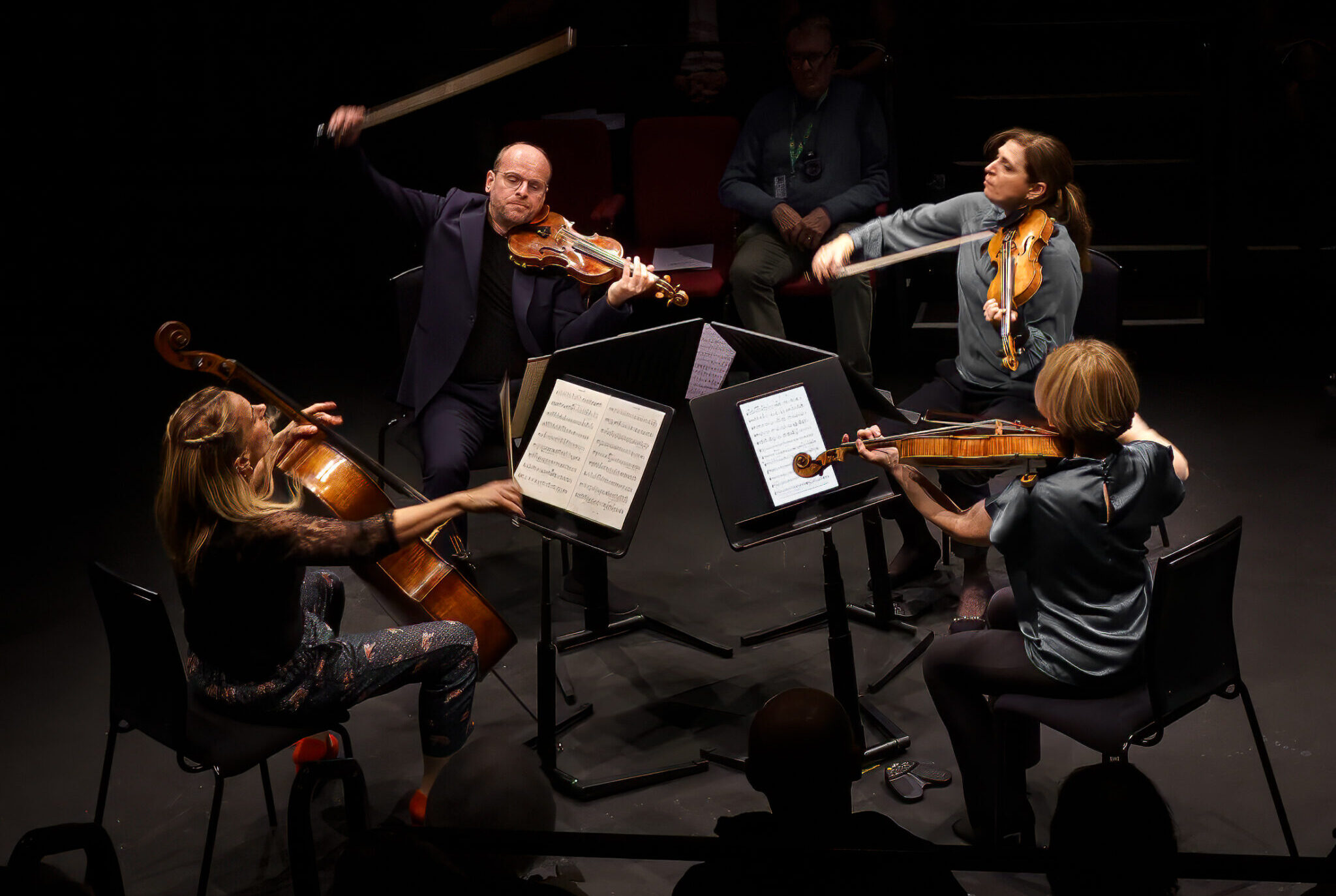
Fibonacci String Quartet, photo by Julia Bohle

BEETHOVEN String Quartet Op.18 No.1 (28’)
BARTÓK String Quartet No.5 (30’)
SCHUMANN String Quartet No.3 in A (26’) 

Three contrasting pieces from the string quartet repertoire are brought together in this Sheffield debut for the Fibonacci Quartet. With a glittering array of prizes and accolades, this young group has rapidly made a name as one of the most exciting European quartets working today.  

Beethoven’s First Quartet is an expansive work – by turns lyrical, dramatic and wryly comic – while Bartók’s Quartet No.5 dazzles with the composer’s signature folk-inflected energy and rhythm. Schumann’s Quartet No.3 brings the concert to a sumptuously romantic close. 

Save 20% when you book for 10 or more Music in the Round Sheffield concerts in one transaction. 
Save 10% when you book for 5 or more Music in the Round Sheffield concerts in one transaction. Find out more. 

BEETHOVEN Ludwig van, String Quartet in F Op.18 No.1

Allegro con brio
Adagio affetuoso ed appassionato
Scherzo. Allegro molto
Allegro

Beethoven’s String Quartets Op.18 were written between 1798 and 1800 – his first exploration of the genre in which his teacher Haydn had excelled. Beethoven was commissioned to write the quartets by Prince Lobkowitz. The F major Quartet Op.18 No.1 was the second of the set to be composed, in January–March 1799. The first movement gave Beethoven a good deal of trouble. An early manuscript shows the state of the work before extensive revisions were made in the summer of 1800. In a letter to Carl Amenda dated 1 July 1801 (in which he also confides about his increasing deafness), he begs his friend not to show anyone the first version of the quartet as “it’s been reworked very thoroughly … I’ve only now learned how to write quartets properly”. The results of Beethoven’s revisions in the first movement were especially effective in increasing tension and momentum in the development section. A conversation reported between Amenda and Beethoven is revealing about the Adagio. Amenda said “it pictured for me the parting of two lovers”, to which Beethoven apparently replied: “Good! I thought of the scene in the burial vault in Romeo and Juliet.” After the emotional intensity of the slow movement, the Scherzo comes as a relief, before a swirling scale-like theme launches the finale.


Nigel Simeone 2013 © 

BARTÓK Béla, String Quartet No.5

Allegro
Adagio molto
Scherzo – alla bulgarese
Andante
Finale. Allegro vivace


Bartók composed his Fifth Quartet quickly: between 6 August and 6 September 1934. It was commissioned by Elizabeth Sprague Coolidge and dedicated to her. The first performance was given at the Library of Congress in Washington D.C. by the Kolisch Quartet on 8 April 1935. The opening uses emphatically repeated B flats to introduce a closely-argued first movement. The repeated notes return, this time on E naturals and the music becomes increasingly animated. At the close, all four instruments converge on a B flat. The second movement is a magnificent example of Bartók’s ‘night music’, full of mysterious trills and whispered flourishes over sustained chords, rising to a climax before sinking again into the darkness, ending when the cello slithers down a scale into silence. The third movement is a lively dance in a rhythm derived from Bulgarian folk music – in this case 4+3+2/8. The Andante is another piece of ‘night music’, this time punctuated by unexpected pizzicatos and gently shuddering repeated chords. As in the second movement, there is an intense fortissimo climax before the shuddering chords and pizzicato cello glissandos and a solitary violin B natural bring the movement to an enigmatic close. The fifth movement has similar energy and tension of the first, and the whole quartet can be seen as a gigantic arch form. To underline this, the final flourish brings all four instruments to the B flat from which the work began.


Nigel Simeone © 

SCHUMANN Robert, String Quartet No.3 in A

Andante espressivo – Allegro molto moderato
Assai agitato
Adagio molto
Finale. Allegro molto vivace – Quasi Trio


1842 is known as Schumann’s ‘year of chamber music’. In September and October he composed the Piano Quintet and Piano Quartet, and during the summer he devoted himself to string quartets, writing three of them in the space of six weeks. Three years earlier, in 1839, he had planned to spend the summer writing quartets, but two incomplete fragments were left abandoned. He did, however, immerse himself in studying Beethoven’s late quartets. Three years later, he wrote in his diary in February 1842 that he was having ‘quartet thoughts’ and in June he got down to serious work. All three quartets were dedicated to his friend Mendelssohn, and after Mendelssohn’s death in 1847, Schumann wrote to his publisher Härtel: ‘My quartets have taken on a special meaning for me through the death of Mendelssohn … I still view them as the best works of my earlier period, and Mendelssohn often expressed the same view to me.’ The Quartet in A major was the last to be written and Schumann composed it at great speed, finishing it in less than a week. The first movement begins with a dream-like introduction. This ends with a falling fifth that forms the start of the main theme that follows. The second subject is introduced by the cello before being taken up by the other instruments. This sonata form movement ends as it began, with a falling fifth, this time in the cello. The second movement is marked Assai agitato and it is a set of a variations on a restless theme. The music finds repose only in the serene coda which ends in radiant A major. The slow movement, in D major, is the expressive heart of the work, based on two themes, the first of them a richly harmonized melody, the other a more unsettled and fragmented idea. The finale is a rondo that brings the quartet to a jubilant conclusion

JASAD: MUSIC FOR MIDDLE EASTERN FLUTE

Faris Ishaq

Crucible Playhouse, Sheffield
Saturday 28 February 2026, 7.00pm

Tickets:
£23
£14 UC, PIP & DLA
£5 Students & Under 35s 

Past Event
Nay musician, Faris Ishaq

Nay master, percussionist and composer, Faris Ishaq charts unexplored territories with one of the oldest types of flute still in use today, the Nay. Rooted in his Palestinian heritage, Faris celebrates the instrument, which has Middle Eastern roots dating back to around 5000 BCE, and its cultural legacy, in his own compositions.

In ‘Jasad’ – Arabic for ‘body’ – he draws on the essence of the Nay to create a distinctive solo setup, playing the instrument alongside a leg-mounted frame drum and foot percussion, and weaves these sounds together to produce a multi-layered acoustic solo performance. With exceptional dexterity and expressive nuance, he blends intricate melodies with dynamic beats to evoke the feel of looped textures while being fully acoustic.

“A walking musical genius”Max Reinhard, former BBC Radio 3

Save 20% when you book for 10 or more Music in the Round Sheffield concerts in one transaction. 
Save 10% when you book for 5 or more Music in the Round Sheffield concerts in one transaction. Find out more. 

SHEFFIELD JAZZ

Denys Baptiste Quartet

Crucible Playhouse, Sheffield
Friday 27 February 2026, 7.30pm

Tickets*:
£20 / £18 over 60, Disabled, Unemployed
£10 18-30 year-olds & students with NUS card
£5 15-17 year-olds / Under 15s free


Past Event
Saxophonist Denys Baptiste

DENYS BAPTISTE saxophone
SULTAN STEVENSON piano
LARRY BARTLEY bass
JOEL BARFORD drums
Acclaimed saxophonist Denys Baptiste presents his new quartet, featuring rising star pianist Sultan Stevenson, who will explore an exciting mix of new compositions, standards and revisit compositions from his award-winning albums. An amazingly versatile musician with roots steeped in the jazz tradition, Denys incorporates ideas from other musical forms and popular culture. His powerful technique and an ability to improvise effortlessly across a wide range of musical styles have made him a much sought after soloist, playing with some of the biggest names in jazz and other genres. Expect an evening of deep swing, infectious melodies and inventive solos. 

*Please note Music in the Round offers and discounts do not apply to this concert.   

SYMPHONIC DANCES FOR TWO PIANOS

Ivana Gavrić & Tim Horton

Crucible Playhouse, Sheffield
Thursday 26 February 2026, 7.00pm

Tickets:
£23
£14 UC, PIP & DLA
£5 Students & Under 35s 

Past Event

DEBUSSY En blanc et noir (16’)
RAVEL La valse  (12’)
RACHMANINOV Symphonic Dances (30’) 

With their 2025 two-piano concert described as “piano playing at its most… visceral” (Bachtrack), Tim Horton and Ivana Gavrić return to the Crucible Playhouse for a concert of spellbinding and exhilarating music for two pianos. Rachmaninov’s own arrangement of his ‘Symphonic Dances’ takes centre stage, with its arresting rhythmic passages and virtuosic energy. Debussy’s ‘En blanc et noir’, by contrast, sees expressionist clouds of colour conjured from the two pianos, while Ravel’s poetic ‘La valse’ is best described by the composer himself: “Whirling clouds give glimpses, through rifts, of couples dancing. The clouds scatter, little by little. One sees an immense hall peopled with a twirling crowd. The scene is gradually illuminated. The light of the chandeliers bursts forth, fortissimo”. 

This concert will be recorded by BBC Radio 3 for future broadcast.

Save 20% when you book for 10 or more Music in the Round Sheffield concerts in one transaction. 
Save 10% when you book for 5 or more Music in the Round Sheffield concerts in one transaction. Find out more. 


DEBUSSY Claude, En blanc et noir

  1. Avec emportement
  2. Lent. Sombre
  3. Scherzando 

One of Debussy’s last compositions, En blanc et noir for two pianos was completed in June 1915. It was originally called ‘Caprices en blanc et noir’, the title under which it was first performed in January 1916 at a private concert in the Paris salon of the Princesse de Polignac (played by Walter Rummel and Thérèse Chaigneau). Later the same year, in December 1916, it was given under its definitive title by Debussy and Roger-Ducasse, at a concert given for the benefit of French prisoners of war. Fiercely patriotic, and unafraid to express his anti-German sentiments in time of war, Debussy prefaced each movement with a literary quotation. The first is from Jules Barbier and Michel Carré’s libretto for Gounod’s Roméo et Juliette: ‘He who stays in his place and does not dance, admits to disgrace’, almost certainly a bitter self-reflection: Debussy, greatly weakened by cancer and now very ill, was unable to take part in the ‘dance’ of fighting for France. Debussy’s music is less confrontational: dedicated to Serge Koussevitzky, it is essentially a kind of waltz, the writing brilliantly exploiting the potential of two pianos. The superscription for the second movement is taken from François Villon’s Ballade contre les ennemis de la France (written in 1461): ‘worthless is he … who would wish evil on the state of France!’ The dedication is a memorial to Jacques Charlot, ‘killed by the enemy on 3 March 1915’. Charlot was the nephew of Debussy’s publisher Jacques Durand, and the composer’s quiet rage can be heard at the start of this movement when low chords are interrupted by a dissonant chord followed by distant bugle calls. After a radiant section marked ‘calme’, what follows (‘sourdement tumultueux’) is hushed and disturbing, with the German chorale melody ‘Ein feste Burg ist unser Gott’ emerging from the texture. The final Scherzando is prefaced by a line from Charles d’Orléans: ‘Winter, you are nothing but a villain’ and it is dedicated to Igor Stravinsky. Though the music is sometimes playful, the mood is often equivocal, as are Debussy’s intentions: En blanc et noir is a bewitching combination of boldness and ambiguity. 


© Nigel Simeone 2026 


RAVEL Maurice, La Valse for Solo Piano

In a thought-provoking discussion of Ravel’s La Valse, the composer George Benjamin wrote: ‘Whether or not it was intended as a metaphor for the predicament of European civilization in the aftermath of the Great War, its one-movement design plots the birth, decay and destruction of a musical genre: the waltz.’ Ravel himself was at pains to distance the work – written in 1919–20 – from any such immediate associations. In his published preface to the score, he described the scene he had tried to evoke: ‘Drifting clouds give glimpses, through rifts, of couples waltzing. The clouds gradually scatter, and an immense hall can be seen, filled with a whirling crowd. The scene gradually becomes illuminated. The light of chandeliers bursts forth. An imperial court about 1885.’ But of all Ravel’s orchestral works, this is the most dissonant, brutal and strange: the swaying one-in-a-bar of the Viennese waltz becomes a sinister undertow at the start, before the main theme begins to emerge, seeming to crawl towards the light, and gradually gaining in confidence. But at the end, it is brutally crushed in a way that is both stunning and disturbing. Ravel’s own solo piano version emphasizes the percussive characteristics of the music, especially its rhythmic energy.

Nigel Simeone 2014 (c)

RACHMANINOV Sergei, Symphonic Dances, Op.45 for Two Pianos

  1. Non allegro
  2. Andante con moto. Tempo di valse
  3. Lento assai – Allegro vivace 

This is Rachmaninoff’s last major composition, completed in 1940. The Symphonic Dances were dedicated to Eugene Ormandy and the Philadelphia Orchestra who gave the premiere on 3 January 1941. Though the two-piano version was finished first (in August 1940), its earliest known performance not given until August 1942 at a private event in Beverly Hills, California, when it was reportedly played by Rachmaninoff and Vladimir Horowitz. The original title was ‘Fantastic Dances’ with the movements called ‘Noon’, ‘Twilight’ and ‘Midnight’. Rachmaninoff decided to scrap these programmatic titles, and to emphasise the symphonic stature of the music was surely correct: this is powerful, imposing music which the Rachmaninoff authority Geoffrey Norris described as ‘a symphony in all but name.’ The opening of the first dance has a kind of stark energy that develops an impressive head of 

steam. A more reflective central section leads to a reprise of the opening, but this then dissolves into a beautiful coda where Rachmaninoff introduces a quotation of the main theme from his First Symphony: a work that had famously failed at its premiere but in which he still (rightly) had faith. This theme has hints of Orthodox church music – an influence to which the composer returns later in the work. The second movement is a beguiling and harmonically ambiguous waltz. While much of the finale dazzles with brilliant colour in its outer sections (with a lyrical interlude at its heart), it also includes prominent references to the Dies irae plainchant and a reworking of music from Rachmaninoff’s own All-Night Vigil. At the start of the thrilling coda, Rachmaninoff wrote on the orchestral version ‘Alleluia’, and it’s likely he intended this close to serve as a kind of joyous valediction. 


© Nigel Simeone 2026 

AN INTRODUCTION TO LIVE CODING & MUSIC

Alex McLean

The Hollis Room (Upper Chapel), Sheffield
Friday 13 February 2026, 11.00am

Tickets:
£10

Past Event
Alex McLean live coding at a music event

Join us for a workshop on making musical patterns with live coding led by Alex McLean. Whether you’re a complete novice or simply curious about the world of coding and music, this event offers a unique opportunity to explore creativity through sound. No prior experience is necessary, just bring your curiosity and a desire to experiment!

Alex will introduce the open-source live coding platform that he co-instigated, Strudel. It enables complex musical rhythms and patterns to be created and explored with simple code.  

The workshop is suitable for beginners with no experience in coding or music-making, exploring patterns by listening to and adjusting just a line or two of code.  

Participants should bring a laptop (or similar device with a web browser  as long as it can make sounds with https://strudel.cc/)

Part of our Percussion, Pattern & Primes weekend. 

Save 20% when you book for 10 or more Music in the Round Sheffield concerts in one transaction. 
Save 10% when you book for 5 or more Music in the Round Sheffield concerts in one transaction. Find out more. 

BACH FOR ORGAN

David Goode

Upper Chapel, Sheffield
Friday 13 February 2026, 2.00pm

Tickets:
£17
£10 UC, PIP & DLA
£5 Students & Under 35s 

Past Event
Organ player, David Goode

BACH
Prelude in E flat BWV552 (i) (9’)
Chorale Preludes from Clavierübung III: 
   Christ, unser Herr, zum Jordan kam BWV684 (5)
   Dies sind die heil’gen zehn Gebot BWV678 (5)
   Canonic Variations on ‘Vom Himmel hoch’ BWV769 (12)
From Die Kunst der Fuge:
   Contrapunctus I  (3’)
   Contrapunctus XII (3’)
   Contrapunctus IX (3’)
From Orgelbüchlein:
   O Lamm Gottes, unschuldig BWV618 (4)
   O Mensch, bewein’ dein Sünde gross BWV622 (6)
   Fugue in E flat BWV552 (ii) (7) 

David Goode performs some of Bach’s best-loved works for organ, showcasing the composer’s genius for pattern, number and symbolism. Discover secret messages hidden in Bach’s music and marvel at some of the greatest masterpieces of the Baroque including ‘The Art of Fugue’ 

Praised for his “spectacular playing” (BBC Music Magazine), organist David Goode’s Complete Bach recordings, released on Signum Classics, are among the finest ever made, “notable for the flair, clarity and spontaneity that Goode brings to this timeless music” (Gramophone).  

Part of our Percussion, Pattern & Primes weekend. 

Save 20% when you book for 10 or more Music in the Round Sheffield concerts in one transaction. 
Save 10% when you book for 5 or more Music in the Round Sheffield concerts in one transaction. Find out more. 

Bach for Organ


Few composers can have delighted more than Bach in patterns of all kinds. Those in today’s programme fall into several overlapping categories. One is canon, the technical device where a tune fits neatly with itself played at the same time but slightly later (and possibly upside-down, or at a different speed). There is Bach’s systematic exploration of fugal technique, the ‘Art of Fugue’, written right at the end of his life; and there is symbolism of various kinds: pictorial representation of theological truths in chorale preludes, or numerological symbolism such as that referring to the Trinity.  

Today’s programme is framed by the mighty Prelude and Fugue in E flat, movements written to bookend Bach’s great 1739 series of chorale preludes, Part III of the Clavierübung (or ‘Keyboard Exercises’). That collection is based around the Lutheran catechism, the exposition of religious faith as Bach professed it, and central to it is the declaration of God as Father, Son and Holy Spirit. Thus the number 3 plays a major role: partly in the unusual key signature of three flats, but also in the structure of the music – there are 3 ‘blocks’ of music in the Prelude, which cycle around, and three sections to the Fugue (thus a ‘triple fugue’). This is music of grandeur, profundity and brilliance, opening in the march-like ‘French overture’ style that was used for the entrance of a monarch (in this case, the divine King. 

Next, two chorale preludes from within the collection. Christ unser Herr is a setting of a hymn about Christ’s baptism in the River Jordan. Bach uses pictorial representation here: running semiquavers in the LH to depict the stream, two overlapping parts in the RH using a ‘cross’ shape to represent Christ himself, and the tune through the middle, played in the pedals. At the moment that the tune enters, the ‘cross’ figure (Christ) briefly descends below the waves! Dies sind is concerned with the Ten Commandments and it is therefore perhaps no surprise that the tune, when it enters in the LH, is treated in canon, that ‘rule-based’ technique. However, one might conclude that Bach considered the commandments to be the route to a happy and fulfilling life, since he encloses this canon within three more parts of delightfully relaxed and pastoral serenity. 

Canon finds perhaps its most thorough treatment in the remarkable Canonic Variations on the Christmas hymn ‘Vom Himmel hoch’ (‘From heaven above’) written by Bach in 1747 for the ‘Learned Society’ of his former pupil Lorenz Mitzler. There are five variations employing all manner of intricate canonic devices, beginning with the fluttering down of the angels with the Christmas news, and ending with joyous pealing of bells. The last variation alone uses canon in multiple different ways; and along the course of the variations Bach more than once weaves in his musical ‘signature’ (the notes B-A-C-H equalling B flat-A-C-B natural in English notation). 

Bach’s magisterial treatise on fugal technique, Die Kunst der Fuge, was written towards the end of his life and left tantalisingly incomplete at his death in 1750, breaking off at the climactic moment. No particular instrument is specified, but the work lies well for keyboard and lends itself to arrangement. Today we hear three contrasting movements: the opening one, the most straightforward, on the theme of the whole piece; then a canon on a decorated version (the Art of Fugue, needless to say, includes several canons); and finally an athletic fugue on a different theme (in running quavers) which before long combines in various ways with the main theme. 

After such intellectual rigour, a couple of gentle chorale preludes from his collection Orgelbüchlein (‘Little Organ Book’) from much earlier in his career, which presents settings of chorales for use throughout the church year. Both are for Passiontide, the season commemorating Christ’s suffering and death. In O Lamm Gottes (‘O Lamb of God, sinless’) the tune is again treated in canon (between the pedals and the alto voice) but the mood is set by the other parts which employ the ‘seufzer’ or ‘sighing’ figure traditionally associated with melancholy and suffering. O Mensch, bewein (‘O Man, bewail your great sin’) is one of the most celebrated of Bach’s chorale settings, being of the utmost expressivity and, in the closing bars, remarkable chromaticism (including a rising bass in which some have seen Christ’s walk to the cross). 

And so back to the E flat Fugue to finish: overall, a variety of forms and genres, whether practical or theoretical in aim, and a glimpse into Bach’s rich and distinctive world of pattern, order and meaning.  


David Goode (c) 2026 

“Goode’s performances are all one could hope for.”

Gramophone

SYMMETRIES IN SOUND

Ensemble 360

Upper Chapel, Sheffield
Friday 13 February 2026, 7.00pm

Tickets:
£23
£14 UC, PIP & DLA
£5 Students & Under 35s 

Past Event
Ensemble 360 string trio musicians

DE MACHAUT Ma fin est mon commencement (arr. trio) (6’)
PICFORTH In Nomine (arr. chamber ensemble) (4’)
Attrib. MOZART Der Spiegel (2’) 
CAGE Book One from ‘Music of Changes’ (8’) 
PÄRT Spiegel im Spiegel (10’)
DEBUSSY Reflets dans l’eau (5’)
MOZART Sonata in B flat for Bassoon and Cello (15’)
BARTÓK String Quartet No.4 (25’) 

This celebration of musical games and mirrors includes ‘Der Spiegel’, a piece for two violinists looking at the same sheet of music, one right-way-up, the other upside-down. Also playing with reading the music is De Machaut’s ‘Ma fin est mon commencement’, a piece performed forwards then backwards. Pärt’s popular piece for cello and piano, ‘Spiegel im Spiegel’ (Mirror in the mirror) and Debussy’s impressionistic evocation, ‘Reflets dans l’eau’ (Reflections in the water) highlight musical mirrors, and the concert culminates with a wonder of musical structure, Bartók’s String Quartet No.4, composed as a musical arch. 

Part of our Percussion, Pattern & Primes weekend. 

Save 20% when you book for 10 or more Music in the Round Sheffield concerts in one transaction. 
Save 10% when you book for 5 or more Music in the Round Sheffield concerts in one transaction. Find out more. 

Symmetries in Sound

DE MACHAUT – Ma fin est mon commencement (arr. trio) 

Ma fin est mon commencement [My end is my beginning] by the late-Medieval French composer and poet Guillaume de Machaut is a cunningly constructed piece. Originally composed as a song for three voices, the music is written in the form of several palindromes. The lowest voice – in this arrangement, the bassoon – first plays its part forward. Then, at the middle of the piece, it reads it backwards, playing an exact mirror of the melodic line. The upper two voices – violin and viola, here – play their parts forward, swapping in the middle to then play each other’s melodies backwards. The result is music of perfect symmetry. 


PICFORTH – In Nomine (arr. chamber ensemble)  

This ‘In Nomine’ by the English composer Picforth (about which little is known) was written around 1580. Originally composed for a consort of five viols, each part plays notes of only one duration. The cello plays notes lasting eight beats, the bassoon: six, viola: four, and so on. The inspiration here was planetary movement, with each part representing the orbit of a celestial body. Although each instrument is on a different temporal plane – most clearly, the second violin’s triple time against the first violin’s duple – they interlock perfectly. For artists, astronomers, and philosophers in Renaissance Europe, the idea of the ‘harmony of the spheres’ was central. Nature, they felt, existed in perfect balance and harmony; man’s music was our nearest approximation to this heavenly structure. 


MOZART – Der Spiegel (2′) 

Attributed to Mozart, this playful piece for two violins is a musical curio. A violinist stands on one side of a table, reading the music right way up, while a second stands on the other, reading that same page upside down. Miraculously, the music is a perfectly formed duet, with the music working no matter which way up the page is read.  


CAGE – ‘Book One’ from Music of Changes (8′)  

The twentieth century composer John Cage – perhaps best known for his work 4’33’’ which consists of no music, only the sounds of the concert hall – was deeply influenced by Zen Buddhism. Starting in the 1950s, Cage began experimenting with ways of removing his ego from the act of composition. In particular, he made use of the ancient Chinese divination text, the I Ching, to create a system of ‘chance music’. In Music of Changes – a groundbreaking piece of indeterminate music from 1951 – Cage uses coin tosses and charts derived from the I Ching to remove his own intentions. Instead, chance procedures are used to decide all aspects of the musical composition from pitch and duration to dynamics and rhythms.  


PÄRT – Spiegel im Spiegel (10′)  

The Estonian composer Arvo Pärt is best known for his minimal, meditative compositions. Influenced by his own mystical experiences with chant music, he coined a term for this compositional style – tintinnabuli – which describes the simple, bell like textures. In Spiegel im Spiegel [mirror within mirror], you hear this clearly in the piano’s arpeggios. The structure of the piece follows a strict formula, with the title directly reflecting what is happening in the music: each ascending melodic line is followed by a descending mirror phrase. Initially, the melody consists of only two notes, with another note being added with each of the following phrases, creating a seemingly endless continuum. After each distancing, the melody returns to the central pitch of A, which, according to the composer, is like “returning home after being away”. The piano part accompanies the melody part at each step like a “guardian angel” (as Pärt says).  


DEBUSSY – Reflets dans l’eau (5′)  

Debussy’s Reflets dans l’eau [Reflections in the water] is the first piece from his collection of solo piano works, Images: Volume 1. In it, Debussy conjures a feeling of water – musical gestures emanating outward from the centre of the keyboard, the harmony free-floating, textures reflecting water as both glistening and murky depths. There is another mathematical wonder at work, here. The piece is organised using the golden ratio. The sequence of keys is marked out by the intervals 34, 21, 13 and 8, while the piece’s main climax sits at the ‘phi position’. 


MOZART – Sonata in Bb for Bassoon and Cello K.292 (15’) 

The origins of Mozart’s Sonata for Bassoon and Cello are shrouded in mystery: no autograph manuscript exists and the work was not published until 1805, fourteen years after Mozart’s death. Along with the Bassoon Concerto it is one of two surviving works that Mozart composed for the instrument. They were possibly composed in 1774 when the 18-year-old Mozart was staying in Munich and had made friends with an amateur bassoonist called Baron Thaddäus von Dürniz. While the bassoon line in the Sonata is the principal part, the cello line is essentially an accompanying bass line rather than an equal partner.  

The piece shows the young Mozart’s mastery of musical proportion and balance. The first two movements are in sonata form; contrasting ideas are introduced, developed, and then returned to. The ratios here are those of the golden ratio. Indeed, Mozart’s sister Nannerl noted he was always playing with numbers and even scribbled mathematical equations for probabilities in the margins of some compositions (for example, the Fantasia and Fugue in C Major, K394), some of which mathematicians suggest were Fibonaccci number calculations. 


BARTOK – String Quartet No. 4 (25’) 

The Hungarian composer Béla Bartók held a long fascination with mathematics and how it related to music. His String Quartet No.4, like the fifth string quartet and several other pieces by the composer, is composed in an arch (or mirror) form. The first movement is thematically related to the last, and the second to the fourth, while the third movement stands alone as a central pivot point. What is more, the outer four movements feature rhythmic sforzandos that cyclically tie them together in terms of climactic areas. The symmetry of the movements isn’t limited only to the themes; the lengths of the movements show symmetry as well. The first, third and fifth movements are approximately six minutes long, whereas the second and fourth are shorter, at about three minutes each. Bartók’s harmony is also mathematically derived. The quartet focusses on the chromatic scale, with the twelve notes divided into symmetrical units, with tonal centres being based on ‘axes of symmetry’. He also incorporates whole-tone, pentatonic, and octatonic scales as subsets of the chromatic scale, exploring their asymmetries.  

© Dr Benjamin Tassie 2026

FANTASIES FOR FLUTE & HARP

Catrin Finch & Juliette Bausor of Ensemble 360

Upper Chapel, Sheffield
Saturday 31 January 2026, 2.00pm

Tickets:
£23
£14 UC, PIP & DLA
£5 Students & Under 35s 

Past Event
Harpist, Catrin Finch, with harp

JS BACH Flute Sonata in G minor BWV1020 (12’)
FAURÉ Fantasie Op.79 (5’)
RAVEL Pavane pour une infante défunte (5′)
NEILSEN The Fog is Lifting (3′)
ALWYN Naiades Fantasy Sonata (13’)
DEBUSSY Syrinx (3′)
DEBUSSY Claire de lune (5′)
ROTA Sonata for Flute and Harp (13’)
PIAZZOLLA Bordel 1900 from ‘Histoire de Tango’ (4’)
BORNE ‘Carmen’ Fantasie (13’)

The chart-topping and multi-award-winning “queen of harps”, Catrin Finch, joins Ensemble 360’s flautist Juliette Bausor for a glorious afternoon of duos. Arrangements and original works for this classic instrumental combination will sweep you away in this rare collaboration between two long-time friends.  

The concert marks Catrin’s long-awaited return to Music in the Round, following her memorable sold-out performance with Senegalese kora player Seckou Keita in 2018.

Post-concert Q&A with Catrin Finch & Juliette Bausor
Free, no need to book, just stay after the concert.  

Save 20% when you book for 10 or more Music in the Round Sheffield concerts in one transaction. 
Save 10% when you book for 5 or more Music in the Round Sheffield concerts in one transaction. Find out more. 

Fantasies for Flute & Harp

Flute and harp duos have a history stretching back hundreds of years. The combination of instruments was very popular in the salons and courts of France in the mid-18th and early 19th centuries, mainly as a result of the harp’s most famous patron Marie Antoinette. Many courts and chateaux around France owned a harp and evening recitals of solo harp, or harp together with flute or violin, were commonplace. Mozart’s Concerto for Flute and Harp K299 was composed in 1778 for the Duke of Guines and his daughter, helping establish this pairing in the concert repertoire.

The combination fell out of favour in the mid-19th century, but experienced a renaissance in the late 19th and early 20th centuries when French composers, drawn to its impressionistic colours and delicate textures, rediscovered its possibilities. Debussy in particular used the flute and harp’s capacity for creating shimmering, atmospheric soundscapes, while subsequent composers including Ravel, Roussel and Fauré contributed works that cemented the duo’s place in modern repertoire. Today, the pairing continues to attract composers across all styles, from neoclassical to contemporary, who are captivated by the instruments’ complementary timbres.

Jo Towler © 2026 

“Catrin Finch proves her worth as a notable composer-performer as her fingers dance over the notes”

Classic FM

FRETWORK: TAKE FIVE

Fretwork Viol Consort

Crucible Playhouse, Sheffield
Tuesday 3 February 2026, 7.00pm

Tickets:
£23
£14 UC, PIP & DLA
£5 Students & Under 35s 

Past Event
Fretwork Viol Consort with their instruments

BACH Pièce d’Orgue BWV572 (6’)
GIBBONS Two In Nomines in 5 parts (8’)
DEBUSSY La fille aux cheveux de lin (3’)
PURCELL Fantazia Upon One Note (3’)
BALDWIN Proporcions to the minim(3’)
PARSONS In Nomine (2’)
TYE Trust (2’)
DESMOND & REES Take Five In Nomines (6’)
PÄRT Fratres (9’)
WEELKES In Nomine in 5 parts (3’)
GOUGH Birds on Fire, Part I (6’)
BYRD Fantasy: two parts in one the fourth above (6’)
BYRD Browning (4’)
BUSH/BEAMISH Running Up That Hill (5’) 

For nearly 40 years, Fretwork has been celebrated as the world’s leading viol consort.  

Returning to the Crucible Playhouse for the first time in over a decade, these acclaimed musicians share a playful and imaginative evening of music. Together, they trace a journey through core viol repertoire from Byrd and Weelkes, a Bach transcription, arrangements of great Romantic works and Arvo Pärt’s stirring modern classic ‘Fratres’. The concert culminates in an arrangement of a Kate Bush classic by one of Britain’s leading contemporary composers. 

Save 20% when you book for 10 or more Music in the Round Sheffield concerts in one transaction. 
Save 10% when you book for 5 or more Music in the Round Sheffield concerts in one transaction. Find out more. 

Fretwork: Take Five

Bach’s Fantasia or Piece d’Orgue was originally written, as the name suggests, for organ. In it, a dynamic and cheerful opening leads to a contrapuntal central section in five voices, realised here on the five viols of the consort. Orlando Gibbons (1583-1625) was an English composer and keyboard player. His Nomine in 5 Parts, composed around 1610, are among the most celebrated consort works of the Jacobean era. By contrast, Debussy’s La fille aux cheveux de lin, originally a solo piano piece, evokes the ‘girl with flaxen hair’ of Leconte de Lisle’s poem of the same name. The number five continues later in the programme with the jazz standard, composed by Paul Desmond and made famous by the Dave Brubeck Quartet. 

Estonian composer Arvo Pärt’s Fratres has fast become a modern classic. Written without fixed instrumentation, it is driven by three voices that unfold simple repeating melodic material. Back in England, William Byrd (c.1540-1623) was one of the most influential composers of the Renaissance. The Fantasia was a popular form; with roots in improvisation, it seldom followed a strict musical form but was instead composed around an imaginative musical idea. The programme ends with music of an altogether different kind – Sally Beamish’s arrangement of Kate Bush’s iconic Running Up That Hill. 

Dr Benjamin Tassie © 2026 

“Fretwork is the finest viol consort on the planet”

London Evening Standard

ROMANTIC STRING QUARTETS

Consone Quartet

Crucible Playhouse, Sheffield
Tuesday 10 February 2026, 7.00pm

Tickets:
£23
£14 UC, PIP & DLA
£5 Students & Under 35s 

Past Event
Consone String Quartet

C SCHUMANN (arr. Tress) Three Romances (10’)
MOZART String Quartet in C ‘Dissonance’ (22’)
SCHUBERT String Quartet No.13 ‘Rosamunde’ (30’) 

The “top-notch” (Allmusic) Consone Quartet has won numerous illustrious prizes, was the first period instrument quartet to be selected as BBC New Generation Artists and is rapidly building a following as Music in the Round’s Visiting Quartet.  

This promises to be a captivating programme of music including Clara Schumann’s ‘Three Romances’ in a lush string quartet arrangement. Mozart’s striking ‘Dissonance’ Quartet, with its innovative opening, unfolds into the composer’s signature elegance and vitality. Schubert’s lyrical ‘Rosamunde’ Quartet concludes the evening, with its lush melodic themes woven through moments of tender melancholy and exuberant joy. 

Save 20% when you book for 10 or more Music in the Round Sheffield concerts in one transaction. 
Save 10% when you book for 5 or more Music in the Round Sheffield concerts in one transaction. Find out more. 

SCHUMANN Clara, Three Romances for violin and piano, Op.22

i. Andante molto
ii. Allegretto, mit zarten Vortrage
iii. Leidenschaftlich schnell

Clara and Robert Schumann moved to Düsseldorf in early 1853, and found a house where Clara could practice and compose without disturbing her husband. She made the most of their improved circumstances and wrote several new pieces during the summer of 1853, including the Three Romances dedicated to Joseph Joachim, a close friend of both Robert and Clara. These character pieces, of which the third is much the longest, are among the last pieces Clara composed: Robert’s mental health took a turn for the worst the following year and he was moved to a sanatorium where Clara was only allowed to visit when it was clear that he was dying in 1856. After his death, she composed almost nothing, concentrating on playing the piano and overseeing Robert’s musical legacy.


Nigel Simeone 2014

MOZART Wolfgang Amadeus, String Quartet in C K465

Adagio–Allegro
Andante cantabile
Menuetto. Allegro
Allegro molto

In 1785 the Viennese publisher Artaria issued a set of six string quartets by Mozart, the title page of which reads: ‘Six Quartets for two violins, viola and violoncello. Composed and dedicated to Signor Joseph Haydn, Master of Music for the Prince of Esterhazy, by his friend W.A. Mozart.’ This was a most unusual dedication for the time: composers nearly always dedicated works to the aristocrats who supported them financially, not to fellow musicians. The Artaria edition of the six ‘Haydn’ Quartets includes a long dedicatory epistle dated 1 September 1785, and headed ‘To my dear friend Haydn’. The quartets, he writes, are ‘the fruit of a long and laborious study,’ but that Haydn himself had told Mozart of his ‘satisfaction with them during your last visit to this capital. It is this above all which urges me to commend them to you … and to be their father, guide and friend!’

This admiration was mutual: after hearing these quartets, Haydn told Mozart’s father that ‘your son is the greatest composer known to me either in person or by name.’ Mozart’s ‘long and laborious study’ included a detailed examination of Haydn’s Six Quartets Op.33, which had been composed in 1781. Though Mozart’s music is very much his own in this magnificent set of quartets, it is interesting to note that the scholar David Wyn Jones has found striking parallels between the two sets of quartets, including the slow movements of Op.33 No.1 and K465.

The ‘Dissonance’ Quartet K465 is so called because of the extraordinary slow introduction to the first movement, described by Maynard Solomon as ‘an alien universe’ in which ‘reality has been defamiliarized, the uncanny has supplanted the commonplace.’ In this introduction, Solomon writes that ‘Mozart has simulated the transition from darkness to light, from the underworld to the surface.’ It is a passage of the most extreme chromaticism, but it reaches, finally, the simplicity of C major with the arrival of the main Allegro. The slow movement has parallels with the slow movement of Haydn’s Quartet Op.33 No.1, but it is also a magnificent movement in its own right. The Mozart biographer Otto Jahn waxed lyrical, calling it ‘one of those wonderful manifestations of genius which are only of the earth insofar as they take effect upon human minds, and which soar aloft into a region of blessedness where suffering and passion are transfigured.’ The Minuet has a darker central section in the minor key while the finale is unclouded apart from the occasional surprising twist of harmony – another subtle tribute to the genius of the work’s dedicatee.


Nigel Simeone 2014

SCHUBERT String Quartet No.13 ‘Rosamunde’

Allegro ma non troppo
Andante
Menuetto – Allegretto – Trio
Allegro moderato

Schubert finished his Octet on 1 March 1824 and the A minor Quartet was completed just a few days later. By the end of the same month he had not only written a handful of songs but also the ‘Death and the Maiden’ Quartet. In the space of little more than a month, he had composed three chamber music masterpieces, each of them highly distinctive. The A minor Quartet was given its first performance at the Musikverein in Vienna, played by the Schuppanzigh Quartet which went on the following year to give the premieres of Beethoven’s Op.127, Op.130 and Op.132 quartets. Most of Schubert’s chamber music (including ‘Death and the Maiden’) was only published after his death, but the A minor Quartet – optimistically billed as the first in a set of three – was published by Sauer & Leidesdorf in September 1824, with a dedication from Schubert ‘to his friend Schuppanzigh’.

For much of the time, the mood of this quartet is one of almost numbing melancholy. The first movement opens with a bleak accompaniment figure, the cello introducing a tremulous rhythm, over which the first violin enters with a drooping melody of infinite sadness. This sets the tone for much of what follows. The slow movement is a reworking of one of the entr’actes from Schubert’s Rosamunde music, giving the quartet its nickname. The wraith-like Minuet also draws on an earlier source, the song Der Götter Griechenlands D677, composed in 1819 and setting the words: ‘Schöne Welt, wo bist du?’ – ‘Beautiful world, where are you?’ The mood of quiet restraint is even maintained in the finale but here the clouds seem to lift, at least for a moment, and the music ends with a strong cadence in A major.


Nigel Simeone

“This was ‘serious’ music-making – concentrated, thoughtful, carefully considered – but the Quartet’s interpretations were fresh and personal, and the playing relaxed and warm.”

Seen and Heard International

BEETHOVEN, BRAHMS & BRITTEN

Li-Wei Qin & Jeremy Young

Crucible Playhouse, Sheffield
Saturday 17 January 2026, 7.00pm

Tickets:
£23
£14 UC, PIP & DLA
£5 Students & Under 35s 

Past Event
Cellist, Li Wei Qin with his cello

BRAHMS Sonata in E minor Op.38 (25’)
BRITTEN Sonata for Cello and Piano Op.65 (20’)
FANG Lin Chong (8’)
BEETHOVEN Sonata in D Op.102 No.2 (20’) 

A rare chance to hear the Chinese-Australian star cellist up close, performing some of the greatest chamber works ever written for the cello. “A superbly stylish, raptly intuitive performer” (Gramophone), Li-Wei Qin has twice been a soloist at the BBC Proms and has enjoyed artistic collaborations with many of the world’s most prestigious orchestras. 

For his Sheffield debut, Li-Wei performs the last and perhaps finest of Beethoven’s cello sonatas; this is an opportunity to hear the much-decorated musician (Silver Medal, International Tchaikovsky Competition; First Prize, International Naumburg Competition) return to a work he has recorded for Decca to great acclaim. Brahms’s song-like and soulful Sonata is also among the highlights, in what promises to be an evening of stirring emotions and musicality of the highest order. 

This concert will be recorded by BBC Radio 3 for future broadcast.

Save 20% when you book for 10 or more Music in the Round Sheffield concerts in one transaction. 
Save 10% when you book for 5 or more Music in the Round Sheffield concerts in one transaction. Find out more. 

BRAHMS Johannes, Sonata in E Minor, Op.38

  1. Allegro nontroppo
  2. Allegretto quasi Menuetto
  3. Allegro


Brahms began his E minor Cello Sonata in the summer of 1862, but it was not until 1865 that he completed the work. The main themes of both the first and third movements allude to Bach’s Art of Fugue, but Brahms’s treatment of these ideas is firmly in the Romantic tradition. The first movement opens with the cello introducing the principal theme, accompanied by tentative piano chords played off the beat, before the same theme passes to the piano. The second group of themes ends with a particularly lyrical idea in B major that closes the exposition. A turbulent development section leads to a return of the main theme, this time accompanied by a melancholy falling motif in the piano as well as the off-beat chords. The coda brings the movement to a tranquil close in E major. Brahms originally wrote two central movements: the present Allegretto quasi Menuetto in A minor, and an Adagio which he abandoned. The Allegretto has a kind of folkish charm, as well as an ingenious Trio section derived from the same musical idea. The finale opens with the grandest of fugues, though the movement is broadly in sonata form. Whereas the first movement ended with a mood of consolation, the finale is dark, dramatic and intense to the end. The work was published in 1866 by Simrock (Brahms had sold him the sonata by telling him it was easy to play). The first public performance was given in Basel on 12 February 1867, by Moritz Kahnt and Hans von Bülow.  


© Nigel Simeone 2016 

BRITTEN Benjamin, Sonata for Cello in C, Op.65

1. Dialogo. Allegro
2. Scherzo–pizzicato. Allegretto
3. Elegia. Lento
4. Marcia. Ernergico5. Moto perpetuo. Presto

Britten sat next to Shostakovich at a concert in the Royal Festival Hall on 21 September 1960 – the occasion of the first British performance of Shostakovich’s Cello Concerto No. 1, played by Mstislav Rostropovich. Britten was electrified by Rostropovich’s playing (Shostakovich later told Rostropovich that at the end of concert he was covered in bruises from being poked in the ribs by Britten: ‘As he liked so many things in the concerto, I am now suffering!’). Britten was delighted when Rostropovich asked him to write a piece for him. He planned the Sonata on a holiday in Greece and completed it in December 1960 and January 1961. Rostropovich and Britten gave the first performance on 7 July 1961 at the Jubilee Hall in Aldeburgh. In his programme note for the premiere, Britten wrote short descriptions of each movement. The first is ‘a discussion of a tiny motive of a rising or falling second. The motive is lengthened to make a lyrical second subject which rises and falls from a pizzicato harmonic.’ The demanding pizzicato second movement is ‘almost guitar-like in its elaborate right-hand technique’ while the third is ‘a long tune … developed by means of double, triple and quadruple stopping, to a big climax, and sinks away to a soft conclusion.’ The short march has the cello playing ‘a rumbustious bass to the jerky tune on the piano’, which returns after the central section ‘very softly, with the bass (now in the treble) in harmonics. The closing moto perpetuo includes an allusion to the D-S-C-H theme that Shostakovich used extensively in the Cello Concerto No. 1 – something Britten does not mention in his note, which describes the treatment of the dance-like theme as ‘now grumbling, now carefree’.

Nigel Simeone (C)

BEETHOVEN Ludwig van, Sonata for Cello and Piano in D Op.102 No.2

Allegro con brio
Adagio con molto sentimento d’affetto
Allegro – Allegro fugato

Beethoven’s last two cello sonatas were composed in 1815 dedicated to the Countess Anna Maria Erdödy. The initial critical response was one of bewilderment, one critic declaring that “these two sonatas are definitely among the strangest and most unusual works … ever written for the pianoforte. Everything about them is completely different from anything else we have heard, even by this composer.” Indeed, the D major Cello Sonata Op.102 No.2 is a work that points forward to some of Beethoven’s final instrumental works – the late piano sonatas and quartets – in significant ways. The Beethoven scholar William Kinderman has suggested that the solemnity and austerity of the slow movement (in D minor) has pre-echoes of the ‘Heiliger Dankgesang’ from the Quartet Op.132, while fugal finale is the one of a series of such movements in Beethoven’s late instrumental pieces (followed by the ‘Hammerklavier’ Sonata and the Grosse Fuge among others). The whole sonata, from the brusque opening of its first movement, to the extraordinary culmination of the fugue, is characterized by wild emotional contrasts: the stern, profoundly serious Adagio is flanked by two faster movements that are dominated by a fiery, even angry, dialogue between the two instruments.

Nigel Simeone © 2012

“The emotional depth in Qin’s playing is breathtaking”

BBC Music Magazine

GUITAR CLASSICS

Craig Ogden

Crucible Playhouse, Sheffield
Saturday 17 January 2026, 2.00pm

Tickets:
£23
£14 UC, PIP & DLA
£5 Students & Under 35s 

Past Event

TORROBA Sonatina for Guitar 1. Allegretto (4)
TORROBA Madroños (3)
VILLA-LOBOS Five Preludes (20)
PIAZZOLLA Invierno Porteño (7)
DYENS Con Fuoco from Libre Sonatina (4′)
REINHARDT (arr. Dyens) Nuages (3’)
SHEARING (arr. Lovelady) Lullaby of Birdland (7’)
HOUGHTON Kinkachoo I Love You (3’)
MARAIS Les Voix Humaines (6’)
KOSHKIN The Usher Waltz (7’)
SOR Introduction and Variations on a Theme by Mozart (9’) 

Back by popular demand, Classic FM chart-topper Craig Ogden returns to Sheffield.   

One of the greatest classical guitarists of our time, his incredible career over three decades has included a stream of best-selling albums and appearances with the world’s finest orchestras.   

Craig’s previous solo recital in the Playhouse was described as “dazzlingly skilful and approachably genial” (Bachtrack). In an eclectic programme of personal passions, brimming with South American guitar classics and fresh, inventive arrangements of favourites such as the jazz talent of Django Reinhardt and more, this promises to be an intimate and entertaining tour through the guitar repertoire.  

Prepare to be wowed by his brilliance and charmed by his warmth.

Early booking recommended.
Save 20% when you book for 10 or more Music in the Round Sheffield concerts in one transaction.
Save 10% when you book for 5 or more Music in the Round Sheffield concerts in one transaction. Find out more.