SYMMETRIES IN SOUND

Ensemble 360

The Stables, Milton Keynes
Monday 16 March 2026, 8.00pm

Tickets
£11 – £27.50

Past Event

DE MACHAUT Ma fin est mon commencement (arr. trio) (6’)
PICFORTH In Nomine (arr. chamber ensemble) (4’)
Attrib. MOZART Der Spiegel (2’) 
CAGE Book One from ‘Music of Changes’ (8’) 
PÄRT Spiegel im Spiegel (10’)
DEBUSSY Reflets dans l’eau (5’)
BARTÓK String Quartet No.4 (25’) 

From the musical games of Mozart’s music to the playful patterns in Bartók and beyond, the mysteries of mathematics are never far from the surface of classical music.

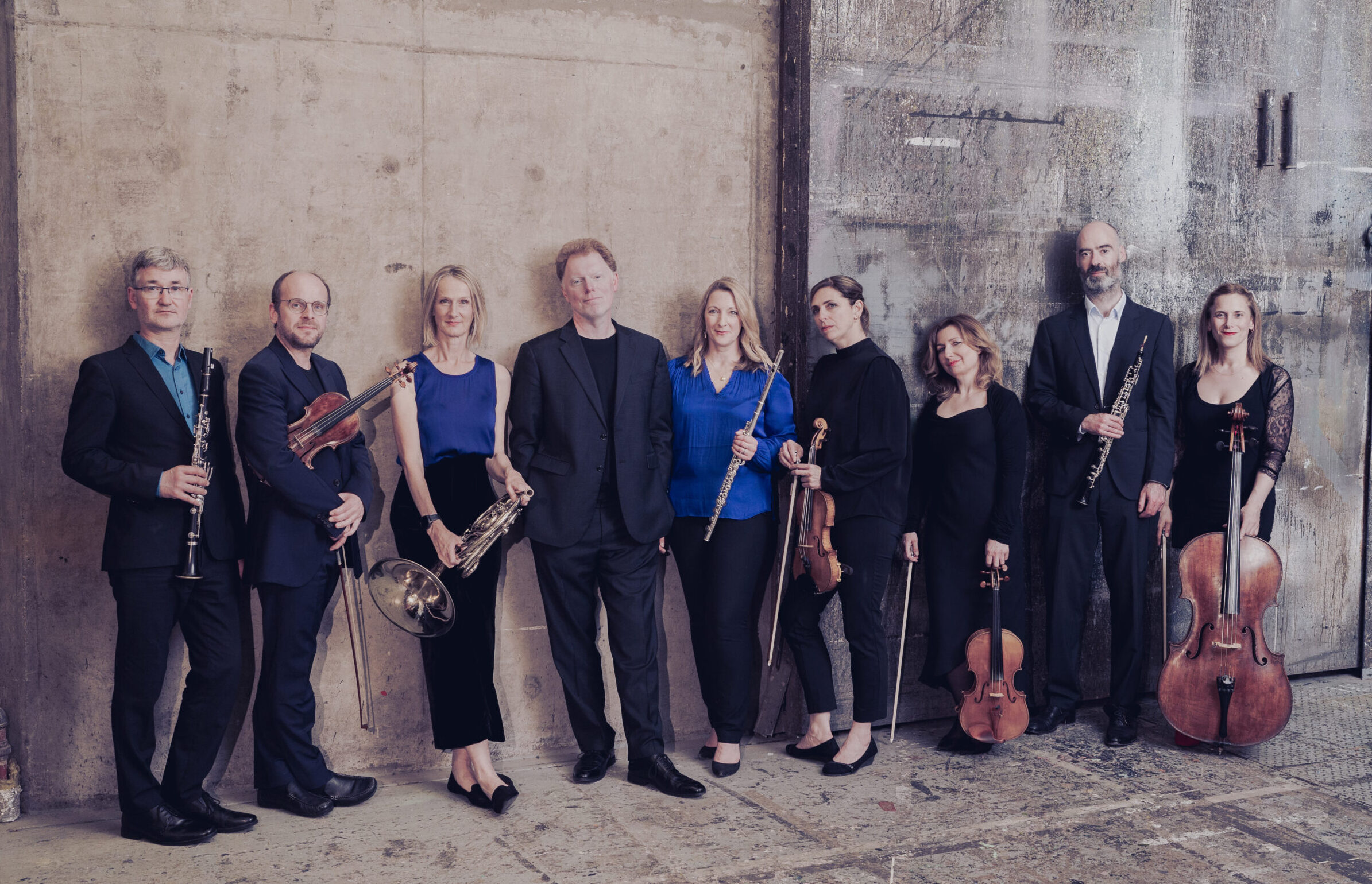
This playful one-off concert with the world-class musicians of Ensemble 360, celebrates musical games and mirrors, exploring the fascinating relationships between music, numbers and patterns.

‘Der Spiegel’, Mozart’s piece for two violinists features two musicians looking at the same sheet of music, one right-way-up, the other upside-down. De Machaut’s ‘Ma fin est mon commencement’, is a piece performed forwards then backwards. Pärt’s masterpiece for cello and piano, ‘Spiegel im Spiegel’ (Mirror in the mirror) and Debussy’s impressionistic evocation, ‘Reflets dans l’eau’ (Reflections in the water) explore reflective textures. The concert culminates with a wonder of musical structure, Bartók’s String Quartet No.4, composed as a musical arch, showcasing symmetry, structure and the enchanting interplay of mirrored sounds.

Symmetries in Sound

DE MACHAUT – Ma fin est mon commencement (arr. trio) 

Ma fin est mon commencement [My end is my beginning] by the late-Medieval French composer and poet Guillaume de Machaut is a cunningly constructed piece. Originally composed as a song for three voices, the music is written in the form of several palindromes. The lowest voice – in this arrangement, the bassoon – first plays its part forward. Then, at the middle of the piece, it reads it backwards, playing an exact mirror of the melodic line. The upper two voices – violin and viola, here – play their parts forward, swapping in the middle to then play each other’s melodies backwards. The result is music of perfect symmetry. 


PICFORTH – In Nomine (arr. chamber ensemble)  

This ‘In Nomine’ by the English composer Picforth (about which little is known) was written around 1580. Originally composed for a consort of five viols, each part plays notes of only one duration. The cello plays notes lasting eight beats, the bassoon: six, viola: four, and so on. The inspiration here was planetary movement, with each part representing the orbit of a celestial body. Although each instrument is on a different temporal plane – most clearly, the second violin’s triple time against the first violin’s duple – they interlock perfectly. For artists, astronomers, and philosophers in Renaissance Europe, the idea of the ‘harmony of the spheres’ was central. Nature, they felt, existed in perfect balance and harmony; man’s music was our nearest approximation to this heavenly structure. 


MOZART – Der Spiegel (2′) 

Attributed to Mozart, this playful piece for two violins is a musical curio. A violinist stands on one side of a table, reading the music right way up, while a second stands on the other, reading that same page upside down. Miraculously, the music is a perfectly formed duet, with the music working no matter which way up the page is read.  


CAGE – ‘Book One’ from Music of Changes (8′)  

The twentieth century composer John Cage – perhaps best known for his work 4’33’’ which consists of no music, only the sounds of the concert hall – was deeply influenced by Zen Buddhism. Starting in the 1950s, Cage began experimenting with ways of removing his ego from the act of composition. In particular, he made use of the ancient Chinese divination text, the I Ching, to create a system of ‘chance music’. In Music of Changes – a groundbreaking piece of indeterminate music from 1951 – Cage uses coin tosses and charts derived from the I Ching to remove his own intentions. Instead, chance procedures are used to decide all aspects of the musical composition from pitch and duration to dynamics and rhythms.  


PÄRT – Spiegel im Spiegel (10′)  

The Estonian composer Arvo Pärt is best known for his minimal, meditative compositions. Influenced by his own mystical experiences with chant music, he coined a term for this compositional style – tintinnabuli – which describes the simple, bell like textures. In Spiegel im Spiegel [mirror within mirror], you hear this clearly in the piano’s arpeggios. The structure of the piece follows a strict formula, with the title directly reflecting what is happening in the music: each ascending melodic line is followed by a descending mirror phrase. Initially, the melody consists of only two notes, with another note being added with each of the following phrases, creating a seemingly endless continuum. After each distancing, the melody returns to the central pitch of A, which, according to the composer, is like “returning home after being away”. The piano part accompanies the melody part at each step like a “guardian angel” (as Pärt says).  


DEBUSSY – Reflets dans l’eau (5′)  

Debussy’s Reflets dans l’eau [Reflections in the water] is the first piece from his collection of solo piano works, Images: Volume 1. In it, Debussy conjures a feeling of water – musical gestures emanating outward from the centre of the keyboard, the harmony free-floating, textures reflecting water as both glistening and murky depths. There is another mathematical wonder at work, here. The piece is organised using the golden ratio. The sequence of keys is marked out by the intervals 34, 21, 13 and 8, while the piece’s main climax sits at the ‘phi position’. 


MOZART – Sonata in Bb for Bassoon and Cello K.292 (15’) 

The origins of Mozart’s Sonata for Bassoon and Cello are shrouded in mystery: no autograph manuscript exists and the work was not published until 1805, fourteen years after Mozart’s death. Along with the Bassoon Concerto it is one of two surviving works that Mozart composed for the instrument. They were possibly composed in 1774 when the 18-year-old Mozart was staying in Munich and had made friends with an amateur bassoonist called Baron Thaddäus von Dürniz. While the bassoon line in the Sonata is the principal part, the cello line is essentially an accompanying bass line rather than an equal partner.  

The piece shows the young Mozart’s mastery of musical proportion and balance. The first two movements are in sonata form; contrasting ideas are introduced, developed, and then returned to. The ratios here are those of the golden ratio. Indeed, Mozart’s sister Nannerl noted he was always playing with numbers and even scribbled mathematical equations for probabilities in the margins of some compositions (for example, the Fantasia and Fugue in C Major, K394), some of which mathematicians suggest were Fibonaccci number calculations. 


BARTOK – String Quartet No. 4 (25’) 

The Hungarian composer Béla Bartók held a long fascination with mathematics and how it related to music. His String Quartet No.4, like the fifth string quartet and several other pieces by the composer, is composed in an arch (or mirror) form. The first movement is thematically related to the last, and the second to the fourth, while the third movement stands alone as a central pivot point. What is more, the outer four movements feature rhythmic sforzandos that cyclically tie them together in terms of climactic areas. The symmetry of the movements isn’t limited only to the themes; the lengths of the movements show symmetry as well. The first, third and fifth movements are approximately six minutes long, whereas the second and fourth are shorter, at about three minutes each. Bartók’s harmony is also mathematically derived. The quartet focusses on the chromatic scale, with the twelve notes divided into symmetrical units, with tonal centres being based on ‘axes of symmetry’. He also incorporates whole-tone, pentatonic, and octatonic scales as subsets of the chromatic scale, exploring their asymmetries.  

© Dr Benjamin Tassie 2026

BOHEMIAN DIALOGUES

Ensemble 360

Royal Spa Centre, Leamington Spa
Sunday 8 March 2026, 3.00pm

Tickets
£23
£11.50 Under 35s
£3 Child/Student

Past Event
Ensemble 360 musicians

SUK Piano Quartet Op.1
PHYLLIS TATE Sonata for Clarinet and Cello
MARTINŮ Three Madrigals for Violin and Viola H.313
DOHNÁNYI  Sextet in C Op. 37

Czech music is one of Leamington Music’s specialities and Suk’s youthful Piano Quartet Op.1 – dedicated to his teacher Antonín Dvořák – is brimming with character and confidence. Martinů’s Three Madrigals represent the determination of the composer’s creative spirit to continue despite major obstacles and are beautifully balanced by the Sonata for Clarinet and Cello by Phyllis Tate, who was known for her idiosyncratic musical imagination and her unique sensitivity to musical colour. We round off the afternoon with the Sextet by Dohnányi – a Romantic work, richly scored and bubbling with tunes.

Concert generously supported by Howard Skempton

SUK JOSEF, Piano Trio in C Minor, Op.2

  1. Allegro
  2. Andante
  3. Vivace 

Suk composed the earliest version of his Piano Trio in 1889 during his first year as a composition pupil at the Prague Conservatory, originally in four movements. A year later, he revised while in the class of Karel Stecker (to whom the trio is dedicated), and the first 

performance was given at an evening of music by student composers on 15 January 1891. Suk completed the revision process once he had joined Dvořák’s composition class (he later married Dvořák’s daughter), completing the definitive version in spring 1891. The opening of the Allegro is muscular and impassioned; its bold opening theme gives way to a more tender contrasting theme and these two characterful ideas form the basis of what follows. Even though Suk was still a student, his handling of form is impressively confident and closely-argued. He brings this admirably compact movement to an affirmative close in C major. The second movement is marked Andante and it resembles a gentle folk dance, reaching a dramatic climax before moving into a tranquil coda, still dominated by the dotted rhythms that have permeated the whole movement. The third movement, marked Vivace, is a vigorous finale, with some enchanting moments of repose. A change from C minor to C major sets up the coda which brings the work to an impressive conclusion. 

© Nigel Simeone 2026 


TATE PHYLLIS, Sonata for Clarinet and Cello

Tate wrote Sonata for Clarinet and Cello upon discovering that (at that time) only one work had been written for this duo of instruments. It was first performed in 1947 by Frederick Thurston and William Pleeth, to whom she dedicated the piece.  

The Sonata for Clarinet and Cello is one of Phyllis’s most performed works.  

Phyllis discovered that only one work had been written for these instruments, a duet of 1894 by a clarinettist named Johann Sobeck. She set to work on the Sonata, which was critically acclaimed as a ‘minor masterpiece’ and ‘a tour de force of the first order, revealing a wonderful sense of colour’ (Music and Letters 1950). 

The first movement is fairly slow and mostly cantabile. A feature is the persistent interruption of the flow by a curious sotto voce semitonal passage between the two instruments, as if played in brackets. The second and third movements are fairly straightforward from the audience’s point of view. The fourth movement is the most elaborate and takes the form of free variations on thematic material heard in the first movement, but now much transformed. 

Following the first performance at the Wigmore Hall, Martin Cooper wrote in The Spectator:  ‘At this concert the work of a young English composer, Phyllis Tate, quite overshadowed the small works by great names which composed the rest of the programme. The imaginative power, the real mercurial emotion and the wit and skill with which the two instruments are blended and contrasted makes this essay entirely successful.’ 

The Sonata was one of the works chosen to represent our country at the International Society of Contemporary Music Festival in Salzburg in 1952. Since then it has been performed many times, recently by The Varenne Ensemble (Elaine Cocks, clarinet and Robin Michael, cello) at a NASDA concert in 2014. 

MARTINŮ Bohuslav, Three Madrigals

Poco allegro
Poco andante
Allegro

It was hearing a performance of Mozart’s Duo in B flat played by Josef and Lillian Fuchs (brother and sister) that inspired Martinů to compose his Three Madrigals in February–March 1947, with the subtitle ‘Duo No. 1’ on the autograph manuscript. Martinů wrote to his friend Miloš Šafránek on 16 May 1947: ‘I have written Three Madrigals for violin and viola … for J. Fuchs and Lillian (his sister) who is a great and unique viola player. I heard them at a concert and was amazed by their artistic quality, so I wrote the Duo for them, and it seems to be good. They are both excited and will put it in their Carnegie recital.’ This was given on 22 December 1947 and in the next day’s New York Times, the venerated critic Virgil Thomson gave a warm welcome to the new work: ‘a delight for musical fantasy, for ingenious figuration [and] for Renaissance-style evocation.’ Josef and Lillian Fuchs performed the Madrigals on many more occasions and when their recording of the work was issued in 1950, it was coupled, appropriately, with the Mozart Duo in B flat.

© Nigel Simeone

DOHNÁNYI Ernst von, Sextet in C Op.37

Allegro appassionato
Intermezzo
Allegro con sentimento
Presto, quasi l’istesso tempo

Born in Hungary, Dohnányi’s early compositions had been praised by Brahms, and he always had a strong sense of being part of the Austro-German Romantic tradition. In this respect he was very different from his classmate at the Budapest Academy, Béla Bartók, but his music is always beautifully crafted and has very individual harmonic touches. The Sextet for piano, violin, viola, cello, clarinet and horn was completed on 3 April 1935 and it is the most unusually scored of his chamber works. It was first performed in Budapest on 17 June 1935, with the composer at the piano, and received warm reviews. One critic specifically praised the unusual choice of instruments, commenting that ‘the combination … is neither coincidental nor arbitrary.’

The musical structure is unified by Dohnányi’s use of a dramatic rising motif – often on the horn – that is first heard right at the start. The first movement is brooding and tense, but ends with hope (the rising motif returning in triumph). The Intermezzo includes a rather sinister march, while the third movement is a set of variations that includes one that is scherzo-like. This leads directly into the finale – an almost dizzyingly ebullient movement which suggests a kind of jazzed-up Brahms.

Nigel Simeone © 2011

FAMILY CONCERT: THE STORM WHALE

Ensemble 360

Royal Spa Centre, Leamington Spa
Sunday 8 March 2026, 11.30am

Tickets
£9 children
£15 adults
£42 family ticket (2 adults + 2 children)

Past Event

A brand-new storybook concert, based on the modern classic book series by Benji Davies.

The Storm Whale tells the story of a child, and a whale washed up on the beach,  and friendships that will change their lives forever and echo down the generations. These heart-warming tales of friendship, love and courage are brought to life through music specially written to accompany the book by our Children’s Composer-in-Residence, Paul Rissmann.  

Perfect for 3 to 7 year-olds and their families, this is an illustrated and narrated storybook concert from Music in the Round, the producers of previous popular family concerts Izzy GimzoGiddy Goat and Sir Scallywag. It is a wonderful introduction to a live concert experience, brimming with wonderful music, memorable songs, images from the book and plenty of chances to join in.

The Storm Whale tells a simple but powerful story about loneliness and the love between a parent and child… The world may be as big and lonely and incomprehensible as the ocean, but still it’s possible to find tremendous, heart-stopping tenderness.” The New York Times on the book

With many thanks to all our funders, including:

The Sarah Nulty Power of Music Foundation, The JG Graves Charitable Trust, Sheffield Town Trust and Wise Music Foundation

“The musicians did a wonderful job of introducing the young audience to enjoyment of the theatre, live music and engaging story-telling. Proof of their success [were] the lines of excited children coming up to meet the musicians who had gathered in the foyer with their instruments.”

The Yorkshire Post (on a previous Music in the Round storybook concert)

BEETHOVEN & BRAHMS

Ensemble 360

Palace Theatre, Mansfield
Wednesday 18 February 2026, 7.30pm

Tickets
£16*

*Box office charges may apply

Past Event
Ensemble 360 string musicians in performance

BRITTEN Three Divertimenti for String Quartet (10’)
BRAHMS Clarinet Quintet in B minor Op.115 (40′)
BEETHOVEN String Quartet Op.59 No.2 ‘Razumovsky’ (37’)

Join Music in the Round for friendly and welcoming classical concerts performed by the brilliant Ensemble 360, a group of world-class artists who perform music written specially for small combinations of strings, wind and piano.

You’ll be sitting just metres away from these amazing musicians, performing spine-tingling music with their heart and soul on the Palace Theatre’s stage where the audience surround the performers on all sides.

These exceptional musicians perform one of Beethoven’s dynamic and ground-breaking ‘Razumovsky’ string quartets – a restless and passionate piece, full of the power, turbulence and energy that makes Beethoven one of the best loved composers of all time.

Benjamin Britten’s playful and charming Three Divertimenti also feature, alongside Brahms’s celebrated clarinet quintet, a sublime, colourful and profound work for clarinet and strings.

BRITTEN Benjamin, Three Divertimenti for String Quartet

Britten planned these movements as part of a five-movement Quartetto serioso with a subtitle from Shakespeare’s Winter’s Tale: “Go play, boy, play!” An earlier version of the opening March was written for a suite inspired by the film Emil and the Detectives (the children’s novel by Erich Kästner was a great favourite of Britten’s), but this was never completed. Eventually he settled on a work in three movements, and the first performance was given by the Stratton Quartet at the Wigmore Hall on 25 February 1936. The audience response was chilly and a hurt Britten withdrew the Three Divertimenti, which were only published after his death. His brilliant gift for idiomatic quartet writing is already apparent in this early work – from the arresting rhythms and textures of the March to the beguiling central Waltz, and the driving energy of the closing Burlesque.


© Nigel Simeone

BRAHMS Johannes, Clarinet Quintet Op.115

Allegro
Adagio
Andantino. Presto non assai, ma con sentimento
Con moto

In 1890, while only in his late fifties, Brahms declared that he was retiring: the String Quintet Op. 111 was to be his farewell from composition. A few months later he heard Richard Mühlfeld, clarinettist of the Meiningen Orchestra, and wrote to Clara Schumann that ‘the clarinet cannot be better played’. It inspired him to carry on composing. In the summer of 1891 Brahms went to stay at Bad Ischl in the Salzkammergut where he wrote the Clarinet Trio and Clarinet Quintet. Mühlfeld gave the premieres of both works on 12 December 1891 in Berlin. On hearing a performance in London the following year, George Bernard Shaw wrote that ‘it surpassed my utmost expectations’, and when the conductor Arthur Nikisch heard the Quintet, he fell to his knees in front of Brahms.

It has a rare and hypnotic beauty, thanks to its pervasive mood of melancholy, occasionally interrupted by quiet rapture, or by fiery gypsy figurations. The opening is played by the strings alone (like Mozart’s Clarinet Quintet), from which the clarinet emerges as if through the mists. Ideas gradually become more fully formed, and Brahms uses the tension between the home key (B minor) and its relative major (D major) to great expressive effect. The slow movement is a song-like Adagio, interrupted by a clarinet outburst in which Brahms evokes the improvisations of gypsy players. The third movement is a gentle interlude, with a more animated central section, and the finale is a theme and variations in which music from the opening movement is recalled at the end, to magical effect.

© Nigel Simeone

BEETHOVEN Ludwig Van, String Quartet in E minor Op.59 No.2 Razumovsky

Allegro 
Molto Adagio. Si tratta questo pezzo con molto di sentimento  
Allegretto. Maggiore (Thème russe)  
Finale. Presto 

“Demanding but dignified” was how the Allgemeine Musik-Zeitung described Beethoven’s new quartets dedicated to Count Rasumovsky when they were first heard in 1807. Composed in 1806, and including Russian melodies from a collection of folk tunes edited by Ivan Prach (published in 1790), these quartets were a major development in the quartet form. But though they were longer and more challenging than any earlier quartets, they were an immediate success. Before the Rasumovsky Quartets were played, Beethoven offered them to publisher Breitkopf & Härtel in Leipzig – in a job lot with the Fourth Piano Concerto, the Fourth Symphony and Fidelio, but the deal fell through and the quartets were first published in Vienna by the Bureau des Arts et d’Industrie and in London by Clementi. 

While the first of the Rasumovsky Quartets is unusually expansive, the second is more concentrated. From the opening two-chord gesture establishing E minor as the home key, the first movement is tense and full of rhythmic ambiguity. The hymn-like slow movement has a combination of richness and apparent simplicity that blossoms into a kind of ecstatic aria: Beethoven himself is reported to have likened it to “a meditative contemplation of the stars”. The uneasy rhythms of the Scherzo are contrasted by a major-key Trio section in which Beethoven quotes a Russian tune that famously reappeared in the Coronation Scene of Mussorgsky’s opera Boris Godunov. The finale begins with a surprise: a strong emphasis on the note C that is tantalising and unexpected in a movement that moves firmly towards E minor.  

© Nigel Simeone 

“I was transported for 90 minutes. I felt joy. I felt emotional, excited and thankful for the opportunity.”

Audience member 

“The enthusiasm and technical skill of the musicians is awe-inspiring.”

Audience member

FAMILY CONCERT: THE STORM WHALE

Junction, Goole
Sunday 22 February 2026, 1.00pm
Past Event

A brand-new storybook concert, based on the modern classic book series by Benji Davies.

The Storm Whale tells the story of a child, and a whale washed up on the beach,  and friendships that will change their lives forever and echo down the generations. These heart-warming tales of friendship, love and courage are brought to life through music specially written to accompany the book by our Children’s Composer-in-Residence, Paul Rissmann.  

Perfect for 3 to 7 year-olds and their families, this illustrated and narrated storybook concert is brought to Cast with Music in the Round, the producers of previous popular family concerts Izzy GimzoGiddy Goat and Sir Scallywag. It is a wonderful introduction to a live concert experience, brimming with wonderful music, memorable songs, images from the book and plenty of chances to join in.

The Storm Whale tells a simple but powerful story about loneliness and the love between a parent and child… The world may be as big and lonely and incomprehensible as the ocean, but still it’s possible to find tremendous, heart-stopping tenderness.” The New York Times on the book

With many thanks to all our funders, including:

The Sarah Nulty Power of Music Foundation, The JG Graves Charitable Trust, Sheffield Town Trust and Wise Music Foundation

“The musicians did a wonderful job of introducing the young audience to enjoyment of the theatre, live music and engaging story-telling. Proof of their success [were] the lines of excited children coming up to meet the musicians who had gathered in the foyer with their instruments.”

The Yorkshire Post (on a previous Music in the Round storybook concert)

MOZART & BEETHOVEN STRING QUARTETS

Ensemble 360

Junction, Goole
Sunday 22 February 2026, 5.00pm
Past Event
String players of Ensemble 360

BRITTEN Three Divertimenti for String Quartet (10’) 
MOZART String Quartet No.20 in D ‘Hoffmeister’ (26’) 
BEETHOVEN String Quartet Op.59 No.2 ‘Razumovsky’ (37’)  

A passionate tour through three centuries of extraordinary music with the string quartet of Ensemble 360.

Britten’s playful and inventive Three Divertimenti is followed by Mozart’s radiant ‘Hoffmeister’ Quartet, blending grace and sophistication. The evening concludes with Beethoven’s fiery second ‘Razumovsky’ Quartet, a work of thrilling intensity and deep passion. 

Performed with warmth and exhilarating energy, this programme showcases the expressive power of the string quartet. 

BRITTEN Benjamin, Three Divertimenti for String Quartet

Britten planned these movements as part of a five-movement Quartetto serioso with a subtitle from Shakespeare’s Winter’s Tale: “Go play, boy, play!” An earlier version of the opening March was written for a suite inspired by the film Emil and the Detectives (the children’s novel by Erich Kästner was a great favourite of Britten’s), but this was never completed. Eventually he settled on a work in three movements, and the first performance was given by the Stratton Quartet at the Wigmore Hall on 25 February 1936. The audience response was chilly and a hurt Britten withdrew the Three Divertimenti, which were only published after his death. His brilliant gift for idiomatic quartet writing is already apparent in this early work – from the arresting rhythms and textures of the March to the beguiling central Waltz, and the driving energy of the closing Burlesque.


© Nigel Simeone

MOZART Amadeus, String Quartet in D K499

1. Allegretto
2. Menuetto and Trio. Allegretto
3. Adagio
4. Allegro


Like Haydn before him, Mozart habitually published his string quartets in groups of six (the ‘Haydn’ Quartets) or three (the ‘Prussian’ Quartets). Between these two sets there is a single work, entered in Mozart’s manuscript catalogue of his own works on 19 August 1786 as ‘a quartet for 2 violins, viola and violoncello’. The autograph manuscript (in the British Library) is simply titled ‘Quartetto’. It was published in 1788 by the Viennese firm founded by Mozart’s friend Franz Anton Hoffmeister and it has come to be known as the ‘Hoffmeister’ Quartet as a result. The first movement opens with a theme in octaves that outlines a descending D major arpeggio – an idea that dominates much of the movement despite some startling harmonic excursions along the way. The development section is marked by almost continuous quaver movement that gives way magically to the opening theme at the start of the recapitulation. The Minuet has an easy-going charm that contrasts with the sterner mood (and minor key) of the Trio section. The great Mozart biographer Alfred Einstein thought the Adagio spoke ‘of past sorrow, with a heretofore unheard-of-depth’. It is not only a deeply touching movement but also an extremely ingenious one, not least when the initial idea heard on two violins returns on viola and cello, investing the same music with a darker, richer texture. The finale is fast and playful, but there’s also astonishing inventiveness in the flow of ideas, from the opening triplets with their chromatic twists to a contrasting theme which scampers up and down the scale. A few sudden and surprising dynamic contrasts keep the listener guessing right to the end.


Nigel Simeone

BEETHOVEN Ludwig Van, String Quartet in E minor Op.59 No.2 Razumovsky

Allegro 
Molto Adagio. Si tratta questo pezzo con molto di sentimento  
Allegretto. Maggiore (Thème russe)  
Finale. Presto 

“Demanding but dignified” was how the Allgemeine Musik-Zeitung described Beethoven’s new quartets dedicated to Count Rasumovsky when they were first heard in 1807. Composed in 1806, and including Russian melodies from a collection of folk tunes edited by Ivan Prach (published in 1790), these quartets were a major development in the quartet form. But though they were longer and more challenging than any earlier quartets, they were an immediate success. Before the Rasumovsky Quartets were played, Beethoven offered them to publisher Breitkopf & Härtel in Leipzig – in a job lot with the Fourth Piano Concerto, the Fourth Symphony and Fidelio, but the deal fell through and the quartets were first published in Vienna by the Bureau des Arts et d’Industrie and in London by Clementi. 

While the first of the Rasumovsky Quartets is unusually expansive, the second is more concentrated. From the opening two-chord gesture establishing E minor as the home key, the first movement is tense and full of rhythmic ambiguity. The hymn-like slow movement has a combination of richness and apparent simplicity that blossoms into a kind of ecstatic aria: Beethoven himself is reported to have likened it to “a meditative contemplation of the stars”. The uneasy rhythms of the Scherzo are contrasted by a major-key Trio section in which Beethoven quotes a Russian tune that famously reappeared in the Coronation Scene of Mussorgsky’s opera Boris Godunov. The finale begins with a surprise: a strong emphasis on the note C that is tantalising and unexpected in a movement that moves firmly towards E minor.  

© Nigel Simeone 

FAMILY CONCERT: THE STORM WHALE

Wiltshire Music Centre, Bradford on Avon
Saturday 14 February 2026, 2.00pm

Tickets
£15
£10 U12s

Past Event

A brand-new storybook concert, based on the modern classic book series by Benji Davies.

The Storm Whale tells the story of a child, and a whale washed up on the beach,  and friendships that will change their lives forever and echo down the generations. These heart-warming tales of friendship, love and courage are brought to life through music specially written to accompany the book by our Children’s Composer-in-Residence, Paul Rissmann.  

Perfect for 3 to 7 year-olds and their families, this illustrated and narrated storybook concert is brought to Wiltshire Music Centre with Music in the Round, the producers of previous popular family concerts Izzy GimzoGiddy Goat and Sir Scallywag. It is a wonderful introduction to a live concert experience, brimming with wonderful music, memorable songs, images from the book and plenty of chances to join in.

The Storm Whale tells a simple but powerful story about loneliness and the love between a parent and child… The world may be as big and lonely and incomprehensible as the ocean, but still it’s possible to find tremendous, heart-stopping tenderness.” The New York Times on the book

With many thanks to all our funders, including:

The Sarah Nulty Power of Music Foundation, The JG Graves Charitable Trust, Sheffield Town Trust and Wise Music Foundation

“The musicians did a wonderful job of introducing the young audience to enjoyment of the theatre, live music and engaging story-telling. Proof of their success [were] the lines of excited children coming up to meet the musicians who had gathered in the foyer with their instruments.”

The Yorkshire Post (on a previous Music in the Round storybook concert)

CHRIS ADDISON’S INCOMPLETE GUIDE TO CHAMBER MUSIC

Chris Addison & Friends

Wiltshire Music Centre, Bradford on Avon
Saturday 14 February 2026, 7.30pm

Tickets:
£27 
£13.50 (U18s & students)

Past Event

“It’ll be a really fun show with some of the most insanely talented musicians playing some of the best music ever written… All you have to know is – do you like a good tune? Because we’re going to be playing a ton of those.” Chris Addison

Chris Addison (The Thick of It, Mock the Week) joins Music in the Round to bring his infectious enthusiasm for classical music to Wiltshire Music Centre.  

Telling the story of Europe from the courts of 17th century Italy, through the political and social revolutions of 18th and 19th century Europe, to the weird and wonderful sounds conjured by today’s contemporary composers, Chris takes us on a journey through the rich, vibrant – and sometimes bizarre – history of classical chamber music.  

Discover how a bassoonist beat up Bach, Mozart’s passion for the newly-invented clarinet (and for crude poetry), Beethoven’s embattled relationship with his failing hearing and the Emperor of France, and how Schoenberg tore up the musical rule book in a continent ravaged by war. Featuring live performances from some of the UK’s finest musicians and the inimitable curiosity and wit of Chris Addison’s storytelling, this will be an evening of insight, laughter and spine-tingling music. 

Programme includes excerpts from:
CORELLI Trio Sonata da Camera Op.2 No.1 in D
STROZZI (arr. Birchall) Che si può fare Op.8
JS BACH Prelude from Cello Suite No.1 in G
CPE BACH Flute concerto in D minor
HAYDN String Quartet Op.76 No. 3 ‘Emperor’
MOZART Trio for Piano, Clarinet and Viola K.498 ‘Kegelstatt’
BEETHOVEN Serenade for flute, violin and viola Op.25
CHOPIN Nocturne No.20 in C sharp minor
DEBUSSY Syrinx
S. COLERIDGE-TAYLOR Clarinet Quintet
SMYTH Piano Trio in D minor
SHOSTAKOVICH String Quartet No.8 in C minor Op.110
SCHOENBERG Suite for Piano Op.25
REICH New York Counterpoint
MEREDITH Tuggemo


“Perfect for someone like me who knows next to zero about classical music but [Chris] put people at ease, made us laugh and I loved the interaction with the musicians too who were bloody awesome!”

Audience comment

“I absolutely loved Chris Addison’s enthusiasm and knowledge. A history and music class rolled into one with beautiful performances from all the musicians… I left feeling elated and could have listened for hours!”

Audience comment

SCHOOLS’ CONCERT: THE STORM WHALE

Ensemble 360

The Guildhall, Portsmouth
Monday 19 January 2026, 1.30pm

Music in the Round invites your class to take part in a brilliant music project, culminating in a live concert at The Guildhall, Portsmouth.

Paul Rissmann (composer) has created a brand-new piece of music based around the modern-classic children’s books by Benji Davies, which includes songs for your class to learn and join in with in the concert.

The Storm Whale tells the story of a boy, a whale washed up on the beach and friendships that will change their lives forever and echo down the generations. Benji Davies’ heart-warming tales of friendship, love and courage are brought to life through music specially written to accompany the book. 

Our EY and KS1 practitioners will support you to embed singing and music-making in classroom learning throughout the project, with training, resources, and in-school support newly developed around The Storm Whale books. The project introduces young children to classical music in a fun and educational setting, including a concert featuring strings, woodwind and horn, presented together with story-telling and projected illustrations.

Performed by the wonderfully dynamic and hugely engaging musicians from Ensemble 360, this concert is a great introduction to live music for early years and KS1 children. It’s full of wit, invention, songs and actions, and plenty of opportunities to join in.

An educators’ classroom pack and other resources are available here.

The Storm Whale tells a simple but powerful story about loneliness and the love between a parent and child… The world may be as big and lonely and incomprehensible as the ocean, but still it’s possible to find tremendous, heart-stopping tenderness.” The New York Times on the book

With many thanks to all our funders, including:

The Sarah Nulty Power of Music Foundation, Gripple Foundation, JG Graves Charitable Trust, Sheffield Town Trust and Wise Music Foundation

“The musicians did a wonderful job of introducing the young audience to enjoyment of the theatre, live music and engaging story-telling. Proof of their success [were] the lines of excited children coming up to meet the musicians who had gathered in the foyer with their instruments.”

The Yorkshire Post (on a previous Music in the Round storybook concert)

GOLDBERG VARIATIONS

Ensemble 360

Emmanuel Church, Barnsley
Friday 24 April 2026, 7.30pm

Tickets:
£16
£11.50 DLA / UC / PIP
£5 Under 35s & Students

Past Event
Ensemble 360 string trio musicians

BACH Cello Suite No. 1 in G (19′)
MOZART String Duo No. 1 for Violin and Viola in G (16′)
BACH Goldberg Variations for String Trio (60′)

Bach’s hugely popular ‘Goldberg Variations’ are performed in a breath-taking conversational arrangement for violin, viola and cello, presented together with one of the best-loved works for solo cello, Bach’s Cello Suite No.1.

BACH Johann Sebastian, Cello Suite No.1 in G

Prélude
Allemande
Courante
Sarabande
Menuett I
Menuett II
Gigue

Bach’s Cello Suites were probably composed in about 1720 during Bach’s time in Cöthen. It isn’t known for whom Bach wrote them, though there are at least two likely candidates working in Cöthen at the time: Christian Ferdinand Abel (1682–1761), a great friend of the composer for whom Bach wrote the three sonatas for viola da gamba and harpsichord (BWV 1027–9) and Carl Berhard Lienicke (d. 1751), the leading cellist of the Cöthen orchestra. Whether either of them was the player Bach had in mind is a matter of pure speculation since no documentary evidence has come to light. Equally uncertain is why Bach wrote them. The likeliest explanation is that they were intended – like much of his keyboard music – for private performance. Bach sets the tone of the First Suite with a Prelude made of undulating arpeggios. The Allemande meanders purposefully until it arrives at a strong final cadence in the home key. Downward leaps and rather playful decorations characterize the Courante. Using multiple stopping, the Sarabande is noble and understated. It is in two sections; the first ends on D (the dominant) and the second moves to E minor before returning to the tonic, G. The pair of graceful Minuets contrast major and minor and both are marked by flowing movement. The Gigue brings the suite to a joyful conclusion.


Nigel Simeone 2018 © 

MOZART Wolfgang Amadeus, String Duo No.1 for Violin and Viola in G

Allegro
Adagio
Rondeau. Allegro 

String Duo No.1 for G major and its companion String Duo No.2 in B-flat major were not originally credited as being Mozart’s works. In 1783, Mozart’s friend Michael Haydn – a fellow composer and younger brother of Joseph Haydn – had been tasked with writing six duos for the Prince-Archbishop Colloredo, who employed both Michael Haydn and Mozart. Haydn fell ill before he could complete all six of them, and as a favour to his friend, Mozart completed the set with String Duos No.1 and No.2. Colloredo was none the wiser that two of the pieces hadn’t been written by Haydn, and it wasn’t until a subsequent newspaper advertisement went out that anyone realised Mozart was responsible for them. 

String Duo No.1 differs significantly from its counterpart due to the fact the viola has a much more complex and conversational role, as opposed to being just an accompaniment for the violin. The first movement of the duo is an Allegro, containing an expressive conversation between the two instruments. Each theme is passed back and forth, extending the development section until it almost runs away with itself before impressively reigning itself in for a comparatively subdued ending. The Adagio in contrast is extremely peaceful, with the melody and the harmonic support tenderly balancing each other out. The final Rondeau returns with the vigour of the opening movement, rounding off the lyrical conversation with vitality and Mozart’s trademark wit. 

BACH Johann Sebastian, Goldberg Variations (arranged for String Trio by Dmitri Sitkovetsky)

Bach originally wrote the Goldberg Variations for harpsichord, and this was one of the very few works published during the composer’s lifetime, by the firm of Baltasar Schmid at Nuremberg in 1741. The original title page describes the work as ‘Clavier-Übung [Keyboard Practice], consisting of an Aria, with diverse variations for harpsichord with two manuals, prepared to delight the souls of music-lovers by Johann Sebastian Bach.’ There was no irony here: Bach, as a devout Lutheran, was deeply conscious of the spiritual dimension of music, and its aspiration to enrich the soul as well as to divert and entertain. But the work was also an extraordinary feat: if we count each prelude and fugue of the Well-Tempered Clavier as self-contained pairs of works, then the Goldberg Variations is by far the largest piece of keyboard music published in the eighteenth century and it attracted international attention early on. Bach is often thought of as a composer whose music was rediscovered only in the nineteenth century (thanks in large part to Mendelssohn and Schumann), but his keyboard music was the exception to this. In his pioneering General History of the Science and Practice of Music published in 1776, Sir John Hawkins devotes several pages to Bach, thanking Johann Christian Bach (then in London) for supplying some of the information. But he then goes on to quote three full pages of music examples comprising the Aria (‘Air’), Variation 9 and Variation 10 from the Goldberg Variations, making this one of the first pieces of Bach to appear in print in England.

But where is Goldberg in all this, and who was he? In 1741, Bach stayed with Count Keyserlingk in Dresden, who employed a young musician called Johann Gottlieb Goldberg. According to Johann Nikolaus Forkel in his 1802 biography of Bach, the story goes as follows: ‘The Count was often unwell and had sleepless nights. On these occasions, Goldberg had to spend the night in an adjoining room so that he could play something to him during this sleeplessness. The Count remarked to Bach that he would like to have a few pieces for his musician Goldberg, pieces so gentle and somewhat merry that the Count could be cheered up by them during his sleepless nights. Bach thought he could best fulfil this wish with some variations … The Count henceforth referred to them only as his variations. He could not get enough of them, and for a long time, whenever sleepless nights came, he would say, Dear Goldberg, do play me one of my variations. Bach was perhaps never rewarded so well for one of his compositions. The Count bestowed on him a gold beaker filled with one hundred Louis d’or.’

It’s a fine tale – and the source for the famous legend of these variations as a cure for insomnia – but it’s mostly fictitious. As Peter Williams has demonstrated, Goldberg was only born in 1727 (and was thus in his early teens at the time of Bach’s visit to Keyserlingk), so it’s wildly improbable that Bach wrote the variations for him to play. Moreover, they had actually been published before Bach’s visit to Dresden, so the chances are that he presented the Count with a

copy having been asked about the possibility of composing some suitable music. This also explains the absence of either the Count’s name or Goldberg’s on the title page of the first edition of the score – and the presence of the Aria in Anna Magdalena’s Notebook, most of which was compiled years earlier. Williams has also speculated that the player Bach most probably had in mind for the variations was his son Wilhelm Friedmann, a brilliant performer and who had worked as organist of the Sophienkirche in Dresden since 1733.

The variations constitute a virtual encyclopaedia of what was possible in terms of imaginative harpsichord writing, and is even more remarkable for Bach’s brilliant manipulation of the theme. As a master of transcribing his own music for different instrumental combinations, the arrangement of the Goldberg Variations for string trio is an idea that would surely have appealed to Bach. Just as Mozart arranged some of the keyboard fugues for string quartet, and others have arranged The Art of Fugue for the same forces, so Sitkovetsky has taken up the challenge of re-thinking Bach’s music for entirely different instruments – as Bach himself had done not only with his own music but also with other composers such as Vivaldi. This arrangement was made in 1985 to celebrate the 300th anniversary of Bach’s birth, and it is dedicated to the memory of Glenn Gould, whose astonishing 1955 recording of the Goldberg Variations became an instant bestseller and introduced a whole generation to this extraordinary music.

Nigel Simeone © 2010

MOZART & BEETHOVEN STRING QUARTETS

Ensemble 360

Emmanuel Church, Barnsley
Friday 20 February 2026, 7.30pm

Tickets:
£16
£11.50 DLA / UC / PIP
£5 Under 35s & Students

Past Event
String players of Ensemble 360

BRITTEN Three Divertimenti for String Quartet (10’) 
MOZART String Quartet No.20 in D ‘Hoffmeister’ (26’) 
BEETHOVEN String Quartet Op.59 No.2 ‘Razumovsky’ (37’)  

A passionate tour through three centuries of extraordinary music with the string quartet of Ensemble 360.

Britten’s playful and inventive Three Divertimenti is followed by Mozart’s radiant ‘Hoffmeister’ Quartet, blending grace and sophistication. The evening concludes with Beethoven’s fiery second ‘Razumovsky’ Quartet, a work of thrilling intensity and deep passion. 

Performed with warmth and exhilarating energy, this programme showcases the expressive power of the string quartet. 

BRITTEN Benjamin, Three Divertimenti for String Quartet

Britten planned these movements as part of a five-movement Quartetto serioso with a subtitle from Shakespeare’s Winter’s Tale: “Go play, boy, play!” An earlier version of the opening March was written for a suite inspired by the film Emil and the Detectives (the children’s novel by Erich Kästner was a great favourite of Britten’s), but this was never completed. Eventually he settled on a work in three movements, and the first performance was given by the Stratton Quartet at the Wigmore Hall on 25 February 1936. The audience response was chilly and a hurt Britten withdrew the Three Divertimenti, which were only published after his death. His brilliant gift for idiomatic quartet writing is already apparent in this early work – from the arresting rhythms and textures of the March to the beguiling central Waltz, and the driving energy of the closing Burlesque.


© Nigel Simeone

MOZART Amadeus, String Quartet in D K499

1. Allegretto
2. Menuetto and Trio. Allegretto
3. Adagio
4. Allegro


Like Haydn before him, Mozart habitually published his string quartets in groups of six (the ‘Haydn’ Quartets) or three (the ‘Prussian’ Quartets). Between these two sets there is a single work, entered in Mozart’s manuscript catalogue of his own works on 19 August 1786 as ‘a quartet for 2 violins, viola and violoncello’. The autograph manuscript (in the British Library) is simply titled ‘Quartetto’. It was published in 1788 by the Viennese firm founded by Mozart’s friend Franz Anton Hoffmeister and it has come to be known as the ‘Hoffmeister’ Quartet as a result. The first movement opens with a theme in octaves that outlines a descending D major arpeggio – an idea that dominates much of the movement despite some startling harmonic excursions along the way. The development section is marked by almost continuous quaver movement that gives way magically to the opening theme at the start of the recapitulation. The Minuet has an easy-going charm that contrasts with the sterner mood (and minor key) of the Trio section. The great Mozart biographer Alfred Einstein thought the Adagio spoke ‘of past sorrow, with a heretofore unheard-of-depth’. It is not only a deeply touching movement but also an extremely ingenious one, not least when the initial idea heard on two violins returns on viola and cello, investing the same music with a darker, richer texture. The finale is fast and playful, but there’s also astonishing inventiveness in the flow of ideas, from the opening triplets with their chromatic twists to a contrasting theme which scampers up and down the scale. A few sudden and surprising dynamic contrasts keep the listener guessing right to the end.


Nigel Simeone

BEETHOVEN Ludwig Van, String Quartet in E minor Op.59 No.2 Razumovsky

Allegro 
Molto Adagio. Si tratta questo pezzo con molto di sentimento  
Allegretto. Maggiore (Thème russe)  
Finale. Presto 

“Demanding but dignified” was how the Allgemeine Musik-Zeitung described Beethoven’s new quartets dedicated to Count Rasumovsky when they were first heard in 1807. Composed in 1806, and including Russian melodies from a collection of folk tunes edited by Ivan Prach (published in 1790), these quartets were a major development in the quartet form. But though they were longer and more challenging than any earlier quartets, they were an immediate success. Before the Rasumovsky Quartets were played, Beethoven offered them to publisher Breitkopf & Härtel in Leipzig – in a job lot with the Fourth Piano Concerto, the Fourth Symphony and Fidelio, but the deal fell through and the quartets were first published in Vienna by the Bureau des Arts et d’Industrie and in London by Clementi. 

While the first of the Rasumovsky Quartets is unusually expansive, the second is more concentrated. From the opening two-chord gesture establishing E minor as the home key, the first movement is tense and full of rhythmic ambiguity. The hymn-like slow movement has a combination of richness and apparent simplicity that blossoms into a kind of ecstatic aria: Beethoven himself is reported to have likened it to “a meditative contemplation of the stars”. The uneasy rhythms of the Scherzo are contrasted by a major-key Trio section in which Beethoven quotes a Russian tune that famously reappeared in the Coronation Scene of Mussorgsky’s opera Boris Godunov. The finale begins with a surprise: a strong emphasis on the note C that is tantalising and unexpected in a movement that moves firmly towards E minor.  

© Nigel Simeone 

SCHOOLS’ CONCERT: THE STORM WHALE

Ensemble 360

White Rock Studio, Hastings
Monday 27 April 2026, 1.30pm

Music in the Round invites your class to take part in a brilliant music project, culminating in a live concert at White Rock Theatre, Hastings. 

Paul Rissmann (composer) has created a brand-new piece of music based around the modern-classic children’s books by Benji Davies, which includes songs for your class to learn and join in with in the concert.

The Storm Whale tells the story of a boy, a whale washed up on the beach and friendships that will change their lives forever and echo down the generations. Benji Davies’ heart-warming tales of friendship, love and courage are brought to life through music specially written to accompany the book. 

Our EY and KS1 practitioners will support you to embed singing and music-making in classroom learning throughout the project, with training, resources, and in-school support newly developed around The Storm Whale books. The project introduces young children to classical music in a fun and educational setting, including a concert featuring strings, woodwind and horn, presented together with story-telling and projected illustrations.

Performed by the wonderfully dynamic and hugely engaging musicians from Ensemble 360, this concert is a great introduction to live music for early years and KS1 children. It’s full of wit, invention, songs and actions, and plenty of opportunities to join in.

An educators’ classroom pack and other resources are available here.

The Storm Whale tells a simple but powerful story about loneliness and the love between a parent and child… The world may be as big and lonely and incomprehensible as the ocean, but still it’s possible to find tremendous, heart-stopping tenderness.” The New York Times on the book

With many thanks to all our funders, including:

The Sarah Nulty Power of Music Foundation, Gripple Foundation, JG Graves Charitable Trust, Sheffield Town Trust and Wise Music Foundation

“The musicians did a wonderful job of introducing the young audience to enjoyment of the theatre, live music and engaging story-telling. Proof of their success [were] the lines of excited children coming up to meet the musicians who had gathered in the foyer with their instruments.”

The Yorkshire Post (on a previous Music in the Round storybook concert)