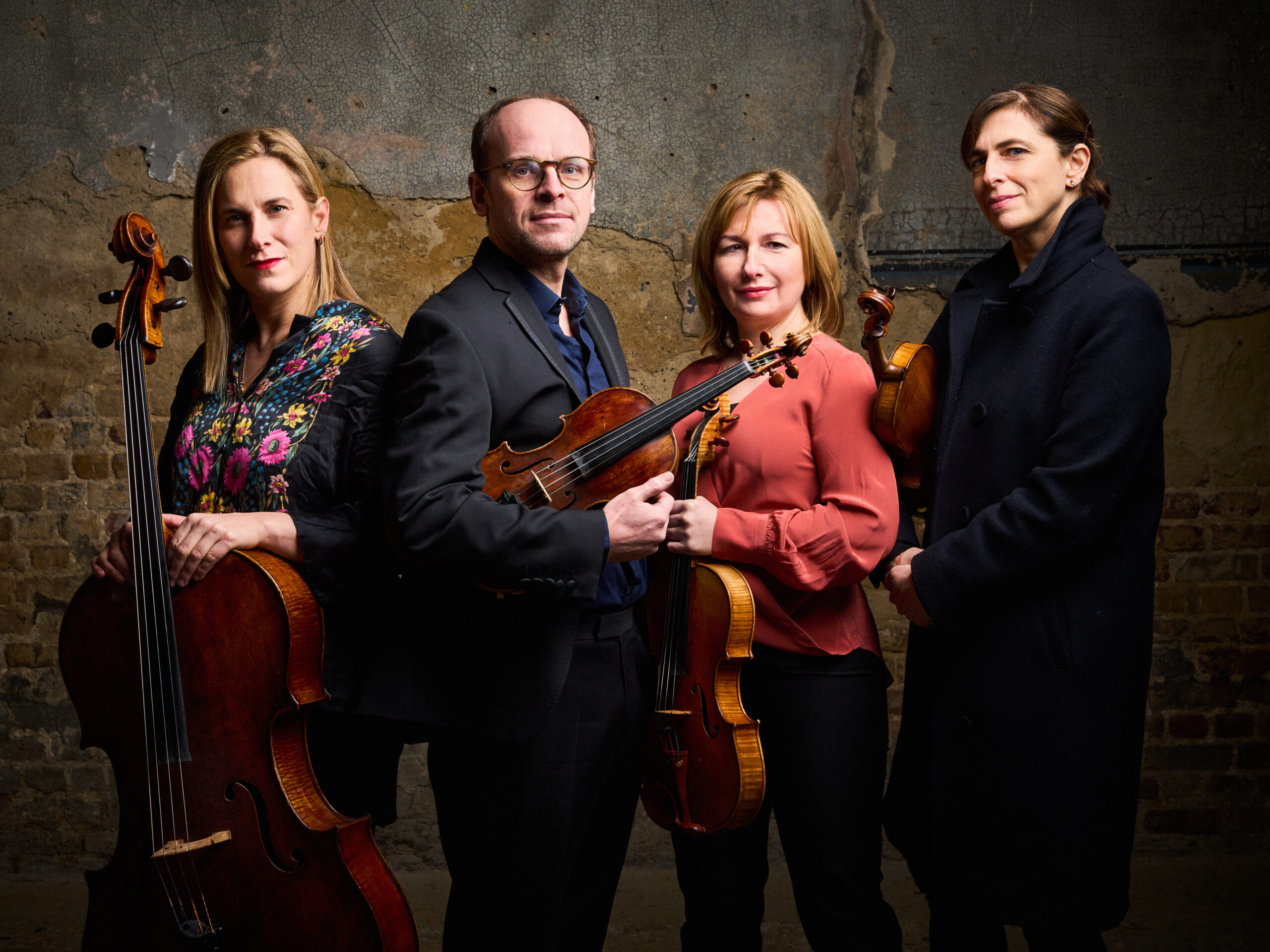
BRITTEN Three Divertimenti for String Quartet (12’) DVOŘÁK Quartet No.11 in C Op.61 (39’) DVOŘÁK String Quintet No.2 in G, Op.77 (35’)
Dvořák’s exceptional and unusually scored String Quintet No.2 is operatic in scope and richly textured, earning the dedication ‘For my country’ from the Czech composer, who yearned to create a distinctly bohemian musical language in a time of turmoil across eastern Europe. His celebrated Quartet No.11 features the thrilling, turbulent writing that has placed him at the heart of the chamber music repertoire.
Save £s when you book for 5 Music in the Round concerts or more at the same time. Find out more here.
View the brochure for our Sheffield 2024 concerts online here or download it below.
BRITTEN Benjamin, Three Divertimenti for String Quartet
Britten planned these movements as part of a five-movement Quartetto serioso with a subtitle from Shakespeare’s Winter’s Tale: “Go play, boy, play!” An earlier version of the opening March was written for a suite inspired by the film Emil and the Detectives (the children’s novel by Erich Kästner was a great favourite of Britten’s), but this was never completed. Eventually he settled on a work in three movements, and the first performance was given by the Stratton Quartet at the Wigmore Hall on 25 February 1936. The audience response was chilly and a hurt Britten withdrew the Three Divertimenti, which were only published after his death. His brilliant gift for idiomatic quartet writing is already apparent in this early work – from the arresting rhythms and textures of the March to the beguiling central Waltz, and the driving energy of the closing Burlesque.
In 1881, the Viennese violinist Joseph Hellmesberger asked Dvořák to write a new work for his quartet. In October, while working on the opera Dimitrij, Dvořák was alarmed to read an announcement in the Viennese press that the first performance of this quartet would be given on 15 December. He wrote to a friend on 5 November: ‘It still doesn’t exist! … I now have three movements prepared and am working on the finale.’ In fact, Dvořák had no reason to panic: he worked quickly and the C major quartet was written between 25 October and 10 November 1881.
It has fewer overtly Slavonic elements than its immediate predecessor (the E flat Quartet, Op.51), and, perhaps in a nod to Hellmesberger’s commission, the main influences are from Viennese masters: Beethoven and, especially, Schubert. The spacious first movement transforms its two main themes with great ingenuity and harmonic imagination. The Adagio opens with a fervent theme presented as an intimate dialogue between the two violins; its second idea has what Dvořák’s biographer Otakar Šourek described as a ‘veiled expression of melancholy’. The influence of Beethoven is most apparent in the rather terse Scherzo while the falling theme of the central Trio provides a delightful contrast. The finale (a sonata-rondo) brings the work to a joyous conclusion, with Dvořák at his most inimitably Czech.
After all the rush, Hellmesberger’s advertised December premiere in Vienna had to be cancelled due to a catastrophic fire at the Ringtheater, and the earliest known performance was given by Joseph Joachim’s quartet on 2 November 1882 in Berlin.
Scored for the unusual combination of string quartet and double bass, Dvořák’s String Quintet in G major was first performed on 18 March 1876 as the composer’s Op.18 – a number that was changed when the work was first published by Simrock twelve years later in 1888. Originally the work had five movements (with an ‘Intermezzo’ before the Scherzo, reworked as the Nocturne in B major for string orchestra), and despite the published opus number, it is one of the composer’s first chamber works to be fully characteristic of his mature style. The first movement opens with a motif played first by the viola (Dvořák’s own instrument) that dominates much of the musical argument – the triplet figure in it is to be heard in the second theme too. The Scherzo finds Dvořák writing in the style of a folk dance, the opening theme consists of a lively opening motif that contrasts with a gentler idea over which Dvořák later introduces a warmly expressive new tune. The third movement has been described by the great Dvořák scholar Otakar Šourek as ‘one of the most entrancing slow movements in the whole of Dvořák’s chamber music … a flowing stream of passionate warmth [and] depth of feeling’. The finale has the same kind of sunny mood as the first movement, but with an even greater sense of joyful energy. Though there are moments of repose (during which the thematic material is treated to some ingenious transformations), the work ends with what Dvořák’s biographer Otakar Šourek aptly described as ‘high-spirited verve’.
RACHMANINOV Trio élégiaque No.1 in G minor (14’) PROKOFIEV Sonata for Cello (23’) TCHAIKOVSKY String Quartet No.2 in F Op.22(36’) A blistering celebration of Russian music. Best known for his sweeping symphonic music and monumental works for piano, this concert opens with a heart-wrenching trio by Rachmaninov. It concludes with Tchaikovsky’s profoundly moving Second Quartet.
Please note the change from the previously advertised programme.
Save £s when you book for 5 Music in the Round concerts or more at the same time. Find out more here.
View the brochure for our Sheffield 2024 concerts online here or download it below.
RACHMANINOV Sergei, Trio élégiaque No.1 in G minor
Lento lugubre
Risoluto
Tempo primo
Più vivo
Alla marcia funebre
Rachmaninov wrote two piano trios, both called “elegiac”. The second (D minor) trio was composed at the end of 1893 as a memorial to Tchaikovsky, but the present G minor Trio dates from January 1892, and was first performed on 30 January 1892 with Rachmaninov at the piano and his friend Anatoly Brandukov as the cellist – later to be the dedicatee of Rachmaninov’s Cello Sonata and best man at Rachmaninov’s wedding. The G minor Trio was written while Rachmaninov was still a student, and is a single-movement lamentation. The main theme (reminiscent of a melody in Tchaikovsky’s Manfred Symphony) is first presented by the piano over shimmering bare fifths. This idea dominates the movement, appearing in a variety of guises, and the contrasting falling melody that is no more consoling. The final presentation of the main idea is the most stark – a transformation into a funeral march.
In 1947 Prokofiev heard a young Mstislav Rostropovich, aged twenty at the time, performing his First Cello Concerto. Prokofiev decided to compose a piece especially for him and the result was the Cello Sonata, written in 1949, to be performed by Rostropovich and pianist Sviatoslav Richter. After a tedious process of playing the work to the Soviet Composer’s Union to ensure that the new sonata was not ‘hostile to the spirit of the people’, they were finally allowed to give the premiere at the Moscow Conservatory on 1 March 1950. It was well received, with Prokofiev’s friend and colleague Nikolai Miaskovsky described the sonata as ‘a miraculous piece of music.’
The first movement opens with a brooding theme in the cello’s lowest register, gradually emerging from the depths before arriving at a slightly quicker section and a dramatic climax, then a return to the opening material and a coda which eventually subsides on to quiet C major chords. The second movement begins with a theme on the piano and its short rhythmic cells soon generate further ideas in a dialogue between cello and piano. A central section introduces a contrasting idea in triple time before the initial ideas return. The finale shifts effortlessly through a bewildering range of keys while maintaining an almost constant sense of momentum. A brief respite comes before the exciting close, which Prokofiev published in two versions (one less technically demanding than the other), bringing the work to a powerful conclusion in C major.
Adagio – Moderato assai Scherzo. Allegro giusto Andante ma non tanto Finale. Allegro con moto
Tchaikovsky wrote his Second String Quartet in January 1874 and it remains a neglected work – a fate it shares with the Third Quartet of 1876 – certainly when compared with the better-known First Quartet. In his biography Tchaikovsky: the man and his music, David Brown has suggested that the F major shows Tchaikovsky trying to grapple with the economy and rigour of Beethoven’s quartets, particularly in the first movement where the thematic material is “more concise” than might be expected with Tchaikovsky, “thus facilitating far greater flexibility in what is built from it.” This is a very fair assessment of a movement that has clear debts to Beethoven in terms of structure and compositional process. The Scherzo is delightfully quirky, based on a lopsided bar of 2, 2 and 3 beats until the more stable, waltz-like Trio section. The emotional core of the work is anguished slow movement (David Brown describes this as music of pain-filled intensity). The Rondo finale that follows is effervescent and untroubled.
L OSBORN Me and 4 Ponys for Piano Quintet (15’) P WILSON Piano Quintet (16’) R VITKAUSKAITĖ Nanga (14’) B LUNN String Trio [world premiere] (15’)(RPS Composer 2023 Commission for Music in the Round)
A celebration of Ensemble 360 and Music in the Round’s collaboration with composers commissioned through the Royal Philharmonic Society. Alongside a world premiere of a new string trio by Ben Lunn, whose evocative music has already marked him out as a distinctive new voice, the Ensemble revisits some of their favourite works from recent commissions. Laurence Osborn’s playful piece inspired by children’s drawings went down a storm when Ensemble 360 first played it in 2018, as did Rūta Vitkauskaitė’s eruption of musical energy inspired by the Scottish landscape, while Peter Wilson’s wonderfully rhapsodic quintet was described as ‘Elgar in a hall of mirrors’.
Save £s when you book for 5 Music in the Round concerts or more at the same time. Find out more here.
View the brochure for our Sheffield 2024 concerts online here or download it below.
Thanks to the Hinrichsen Foundation for supporting Sounds of Now.
OSBORN, Laurence Me and 4 Ponys
Me and 4 Ponys is about drawings by children. I love drawings by children because they are completely unconcerned with consequence or correction. The first mark on paper is always part of the final piece. Each line is fearlessly drawn. Form, scale, and subject change constantly throughout the creative process, at the whim and intuition of the artist. The results are always endearing and grotesque in equal measure. Me and 4 Ponys wasn’t made in this way – I rewrote and scrapped a lot of music while writing it. But it musicalises aspects of children’s drawings – hard, wax-crayon-like textures, and big, unannounced gestures like handprints or blobs of paint. There’s a jig-like pulse that persists throughout the piece, which is why the title refers to ponies.
I started writing NANGA in Autumn during long walks through rainy fields, and continued into the tired Winter nights, through Spring, with bursting energy of slowly returning postlockdown traffic, and completing it finally in the generously sunny Summer. It has been a strange year, with long periods of isolation, very little social life, prolonged moments of stillness and refection, while I was living a very active inner life of ideas, thoughts, memories, creative flow and frustrations. All of that sank into the musical landscape of this composition: a record of a crisp delicacy of the first frost, sentimental afternoon memories provoked by scattered sunbeam, the burst of thoughts in the deep, dark Scottish winter nights. Overall, NANGA is a very active piece. I imagined it as a wave of energy, an unrelenting force embodying the constant change from ever passing time. The wave returns in its cycle three times, finally being taken over by violoncello Cadenza (co-written with Gemma Rosefield), and settling onto the long rumbling Coda in the lowest register of the instrument. I have chosen the title, NANGA, for its sound rather than meaning. The sound of this word can be found in a variety of cultures, it will mean the highest compliment in one language, and an insult in another, a musical instrument on one part of the planet, and a mountain on another. For me, nanga sounds like a soft but strong jump forwards, an assertive start with strong and direct aim, a peaceful pool of water dropping into a powerful waterfall on its end. It is very versatile; it can unlock many contradictory meanings within the piece, all of them united, however, by the flow of one musical stream aiming towards the grounded finale.
When composing this work, my thoughts had splintered down many roads – considering the history of the trio, contemplating the dynamics of counterpoint and conversation in three parts, thinking about intellectual music, questioning how music reaches people, and what do we gain from music. Because of this, the work is full of contradictions, well maybe they aren’t. Its a work, where I want to engage with the history of the trio but also to change it and challenge it. I want to connect to people, but also compose something challenging. Overall, I feel that historically composers have used the string quartet as a way to demonstrate their talents in a microcosm. I wanted to see if I can use the string trio in that manner – especially as it is my second such trio.
BEETHOVEN Cello Sonata Op.102 No.1 (15’) BEETHOVEN 12 Variations on ‘See the conqu’ring hero comes’ from Handel’s Judas Maccabaeus (13’) BEETHOVEN Cello Sonata Op.102 No.2 (20’)
No interval
Gemma Rosefield and Tim Horton presented Beethoven’s first two cello sonatas in sell-out concerts that launched Sheffield’s Classical Weekend 2023. They return to present the final pair of sonatas , interspersed with Beethoven’s charming and inventive variations on a theme from Handel’s oratorio ‘Judas Maccabaeus’. These two phenomenal musicians, with a deep understanding and enjoyment of the great composer, are sure to bring to life these absolute glories of virtuosic music for cello and piano.
Save £s when you book for 5 Music in the Round concerts or more at the same time. Find out more here.
View the brochure for our Sheffield 2024 concerts online here or download it below.
Beethoven’s two cello sonatas Op.102 (in C major and D major) were composed in 1815 and dedicated to Beethoven’s friend, Countess Anna Maria Erdödy. They were published in Vienna (by Artaria) and Bonn (by Simrock) in 1817. The first of the two sonatas is one of Beethoven’s most unusual structures, consisting of two fast movements, each of them preceded by an extended slow introduction.
The first movement opens gently, with a lyrical melody in the upper register of the cello, to which the piano responds with an answering phrase, establishing the instrumental dialogue that is so often a feature of this sonata. After subsiding on to a C, the lowest note of the cello, there is an abrupt change of mood and tempo with the arrival of a stern idea in A minor, marked by dotted rhythms. The movement remains in A minor for most of the movement, ending tersely. The second movement begins with an elaborate slow introduction which gives way to a radiant recollection of the first movement – an unusual procedure that Beethoven was to use again in the finale of his Ninth Symphony. The main theme of the Allegro begins strangely, with a four-note rising fragment and a held note, but this idea quickly develops dramatic momentum, interrupted on several occasions by passages where the cello plays sustained notes and the piano is silent. The movement ends by appearing to fizzle out (using the four-note idea), before a triumphant closing flourish.
BEETHOVEN Ludwig Van, 12 Variations on ‘See the conqu’ring hero comes’ from Handel’s Judas Maccabaeus
In 1796, the young Beethoven set out on a concert tour (the only one of his career) that took him to Prague, Dresden, Leipzig and Berlin. While in Berlin, he visited the court of the Friedrich Wilhelm II, the King of Prussia. During this visit, Beethoven composed several works for cello and piano, including the two Op. 5 Sonatas, and this set of variations on the famous tune ‘See the conqu’ring hero comes’ from Handel’s Judas Maccabaeus. Beethoven once described Handel as ‘the greatest composer that ever lived’ and copied out Messiah in order ‘to unravel its complexities’. His choice of theme is therefore no surprise, and the words of the tune may have seemed an appropriate tribute to King Friedrich Wilhelm. The first performance was probably given by Beethoven and Jean–Louis Duport in Berlin in 1796, at the same time as the premiere of the Op. 5 cello sonatas. The theme is presented on the piano, modestly accompanied by the cello. The twelve variations that follow explore the tune with great wit and ingenuity, including a plaintive version of the theme in G minor (Variation 4), great dramaitc intensity in Variation 8 (the other variation in a minor key), presenting the theme in canon between the two instruments (Variation 10) and, following a rhapsodic Adagio, reworking it as an invigorating dance to end the work in suitably triumphant mood.
Nigel Simeone 2016
BEETHOVEN Ludwig van, Sonata for Cello and Piano in D Op.102 No.2
Allegro con brio
Adagio con molto sentimento d’affetto
Allegro – Allegro fugato
Beethoven’s last two cello sonatas were composed in 1815 dedicated to the Countess Anna Maria Erdödy. The initial critical response was one of bewilderment, one critic declaring that “these two sonatas are definitely among the strangest and most unusual works … ever written for the pianoforte. Everything about them is completely different from anything else we have heard, even by this composer.” Indeed, the D major Cello Sonata Op.102 No.2 is a work that points forward to some of Beethoven’s final instrumental works – the late piano sonatas and quartets – in significant ways. The Beethoven scholar William Kinderman has suggested that the solemnity and austerity of the slow movement (in D minor) has pre-echoes of the ‘Heiliger Dankgesang’ from the Quartet Op.132, while fugal finale is the one of a series of such movements in Beethoven’s late instrumental pieces (followed by the ‘Hammerklavier’ Sonata and the Grosse Fuge among others). The whole sonata, from the brusque opening of its first movement, to the extraordinary culmination of the fugue, is characterized by wild emotional contrasts: the stern, profoundly serious Adagio is flanked by two faster movements that are dominated by a fiery, even angry, dialogue between the two instruments.
HAYDN String Quartet in D ‘The Lark’ (15’) HENSEL-MENDELSSOHN String Quartet in E flat (21’) R SCHUMANN Bilder aus Osten, Op.66 (extracts arr. Friedrich Hermann) (8’) MENDELSSOHN String Quartet in F minor, Op.80 (26’)
Recent BBC New Generation Artists, the Consone Quartet comprises four sensitive and spirited musicians who have formed a dynamic ensemble prized for expressive interpretations of Classical and Romantic repertoire rooted in a profound understanding of the music and its time. They perform music by Fanny Mendelssohn and her brother Felix, alongside one of Haydn’s most popular string quartets and some glorious lyrical writing from Robert Schumann.
“I’ve really enjoyed the sound of their gut strings with period bows, the almost viol-like melancholy it adds in places alongside the velvety clarity of textures and lovingly applied expressive slides elsewhere.” Andrew McGregor on BBC Radio 3 Record Review
Save £s when you book for 5 Music in the Round concerts or more at the same time. Find out more here.
View the brochure for our Sheffield 2024 concerts online here or download it below.
HAYDN Joseph, String Quartet in D Op.64, No.5 ‘Lark’
It was the soaring violin theme at the start of the first movement which gave this quartet its nickname, in a movement which wears its learning lightly, transforming the main melody in inventive ways right up to its final appearance. The hymn-like Adagio cantabile (with a contrasting minor-key central section) is followed by a Minuet which combines the feeling of a rustic dance with sophisticated motivic development. The finale is an exciting virtuoso display with almost continuous activity, but also some ingenious elements of contrast (such as the passage where the rushing main idea is treated fugally).
Composed in 1790, Haydn’s Op.64 quartets were the earliest to receive their premieres at public concerts rather than at intimate gatherings of connoisseurs, and the finale of The Lark must have electrified its large audience – and delighted the composer himself: at the invitation of Johann Peter Salomon, Haydn arrived in England on New Year’s Day 1791 and remained there for the next 18 months. When the Quartets were published by the London firm of John Bland in June 1791, the title page announced that they had been ’composed by Giuseppe Haydn and perform’d under his direction at Mr Salomon’s concert, the Festino Rooms, Hanover Square’.
HENSEL-MENDELSSOHN Fanny, String Quartet in E flat
In the last couple of decades, the increasing interest in Fanny Hensel-Mendelssohn’s music has demonstrated beyond doubt that her brother Felix was not the only member of the family with extraordinary gifts.
Fanny’s only String Quartet dates from 1834 but has its origins in an earlier piano sonata from 1829. That was never completed but its first two movements were reworked as the Adagio and Scherzo of the present quartet which was given its first performance at her Berlin salon in 1834. The formal freedom of this quartet is one of its most remarkable features, beginning with an intense, fantasia-like Adagio that begins in C minor before gradually working towards the home key of E flat by the end of the movement. The Scherzo in C minor, with a Trio section in C major, has something an elfin quality, whereas the following Romanze is a deeply-felt movement that shifts between G minor and major with some surprising detours into remote keys. The finale is a Rondo whose main theme (in tumbling thirds on the violins) dominates this movement, an exciting moto perpetuo.
Robert Schumann wrote Bilder aus Osten (‘Pictures from the East’) for piano four-hands in December 1848, as a Christmas present for his wife Clara. According to a preliminary note by Robert in the first edition, the pieces were inspired by the poet Friedrich Rückert’s German translations of Arabic Maqāmāt (tales of Arabic life). The central character of Rückert’s selection, Abu Seid, was likened by Robert to Germany’s own folk character Till Eulenspiegel and Schumann wrote that his aim in these pieces was to ‘express oriental poetry and thinking in our own art, as has already been done in German poetry’.
Violinist Friedrich Hermann (1828–1907) studied with Felix Mendelssohn and Ferdinand David, played in the Leipzig Gewandhaus Orchestra and became professor of violin at the Leipzig Conservatory. His string quartet transcriptions of Bilder aus Osten demonstrate great skill in reimagining Schumann’s piano duets for entirely different forces, with thoroughly convincing results.
MENDELSSOHN Felix, String Quartet in F minor, Op.80
The last of Felix Mendelssohn’s string quartets was composed in August–September 1847 at Interlaken, a few months after the death of his sister, Fanny Hensel-Mendelssohn. Written as an instrumental Requiem in her memory, it was completed shortly before Mendelssohn’s own death. The first movement is defiant and agitated, while the Scherzo is most unlike Mendelssohn’s usual Scherzo style: this is earnest, dark and intense music. The deeply-felt Adagio is the emotional heart of the work, and the movement that is most obviously elegiac in character. The uneasy start of the finale, marked by syncopations and trills, finds moments of lyricism (including some self-quotations) as well as outbursts of anger. Few works in Mendelssohn’s output are so personal, and so overtly emotional. Though Mendelssohn heard the work played privately, the first public performance took place after his death. It was given in Leipzig by a quartet led by Joseph Joachim at a memorial concert on 4 November 1848 – the first anniversary of Mendelssohn’s death.
R SCHUMANN Arabesque in C major Op.18 (7’) DEBUSSY Children’s Corner (17’) DEBUSSY Two Arabesques (7’) R SCHUMANN Kinderszenen Op.15 (19’) BAUER From the New Hampshire Woods, Op.12 No.1 ‘White Birches’ (3’) MONK Railroad (3’) RZEWSKI Winnsboro Cotton Mill Blues (10’) STEVEN OSBORNE Improvisations (10’) JARRETT My Song (7’) EVANS I Loves You Porgy (6’) PETERSON Indiana (4’)
One of the world’s most sought-after pianists on stage and in the recording studio, Steven Osborne OBE has received numerous prestigious awards, including The Royal Philharmonic Society Instrumentalist of the Year, two BBC Music Magazine Awards and two Gramophone Awards.
He makes his long-awaited return to the Crucible Playhouse, performing some of the most popular piano masterpieces by Robert Schumann and Debussy. These are followed by a thrilling journey through 20th century Americana, taking in the span of sophisticated jazz and folk cultures. By the end of this concert, you’ll fully understand why so many say that Steven Osborne is a pianist who really can play anything and everything!
Includes free post-concert Q&A.
Please note, tickets from Steven’s postponed March 2023 concert have been reissued for this new date.
Save £s when you book for 5 Music in the Round concerts or more at the same time. Find out more here.
View the brochure for our Sheffield 2024 concerts online here or download it below.
Schumann composed his Arabeske in Vienna in 1839, having moved to the city from Leipzig the year before. It appears that he felt somewhat intimidated by Vienna’s immense musical history, and wrote in a letter that he wished to distance himself from any comparison with his predecessors, especially Beethoven. So this Arabeske is deliberately simple in style, even veering towards childish naivety: just a lightly decorated stream of notes, which has become a favourite addition to many great pianists’ programmes.
Debussy was still in his twenties when he composed these two short pieces, and from a time before he created works that began to draw comparisons with the Impressionist artists, a comparison he never acknowledged himself. At the time he wrote his Arabesques in the 1890s, Art Nouveau was changing the face of Paris, and this seems to have been more an influence on Debussy than Impressionism. Art Nouveau’s simplicity of lines and shapes, rooted in the natural world, was of great appeal to Debussy, which reminded him of music from the French Baroque period, and he once wrote: “That was the age of the ‘wonderful arabesque’ when music was subject to the laws of beauty inscribed in the movements of Nature herself.”
BAUER Marion, From the New Hampshire Woods, Op.12 No.1 ‘White Birches’
Marion Bauer was born in Washington State, and in 1906 she became the first American to study in Paris with Nadia Boulanger, one of the last century’s greatest composition teachers. Boulanger struck a deal with Bauer: she’d teach her composition if Bauer would give her English lessons in return. Back in America, Bauer became one of the country’s most important musical figures, as both composer, teacher, and a mover-shaker behind the scenes.
Bauer often visited the Macdowell Colony, an artists’ residency in New Hampshire, which is where she composed this suite, inspired by the local landscape, in 1929.
Meredith Monk was born in New York into a line of musicians on her maternal side: her mother was a well-known singer who performed under the stage name of Audrey Marsh. Even from a young age, Monk had always integrated music with dance, and in the 1960s she formed the avant-garde ensemble The House, dedicated to multi-disciplinary performance. Monk began to experiment with remarkable vocal techniques, and her recordings and live events have been of huge importance to successive generations of experimental musicians, performance artists and film makers.
Monk has also composed many miniatures for piano and has cited the jazz pianist Thelonius Monk as a major inspiration. Railroad (Travel Song) dates from 1981
As a composer and pianist, Frederic Rzewski’s (pron. Shev-skee) career was marked by works that tackled social issues head on, with a style that was often deliberately confrontational, violent and called on immense physical demands from performers.
The Winnsboro Cotton Mill Blues was a song that workers would sing and whistle in the 1930s, whilst at work in a textile factory in South Carolina. The original song opens with the verse:
Ol’ man seargent sittin’ at the desk
The damn ol’ fool won’t give us no rest
He’d take the nickels off a dead man’s eyes
To buy a Coca-Cola an’ a eskimo pie.
In Rzewski’s version for solo piano, the gorgeous bluesy song emerges out of the mechanical noise of the factory, which the performer has to create using their forearms as well as their hands.
Keith Jarrett is one of the giants of modern jazz, who began his career performing with Miles Davis, released the best-selling solo jazz album of all time, and has managed to successfully straddle multiple musical worlds for decades.
My Song is the second track from an album of the same name that Jarrett recorded in Oslo in 1977 with one of his regular collaborators, the Norwegian saxophonist Jan Garbarek. Tonight Steven Osborne will perform his own transcription of My Song.
Many of today’s greatest jazz musicians consider Bill Evans to be one of their most important influences, and his legacy as a composer and pianist is truly immense. Evans played in the sextet that recorded Miles Davis’s Kind of Blue, and later performed with many influential ensembles. His musical style was guided not only by his jazz predecessors, but also from his childhood piano lessons, where he loved music by Mozart, Beethoven, Schubert and especially Debussy.
I Loves You Porgy is a number from George Gershwin’s opera Porgy and Bess, and Evans made a handful of recordings of gentle, introverted improvisations based on the song, which Steven Osborne has transcribed for his own performances.
Oscar Peterson was born in Montreal, Canada, and took piano lessons from the Hungarian Paul de Marky, who belonged to a direct line of pianists leading back to Franz Liszt. But it was jazz, especially boogie-woogie, that beguiled Peterson, and after quitting high school he soon became a go-to session player. He was invited to New York to perform in the prestigious series Jazz at the Philharmonic, and then throughout his life toured the world with his many groups, making landmark recordings of live and studio performances.
(Back Home Again in) Indiana is a jazz standard composed by James Hanley in 1917, that has been recorded by many great musicians. With Oscar Peterson, his performances of Indiana were often a way to demonstrate his incredible technique, with almost comical speeds that draw on the older boogie-woogie style he so loved.
KOECHLIN Trio for Oboe, Clarinet and Bassoon (14’) TOMASI Évocations for oboe (8′) LUTOSŁAWSKI Trio for oboe, clarinet and bassoon (12′) POULENC Sonata for clarinet and bassoon (8′) IBERT Cinq pièces en trio (9′)
No interval
The reed trio brings together the colourful expression of the oboe, the warmth and versatility of the clarinet and the rich depth of the bassoon. Lutosławski’s precise and carefully sculpted trio is followed by Poulenc’s spiky and tender duo and Ibert’s five glorious technicolour pieces.
Watch Adrian Wilson, one of the stars of this concert, in a fun oboe trio recorded specially for our lockdown Festival in May 2020.
Save £s when you book for 5 Music in the Round concerts or more at the same time. Find out more here.
View the brochure for our Sheffield 2024 concerts online here or download it below.
KOECHLIN Charles, Trio for Oboe, Clarinet and Bassoon
Charles Koechlin was an extremely prolific composer, but much of his music remains to be rediscovered. A pupil of Fauré, he was on friendly terms with many of his contemporaries including Ravel and Debussy, and for a time he served as a kind of mentor to Poulenc. His ‘Trio d’anches’ – Trio for reed instruments – was completed in December 1945 and first performed in a French Radio broadcast on 3 May 1946, played by Paul Taillefer (oboe), André Dupont (clarinet) and André Gaby (bassoon). The first movement is slow-moving and serious and it is followed by a spiky Allegro, its main theme introduced by the solo bassoon and then taken up in imitation, first by the oboe, then the clarinet. The Andante begins with the oboe alone, playing a lyrical idea which dominates the movement. The fast finale is playful in mood and technically demanding with rapid scales and angular rhythms, rushing to an exciting close where all three instruments play together in octaves.
Henri Tomasi was born in Marseille and by his mid-teens was earning a good living from playing piano in the city’s restaurants and hotels. The First World War meant that Tomasi had to postpone his studies, but when he finally enrolled at the Paris Conservatoire, his composition teachers included Vincent D’Indy and the flautist Philippe Gaubert – music for wind instruments would later dominate Tomasi’s output. Tomasi divided his career between conducting radio and theatre orchestras, and composing his own works, and he once said: “I’ve always been a melodist at heart. I write for the public at large. Music that doesn’t come from the heart isn’t music.”
His Évocations for solo oboe were first published in 1969 and are sonic postcards depicting the landscape and music of four very different countries and their cultures.
LUTOSŁAWSKI Witold, Trio for oboe, clarinet and bassoon
Following the Warsaw Rising in August 1944, Lutosławski fled to the town of Komorów (20km south-west of Warsaw) and worked on his Trio for oboe, clarinet and bassoon in the attic of a house belonging to one of his uncles. He later wrote that he chose three wind instruments because such an ensemble was ‘the simplest way’ to realise his ‘research into pitch, rhythm and the organisation of sounds’. In short, it was a kind of experiment in compositional discipline, written under extremely difficult circumstances. By the time Lutosławski returned to Warsaw more than 150,000 Polish lives had been lost as a result of brutal Nazi suppression of the Rising.
The Trio was first performed at the Festival of Contemporary Music held in Cracow in September 1945. Writing shortly after the premiere, the Polish critic Stefan Kisielewski described this three-movement work as ‘a laboratory piece, a composer’s étude displaying some of the elements from which Lutosławski constructs his work … and a world of sound combinations which is personal and absolutely original.’
Poulenc wrote this Sonata in September 1922 – it is one of his three early sonatas for wind instruments without piano. The first performance took place at a concert on 4 January 1923, in which Poulenc’s music was played alongside Satie’s La Belle Excentrique and Socrate. Among those present (along with Satie and Poulenc) were two of the great patrons of modern music, Misia Sert and Serge Diaghilev. The Sonata was particularly admired by Stravinsky (not always a fan of Poulenc’s music), who wrote to fellow composer Georges Auric in November 1922 after seeing the manuscript of this work and another of Poulenc’s sonatas from the same time. “I very much loved the music of these two sonatas,” Stravinsky said, “very fresh music where the originalist of Poulenc manifests itself as it does in none of his other works. Moreover, this music is very, very French.”
After serving in the French Navy during the First World War, Ibert won the Prix de Rome for composition in 1919 and his early successes included the orchestral pieces called Escales (‘Ports of Call’), written in 1922. His best-known work, the Divertissement for orchestra followed in 1929 and secured his position as an inventive neoclassicist (who, in the Divertissement, demonstrated that he also had a sense of humour).
He composed the elegantly crafted set of Cinq pièces en trio in 1935 for the Trio d’Anches de Paris, the same ensemble who premiered Martinů’s Four Madrigals,as well as works by Milhaud, Roussel, Françaix and others. The score has a dedication ‘To Fernand Oubradous and the Trio d’Anches de Paris’, and as well as giving the premiere, these players also made the first recording, issued by Louise Dyer’s L’Oiseau-lyre label in 1938. The five short pieces are all written in a charming style which is well-suited to the three wind instruments.
Leading sitarist Jasdeep Singh Degun shares intimate duets with tabla player Harkiret Singh Bahra in masterful improvisations rooted in thousands of years of Indian tradition.
Jasdeep is determined to push the versatility of his instrument and has collaborated with musicians from a wide range of musical backgrounds, including Cerys Matthews, Nitin Sawhney, Mel C and as artist-in-residence with Opera North.
Save £s when you book for 5 Music in the Round concerts or more at the same time. Find out more here.
View the brochure for our Sheffield 2024 concerts online here or download it below.
HAYDN Piano Trio in A, Hob.XV:9 (13’) BRAHMS Piano Trio No.2 (29’) HAYDN Piano Trio in G minor, Hob.XV:1 (14’) BEAMISH ‘TRANCE’ for piano trio (new work for Trio Gaspard’s Haydn Project) (c.10’) LISZT Hungarian Rhapsody No.9 ‘Carnival in Pest’ (10’)
Trio Gaspard comprises three virtuoso musicians from Germany, Greece and the UK, who came together as students and have now established themselves as a major presence in classical concert halls and festivals throughout Europe. Having signed to the Chandos label, they are now recording all of Haydn’s piano trios, and their concert will showcase two of his masterpieces alongside the intense drama of Schumann and Liszt, plus a recent work from Sally Beamish, one of the UK’s best-known living composers.
Save £s when you book for 5 Music in the Round concerts or more at the same time. Find out more here.
View the brochure for our Sheffield 2024 concerts online here or download it below.
Haydn composed this trio in 1785 – the year when he also wrote the ‘Paris’ Symphonies. It was first published in February 1786 by the London firm of William Forster as one of Three Sonatas for the Harpsichord or Piano-Forte with an Accompaniment for a Violin & Violoncello and further editions appeared soon afterwards in Germany and Austria. It is cast in two movements, both in A major. The first is a spacious Adagio in which Haydn can be heard developing the notion of an ‘accompanied’ piano sonata into music where the string parts begin to emerge as more equal partners. Near the end of the movement, Haydn inserts a short cadenza-like passage before the music winds down to a gentle close. The second movement is fast and florid, with its fair share of harmonic quirks, as well as Haydn’s endless melodic invention and his irresistible flair for generating energetic momentum.
Brahms composed the first movement of the C major Piano Trio at Bad Ischl in Austria’s Salzkammergut region in June 1880. It was always one of the composer’s favourite spots, where he was able to compose in peace. The other works to emerge from the 1880 visit were Brahms’s two concert overtures: the Academic Festival Overture and the Tragic Overture, and when he returned in 1882, his summer produced not only the rest of the C major Trio, but also the String Quintet Op.88 and the Song of the Fates Op.89 for chorus and orchestra.
Brahms’s earlier piano trio (in B major, Op.8) was a large-scale and rhapsodic work from his early years (to which he returned in 1889, making extensive revisions), but the C major Trio shows the composer in a much more concise frame of mind. The striding opening theme – first heard in octaves on the violin and cello – has a strong sense of rhythmic energy that is used to propel much of the first movement. The ‘Andante con moto’ similarly opens with a theme in octaves on the strings, but this time it’s a plangent melody in the minor which becomes almost defiant at the movement’s climax. The ghostly ‘Scherzo’ is complemented by a radiant swaying theme in the central Trio section. The main theme of the finale is marked by the use of a sharpened fourth note of the scale (F sharp in C major) that gives it a particular character, and this memorable tune drives the movement to a thrilling conclusion.
The first performances were given in Cologne and Frankfurt am Main in December 1882, with Brahms himself at the piano in the Frankfurt concert.
There’s some debate around the year in which Haydn composed this piano trio. It was certainly in existence by 1766 but it’s likely to date back as early as 1760, making it one of his very first piano trios, a form that Haydn pioneered and eventually completely mastered. If it was composed on the earlier date, Haydn would have still been in his twenties and yet to make his life-changing move to the Palace of Esterháza. Around that time,he was also composing his first symphonies and string quartets, and Haydn’s early style owed much to C.P.E. Bach – thatinfluence is prevalent throughout these three pocket-sized movements. But it’sapparent that Haydn already understood the real potential of combining a piano, violin and cello, and his ability to pack such a short piece of music with so many ideas, is a premonition of how he would develop the piano trio with extraordinary genius throughout the rest of his life.
BEAMISH Sally, Trance
This piece was commissioned by the Trio Gaspard to sit alongside Haydn’s piano trios. The sound of these wonderful players was in my head as I wrote. Haydn’s trios famously give a pretty subordinate role to the cello, so my first idea was to make the cello a soloist in my piece. My relationship with Haydn’s F sharp minor trio goes back to childhood, when my mother, violinist Ursula Snow, performed it many times with her trio. I must have heard hours of rehearsal. This led me to think of my mother, and how much I miss her, and feel I understand her better as I get older. This short piece is dedicated to her memory.
I took F sharp as my starting point, and threaded in occasional notes taken from Haydn’s Andante cantabile movement. The harmonies, which form a repeated chaconne-like pattern in the piano part, are also derived from the Haydn, but in my own way, and not necessarily audible to the listener. The music is like a series of fragmented memories; the violin at first ghost-like, while the cello has an improvisatory line; the violin then drawing the cello into its falling 5th motif, while the piano has the solo line. The three instruments become equal as the music comes to a head, before dissolving into a quiet final statement of the chord sequence.
The melancholic nature of Haydn’s trio affected my approach, combined with memories of my mother and her gradual disappearance into dementia. The title, Trance, indicates a meditative state, but also a ‘passageway’, or departure – the confusing journey of my relationship with my mother as her personality shifted, changed and faded.
Trance was commissioned by the Trio Gaspard, and first performed at the West Cork Festival on 28th June, 2023.
LISZT Franz, Hungarian Rhapsody No.9 ‘Carnival in Pest’
Liszt composed his Carnival in Pest in 1847 for solo piano, the ninth of his Hungarian Rhapsodies in which he aimed to compose virtuoso works in which he could incorporate traditional music from his homeland. Carnival in Pest is dedicated to the Brno-born violinist Heinrich Wilhelm Ernst, It was therefore a particularly appropriate idea for Liszt to compose a version for piano trio which includes a flamboyant violin part – in fact all three instruments are given some dazzling writing.
Dating from 1848, the autograph manuscript of the trio version (in the collection of the Juilliard School in New York) is covered in revisions and deletions, suggesting that Liszt rethought much of the work when he made this transcription. It is a piece that is largely celebratory in mood and Liszt presents a succession of stirring Hungarian Gypsy themes with frequent changes of tempo, interspersed with cadenzas. It culminates in a triumphant reprise of the opening idea on the strings, in octaves, followed by a dizzying coda. It is unclear why Liszt did not publish the trio version during his lifetime, but it eventually appeared posthumously in 1892.
HANDEL Suite for keyboard No.5 The Harmonious Blacksmith (9’) FRANCK Chorale No.2 (9’) ALKAN Comme le vent (5’) DEBUSSY Préludes for piano (selection) (10’) GERMANUS Le tourne-disque antique(7’) DVOŘÁK String Quintet No.3 Op.97 (extracts) (15’) GERSHWIN An American in Paris (13’)
Saxophones, clarinets, oboe and bassoon combine to make the sensational sound of Calefax, five exceptional Dutch musicians whose lively and entertaining performances have won them loyal fans all over the world. George Gershwin’s ‘An American in Paris’ is a vivid portrait of the Roaring ’20s, and in Calefax’s unique arrangement the musical colours of Paris are even more vibrant. They’ll also be treating us to music ranging from the joy of Handel to the rich melodies of Dvořák and the shimmering beauty of Debussy.
Watch a gorgeous example of Calefax’s music, in their trailer from their recent album:
Save £s when you book for 5 Music in the Round concerts or more at the same time. Find out more here.
View the brochure for our Sheffield 2024 concerts online here or download it below.
HANDEL George Frideric, Suite for keyboard No.5 The Harmonious Blacksmith (arr. for Calefax)
WhenCalefaxwasfoundedin 1985, the availablerepertoirewasvirtually non-existent for such an unconventionalensemble: a reed quintet, comprisingoboe, clarinet, saxophone, bassclarinet and bassoon. As a consequence, it was necessary to commission brand new works and a large number of arrangements. The earliest music in the present programme is a transcription of music originally written for harpsichord by George Frideric Handel(1685–1759): the Air and Variations from his Keyboard Suite No. 5, known as ‘The Harmonious Blacksmith’ and first published in 1720. As an inveterate recycler and rearranger of his own music for different instrumental combinations, Handel would surely have been delighted to find this work reimagined for reed instruments.
César Franck (1822–1890) served as the organist of Sainte-Clotilde in Paris for over 30 years at the same time as composing utterly distinctive chamber music (Violin Sonata, Piano Quintet) and orchestral works (Symphony, Symphonic Variations). His music for organ is particularly significant and he composed his Three Chorales for organ in the last year of his life. The organist Dame Gillian Weir has described the Second Chorale as ‘a giant passacaglia, suggesting the tolling of a great bell as it moves from sombre genesis through an avalanche of sound to its peaceful end.’
ALKAN Charles-Valentin, Comme le vent (arr. for Calefax)
Charles-Valentin Alkan(1813–1888) was a prodigy, described as a child with ‘amazing abilities’ at his audition for the Paris Conservatoire in 1820. In the 1830s he established friendships with Liszt and Chopin and gave concerts with both of them. After experiencing bitter professional disappointments in the late 1840s, Alkan became a virtual recluse between 1850 and 1873 when he reappeared unexpectedly and his playing excited a younger generation including Saint-Saëns. An extraordinary pianist (Liszt said that Alkan possessed the finest technique he had ever known) he was also a strikingly original composer. ‘Comme le vent’ is the first of his 12 études in all the minor keys, first published in 1857 during his years of retreat. Marked prestissimamenteit is a dizzying tour de force.
DEBUSSY Claude, Piano Preludes (selection) (arr. for Calefax)
Claude Debussy(1862–1918) composed twenty-four préludes in all, published in two books in 1910 and 1913. Unusually, the titles are only printed at the end of each piece, underlining Debussy’s wish that this was music to be understood on its own terms as well as through descriptive or programmatic means. Each of them is a beautifully conceived entity: some are tender or alluring, some are capricious, while others are flamboyant and even elemental. But whether taken individually or collectively (Debussy himself was happy either way, often playing individual préludesin recitals), they represent the composer at his most distinctive.
Sander Germanus(b.1972) completedLe Tourne-disque Antique (‘The Antique Gramophone’) in 2001, specially commissioned by the Calefax Reed Quintet. Opening with increasingly agitated syncopated rhythms, the title is perhaps an allusion to the kind of dance music that might be heard on a wind-up gramophone before it runs down to a standstill at the end.
DVOŘÁK Antonin, String Quintet No.3 Op.97 (extracts) (arr. for Calefax)
Antonín Dvořák (1841–1904) composed his String Quintet Op.97 in 1893, starting it a month after completing the New World Symphony. The two works share many of the same characteristics, including a fondness for melodies based on pentatonic (black-note) scales, syncopated rhythms, melodies inspired by Dvořák’s discovery of African-American spirituals and hints of the Native Americanmusic which he heard during his stay in Spillville, Iowa in Summer 1893.
GERSHWIN George, An American in Paris (arr. for Calefax)
When George Gershwin (1898–1937) introduced An American in Paris he wrote that ‘My purpose here is to portray the impressions of an American visitor in Paris as he strolls about the city, listens to the various street noises, and absorbs the French atmosphere.’ On the title page of the manuscript, Gershwin called it ‘a tone poem for orchestra’, adding that it was ‘begun early in 1928 and finished November 18, 1928.’ Mixing French touches and American elements Gershwin himself said ‘It’s a humorous piece, nothing solemn about it. It’s not intended to draw tears. If it pleases audiences as a light, jolly piece, a series of impressions musically expressed, it succeeds.’
JEAN TOUSSAINT saxophone EMILE HINTON piano JOSH VADIVELOO bass BEN BROWN drums
Tenor titan Jean Toussaint leads another fine band of top young jazz musicians.
Grammy-winning saxophonist Jean first came to prominence when he joined Art Blakey’s Jazz Messengers in 1982, after studying at the prestigious Berklee College of Music in Boston. Since leaving that legendary band in the mid-eighties Jean has continued to hone his upbeat style while his blistering technique and lyrical sound have graced many great bands – from Wynton Marsalis, Gil Evans and Julian Joseph’s band to his own many excellent bands. Expect exciting music from a saxophonist of international stature.
“Art Blakey used to say ‘it doesn’t matter how complex you want to play, as long as you swing and play from the heart’ then he’d cite the great John Coltrane as an example. I owe it all to the great Art Blakey and I’ll be a Jazz Messenger for life.” Jean Toussaint
View the brochure for our Sheffield 2024 concerts online here or download it below.
L BOULANGER D’un matin de Printemps (5’) L BOULANGER Nocturne (5’) BEETHOVEN ‘Spring’ Sonata (26’) DEBUSSY La cathédrale engloutie (5’) J PIKE Elegy for Ukraine (5’) GRIEG Violin Sonata No.3 in C minor (25’)
Renowned for her “dazzling interpretative flair and exemplary technique” (Classic FM), violinist Jennifer Pike MBE has taken the musical world by storm with her unique artistry and compelling insight into music from the Baroque to the present day.
Jennifer enjoyed overnight success in 2002, when at the age of 12 she became the youngest ever winner of BBC Young Musician of the Year and the youngest major prize-winner in the Menuhin International Violin Competition. She has gone on to establish herself as one of the most exciting artists performing today, in demand as a soloist and recitalist all over the world, with an ability to “hold an audience spellbound” (The Strad) with her “luminous beauty of tone” (The Observer).
For her Crucible Playhouse debut, Jennifer will be joined by celebrated pianist Martin Roscoe, a living legend of the British music scene with whom she has forged a close partnership. Their programme of musical masterworks promises to be an electric start to our 40th anniversary year in Sheffield.
Save £s when you book for 5 Music in the Round concerts or more at the same time. Find out more here.
View the brochure for our Sheffield 2024 concerts online here or download it below.
Lili Boulanger – younger sister of the great teacher Nadia Boulanger – was an astonishingly gifted child: Fauré (who later taught her composition) discovered that she had perfect pitch when she was two years old, and at the age of 19, Lili became the first woman to win the Prix de Rome for musical composition, but throughout her life she was dogged by ill health – the consequence of pneumonia when she was a child – and had to return early from Rome.
D’un matin de printemps exists in three versions: for violin or flute and piano, for orchestra, and for piano trio. The autograph manuscript of the trio version is headed ‘Pièces en trio’ alongside D’un soir triste, which was composed at the same time. Apart from a poignant and beautiful setting of the Pie Jesu (possibly intended as part of a projected Requiem) these are the last two compositions of Boulanger’s tragically short creative life. She died at the age of 24 leaving a remarkable legacy including some memorable Psalm settings, the marvellous song cycle Clairières dans le ciel and a handful of instrumental works such as this trio.
This is one of Lili Boulanger’s first pieces, written in 1911, two years before her victory in the Prix de Rome for composition. Her early death at the age of twenty-four robbed the world of a composer whose mature music – from the last five years of her short life – is notable for its startling originality and stark beauty. That mixture of sensuousness and austerity can be heard even in this early work with its hints of Debussy and of the elegant restraint of her teacher, Fauré.
BEETHOVEN, Ludwig van Violin Sonata in F, Op.24 ‘Spring’
i. Allegro ii. Adagio molto espressivo iii. Scherzo. Allegro molto iv. Rondo. Allegro ma non troppo
The ‘Spring’ Sonata was written in 1800 and first published the following year, originally as the second of a pair of sonatas. Both are dedicated to Moritz von Fries, a banker with an expensive lifestyle (leading to his eventual bankruptcy) and excellent taste in music and art. Beethoven was a regular guest at Fries’s home and as well as the Op. 23 and Op. 24 Violin Sonatas, Fries was also the dedicatee of the Seventh Symphony. The origins of the nickname are obscure, but ‘Spring’ is a very apt choice for this genial work. After the lyrical first movement, the Adagio molto espressivo is a deeply felt song without words, including some elaborate decorations. The Scherzo lives up to its name: a clever and tricky rhythmic joke that plays with the audience’s expectations – and it is also one of Beethoven’s shortest sonata movements. The Rondo is one of Beethoven’s most gentle and unhurried finales, bringing this most radiant of his violin sonatas to an amiable close. The ‘Spring’ Sonata is the first of Beethoven’s violin sonatas to be in four movements (its four predecessors are all in three movements) and it is a work of effortless ingenuity as well as boundless charm.
DEBUSSY Claude, La cathédrale engloutie (The Sunken Cathedral) from Préludes, Book 1
Debussy composed his first set of twelve Préludes in an intense burst of creative activity between 7 December 1909 and 4 February 1910 (the manuscript of La cathédrale engloutie is one of only three in the set not to have a precise date). The whole set was published in April 1910 and Debussy himself gave the first public performance of La cathédrale engloutie on 5 May 1910. In this piece, which moves from the mysterious to the majestic and back again, Debussy conjures up the mythical city of Ys, long sunken into the sea, and its cathedral which was said to rise above the waves at certain times. By calling it a ‘prélude’, Debussy was returning to ostensibly traditional forms (he was subsequently to write études and three sonatas), while remaining daringly original, evoking the sounds of bells, chanting, and a noble organ-like climax. However, the title is only printed at the end of the piece – emphasising that the piece was intended, first of all, to be heard and understood without needing to rely on a specific programme.
Elegy for Ukraine was composed in March 2022 especially for the recorderist John Turner. The outer sections are based on a modal prayer-like melody, whilst the central section is more agitated with the piano depicting a mysterious, flowing river. Fragments of two Ukrainian laments are woven into the piece: ‘Plyve Kacha Po Tysyni’ [the duckling swims in the Tisza] and ‘In the Grove, by the Danube’. An adapted version exists for violin.
GRIEG Edvard Hagerup, Violin Sonata No.3 in C minor, Op.45
i. Allegro molto ed appassionato
ii. Allegretto espressivo alla Romanza – Allegro molto – Tempo I
iii. Allegro animato
Composed in 1886–7, this is the last of Grieg’s sonatas for violin and piano. When work was being prepared by publication by Peters in Leipzig, an editor wrote on the title page of the manuscript: ‘Bold and exuberant – the way I like it!’ It was a shrewd assessment of one of Grieg’s finest pieces of chamber music, composed during a golden age of violin and piano sonatas (Brahms, Franck and Fauré were writing theirs at around the same time as Grieg). In 1886, Grieg wrote to his publisher about a brilliant young violinist called Teresina Tua whose playing inspired him to finish the first draft in January 1887. A few months later Grieg played the work through with the violinist Johan Halvorsen and made some revisions. The first performance was given in Leipzig by Adolf Brodsky (Halvorsen’s teacher) on 10 December 1887, with Grieg at the piano. The Sonata was dedicated to the artist Franz von Lenbach. Grieg was delighted with the work and it remained a favourite of his.
After a passionate C minor opening, the first movement includes a gentler contrasting theme in E flat major. The second movement begins with a lyrical piano solo in E major, which gives way to a faster section that recalls Norwegian folk music. The main theme of the finale – from which much of what follows is derived – is first heard over a delicate piano ostinato. The sonata ends with this same theme presented in a blaze of C major.
We use cookies on our website to give you the most relevant experience by remembering your preferences and repeat visits. By clicking “Accept All”, you consent to the use of ALL the cookies. However, you may visit "Cookie Settings" to provide a controlled consent. You can find out how we use and process your data by reading our Privacy Policy
This website uses cookies to improve your experience while you navigate through the website. Out of these, the cookies that are categorized as necessary are stored on your browser as they are essential for the working of basic functionalities of the website. We also use third-party cookies that help us analyze and understand how you use this website. These cookies will be stored in your browser only with your consent. You also have the option to opt-out of these cookies. But opting out of some of these cookies may affect your browsing experience.
Necessary cookies are absolutely essential for the website to function properly. These cookies ensure basic functionalities and security features of the website, anonymously.
Cookie
Duration
Description
cookielawinfo-checkbox-analytics
11 months
This cookie is set by GDPR Cookie Consent plugin. The cookie is used to store the user consent for the cookies in the category "Analytics".
cookielawinfo-checkbox-functional
11 months
The cookie is set by GDPR cookie consent to record the user consent for the cookies in the category "Functional".
cookielawinfo-checkbox-necessary
11 months
This cookie is set by GDPR Cookie Consent plugin. The cookies is used to store the user consent for the cookies in the category "Necessary".
cookielawinfo-checkbox-others
11 months
This cookie is set by GDPR Cookie Consent plugin. The cookie is used to store the user consent for the cookies in the category "Other.
cookielawinfo-checkbox-performance
11 months
This cookie is set by GDPR Cookie Consent plugin. The cookie is used to store the user consent for the cookies in the category "Performance".
viewed_cookie_policy
11 months
The cookie is set by the GDPR Cookie Consent plugin and is used to store whether or not user has consented to the use of cookies. It does not store any personal data.
Functional cookies help to perform certain functionalities like sharing the content of the website on social media platforms, collect feedbacks, and other third-party features.
Performance cookies are used to understand and analyze the key performance indexes of the website which helps in delivering a better user experience for the visitors.
Analytical cookies are used to understand how visitors interact with the website. These cookies help provide information on metrics the number of visitors, bounce rate, traffic source, etc.
Advertisement cookies are used to provide visitors with relevant ads and marketing campaigns. These cookies track visitors across websites and collect information to provide customized ads.


 Download


 DOWNLOAD


