THE CHIMPANZEES OF HAPPY TOWN

Ensemble 360 & Elinor Moran

The Guildhall, Portsmouth
Monday 20 November 2023, 1.30pm

Booking for schools is now open, for tickets please contact portsmouthmusichub@portsmouthcc.gov.uk

CONCERTS FOR PRIMARY SCHOOLS

Celebrating the importance of love and happiness in everyone’s lives, Paul Rissmann’s much-loved musical retelling of Giles Andreae and Guy Parker-Rees’s best-selling picture-book returns.  

Meet Chutney the Chimpanzee who, with one small act of planting a seed, transforms the lives of the entire town of Drabsville, and teaches its inhabitants to celebrate their differences and make life more colourful along the way!   

With narration, visuals from the book and lots of music to introduce the musicians of Ensemble 360, this is a brilliant first concert for 3 – 7 year-olds.

Presented in collaboration with the Guildhall Trust and Portsmouth Music Hub.

SOUNDS OF NOW: ANNA MEREDITH STRING QUARTETS

Ligeti Quartet

The Guildhall Lens Studio, Portsmouth
Thursday 21 March 2024, 7.30pm

Tickets:

£5 – £10

Past Event

Anna Meredith’s joyful, furious, energetic and restful music dazzles but is never too serious. The critically-acclaimed Ligeti Quartet share tracks from their new album fusing acoustic and electronic music for string quartet by the Mercury-prize nominated composer.

MEREDITH Tuggemo (5’30)
MEREDITH A Short Tribute To Teenage Fanclub (5’)
MEREDITH Honeyed Words (4’)
MEREDITH Chorale (8’)
MEREDITH Shill (3’)
MEREDITH Haze (4’)
MEREDITH Blackfriars (3’)
MEREDITH Nautilus (5’)

Anna Meredith has achieved incredible success straddling multiple musical worlds, never compromising her raw, individual style. This concert is based around the Ligeti Quartet’s new album, Nuc, providing a survey of Meredith’s career to date, heard through her original works for string quartet.

Nuc started life as a conversation between Anna Meredith and Richard Jones (Ligeti Quartet’s viola player) after realising that after a decade of frequently working together, they had almost an album’s worth of music. So an idea developed in which they would not only make the first studio recordings of Anna’s original music for string quartet, but that Richard would create new arrangements of existing tracks by Anna including from her award-winning electronic and dance albums.

The result is a joyful, occasionally furious, never too serious, energetic/restful collection of tracks which dazzle with Anna’s signature compulsive harmonies, rhythmic shifts of gear and sparkling textures.

Find out more and join the conversation here.

Series Discount: 20% discount if you book any 6 or more Portsmouth Chamber Music/Sounds of Now concerts.

Time advertised is the start time, please check your ticket for door time.

Thanks to the Hinrichsen Foundation for supporting Sounds of Now.

“A remarkable, uncompromising collection that shows the composer and ensemble to be uniquely perfect collaborators.”

Buzzmag

SOUNDS OF NOW: ROTATIONS

Tabea Debus, Samuele Telari & Elisa Blasi

The Guildhall Lens Studio, Portsmouth
Friday 8 March 2024, 7.30pm

Tickets:

£5 £10

Past Event

A unique performance of music and movement inspired by the physicality of Roosendael’s Rotations, created in collaboration with award-winning choreographer Sally Marie.

PÄRT Pari Intervallo (5’)
CAGE Harmony XVIII (from 44 Harmonies) (2’)
ROOSENDAEL Rotations for solo recorder (15’)
CAGE Harmony XX (From 44 Harmonies) (5’)
LIM slowly, turning (6’)
CAGE Harmony XXXVI & HARMONY XL (From 44 Harmonies) (3’)
HOSOKAWA Sen V for solo accordion (10’)
CAGE Harmony XII (From 44 Harmonies) (1’)
PÄRT – Spiegel im Spiegel (8’)

A unique programme of music and movement, inspired by the physicality of Roosendael’s Rotations, created by virtuoso recorder player Tabea Debus and dazzling accordion player Samuele Telari, in collaboration with award-winning choreographer Sally Marie.

Featuring a new commission and works from giants of twentieth century music, the show’s choreography of the musicians makes full use of the Guildhall’s intimate ‘in the round’ Studio space.

This performance has no interval. There will be a post-show Q&A with the artists.

Find out more and join the conversation here.

Series Discount: 20% discount if you book any 6 or more Portsmouth Chamber Music/Sounds of Now concerts.

Time advertised is the start time, please check your ticket for door time.

Presented by Music in the Round, in partnership with the Young Classical Artists Trust.

Thanks to the Hinrichsen Foundation for supporting Sounds of Now.

SOUNDS OF NOW: VOICE(LESS)

Rosie Middleton & Angharad Davies

The Guildhall Lens Studio, Portsmouth
Thursday 5 October 2023, 7.30pm

Tickets:

£5 – £10

Past Event

Exploring the sonic force of the human voice and how easily it can be silenced.

Programme includes:

ESIN GUNDUZ – En-he-du-an-na-me-en (3′)
MIRA CALIX – code poem: any chance of war? (c.9′)
LAURA BOWLER – Cover Squirrel (c.15′)
Includes improvisations by Angharad Davies

(A woman sits alone in the room. She tries to speak. Her voice is gone.)

Mezzo-soprano Rosie Middleton and violinist Angharad Davies perform a sequence of works that explore the sonic force of the human voice and how easily it can be silenced.

Esin Gunduz examines power and resistance in music that transforms Rosie’s voice through electronic manipulation. Semaphore, morse code and other non-verbal communication inform Mira Calix’s anti-war musical poem. In Cover Squirrel by Laura Bowler, the human voice switches from operatic power to broken and unintelligible fragments. This provocative performance blends music and physical gesture by two captivating, exceptional performers.

Watch and listen to short clips of work from the performers and find out more about the Voice(less) project here:

This performance has no interval. There will be a post-show Q&A with the artists.

Series Discount: 20% discount if you book any 6 or more Portsmouth Chamber Music/Sounds of Now concerts.

Thanks to the Hinrichsen Foundation for supporting Sounds of Now.

Time advertised is the start time, please check your ticket for door time.

MARSCHNER, BRAHMS, DVOŘÁK

Gould Piano Trio

The Guildhall, Portsmouth
Monday 20 May 2024, 7.30pm

Tickets:

£10 £20

Past Event

MARSCHNER Piano Trio No.2 in G minor, Op.111 (32’)
BRAHMS Piano Trio No.3 in C minor, Op.101 (21’)
DVOŘÁK Piano Trio No.4 in E minor, Op.90 ‘Dumky’ (32’)

The Gould Piano Trio returns to Portsmouth after a warmly received collaboration with violist Gary Pomeroy in 2021. At the heart of this concert is Dvořák’s most celebrated chamber work, the ‘Dumky’ trio which takes its name from a bohemian lament. This earthy and emotionally rich work is full of contrasts, folk tunes and invention. Paired with a rarely performed trio from a celebrated opera composer and Brahms’s lush, dramatic third piano trio, this promises to be an evening of high drama and the finest musicianship.

There will be a post-show Q&A with the artists and Colin Jagger of Portsmouth Chamber Music.

Series Discount: 20% discount if you book any 6 or more Portsmouth Chamber Music/Sounds of Now concerts.

Time advertised is the start time, please check your ticket for door time.

STRAVINSKY, COLERIDGE-TAYLOR, SCHUBERT

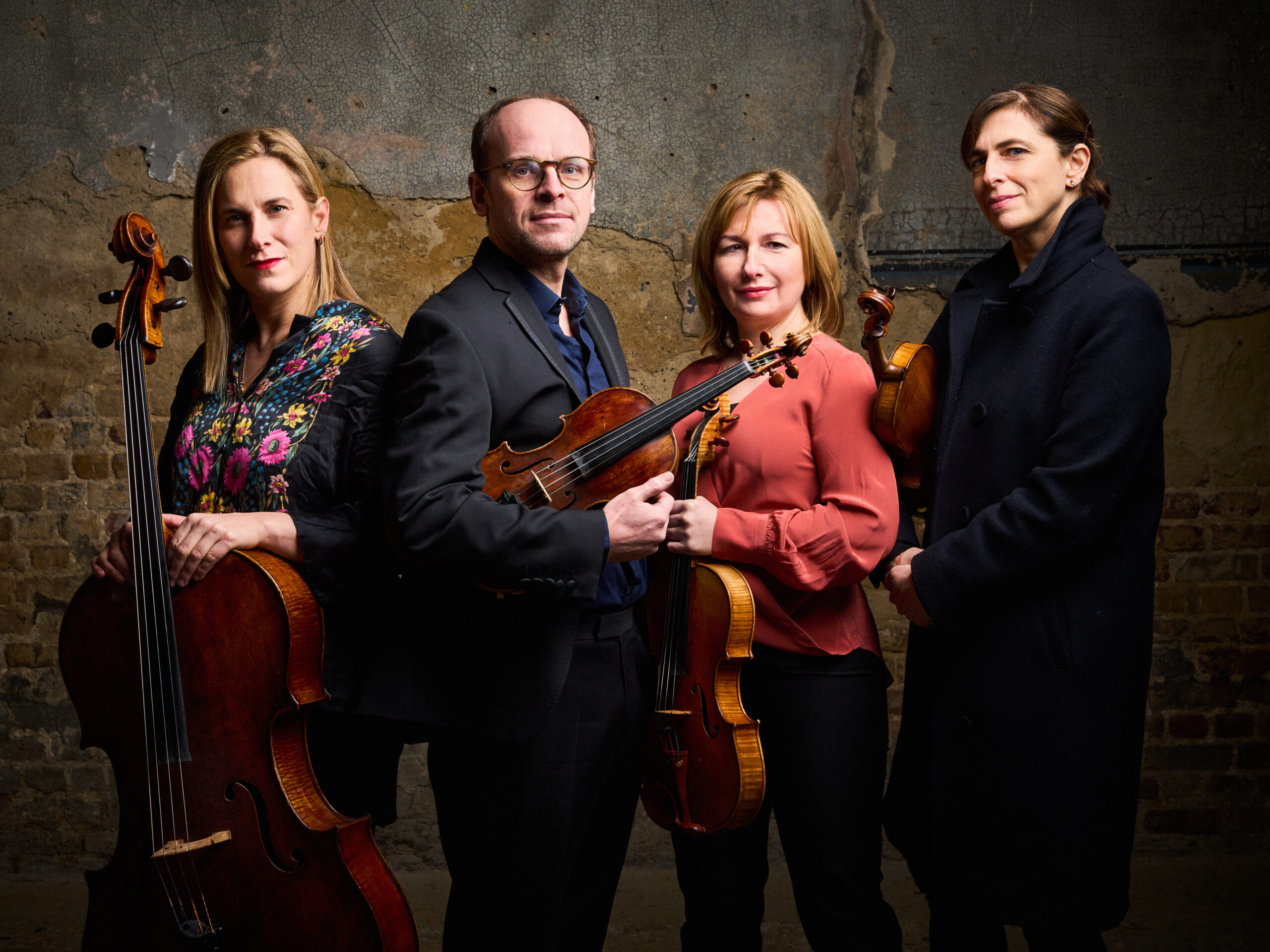
Ensemble 360

The Guildhall, Portsmouth
Monday 22 April 2024, 7.30pm

Tickets:

£10 – £20

Past Event
String players of Ensemble 360

STRAVINSKY Three Pieces for String Quartet (7’)
COLERIDGE-TAYLOR Clarinet Quintet (31’)
SCHUBERT String Quartet No.14 ‘Death and the Maiden’ (40’)

A concert of contrasts, showcasing the versatility of the world-class musicians from Ensemble 360.

Schubert’s deeply personal and beloved ‘Death and the Maiden’ string quartet is set alongside two lesser-known pieces written within a century but which could hardly be more different: Stravinsky’s compelling fragments for string quartet and Samuel Coleridge-Taylor’s exquisite clarinet quintet. The latter is arguably the greatest achievement in Coleridge-Taylor’s chamber music, by turns lyrical and muscular. It bears the unmistakable hallmarks of Dvořák’s profound influence on this tumultuous period of music.

There will be a post-show Q&A with the artists and Colin Jagger of Portsmouth Chamber Music.

Series Discount: 20% discount if you book any 6 or more Portsmouth Chamber Music/Sounds of Now concerts.

Time advertised is the start time, please check your ticket for door time.

STRAVINSKY Igor, Three Pieces for String Quartet

Composed in 1914, Stravinsky revised these pieces in 1918 when he dedicated them to the Swiss conductor Ernest Ansermet. The first performance was given in Paris in May 1915 by a quartet which included the composer Darius Milhaud playing violin, while the 1918 version had its premiere in London on 13 February 1919. The work comprises three short movements without titles or tempo markings. Though the dimensions of the pieces are slight, Stravinsky managed to baffle (and infuriate) early critics with the unusual sound effects and performance markings in places, and the deliberate absence of any conventional forms or traditional thematic development. Instead, the mood is by turns stange and grotesque. The second piece was inspired by the comedian Little Tich (Harry Relph) whose jerky stage act had impressed Stravinsky during a visit to London in 1914. The result might almost be described as an anti-quartet, and as the critic Paul Griffiths later remarked, these little pieces are ‘determinedly not a “string quartet”. The notion of quartet dialogue has no place here, nor have subtleties of blend: the texture is completely fragmented, with each instrument sounding for itself.’  

 Nigel Simeone 

COLERIDGE-TAYLOR Samuel, Clarinet Quintet Op.10

Allegro energico
Larghetto affettuoso
Scherzo. Allegro leggiero
Finale. Allegro agitato – Poco più moderato – Vivace

Samuel Coleridge-Taylor was born in London and entered to Royal College of Music in 1890 to study the violin. His ability as a composer soon became apparent, and he studied composition with Stanford, becoming one of his favourite pupils. His Piano Quintet Op.1 (1893) heralded the arrival of a remarkable talent, but the Clarinet Quintet, composed in 1895, demonstrates Coleridge-Taylor at the height of his creative powers. Stanford had given his students a challenge, declaring that after Brahms’s Clarinet Quintet, written in 1891, nobody would be able to escape its influence. Coleridge-Taylor couldn’t resist trying, and when Stanford saw the result he is said to have exclaimed ‘you’ve done it!’ Coleridge-Taylor took his influences not from Brahms but from another great contemporary composer: in places this work sounds like the clarinet quintet that Dvořák never wrote. That’s a mark of Coleridge-Taylor’s wonderfully fluent and assured writing. The sonata form first movement is both confident and complex, with the clarinet forming part of an intricately-woven ensemble texture. The Larghetto has a free, rhapsodic character, dominated by a haunting main theme. The Scherzo delights in rhythmic tricks while the central Trio section is more lyrical. The opening theme of the finale governs much of what follows until a recollection of the slow movement gives way to an animated coda. The first performance took place at the Royal College of Music on 10 July 1895, with George Anderson playing the clarinet. Afterwards, Stanford wrote to the great violinist Joseph Joachim describing the piece as ‘the most remarkable thing in the younger generation that I have seen.’

MENDELSSOHN STRING QUARTETS

Consone Quartet

The Guildhall, Portsmouth
Monday 26 February 2024, 7.30pm

Tickets:

£10 – £20

Past Event

HAYDN String Quartet in D Op.64, No.5 ‘Lark’ (20’)
FANNY HENSEL-MENDELSSOHN String Quartet in E flat (22′)
FELIX MENDELSSOHN String Quartet in E minor Op.44, No.2 (32′)

The electrifying Consone Quartet, recent BBC New Generation Artists, comprises four sensitive and spirited musicians who have formed a dynamic ensemble prized for expressive interpretations of classical and romantic repertoire through historically informed performance.

One of Haydn’s most popular quartets opens this concert, featuring a soaring bird-like part for violin which earned the piece its Lark nickname. The evening also contrasts the music of both Mendelssohn siblings: Fanny’s raw, passionate and tempestuous quartet, the only one she published, and Felix’s stately, lyrical and deftly crafted E minor quartet.

There will be a post-show Q&A with the artists and Colin Jagger of Portsmouth Chamber Music.

Series Discount: 20% discount if you book any 6 or more Portsmouth Chamber Music/Sounds of Now concerts.

Time advertised is the start time, please check your ticket for door time.

Time displayed is start time.

HAYDN Joseph, String Quartet in D Op.64, No.5 ‘Lark’

It was the soaring violin theme at the start of the first movement which gave this quartet its nickname, in a movement which wears its learning lightly, transforming the main melody in inventive ways right up to its final appearance. The hymn-like Adagio cantabile (with a contrasting minor-key central section) is followed by a Minuet which combines the feeling of a rustic dance with sophisticated motivic development. The finale is an exciting virtuoso display with almost continuous activity, but also some ingenious elements of contrast (such as the passage where the rushing main idea is treated fugally). 


Composed in 1790, Haydn’s Op.64 quartets were the earliest to receive their premieres at public concerts rather than at intimate gatherings of connoisseurs, and the finale of The Lark must have electrified its large audience – and delighted the composer himself: at the invitation of Johann Peter Salomon, Haydn arrived in England on New Year’s Day 1791 and remained there for the next 18 months. When the Quartets were published by the London firm of John Bland in June 1791, the title page announced that they had been ’composed by Giuseppe Haydn and perform’d under his direction at Mr Salomon’s concert, the Festino Rooms, Hanover Square’.  


© Nigel Simeone 

HENSEL-MENDELSSOHN Fanny, String Quartet in E flat

In the last couple of decades, the increasing interest in Fanny Hensel-Mendelssohn’s music has demonstrated beyond doubt that her brother Felix was not the only member of the family with extraordinary gifts. 


Fanny’s only String Quartet dates from 1834 but has its origins in an earlier piano sonata from 1829. That was never completed but its first two movements were reworked as the Adagio and Scherzo of the present quartet which was given its first performance at her Berlin salon in 1834. The formal freedom of this quartet is one of its most remarkable features, beginning with an intense, fantasia-like Adagio that begins in C minor before gradually working towards the home key of E flat by the end of the movement. The Scherzo in C minor, with a Trio section in C major, has something an elfin quality, whereas the following Romanze is a deeply-felt movement that shifts between G minor and major with some surprising detours into remote keys. The finale is a Rondo whose main theme (in tumbling thirds on the violins) dominates this movement, an exciting moto perpetuo. 


© Nigel Simeone 

MENDELSSOHN Felix, String Quartet in E minor Op.44, No.2

Mendelssohn composed a set of three string quartets first published in 1840 and dedicated to Gustav, Prince of Vasa, Crown Prince of Sweden. The first version of Op.44 No.2 was completed in 1837 and first performed that year, and before publication Mendelssohn revised it two years later. This work shows the most comprehensive command of the medium of the string quartet – demanding but superbly crafted, and beautifully written for the instruments involved. The first movement is dominated by a kind of lyrical melodiousness that hints at the musical language of a more famous work by Mendelssohn in the same key: the Violin Concerto. Where his earlier string quartets were intended as a deliberate homage to Beethoven – reflecting that in their terse, concentrated ideas – in this quartet Mendelssohn is more overtly expressive, while still controlling the form with great concision and skill. The Scherzo in E major is in the dashing, elfin style familiar from the Octet and the incidental music for A Midsummer Night’s Dream and it’s easy to forget just how utterly original Mendelssohn was being in these movements. The slow movement, in G major, is a relaxed song without words, leading to a finale of great intensity and ingenuity in which a consistent level of energetic flow is complemented by a brilliant variety in texture.
© Nigel Simeone

HAYDN, SCHUMANN & MORE

Trio Gaspard

The Guildhall, Portsmouth
Monday 29 January 2024, 7.30pm

Tickets:

£10 – £20

Past Event

HAYDN Piano Trio in A Hob.XV:9 (13’)
SCHUMANN Piano Trio No 2 in F Op.80 (27’)
HAYDN Piano Trio in E flat minor Hob XV:31 (13’)
BEAMISH Piano Trio written for Trio Gaspard’s ‘Haydn Project’ (c.10’)
LISZT Hungarian Rhapsody No.9 ‘Carnival in Pest’ (10’)

Trio Gaspard has earned an international reputation for refreshing interpretations of core piano trio repertoire and championing new music. This eclectic programme does just that, juxtaposing two trios by Haydn, the father or the form, and a short work commissioned from Sally Beamish celebrating this ever-evolving tradition. Liszt’s colourful and virtuosic Hungarian Rhapsody provides a spirited and celebratory finale.

There will be a post-show Q&A with the artists and Colin Jagger of Portsmouth Chamber Music

Series Discount: 20% discount if you book any 6 or more Portsmouth Chamber Music/Sounds of Now concerts.

Time advertised is the start time, please check your ticket for door time.

HAYDN Joseph, Piano Trio in A, Hob.XV:9

Haydn composed this trio in 1785 – the year when he also wrote the ‘Paris’ Symphonies. It was first published in February 1786 by the London firm of William Forster as one of Three Sonatas for the Harpsichord or Piano-Forte with an Accompaniment for a Violin & Violoncello and further editions appeared soon afterwards in Germany and Austria. It is cast in two movements, both in A major. The first is a spacious Adagio in which Haydn can be heard developing the notion of an ‘accompanied’ piano sonata into music where the string parts begin to emerge as more equal partners. Near the end of the movement, Haydn inserts a short cadenza-like passage before the music winds down to a gentle close. The second movement is fast and florid, with its fair share of harmonic quirks, as well as Haydn’s endless melodic invention and his irresistible flair for generating energetic momentum.  


© Nigel Simeone 

SCHUMANN Robert, Piano Trio No 2 in F Op.80

Schumann’s Second Piano Trio was initially sketched in 1847, while he was still finishing the Op. 63 Trio, but it was not completed until nearly two years later, in April 1849. Written in the pastoral key of F major, it is a very different work from its much darker and more dramatic predecessor. The reason for this is immensely touching: when Schumann began work, it was the tenth anniversary of his secret engagement to Clara, and the Trio is full of allusions to their first love. As Joan Chisell wrote: ‘no further guesses are needed as to why the first two movements are threaded with the opening phrase (“In the depths of my heart I keep a radiant image of you”) of his love-song Intermezzo (from the Eichendorff Liederkreis Op. 39) written for Clara just before their eventual long-delayed marriage in 1840.’ The first movement, in quick triple time, is both lively and ardently lyrical, while the song-like slow movement is a radiant outpouring of adoration. The third movement Scherzo is in a minor key, gentle and wistful. After this nostalgic interlude, the finale ends the work in a state of almost untroubled elation. For Clara Schumann this piece remained a great favourite among her husband’s works – partly, no doubt, because of its intimate private messages, but also because it shows Schumann at his most effortlessly inventive. The first performance was given in their house on 29 April 1849, in a private concert that also included the première of Schumann’s Spanisches Liederspiel for four solo voices and piano, and Clara subsequently played it on many occasions.


Nigel Simeone © 2010

HAYDN Joseph, Piano Trio in E flat minor Hob XV:31

Haydn’s autograph manuscript of this trio is in the British Library, part of the extraordinary music collection assembled by the writer Stefan Zweig which was later bequeathed to the nation by his heirs. The first page of music is signed and dated ‘Haydn, 1795’. The most striking aspect of this work is the key of the first movement: E flat minor (with its key signature of six flats). This was very rarely used in the eighteenth century except in works like Bach’s Well-Tempered Clavier which deliberately explored all 24 major and minor keys. The Andante cantabile is rather an austere rondo, which includes some remarkable harmonic excursions (including an episode in B major) and a generally serious mood which is only lightened by a contrasting episode in E flat major. At the head of the last movement, the manuscript has a line in Haydn’s writing which has subsequently been scratched out (presumably by the composer himself): ‘Sonata: Jacob’s Dream’, a reference to Jacob’s vision in the Book of Genesis where he sees a ladder reaching from earth up to an angel-filled heaven. But Haydn’s use of the title was a joke: a violinist he knew liked to show off his playing in the highest register (apparently none too well) and Haydn peppers his cheery movement (in E flat major) with moments where the violin has to play extremely high and fast.  


© Nigel Simeone

BEAMISH Sally, Trance

This piece was commissioned by the Trio Gaspard to sit alongside Haydn’s piano trios. The sound of these wonderful players was in my head as I wrote. Haydn’s trios famously give a pretty subordinate role to the cello, so my first idea was to make the cello a soloist in my piece. My relationship with Haydn’s F sharp minor trio goes back to childhood, when my mother, violinist Ursula Snow, performed it many times with her trio. I must have heard hours of rehearsal.  This led me to think of my mother, and how much I miss her, and feel I understand her better as I get older. This short piece is dedicated to her memory.  


I took F sharp as my starting point, and threaded in occasional notes taken from Haydn’s Andante cantabile movement. The harmonies, which form a repeated chaconne-like pattern in the piano part, are also derived from the Haydn, but in my own way, and not necessarily audible to the listener. The music is like a series of fragmented memories; the violin at first ghost-like, while the cello has an improvisatory line; the violin then drawing the cello into its falling 5th motif, while the piano has the solo line. The three instruments become equal as the music comes to a head, before dissolving into a quiet final statement of the chord sequence.  


The melancholic nature of Haydn’s trio affected my approach, combined with memories of my mother and her gradual disappearance into dementia. The title, Trance, indicates a meditative state, but also a ‘passageway’, or departure – the confusing journey of my relationship with my mother as her personality shifted, changed and faded. 


Trance was commissioned by the Trio Gaspard, and first performed at the West Cork Festival on 28th June, 2023. 

© Sally Beamish 

LISZT Franz, Hungarian Rhapsody No.9 ‘Carnival in Pest’

Liszt composed his Carnival in Pest in 1847 for solo piano, the ninth of his Hungarian Rhapsodies in which he aimed to compose virtuoso works in which he could incorporate traditional music from his homeland. Carnival in Pest is dedicated to the Brno-born violinist Heinrich Wilhelm Ernst, It was therefore a particularly appropriate idea for Liszt to compose a version for piano trio which includes a flamboyant violin part – in fact all three instruments are given some dazzling writing. 

Dating from 1848, the autograph manuscript of the trio version (in the collection of the Juilliard School in New York) is covered in revisions and deletions, suggesting that Liszt rethought much of the work when he made this transcription. It is a piece that is largely celebratory in mood and Liszt presents a succession of stirring Hungarian Gypsy themes with frequent changes of tempo, interspersed with cadenzas. It culminates in a triumphant reprise of the opening idea on the strings, in octaves, followed by a dizzying coda. It is unclear why Liszt did not publish the trio version during his lifetime, but it eventually appeared posthumously in 1892. 

© Nigel Simeone 

RACHMANINOV 150

Ensemble 360

The Guildhall, Portsmouth
Monday 20 November 2023, 7.30pm

Tickets:

£10 – £20

Past Event

RACHMANINOV Trio élégiaque No.1 in G minor (14’)
PROKOFIEV Quintet in G minor (21’)
PROKOFIEV Overture on Hebrew Themes (9’)
TCHAIKOVSKY String Quartet No.2 in F Op.22 (36’)

The world-class musicians from Ensemble 360 return with a blistering programme of Russian music to celebrate the 150th birthday of Sergei Rachmaninov, best known for his sweeping symphonic music and monumental works for piano. They open with his heart-wrenching trio and conclude with a rarely-performed piece by Tchaikovsky, considered by the composer to be his best work of all: a dense, lyrical and dramatic quartet which shares much with his better known large-scale works.

There will be a post-show Q&A with the artists and Colin Jagger of Portsmouth Chamber Music.

Series Discount: 20% discount if you book any 6 or more Portsmouth Chamber Music/Sounds of Now concerts.

Time advertised is the start time, please check your ticket for door time.

RACHMANINOV Sergei, Trio élégiaque No.1 in G minor

Lento lugubre
Risoluto
Tempo primo
Più vivo
Alla marcia funebre


Rachmaninov wrote two piano trios, both called “elegiac”. The second (D minor) trio was composed at the end of 1893 as a memorial to Tchaikovsky, but the present G minor Trio dates from January 1892, and was first performed on 30 January 1892 with Rachmaninov at the piano and his friend Anatoly Brandukov as the cellist – later to be the dedicatee of Rachmaninov’s Cello Sonata and best man at Rachmaninov’s wedding. The G minor Trio was written while Rachmaninov was still a student, and is a single-movement lamentation. The main theme (reminiscent of a melody in Tchaikovsky’s Manfred Symphony) is first presented by the piano over shimmering bare fifths. This idea dominates the movement, appearing in a variety of guises, and the contrasting falling melody that is no more consoling. The final presentation of the main idea is the most stark – a transformation into a funeral march.


Nigel Simeone © 2011

PROKOFIEV Sergei, Quintet in G minor

Tema con variazioni
Andante energico
Allegro sostenuto, ma con brio
Adagio pesante
Allegro precipitato, ma non troppo presto
Andantino


Prokofiev’s Quintet Op.39 of 1924 incorporates music from Trapeze, a ballet he composed at the same time. Written while Prokofiev was living in Paris for a company that could only afford a small instrumental ensemble, the original ballet comprised eight movements of which six were used in the Quintet. The language is often astringent but Prokofiev is highly imaginative in the way he uses limited resources to the fullest possible effect. After a Theme and Variations that moves from a deadpan opening to frenetic energy before returning to the music of the start, the second movement opens with a double bass solo before some rather acidic writing for the whole ensemble. The short Allegro sostenuto, ma con brio is a witty scherzo-type movement that is followed by the darkest part of the Quintet, a brooding Adagio pesante notable for some unusual instrumental colours including sul ponticello string writing. The Allegro precipitato is another brilliant, highly animated exploration of intriguing sonorities, while the concluding Andante is more stately to begin with, becoming a little livelier in the central section, and ending vigorously, with the parts marked tumultuoso e precipitato.

PROKOFIEV Sergei, Overture on Hebrew Themes

Prokofiev composed this piece for clarinet, string quartet and piano in 1919, while he was on tour in the USA. It was commissioned by the Zimro Ensemble, a Russian group who had recently arrived in America. The ‘Hebrew’ themes Prokofiev used were very probably composed by Simeon Bellison, the group’s clarinettist. The premiere was given by Prokofiev with the Zimro Ensemble in New York on 2 February 1920.


Nigel Simeone 2014

TCHAIKOVSKY Pyotr, String Quartet No.2 in F Op.22

Adagio – Moderato assai 
Scherzo. Allegro giusto 
Andante ma non tanto 
Finale. Allegro con moto 


Tchaikovsky wrote his Second String Quartet in January 1874 and it remains a neglected work – a fate it shares with the Third Quartet of 1876 – certainly when compared with the better-known First Quartet. In his biography Tchaikovsky: the man and his music, David Brown has suggested that the F major shows Tchaikovsky trying to grapple with the economy and rigour of Beethoven’s quartets, particularly in the first movement where the thematic material is “more concise” than might be expected with Tchaikovsky, “thus facilitating far greater flexibility in what is built from it.” This is a very fair assessment of a movement that has clear debts to Beethoven in terms of structure and compositional process. The Scherzo is delightfully quirky, based on a lopsided bar of 2, 2 and 3 beats until the more stable, waltz-like Trio section. The emotional core of the work is anguished slow movement (David Brown describes this as music of pain-filled intensity). The Rondo finale that follows is effervescent and untroubled. 


© Nigel Simeone   

SCHUBERT, JANÁČEK & BRAHMS

Leonkoro Quartet

The Guildhall, Portsmouth
Monday 16 October 2023, 7.30pm

Tickets:

£10 – £20

Past Event

SCHUBERT String Quartet No.9 in G minor D173 (23’)
JANÁČEK String Quartet No.1 ‘Kreutzer Sonata’ (19’)
BRAHMS String Quartet No.1 in C minor, Op.51 No.1 (32’)

The four outstanding young musicians of the Leonkoro Quartet have already acquired an astonishing list of international prizes to their name. Last year’s awards included first prize at the Wigmore Hall International String Quartet Competition, where they astonished both the jury and audience with their boundless energy and powerful musicality, and their appointment to the prestigious BBC Radio 3 New Generation Artists scheme.

For their Portsmouth debut, they’ll be performing a programme that tackles the profound drama of Janáček and Brahms, alongside the graceful lightness of a quartet composed by Schubert when he was still a teenager.

There will be a post-show Q&A with the artists and Colin Jagger of Portsmouth Chamber Music.

Series Discount: 20% discount if you book any 6 or more Portsmouth Chamber Music/Sounds of Now concerts.

Time advertised is the start time, please check your ticket for door time.

SCHUBERT Franz, String Quartet in G minor, D173

Allegro con brio 
Andantino  
Menuetto. Allegro vivace 
Allegro 
 

Schubert’s sheer productivity in 1815, the year in which he turned 18 years of age, is nothing short of astonishing: over 150 songs, two symphonies, piano pieces, religious music and the present string quartet, written between 25 March and 1 April 1815, while Schubert was also working as an assistant teacher in his father’s school. According to a note in his own hand, the first movement was composed ‘in four and a half hours.’ There’s no mistaking the influences on the teenage Schubert in this music, particularly Beethoven’s Op.18 quartets and, above all, Mozart’s Symphony No.40.  

But far from being merely derivative or imitative, this quartet is a notable example of Schubert experimenting with quartet structures, and starting to find his way as an original genius. Schubert expert Brian Newbould has noted that ‘Schubert’s way of plucking … principles from the repertoire all around him in his teenage years … is part of a positive, learning, and properly creative purpose.’ Newbould goes on to write that in this quartet, we find ‘things here that represent the first stirrings of inclinations that were to come to fruition in later works.’ 

© Nigel Simeone 

JANÁČEK Leoš, String Quartet No.1 Kreutzer Sonata

Adagio – Con moto 
Con moto 
Con moto – Vivo – Andante 
Con moto – (Adagio) – Più mosso 
 

Janáček composed his 1st String Quartet in 1923, taking as his inspiration Kreutzer Sonata, the novella by Tolstoy that had in turn been inspired by Beethoven’s famous violin sonata. Janáček’s quartet was composed in just a few days, and it’s probable that he drew on material from an earlier piano trio (now lost) based on the same story. The music does not follow Tolstoy’s narrative in detail, but it does evoke the rage and passion of the protagonists, using a musical language made up of generally quite short motifs that form both the melodies and the urgent, thrilling ideas that accompany them. Janáček also alludes to Beethoven’s Kreutzer, most obviously at the start of the third movement where he recalls the second theme of Beethoven’s opening movement. Janáček’s own motto theme in the Quartet is the rising idea heard at the opening. This returns at the start of the fourth movement, but this time it is followed by a melancholy violin theme, marked ‘as if in tears’. Janáček’s final transformation of the motto theme is magnificent: a furious fortissimo, accompanied by chords marked ‘festive, like an organ’. After this ecstatic moment of release, the music subsides back to the brooding, unsettled mood of the opening. 


© Nigel Simeone 

BRAHMS Johannes, String Quartet in C minor Op.51 No.1

Allegro
Romanze. Poco adagio
Allegretto molto moderato e comodo
Allegro

The string quartet was a form that gave Brahms a great deal of trouble and the masterpieces of Haydn, Mozart and Beethoven meant that Brahms was especially critical of his efforts at quartet writing. The C minor Quartet was finished in the mid-1860s, but Brahms revised it extensively over the next decade and re-wrote it during the summer of 1873. The first performance took place in Vienna in December 1873 by the Hellmesberger Quartet. The work is dedicated to Brahms’s friend Theodor Billroth, one of the most innovative surgeons of his time and a keen amateur musician. There’s a very close relationship between the main themes in each of the four movements, each of which grow from the same basic idea, and the overall structure sees two intimate miniatures framed by the more symphonic outer movements.

Nigel Simeone ©2014

“The Leonkoros draw on a wealth of youthful sonority, fiery vitality and rousing drive.”

Süddeutsche Zeitung

‘AMERICAN’ QUARTET & more

Parish Church of St Peter and St Paul, Tonbridge
Saturday 14 October 2023, 7.30pm

Standard Ticket: £20
Students & Under 18s: £5

Past Event
String players of Ensemble 360

SUK Meditation on the Old Czech Chorale, ‘St Wenceslas’, Op.35a
COLERIDGE-TAYLOR Clarinet Quintet in F sharp minor, Op.10
HOWELLS Rhapsodic Quintet, Op.31
DVOŘÁK Quartet No.12 in F major, Op.96 ‘American’

“… international musicians, brimming with body and soul, with passion, vitality and virtuosity, whose performances never cease to amaze.” (The Independent)

A sumptuous evening of music, including Dvořák’s beloved ‘American’ string quartet and two clarinet quintets showcasing the lush harmonies of Howells and Coleridge-Taylor.


SUK Josef, Mediation on the Old Czech Chorale

Josef Suk, a student of Antonín Dvořák and later his son-in-law, was a composer with a distinct artistic voice and strong ties to Czech musical heritage. His composition, the “Meditation on an Old Czech Chorale,” pays homage to the Bohemian patron saint, St. Wenceslas, and was written when a member of the Bohemian String Quartet to supplement the obligatory playing of the Austrian national anthem (after 1914) with a more distinctively Bohemian piece, and prayer for the wellbeing of the Czech people.

The “Meditation on an Old Czech Chorale’” is a single-movement for string quartet, which was later expanded into a version for string orchestra, adding a double bass line, and later still adapted for violin and organ. Suk‘s use of the violin as the leading voice enhances the expressive nature of the piece, allowing for moments of spiritual contemplation. The work commences with a solemn and tender introduction, featuring the initial statement of the hymn melody. Through subtle variations, this simple melody moves from serene introspection to intense and soaring passages as a recurring motif. The piece reaches a climax with the violin in its highest register, conveying a profound yearning. It gradually fades away, into tranquility.

COLERIDGE-TAYLOR Samuel, Clarinet Quintet Op.10

Allegro energico
Larghetto affettuoso
Scherzo. Allegro leggiero
Finale. Allegro agitato – Poco più moderato – Vivace

Samuel Coleridge-Taylor was born in London and entered to Royal College of Music in 1890 to study the violin. His ability as a composer soon became apparent, and he studied composition with Stanford, becoming one of his favourite pupils. His Piano Quintet Op.1 (1893) heralded the arrival of a remarkable talent, but the Clarinet Quintet, composed in 1895, demonstrates Coleridge-Taylor at the height of his creative powers. Stanford had given his students a challenge, declaring that after Brahms’s Clarinet Quintet, written in 1891, nobody would be able to escape its influence. Coleridge-Taylor couldn’t resist trying, and when Stanford saw the result he is said to have exclaimed ‘you’ve done it!’ Coleridge-Taylor took his influences not from Brahms but from another great contemporary composer: in places this work sounds like the clarinet quintet that Dvořák never wrote. That’s a mark of Coleridge-Taylor’s wonderfully fluent and assured writing. The sonata form first movement is both confident and complex, with the clarinet forming part of an intricately-woven ensemble texture. The Larghetto has a free, rhapsodic character, dominated by a haunting main theme. The Scherzo delights in rhythmic tricks while the central Trio section is more lyrical. The opening theme of the finale governs much of what follows until a recollection of the slow movement gives way to an animated coda. The first performance took place at the Royal College of Music on 10 July 1895, with George Anderson playing the clarinet. Afterwards, Stanford wrote to the great violinist Joseph Joachim describing the piece as ‘the most remarkable thing in the younger generation that I have seen.’

HOWELLS Herbert, Rhapsodic Quintet for Clarinet and Strings Op.31 

Lento, ma appassionato – A tempo, tranquillo – Piu mosso, inquieto – Doppio movimento ritmico, e non troppo allegro – Più elato – Meno mosso – Lento, assai tranquillo – Più adagio 

Herbert Howells is probably best remembered for his church music (including the famous hymn tune ‘All my hope on God is founded’ as well as several outstanding settings of service music) and for his choral masterpiece Hymnus paradisi. But he was also a gifted composer for instruments and wrote a good deal of chamber music at the start of his career. The Rhapsodic Quintet was completed in June 1919 and Howells himself said that there was ‘a mystic feeling about the whole thing’. Still, mystic feelings didn’t come without some serious hard work, and the Howells scholar Paul Spicer has drawn attention to an entry in the composer’s diary where he noted that the quintet had involved quite a lot of preparatory thinking. Howells wrote of his ‘long ponderous thoughts on problems of musical form … hours spent in an easy-chair, fire-gazing, form-thinking.’ The ‘form-thinking’ was clearly productive, since this beautifully written quintet for clarinet and strings in one movement appears to flow effortlessly from one idea to the next as well as having overall coherence. This was an early work – Howells had only recently finished his studies at the Royal College of Music with Stanford and Charles Wood – but his handling of the instruments shows tremendous assurance. Cobbett’s Cyclopedic Survey of Chamber Music makes particular mention of this, describing the work as having a ‘sensitive appreciation of instrumental needs’, but there is more to it than that, since Howells also shows a great gift for unfolding long, lyrical melodies, and contrasting these with more capricious ideas. It’s this combination of fluent and idiomatic writing with memorable thematic material that led Christopher Palmer, in his biography of Howells, to call the Rhapsodic Quintet ‘an outstanding achievement’.  

DVOŘÁK Antonin, String Quartet in F Op.96 ‘American’

Allegro ma non troppo
Lento
Molto vivace
Finale. Vivace ma non troppo

Dvořák was teaching in New York in 1893, and for his summer holiday he travelled over a thousand miles westwards, to the village of Spillville in Iowa, set in the valley of the Turkey River. It had been colonized by Czechs in the 1850s and in these congenial surroundings Dvořák quickly wrote the String Quartet in F major. On the last page of the manuscript draft, he wrote: ‘Finished on 10 June 1893, Spillville. I’m satisfied. Thanks be to God. It went quickly.’

Coming immediately after the ‘New World’ Symphony (which was to have its triumphant première in New York later in the year), the quartet has a mood that suggests something of his contentment in Spillville. Dvořák’s assistant Josef Kovařík recalled the composer’s routine: walks, composing, playing the organ for Mass and talking to locals, observing that he ‘scarcely ever talked about music and I think that was one of the reasons why he felt so happy there.’

Just how ‘American’ is the quartet? While remaining completely true to himself, Dvořák admitted that ‘as for my … F major String Quartet and the Quintet (composed here in Spillville) – I should never have written these works the way I did if I hadn’t seen America’. The first performance was given in Boston on New Year’s Day 1894 by the Kneisel Quartet.

© Nigel Simeone

GOLDBERG VARIATIONS (for string trio)

Ensemble 360

St Peter's Church, Edensor
Sunday 24 September 2023, 5.30pm

Tickets will be available on the door

5.30pm Performance at St Peter’s Church only (no guided walk)
£16 / £10 UC, PIP & DLA / £5 Students & Under 35s

Past Event

5.30pm St Peter’s Church, Edensor
JS BACH Goldberg Variations (arr. for string trio) (60’) 

Enjoy an hour-long tea-time concert at St Peter’s Church on the Chatsworth Estate. Violin, viola and cello showcase the intricacy and spirituality of one of Bach’s most ambitious works. 

This is the final performance in a day of walking and concerts. To book tickets for the guided walk plus all three performances, please visit this page.

You are also welcome to join the guided walk participants in Edensor at approx 4.45pm for a self-catered picnic tea. Please bring your own drinks and a picnic. 

Please note that this is an all-weather event.

Directions and parking information is available here. 

BACH Johann Sebastian, Goldberg Variations (arranged for String Trio by Dmitri Sitkovetsky)

Bach originally wrote the Goldberg Variations for harpsichord, and this was one of the very few works published during the composer’s lifetime, by the firm of Baltasar Schmid at Nuremberg in 1741. The original title page describes the work as ‘Clavier-Übung [Keyboard Practice], consisting of an Aria, with diverse variations for harpsichord with two manuals, prepared to delight the souls of music-lovers by Johann Sebastian Bach.’ There was no irony here: Bach, as a devout Lutheran, was deeply conscious of the spiritual dimension of music, and its aspiration to enrich the soul as well as to divert and entertain. But the work was also an extraordinary feat: if we count each prelude and fugue of the Well-Tempered Clavier as self-contained pairs of works, then the Goldberg Variations is by far the largest piece of keyboard music published in the eighteenth century and it attracted international attention early on. Bach is often thought of as a composer whose music was rediscovered only in the nineteenth century (thanks in large part to Mendelssohn and Schumann), but his keyboard music was the exception to this. In his pioneering General History of the Science and Practice of Music published in 1776, Sir John Hawkins devotes several pages to Bach, thanking Johann Christian Bach (then in London) for supplying some of the information. But he then goes on to quote three full pages of music examples comprising the Aria (‘Air’), Variation 9 and Variation 10 from the Goldberg Variations, making this one of the first pieces of Bach to appear in print in England.

But where is Goldberg in all this, and who was he? In 1741, Bach stayed with Count Keyserlingk in Dresden, who employed a young musician called Johann Gottlieb Goldberg. According to Johann Nikolaus Forkel in his 1802 biography of Bach, the story goes as follows: ‘The Count was often unwell and had sleepless nights. On these occasions, Goldberg had to spend the night in an adjoining room so that he could play something to him during this sleeplessness. The Count remarked to Bach that he would like to have a few pieces for his musician Goldberg, pieces so gentle and somewhat merry that the Count could be cheered up by them during his sleepless nights. Bach thought he could best fulfil this wish with some variations … The Count henceforth referred to them only as his variations. He could not get enough of them, and for a long time, whenever sleepless nights came, he would say, Dear Goldberg, do play me one of my variations. Bach was perhaps never rewarded so well for one of his compositions. The Count bestowed on him a gold beaker filled with one hundred Louis d’or.’

It’s a fine tale – and the source for the famous legend of these variations as a cure for insomnia – but it’s mostly fictitious. As Peter Williams has demonstrated, Goldberg was only born in 1727 (and was thus in his early teens at the time of Bach’s visit to Keyserlingk), so it’s wildly improbable that Bach wrote the variations for him to play. Moreover, they had actually been published before Bach’s visit to Dresden, so the chances are that he presented the Count with a

copy having been asked about the possibility of composing some suitable music. This also explains the absence of either the Count’s name or Goldberg’s on the title page of the first edition of the score – and the presence of the Aria in Anna Magdalena’s Notebook, most of which was compiled years earlier. Williams has also speculated that the player Bach most probably had in mind for the variations was his son Wilhelm Friedmann, a brilliant performer and who had worked as organist of the Sophienkirche in Dresden since 1733.

The variations constitute a virtual encyclopaedia of what was possible in terms of imaginative harpsichord writing, and is even more remarkable for Bach’s brilliant manipulation of the theme. As a master of transcribing his own music for different instrumental combinations, the arrangement of the Goldberg Variations for string trio is an idea that would surely have appealed to Bach. Just as Mozart arranged some of the keyboard fugues for string quartet, and others have arranged The Art of Fugue for the same forces, so Sitkovetsky has taken up the challenge of re-thinking Bach’s music for entirely different instruments – as Bach himself had done not only with his own music but also with other composers such as Vivaldi. This arrangement was made in 1985 to celebrate the 300th anniversary of Bach’s birth, and it is dedicated to the memory of Glenn Gould, whose astonishing 1955 recording of the Goldberg Variations became an instant bestseller and introduced a whole generation to this extraordinary music.

Nigel Simeone © 2010